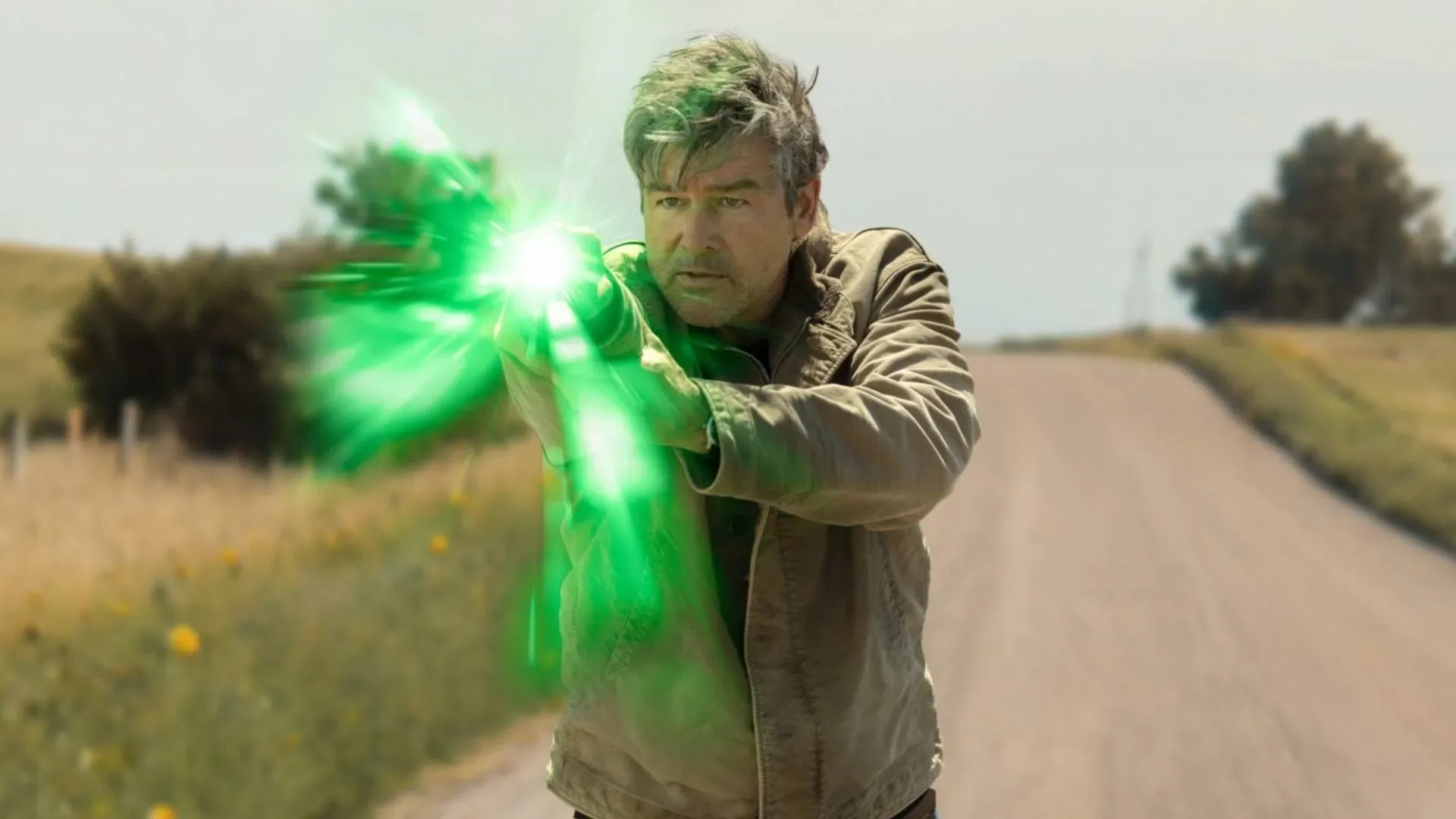
A previously unmade Green Lantern television project is coming into sharper view through newly shared concept art and creative details. Emerald Knights, a canceled series developed from DC’s Green Lantern mythology, was planned around a story spanning two time periods, with the Manhunters positioned as its principal antagonists.
Marc Guggenheim, a co-creator of Arrow and a key creative figure in the Arrowverse, shared three pieces of artwork on October 7 alongside recollections of the project. The images do not provide a complete blueprint for the unproduced show, and Guggenheim notes that some details now require him to rely on memory. Still, what has emerged is enough to establish a distinct creative direction: an ensemble of Lanterns, large-scale construct combat, a proposed new character, and a Guy Gardner costume intended to move somewhat toward his Justice League International look.
The project is particularly interesting now because its broad elements overlap with the approach taken by Lanterns. Both involve the Manhunters in a major capacity, while Emerald Knights was also meant to use two timelines. That does not mean the two shows would have been identical. Shared comic-book material can produce very different stories depending on whose perspective drives the plot, how the eras connect, and what role the threat plays. But it does reveal that the Manhunters and a divided time structure were already seen as fertile foundations for a Green Lantern series.
What the artwork reveals about Emerald Knights
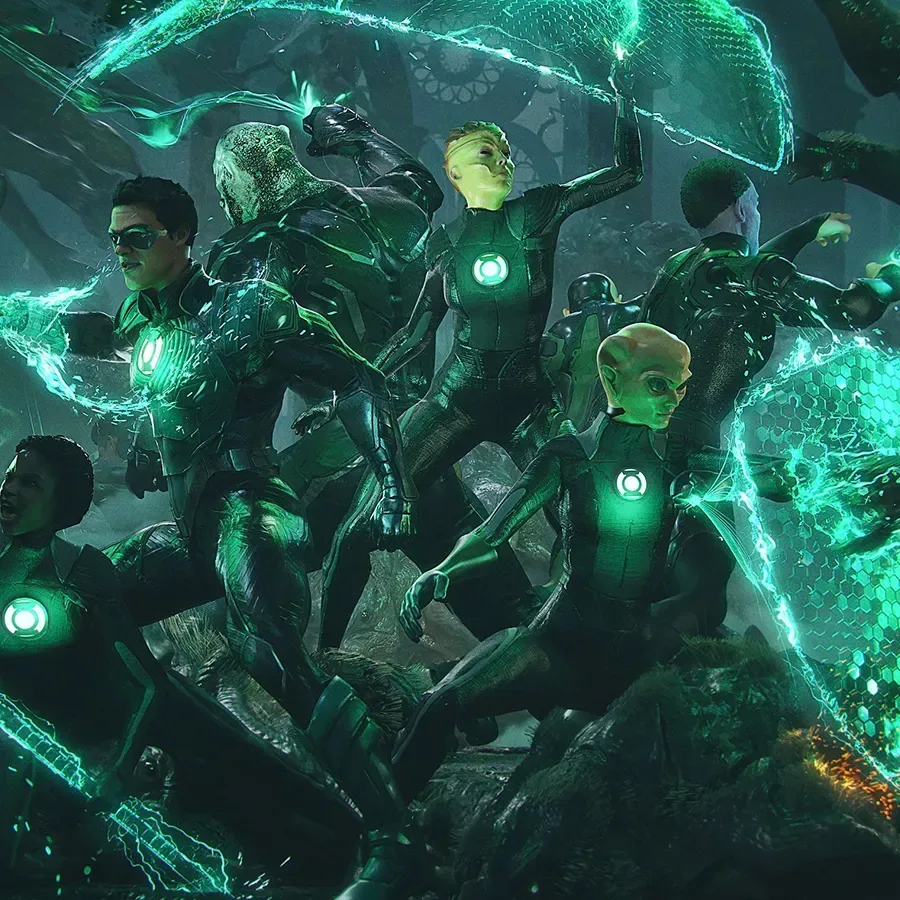
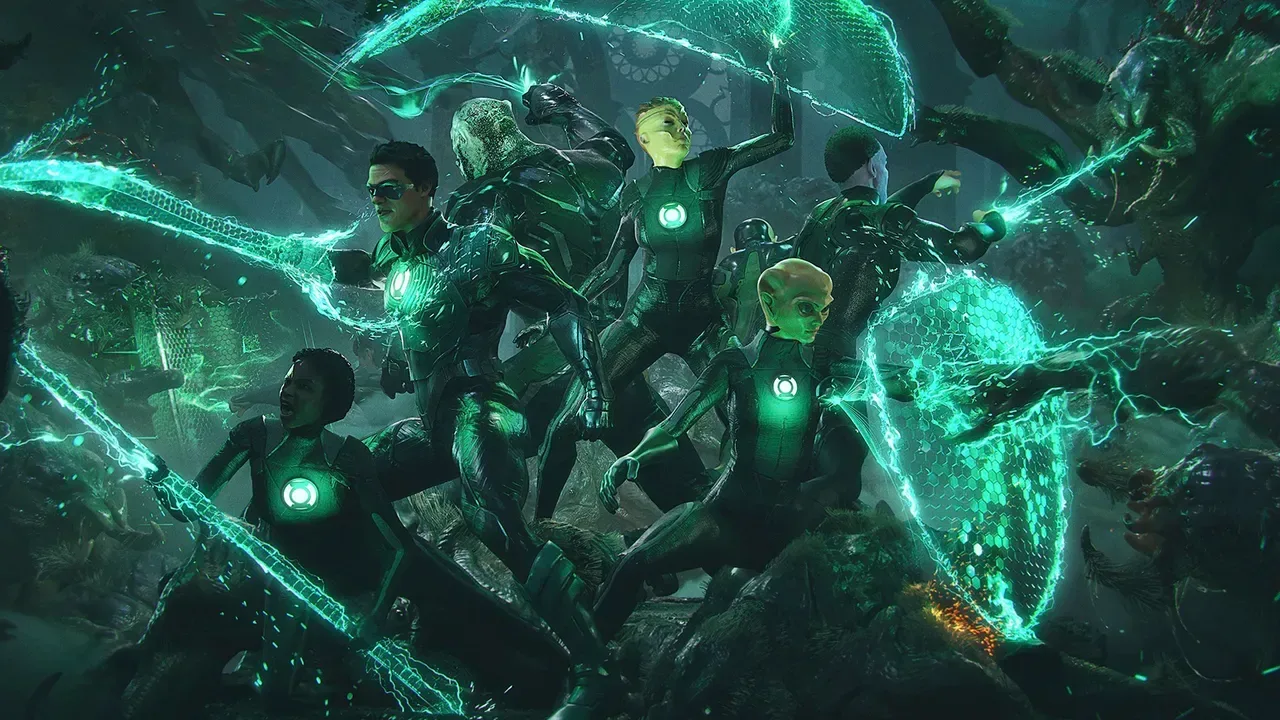
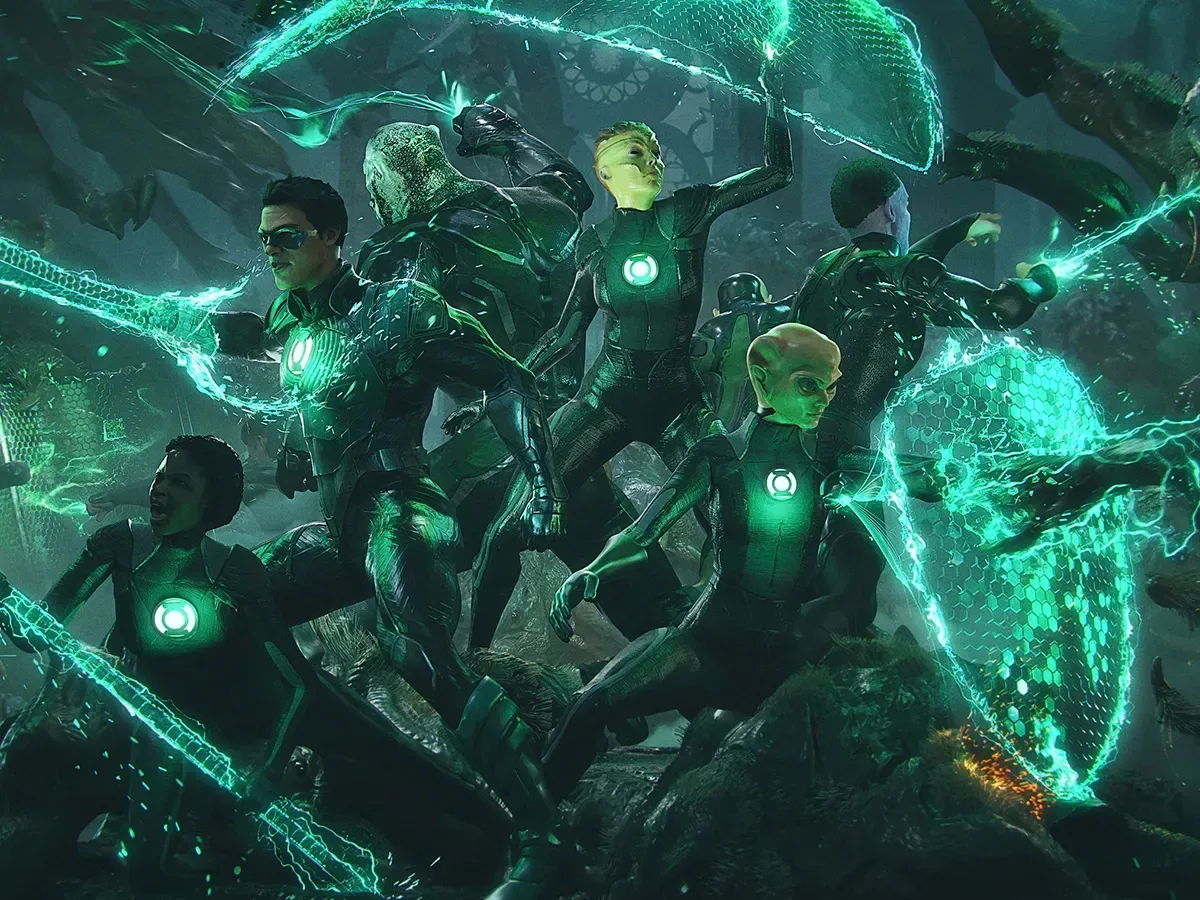
The first concept piece depicts multiple Green Lanterns battling a large attacking force of aliens. Guggenheim identified the image as artwork for the opening sequence of the pilot. The Lanterns are not merely shown firing uniform energy blasts; their rings create varied hard-light projections, including a bo staff, sword, and shields.
That detail matters because a Green Lantern ring’s projected objects—often called constructs—are one of the defining visual ideas of the property. A construct is an energy creation shaped by the ring bearer’s will. On screen, this gives artists and action designers considerable freedom: one Lantern can favor defense, another a weapon, and another a tool designed for a particular tactical problem. The pilot image appears designed to communicate that versatility immediately, putting several styles of ring use on display in one chaotic encounter.
As a proposed opening, it also suggests that Emerald Knights would have established its scope quickly. A team facing a horde invites a different kind of action than a lone hero’s first encounter with a ring. The composition points toward a world in which Green Lanterns already exist as a visible fighting force, at least within the scene depicted, rather than reserving the mythology’s broader interstellar side for much later.
Concept art should not be treated as a production still or a guarantee of what an audience would ultimately have received. It is development material: a visual tool used to test tone, costumes, scale, characters, and story possibilities. Designs can evolve, performers can change, and sequences can be discarded before cameras roll. In this case, that uncertainty is part of the appeal. The images provide a rare look at a route that was explored but never finished as a series.
A two-period narrative and the Manhunter connection
Guggenheim recalled that his original pitch was titled Emerald Knights and that the story would have unfolded across two different time periods. No additional plot mechanics, settings, or dates for those periods were disclosed, so it would be premature to assume how the show planned to divide its story. The structure could have followed separate casts, presented a past event alongside its aftermath, or used the two eras to reveal information gradually. What is confirmed is the intended dual-period framework, not its exact implementation.
Related coverage includes Canceled Green Lantern Series Emerald Knights Revealed in New Concept Art.
The Manhunters were described as the show’s primary villains. In the Green Lantern corner of DC fiction, that name carries a strong technological and institutional flavor. It immediately distinguishes the threat from a conventional gang of enemies or a single costumed adversary, and it lends itself to questions of systems, control, enforcement, and escalation. Those are analytical possibilities suggested by the choice of antagonist rather than disclosed plot points from Emerald Knights.
The overlap with Lanterns is notable. The Manhunters are central antagonists there as well, in a qualified sense, and Lanterns has already been described by one of its co-creators as entering early development for a second season. Seeing an earlier canceled concept return to similar mythology is a reminder that adaptations are not linear handoffs from one creative team to another. A character or villain concept can remain compelling across separate attempts, even when the final projects differ in tone and execution.
For viewers following DC’s wider live-action plans, it also reinforces how flexible its comic material can be. Green Lantern stories can be approached as cosmic action, procedural mystery, ensemble drama, political allegory, or a mixture of several modes. The newly revealed pilot art puts spectacle front and center, while the two-timeline idea implies an interest in narrative contrast and long-term consequences. Elsewhere in DC’s evolving screen slate, Gotham’s characters continue to attract attention, including discussion around Clayface’s possible place in DCU Gotham.
Guy Gardner’s planned costume direction
Two of the additional images focus on characters rather than group combat. One presents an early design for Guy Gardner. Guggenheim said the costume was intended to be modified slightly to better reflect Gardner’s Justice League International design.
That reference is useful because it identifies an aesthetic target without pretending the image represents a final outfit. Costume design in superhero television has a difficult balancing act to perform. It needs to preserve recognizable comic-book signals, allow actors to move, photograph well, and fit alongside other costumes in the same world. A “slight” adjustment toward a particular comic interpretation suggests an effort to make Gardner legible to readers familiar with that version while still adapting the look for this specific production.
Gardner’s inclusion further indicates that Emerald Knights was not conceived only as an origin narrative built around one ring bearer. The group battle artwork already points toward multiple Lanterns, and the dedicated Gardner material supports that ensemble impression. However, the disclosed art does not establish the project’s lead character, full cast, episode count, or the precise status Gardner would have held in the story.
The Jenelle Monáe likeness is not Jo Mullein
The other character image has a clarification attached that is especially important for fans parsing every visual cue. It uses the likeness of Jenelle Monáe, which could make it easy to identify the character as Jo Mullein at a glance. Guggenheim has explicitly said that is not the case: the design was for a new character created for the series.
The costume was designed by Laura Jean Shannon. The use of Monáe’s likeness is understandable in a wider visual context, since writer N.K. Jemisin and comic artist Jamal Campbell used Monáe as a visual reference when developing Jo Mullein’s appearance. But a resemblance, even a highly intentional one, is not the same thing as character identity. The revealed Emerald Knights figure was an original creation rather than Jo Mullein.
That distinction is more than a piece of casting trivia. It shows that the canceled series was willing to add to the Green Lantern setting rather than rely exclusively on pre-existing names. Original characters can supply flexibility in an adaptation: writers can give them mysteries, relationships, or turning points without directly displacing a comic character’s established arc. At the same time, their introduction requires careful handling because recognition is a major part of the appeal of a shared superhero universe. With only the design and Guggenheim’s clarification available, the character’s name, role, powers, and eventual story remain unknown.
Why canceled-project material still matters
There is a temptation to view abandoned screen projects as curiosities with no relevance beyond alternate-history speculation. But production art and creators’ recollections can be valuable in a narrower, more practical sense. They document the questions a creative team was trying to solve: how to visualize ring constructs, which Lanterns might anchor a cast, what comic influences could shape a costume, and which villains could support a series-sized conflict.
For Emerald Knights, the surviving details sketch a fairly coherent premise without filling in blanks that have not been publicly supplied. The show would have used two time periods. Manhunters would have been its primary villains. The pilot was envisioned to begin with a multi-Lantern fight defined by varied constructs. Guy Gardner had a design path tied to Justice League International. And one character image represents a newly invented Lantern-adjacent figure, not Jo Mullein.
That is a substantial amount to learn from three images, yet it remains only a fragment of a canceled series. The concept art is best read as evidence of development intent, not as a lost episode guide. Its real value lies in showing one imaginative use of the Green Lantern toolkit: a wide ensemble, visualized willpower, two eras, and a mechanical adversary force. Whether any of those choices would have survived unchanged into a completed show is unknowable, but the material makes clear that Emerald Knights had progressed far enough to develop a recognizable visual identity of its own.