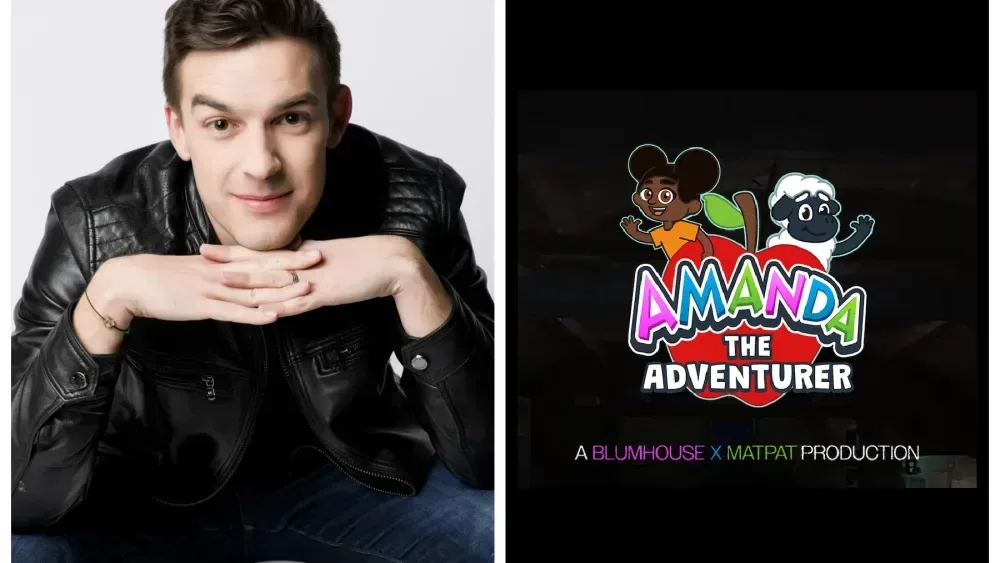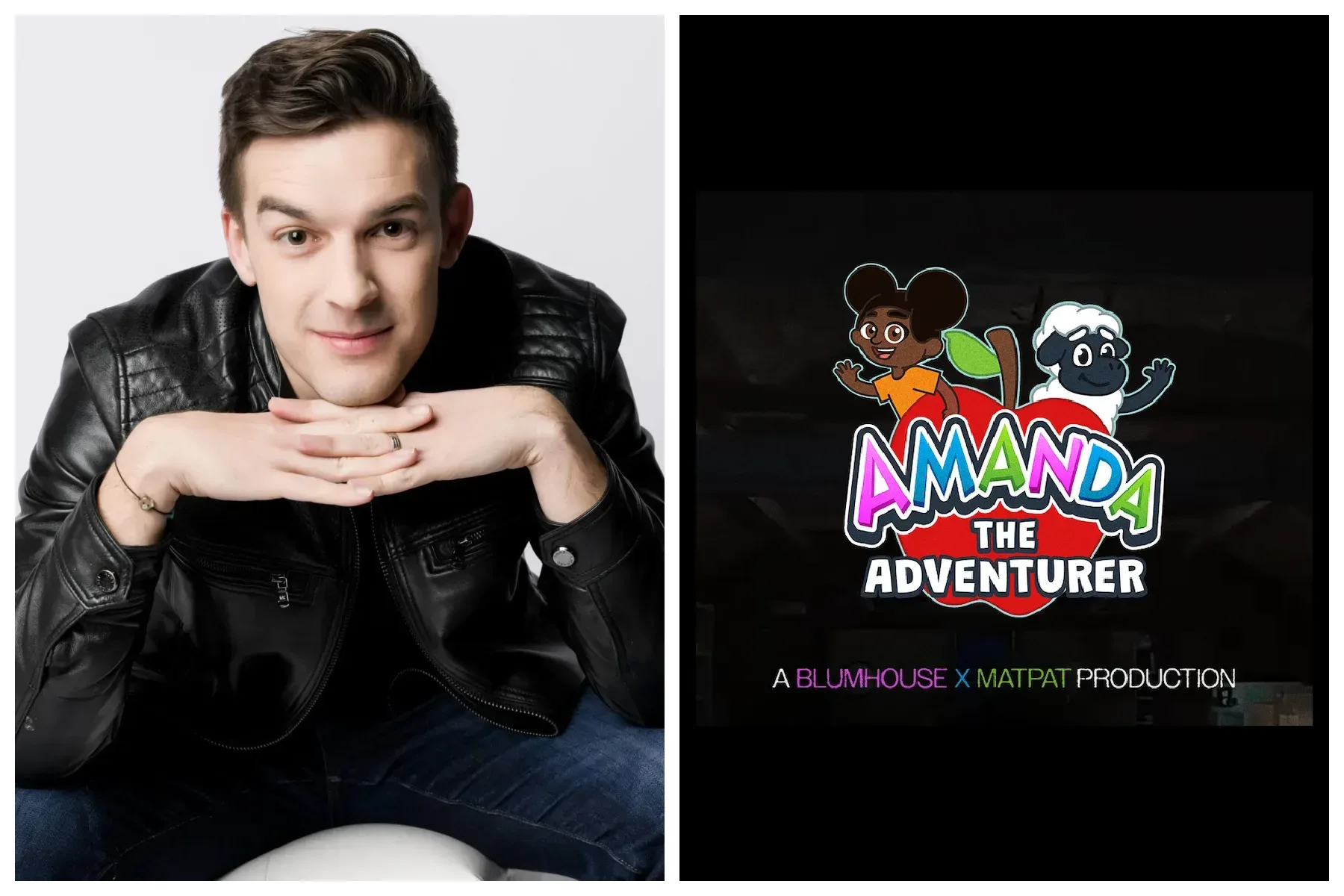
Blumhouse is developing a feature-film adaptation of Amanda the Adventurer, the indie puzzle-horror game series from DreadXP and developer MANGLEDmaw Games. Matthew “MatPat” Patrick will spearhead the project under a new multi-project agreement with Blumhouse, beginning with the game adaptation.
The project was revealed during the Blumfest presentation at New York Comic Con, where Patrick and Jason Blum said the team is speaking with prospective writers and directors. That means the movie remains at an early development stage: no filmmaker, cast, release date, production timetable, or platform has been disclosed.
Patrick and Blum will produce alongside Epic Pictures CEO Patrick Ewald. Patrick moderated the Blumfest panel where the deal and first project were announced.
A horror premise built around forgotten tapes
Amanda the Adventurer follows Riley Park after the death of Riley’s reclusive Aunt Kate, who leaves her house to Riley. While exploring the home, Riley discovers a stack of VHS tapes beside an old television and VCR in the attic. The recordings appear to be episodes of an unfamiliar, cheaply made children’s cartoon from the early 2000s.
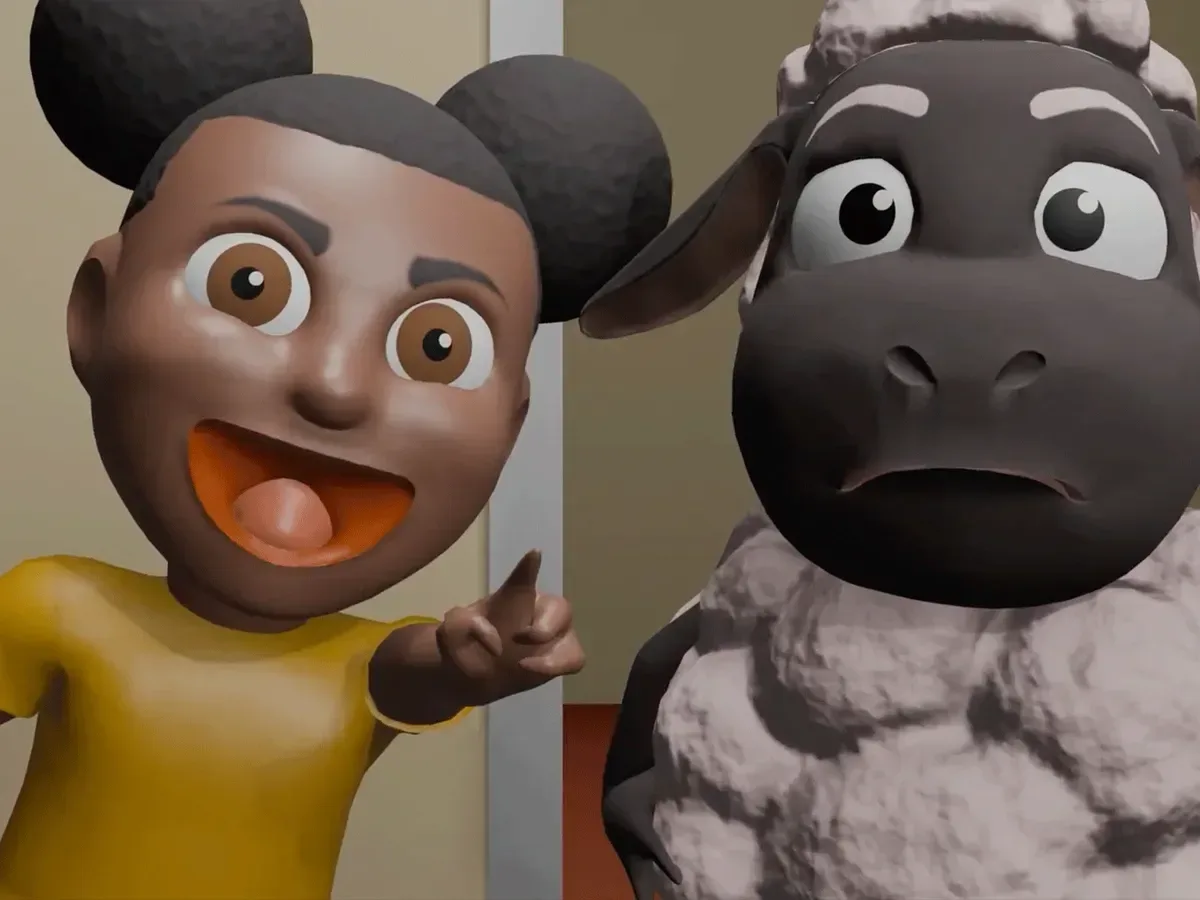
On the surface, the program stars a girl named Amanda and her shy companion, Wooly the Sheep. Its friendly educational-show presentation is the point of entry, but the comfort is gradually undermined: Riley comes to believe Amanda and Wooly are communicating directly through the television. Riley is disturbed by what is happening, yet compelled to keep watching and to determine what Amanda wants.
That setup places the series in puzzle-horror territory. Rather than relying solely on a creature, a haunted location, or a conventional chase, the fear is rooted in discovery, interpretation, and an increasingly uneasy relationship between viewer and recorded media. The VHS format is not merely an aesthetic prop in the premise; it is the mechanism through which Riley accesses the cartoon and encounters its apparent awareness.
For a film adaptation, the attic, tapes, television, Amanda, Wooly, and Riley’s investigation offer a concise foundation with a clear visual identity. They also present the central storytelling task: the games’ tension comes from interacting with and interpreting recordings, while a movie must turn that player-facing process into a dramatic experience for an audience watching Riley make decisions.
What “puzzle-horror” means for the adaptation
Puzzle-horror generally describes horror games in which investigation and problem-solving are integral to progress. Players may be asked to notice details, make connections, respond to clues, or uncover hidden information while a threatening atmosphere builds around them. The supplied description of Amanda the Adventurer emphasizes this idea through Riley’s continuing effort to understand the tapes and Amanda’s needs.
A screen version cannot directly reproduce player input. It can, however, preserve the structure behind it: Riley can test assumptions, follow clues in the house, choose whether to continue viewing, and confront the consequences of each discovery. The effective translation is less about imitating a controller prompt than about retaining the pressure that makes a choice feel dangerous.
The premise also has a natural mystery component. The tapes are initially unfamiliar, the cartoon looks local and low-budget, and its characters seem to recognize the person watching. Those elements establish questions before the film would need to explain any answers: Where did the tapes come from? What is Amanda asking for? What happened around Aunt Kate’s house? And how much agency does Riley retain once the viewing begins?
None of those questions confirms how the film will expand or resolve the game’s story. With writers and a director still under discussion, it is too soon to infer a specific plot, rating, format, or relationship to any particular game installment. The announcement establishes the basic property, producing team, and development status—not a finished creative blueprint.
MatPat’s role matters here
Patrick is widely known as the former host of the YouTube “Theory” channels, an association that makes him a notable fit for a game whose appeal involves close reading, clues, and fan discussion. The newly announced deal places him in a producing and project-leading role for the adaptation rather than simply making him a participant in promotional material.
His past credits span digital entertainment, voice performance, television, theater, and horror-related work. He has hosted the reality competition series The Runner, appeared in a Transformers web series, and had voice-acting roles connected to Blumhouse’s Five Nights at Freddy’s film franchise. He also co-produced the Tony-nominated Broadway play Grey House and the West End musical Your Lie.
That background does not reveal the eventual screenplay or creative direction, but it does make the arrangement more substantial than a one-off license announcement. Patrick’s work has often overlapped with audiences that engage closely with game lore and horror mysteries, while Blumhouse has already worked with him in the orbit of a major game-based horror franchise.
The broader deal is also positioned as multi-project, with Amanda the Adventurer named as its first undertaking. No additional titles or projects have been detailed. Readers should therefore treat the announcement as the start of an ongoing collaboration, not confirmation of a defined slate.
Why the game’s format could translate to film
Children’s programming made unsettling by context is an immediately legible horror image. A bright, simple cartoon can carry familiar signals of safety, routine, and childhood, while the surrounding attic, old hardware, and increasingly direct communication pull those signals out of place. That contrast is central to the provided premise and can work without requiring extensive backstory at the outset.
The relationship between Riley and the screen is equally useful. In many haunted-media stories, a character finds something they ought to leave alone. Here, the important wrinkle is compulsion: Riley feels urged to stop, but cannot shake the need to continue. A film can build suspense out of that push and pull, letting every tape represent both another potential answer and another possible escalation.
There is also a practical advantage in the contained starting point. Riley, Aunt Kate’s inherited home, an attic, tapes, and a small cast of animated characters provide a focused set of story tools. That does not mean the movie will stay confined to those elements; no such scope has been announced. But it gives the production an identifiable core that is distinct from a straightforward live-action haunted-house story.
Audiences should not expect any immediate clarity on whether Amanda and Wooly will be realized through animation, effects, live-action imagery, or some mixture of approaches. Those are filmmaker decisions, and a filmmaker has not yet been announced. For now, the confirmed creative fact is simply that the game’s strange cartoon world is being developed for a feature adaptation.
What has and has not been confirmed
- Confirmed: Blumhouse is developing an Amanda the Adventurer movie.
- Confirmed: The film is based on the indie puzzle-horror game franchise from DreadXP and MANGLEDmaw Games.
- Confirmed: Matthew “MatPat” Patrick is spearheading the project.
- Confirmed: Jason Blum, Patrick, and Epic Pictures CEO Patrick Ewald are producing.
- Confirmed: The team is talking with potential writers and directors.
- Not announced: A writer, director, cast, release date, filming schedule, distributor, or plot beyond the game’s premise.
Blumhouse’s new collaboration with Patrick arrives amid the company’s continued work in digital and horror spaces; it has also partnered with online creator Heidi Wong for original shorts through Blumhouse Atomic Monster, as covered in this look at Wong’s upcoming horror-short project.
For fans of Amanda the Adventurer, the biggest takeaway is that a film is formally in development with producers attached and a prominent game-culture figure guiding its first phase. The next meaningful updates will be the people chosen to write and direct it, followed by details on how the adaptation plans to bring Riley’s unnerving VHS investigation to the screen.