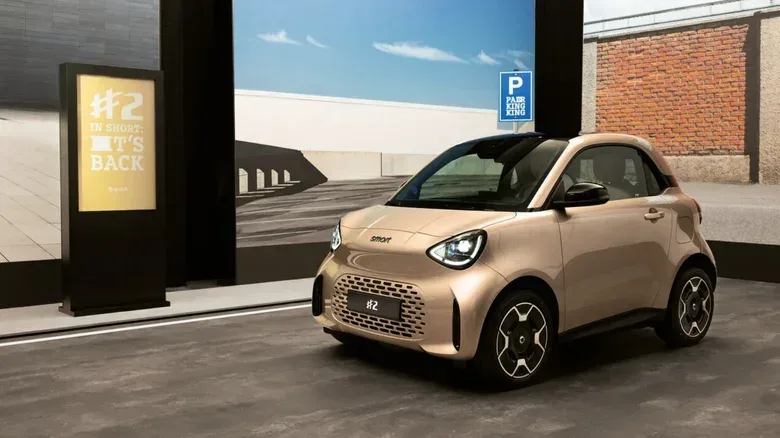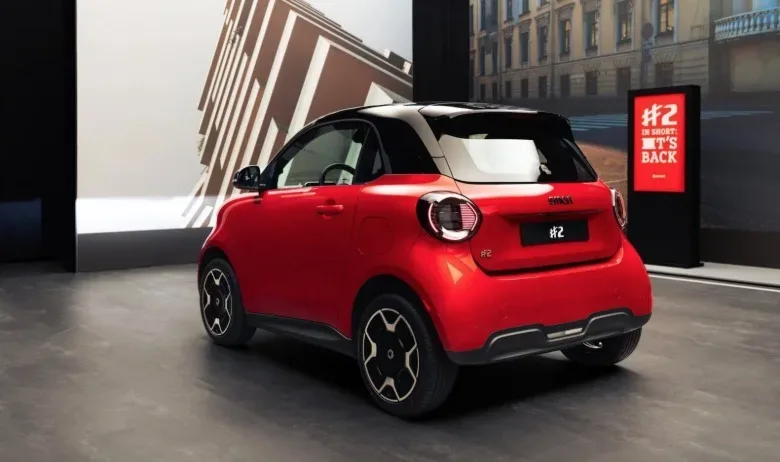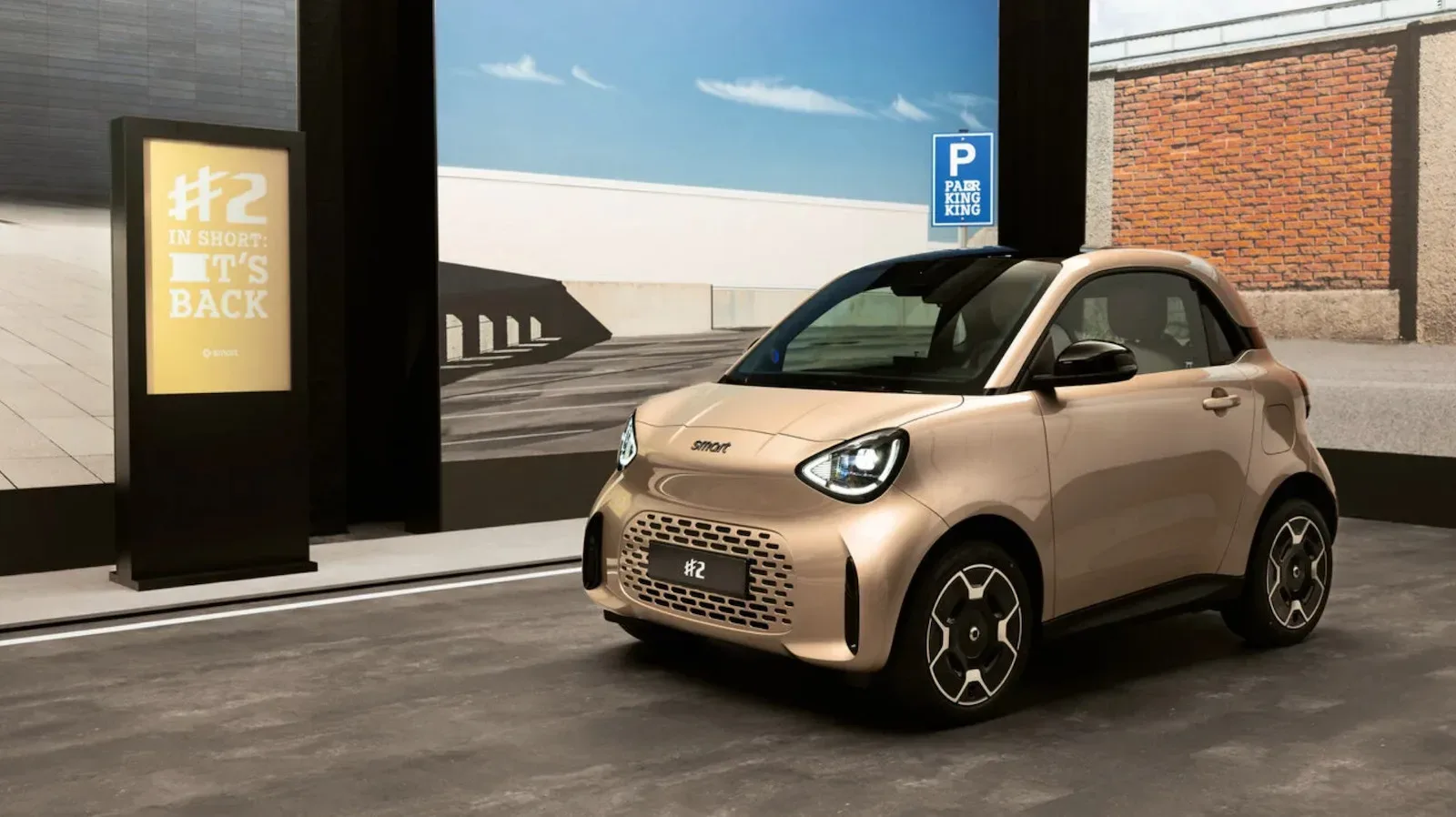
Smart is going small again. The company has revealed the Smart #2, a two-seat electric vehicle that returns its focus to the ultra-compact city-car format associated with the earlier Smart Fortwo. It arrives after a run of SUV releases and four years after the introduction of the Smart #1.
The #2 is built around an unusually direct proposition: carry two people, occupy as little urban space as possible and make tight streets and narrow parking spaces less intimidating. That could sound like a retro exercise, especially with its available two-tone paint treatments recalling the Fortwo, but the mechanical and cabin equipment list is firmly contemporary. Smart is pairing the small footprint with a rear-mounted electric motor, a floor-mounted battery, driver-assistance systems and a screen-heavy dashboard.
Pricing and market availability remain incomplete. Smart says the entry point will be below $26,500 (£20,000), with preorders planned for spring and deliveries expected during summer. There is no exact price yet, and the #2 is unlikely to be offered in the US; Smart has not sold vehicles there since 2019.
A compact car designed around city problems
The Smart #2 seats two, not four. That is the defining compromise and the central reason the vehicle can lean so hard into its compact mission. Rather than trying to satisfy every kind of journey, the #2 is targeted at the parts of driving where vehicle size can be the obstacle: threading through confined streets, fitting into narrow parking spaces and maneuvering where a larger car demands extra clearance.
For buyers who usually travel alone or with one passenger, that layout may be a practical fit rather than merely a novelty. For anyone regularly transporting a family, friends or substantial cargo, the same layout is an obvious limit. Smart has not detailed cargo volume, exterior dimensions, safety ratings or a full driver-assistance feature list, so those are important unknowns rather than blanks to fill with assumptions.
The styling connection to the Fortwo matters because it makes the #2 legible at a glance. The earlier model became synonymous with the tiny two-seat urban car. Smart’s newer #1 preceded this reveal by four years, while the company’s more recent releases have moved into SUV territory. The #2 signals an attempt to bring a familiar formula forward without relying on old hardware.
Motor, battery and handling: what has been confirmed
The #2 uses a rear-mounted 60kW electric motor sending power to the rear wheels. Smart lists 130Nm of torque. In plain English, torque is the turning force available at the wheels; it is a figure often associated with the initial pull a vehicle can provide from a stop. Smart has not supplied acceleration figures, top speed, battery capacity or vehicle weight, so the numbers cannot support a firm prediction about overall performance.
The rear tires are larger than the front tires, an arrangement Smart says should help stability. The car also uses a five-link rear suspension, which Smart says is intended to improve handling and comfort. A five-link suspension is a design that uses multiple separate links to control wheel movement. The practical aim is to better manage how the wheel responds to bumps, cornering forces and changes in road surface. Whether the result feels sporty or comfortable in everyday use will need to wait for independent driving impressions.
Related coverage includes Smart #2 Brings a Two-Seat EV Back to the City.
The battery is mounted in the floor and is claimed to provide up to 180 miles, or 290km, on a charge. That is a useful figure for an ultra-compact EV, but “up to” is the operative phrase. Claimed range is a maximum stated figure, not a promise that every trip will produce the same result. Real-world EV range can vary with driving speed, weather and climate-control use, among other conditions. Our guide to the factors that can cut into an EV’s range explains why the number on a specification sheet is best treated as a starting point for planning.
Smart also says the #2 can fast-charge from 10% to 80% in 20 minutes. That describes the middle portion of the battery rather than a complete refill. EVs commonly charge more slowly as the battery approaches full capacity, which is why charging claims often focus on a 10-to-80% window. The company has not provided the charging power used for that DC fast-charging result, nor the charging conditions behind the claim.
Two screens and multiple ways to connect
Despite the small-car silhouette, the #2 will include a 10.1-inch central display and an 8.8-inch driver display. The central screen is the larger interface for vehicle and infotainment functions, while the driver display is positioned to show key driving information. Smart also lists 4G, Wi-Fi and Bluetooth wireless connectivity.
Driver-assistance systems are included, though Smart has not specified the individual functions. That distinction is worth keeping clear: “driver assistance” is a broad label that can cover a wide range of features. Without an itemized list, it is not possible to say which warnings, parking aids or active driving supports the #2 will include, or whether they will be standard across all markets.
The technology package changes the character of the concept. The Fortwo-inspired exterior points backward to a recognizable city-car shape, while the dashboard and connectivity expectations belong to the current EV market. The question for shoppers will be whether the #2’s compact proportions and two-seat limitation are balanced by its range, charging ability, equipment and final price once detailed configurations arrive.
Four trims, from Pure to a 999-unit Couture Edition
Smart plans several #2 versions. The base Pure trim carries the core equipment outlined above, including the displays, connectivity and driver-assistance systems.
- Pure: The entry-level version with the main #2 equipment package.
- Pure+: Adds 11kW AC charging and a heated driver seat.
- Premium: Adds a glass roof, heated leather seats, additional color choices and a seven-speaker Sennheiser sound system.
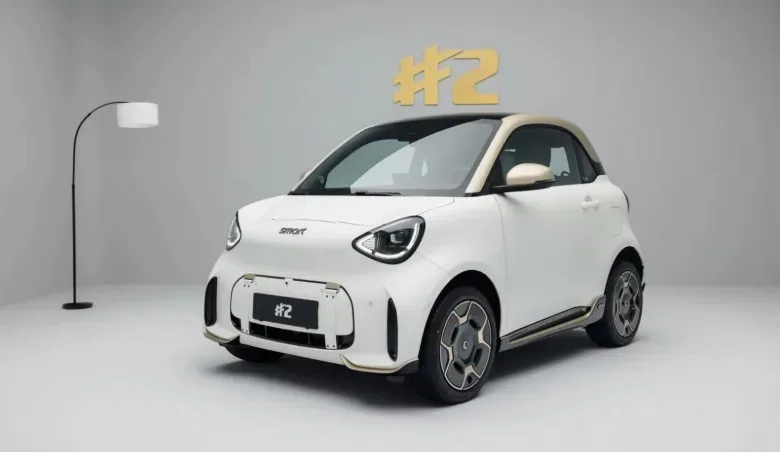
- Couture Edition: A limited run of 999 units with a white exterior, gold-painted roof and gold tire detailing.
The Pure+ model’s 11kW AC charging refers to charging on alternating-current power, the type generally associated with slower destination or home-style charging compared with DC fast charging. The disclosed detail says the higher AC charging capability belongs to Pure+, but Smart has not supplied charge-time estimates for this mode or stated what equipment and infrastructure assumptions apply.
The Premium’s upgrades move the #2 toward a more decorative, comfort-oriented specification: a glass roof, heated leather seats and the seven-speaker audio system are not essential to the city-car concept, but they could matter to buyers looking for a small vehicle that does not feel bare-bones. The Couture Edition pushes that approach further with a visual theme rather than an outlined performance change. Its 999-unit cap is the only stated production limit among the trims.
What the Smart #2 still needs to answer
The reveal establishes the broad shape of the vehicle but leaves several purchase-critical specifics unresolved. Exact pricing is pending. Market-by-market availability is pending. Battery capacity, acceleration, maximum speed, cargo space and full dimensions have not been provided in the available information. Nor has Smart described the precise driver-assistance feature set, the power behind the fast-charging claim or the conditions used to reach its stated range.
Those missing details do not undermine the #2’s core idea. They simply define what remains to be evaluated. Right now, the strongest facts are straightforward: it is a rear-wheel-drive, two-seat EV with a 60kW rear motor, 130Nm of torque, up to 180 miles of claimed range, a 10-to-80% fast-charge claim of 20 minutes and a compact-city purpose. It will offer a range of trims, including a 999-unit Couture Edition, and Smart expects an entry price below $26,500 (£20,000).
For the people who want an EV specifically because they do not want to pilot a large vehicle through a dense city, that clarity may be more valuable than a long feature checklist. The #2 is not trying to be an all-purpose family car in miniature. Its pitch is narrower: a modern electric answer to the perennial problem of limited space.