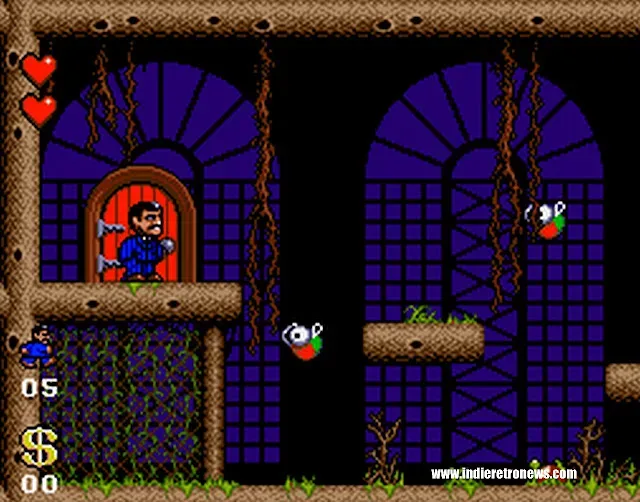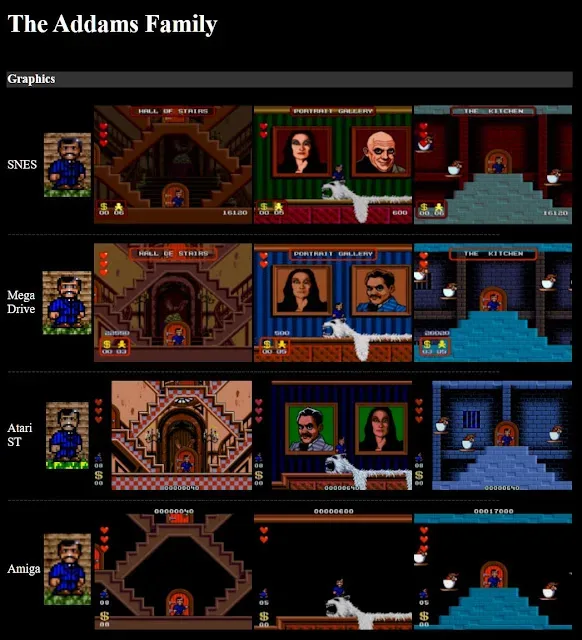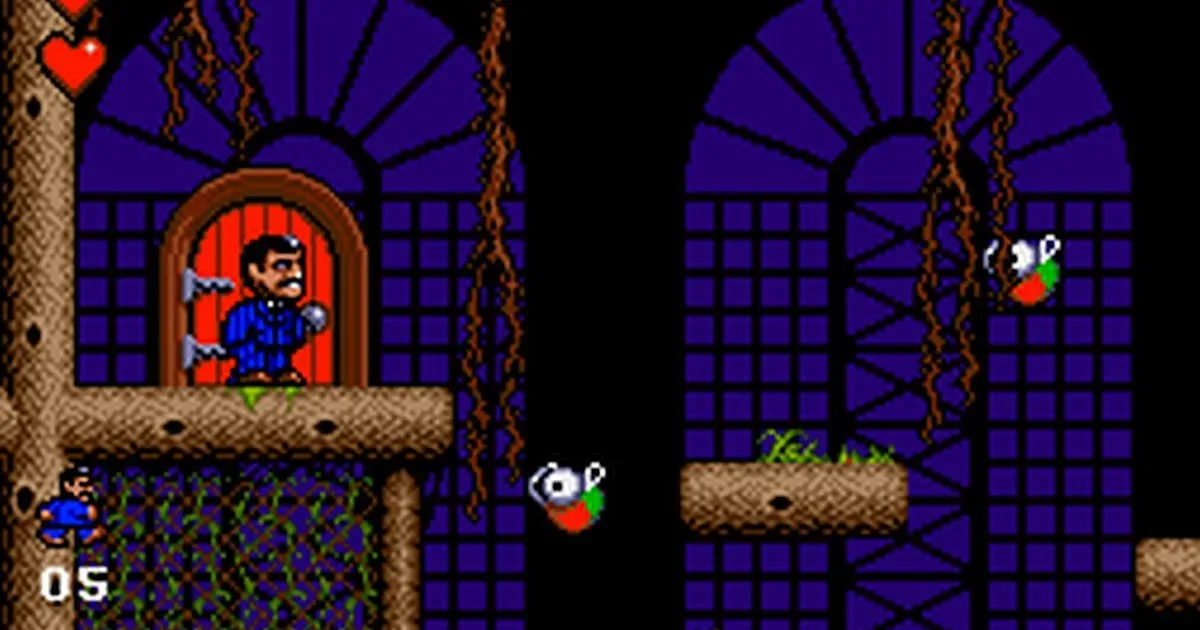
For decades, the Amiga version of The Addams Family carried a conspicuous visual compromise: it did not show the detailed level backgrounds seen in versions released for other 16-bit systems. That absence is now being addressed by The Addams Family: Backgrounds Edition, a heavily modified version of Ocean’s 1992 tie-in game scheduled for release in October 2026.
The project comes from DJ Mike, who investigated the game’s programming after a forum discussion raised the longstanding missing-background question. The discovery was more interesting than a simple matter of absent artwork. The original game reportedly contained programming intended to render those backgrounds, but its own code subsequently ignored and overwrote them before they reached the display.
That means this is not merely an attempt to add an unrelated new visual layer to an old game. It is a restoration-minded modification built around behavior that appears to have existed within the original Amiga code, while also confronting the machine-specific technical barriers that likely kept the effect from shipping in 1992.
A missing layer with an unexpectedly complicated explanation
On paper, restoring a background can sound straightforward: find art, put it behind the action, and scroll it with the stage. On period Amiga hardware, however, the visual presentation of a scrolling game is closely tied to finite graphics resources, memory layout, and the way display layers are built. A feature that looks routine on a screenshot can be expensive when the game must sustain motion without making play feel sluggish.
DJ Mike’s reverse-engineering work found evidence that the original developers had planned more than static scenery. The background system was apparently designed with half-speed parallax scrolling in mind. Parallax is the familiar technique in which a background moves more slowly than the foreground, creating an impression of depth. If the character and platforms travel across the screen at one speed while distant scenery moves at half that rate, the scene seems to have a farther visual plane behind it.
It is a small motion difference with a large effect on the feel of a side-scrolling game. The foreground establishes the playable space; the slower-moving background provides atmosphere and depth without changing where the player can jump or walk. In a game based on the Addams Family’s macabre surroundings, restoring environmental artwork also has an obvious thematic value: the setting can again do more of the storytelling rather than leaving the level action against a comparatively bare backdrop.
But the restoration cannot simply apply one solution across the entire Amiga family. The Backgrounds Edition is being tailored around the distinction between OCS systems and later AGA machines.
Why OCS Amigas need a different compromise
The standard OCS chipset faces the most restrictive conditions. In the original game’s foreground action, its 32-colour bitplanes are already at the practical limit. A bitplane is a way the Amiga’s graphics hardware represents screen imagery: multiple planes combine to produce the visible colour information. The important result here is that the foreground uses the available visual capacity, leaving no painless route to a conventional, separate dual-playfield presentation for the restored scenery.
Related coverage includes The Addams Family Backgrounds Edition Targets October for Amiga.
Dual playfield refers to an Amiga display arrangement that can support two independent image layers. It is an appealing fit for a foreground-plus-background game, but it is not free. Under the stated OCS constraints, trying to use a true dual-playfield effect would cause serious visual lag. For a platform game, that is an unacceptable trade-off. Smooth screen movement and responsive-feeling action are more valuable than a technical flourish that makes the game stutter or crawl.
Accordingly, the OCS version of the Backgrounds Edition restores the artwork but has it scroll at the same speed as the level. It will therefore show the missing environmental layer, while declining to simulate the slower parallax effect where doing so would undermine performance.
That distinction matters because it sets realistic expectations. OCS players are not receiving an inferior or failed implementation; they are receiving an implementation designed around the standard chipset’s limits. The key recovery is the background art itself. The motion behavior is adjusted to protect the smooth performance expected from the original action.
This is also a useful reminder that “the Amiga version” is not one fixed technical target. The platform name covers machines with meaningful graphics and memory differences. A mod intended to make an older game look closer to its apparent original ambitions has to decide which capabilities can be preserved on each configuration and which need an alternative.
AGA machines get the intended half-speed parallax
Owners of AGA-equipped Amigas, including the Amiga 1200 and Amiga 4000, are set to receive the more elaborate version of the effect. On those machines, the Backgrounds Edition uses 32-bit FMODE graphics and keeps 32 distinct copies of the background in memory at once. That substantial memory arrangement is what allows the game to deliver the intended half-speed parallax scrolling without visible interruption.
FMODE is part of the AGA graphics feature set. In this project, it is being leveraged to make the restored background technique practical in a way it is not on standard OCS hardware. The implementation presses right up against the Amiga’s 2MB Chip RAM limit, illustrating why the new edition required major code restructuring and careful memory management rather than a simple switch being flipped.
Chip RAM is particularly important in this context because it is memory accessible to the Amiga’s custom chips, including the graphics hardware. A graphics-heavy change depends on that memory being available in the right form and at the right time. Storing 32 versions of the background simultaneously is a demanding choice, but it supports seamless half-speed movement rather than making the game repeatedly prepare or replace background data as it scrolls.
The AGA approach is consequently not just “more colours” or a vague enhancement. It is a specific memory-and-display strategy that enables the feature the original code appears to have aimed for: foreground action moving normally, with the environmental layer travelling behind it at half speed.
What the project changes—and what it does not claim to change
The Backgrounds Edition is notable because its scope is clearly defined. It focuses on a visual omission in the Amiga release and on the code paths surrounding that omission. The available details support restored background artwork, same-speed scrolling on OCS systems, and half-speed parallax on AGA machines. They do not establish a wholesale remake, redesigned stages, new gameplay content, or changes to the game’s original platforming structure.
That focus is a strength. A targeted restoration can preserve the identity of the 1992 release while making a long-missing portion of its presentation visible. It also makes the differing OCS and AGA versions easier to understand: both are trying to restore the scenery, but they arrive there through hardware-appropriate methods.
For players using a standard OCS Amiga, the practical takeaway is that the game’s scenery should finally be present without sacrificing fluid level scrolling for a more ambitious layered effect. For players on an Amiga 1200 or Amiga 4000, the draw is the full parallax treatment, achieved through AGA-specific graphics handling and a memory configuration that reaches the 2MB Chip RAM ceiling.
The project also fits into a broader pattern in retro development: old binaries can still contain unrealized design intentions, but uncovering them is only the beginning. Reverse engineering can reveal that a feature once existed in code; turning it into a reliable, playable feature on original hardware demands an understanding of the system’s bottlenecks. In this case, the work involves not just recovering art but navigating bitplanes, display-layer limitations, graphics modes, scrolling behavior, and memory residency.
Other recent Amiga work has similarly shown how hardware-aware development can expand what classic software can display, as seen with a Bad Dudes vs DragonNinja AGA port built around parallax and faster blits. The Addams Family project takes a different route: rather than starting from a new port, it is revisiting an existing release whose own programming appears to have retained a hidden trace of a lost visual ambition.
Why the restoration is significant for Amiga preservation
Retro preservation is often discussed in terms of keeping software runnable, but projects such as this add another layer to that idea. A game can survive in a technically playable state while still being incomplete in the more subtle sense that a planned visual component never made it to the screen. The Backgrounds Edition is significant because the missing material was not simply recreated from scratch as a modern embellishment. The investigation points to original logic that prepared the background, only for later behavior to suppress it.
That does not erase the historic release as it was, nor does it turn every missing feature in an old game into something easily recoverable. Instead, it gives Amiga players an alternate way to experience The Addams Family: one that retains the game’s period foundation while restoring background presentation through configuration-specific engineering.
The October 2026 release window is therefore worth watching for owners of both OCS and AGA machines. The central promise is simple enough—backgrounds are back—but the route to that outcome is unusually revealing. Standard OCS hardware receives a performance-conscious synchronized layer; AGA systems receive the half-speed parallax effect that the original game’s code suggests was once intended. After more than three decades, a long-standing visual gap in the Amiga version is set to become a carefully considered technical restoration.