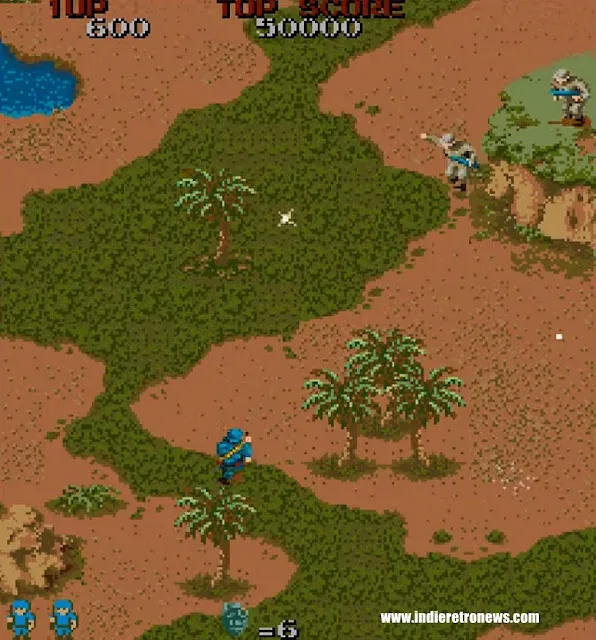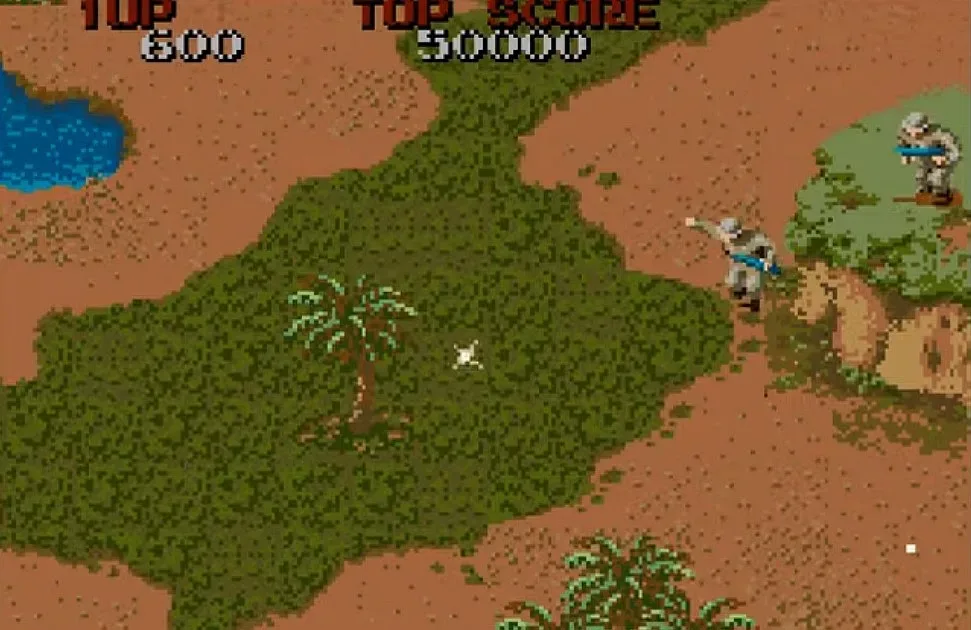
Capcom’s Commando has received a new Amiga conversion built for machines with the Advanced Graphics Architecture, or AGA. JOTD’s enhanced “Arcade” edition targets the Amiga 1200 and Amiga 4000 and is intended to bring the vertical military shooter closer to its arcade original than earlier Amiga versions.
The project is notable not simply as another way to play a familiar coin-op game, but as a technical exercise in reverse engineering and code conversion. JOTD used Commando to resume and develop a specialised process for translating Z80 assembly-derived game logic into code for the Motorola 68000 family used by the Amiga. The release also credits IM76 for music work and PascalDe73 for icons, while Capcom is credited for the original game.
An enhanced edition, not a dismissal of the older port
Amiga players already had an officially released version of Commando. Elite Systems brought an ECS/OCS conversion to the platform in 1989, and JOTD has explicitly described that edition as a strong conversion for the original chipset. That distinction matters: this new AGA edition is not framed as a rescue job for a failed older release. It is an attempt to use later Amiga graphics hardware and a different production method to chase greater arcade accuracy.
The Amiga’s OCS and ECS chipsets refer to earlier generations of the system’s custom graphics and audio hardware. AGA, introduced with models including the Amiga 1200 and 4000, expanded the machine’s graphical capabilities. In practical terms, that makes it an appropriate target for a project whose stated priority is a more faithful visual presentation rather than simply squeezing a playable version onto the broadest possible range of Amiga hardware.
That hardware split is important for anyone approaching the release with older Amiga equipment. The enhanced AGA version is designed around AGA-capable systems, not the original OCS/ECS machines supported by the 1989 conversion. AGA is therefore a requirement tied to the project’s aims, rather than a label that can be assumed to apply to every Amiga configuration.
Why Commando was the test case
JOTD selected Commando as a proving ground for a new Z80 converter. The Z80 is an 8-bit processor widely associated with arcade-era hardware, while the 68000 is the processor family at the centre of the Amiga systems named for this release. Moving a game between those environments is not a matter of copying files from one machine to another. The processors use different instruction sets: the low-level commands that tell each CPU what to do are written in different languages.
In broad terms, assembly language is a human-readable representation of those processor-level instructions. A binary transcode or conversion workflow aims to map one set of low-level operations to another processor’s equivalent. That is distinct from writing a game completely from scratch, and it is also distinct from emulation, where one system imitates another machine at runtime. The stated approach here is to convert the game’s code for the Amiga’s 68000 environment, alongside dedicated graphics and sound work.
JOTD described Commando as a suitable candidate because it was relatively straightforward, properly coded and close enough in hardware character to an earlier Ghosts’n Goblins project to be manageable. The goal was not presented as personal nostalgia; JOTD said he had not played the game in arcades or on Amiga. Instead, the attraction was that it offered a feasible way to refine the conversion tools.
Related coverage includes Commando Returns to Amiga in a New AGA Arcade Edition.
That is a useful reminder that preservation-oriented fan projects can begin with engineering needs as much as affection for a particular game. A title with a contained technical scope can reveal where a converter mishandles logic, timing or processor behaviour. Once those issues are found in a smaller project, the tools may be better prepared for other conversions later.
Reverse engineering supplied the foundation
The work began with an existing disassembly by Scott Tunstall. A disassembly converts executable machine code into assembly-style instructions that can be studied and worked on. It is an essential step when developers do not have the original source code in the form used by the game’s creators.
That disassembly was incomplete, so JOTD completed portions needed for conversion before applying the Z80-to-68000 process. The detail helps explain why “conversion” understates the work involved. A usable game codebase first has to be understood well enough to identify missing or unresolved sections, then adapted for another CPU and integrated with the target machine’s video and audio handling.
JOTD is credited with reverse engineering, the 68000 transcode, graphics conversion and Amiga sound conversion. Those are separate jobs with separate risks. Even when gameplay code can be translated, graphics need to be represented in formats suited to the target hardware, and sound must be arranged around the channels and memory constraints available on that system.
Sound work aims for arcade character
IM76 handled the music for the AGA edition. The project description says chords and samples were packed into three channels, or four where possible, with the objective of making the result sound much closer to the arcade game.
Channel count is a useful technical term here. An audio channel is an independent stream that can play a sound or musical element. Fitting multiple musical components into a limited number of channels requires arrangement decisions: a chord, melodic line, percussion element and sample may compete for the same available playback resources. “Packing” refers to organising those elements so the intended musical texture survives the limitation as effectively as possible.
The reported three- or four-channel approach therefore reflects more than a cosmetic tweak. It is an adaptation of the arcade music to Amiga playback resources, and it is central to the edition’s broader effort to improve the game’s arcade feel. Still, the supplied details do not establish a full specification for every audio or visual change, so players should avoid assuming unlisted features beyond the stated conversion, graphics and sound goals.
What this means for retro Amiga players
For owners of an Amiga 1200 or 4000, this release offers a new version of a landmark vertical shooter created specifically around AGA hardware. For fans of technical Amiga projects, it also provides a visible result from a conversion workflow that JOTD intends to refine: a game chosen in part because it could expose weaknesses in a fresh Z80 conversion tool without demanding an overwhelmingly complex first target.
It also sits alongside prior JOTD conversions including Double Dragon, Ghosts’n Goblins and Xevious. Those credits give useful context for the choice to treat old arcade code as material that can be carefully reworked for Amiga hardware rather than merely recreated at a surface level.
The new edition does not erase the value of the older Elite Systems release. The two projects serve different historical and technical purposes: the 1989 release remains a respected OCS/ECS conversion, while the AGA edition uses a later hardware target and a code-translation effort intended to pursue a tighter arcade match. That makes the new release especially interesting as both a playable revisit and an example of reverse-engineering craft continuing around classic computers.
For more retro-game reading beyond the Amiga scene, see our guide to N64 games for solo sessions.