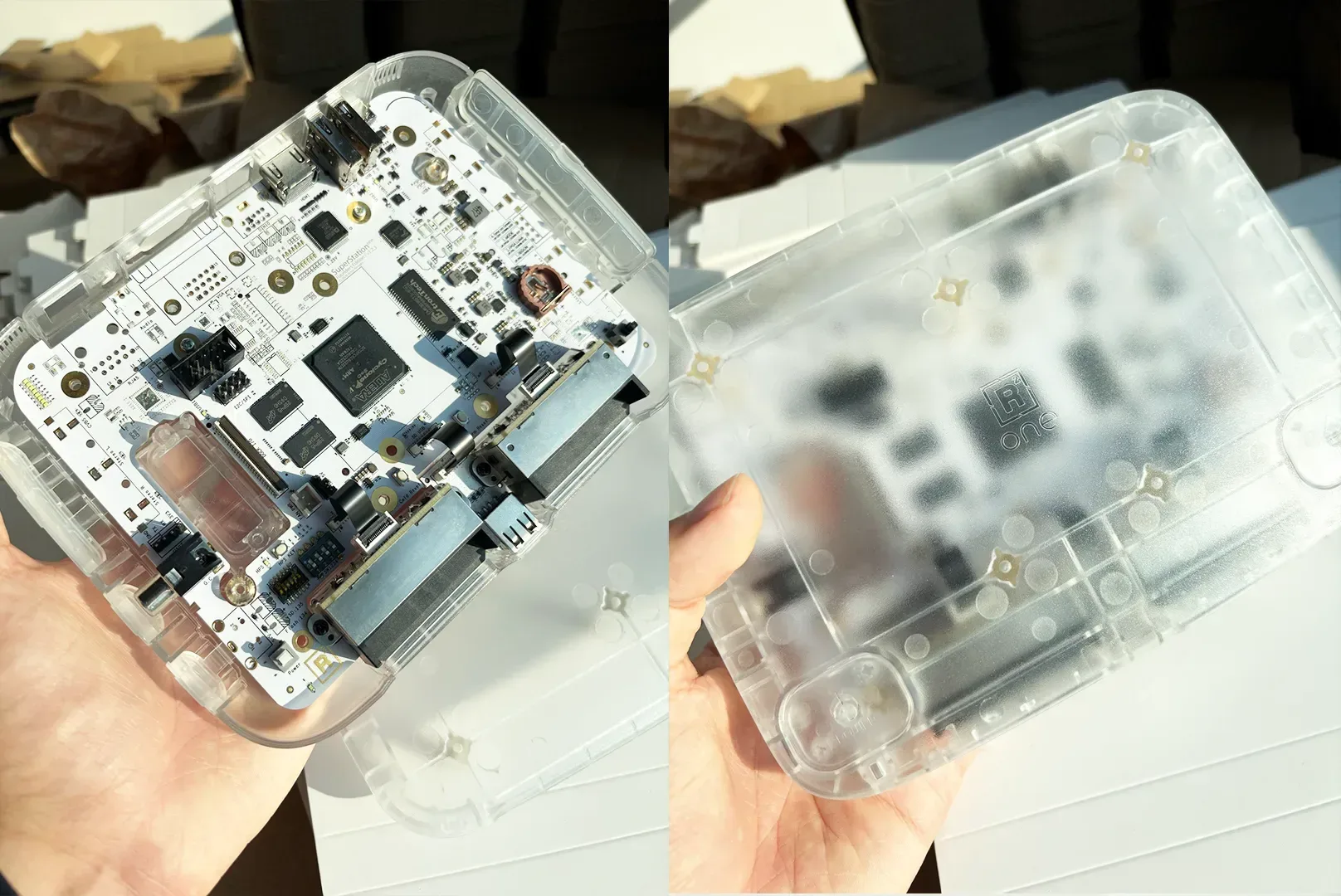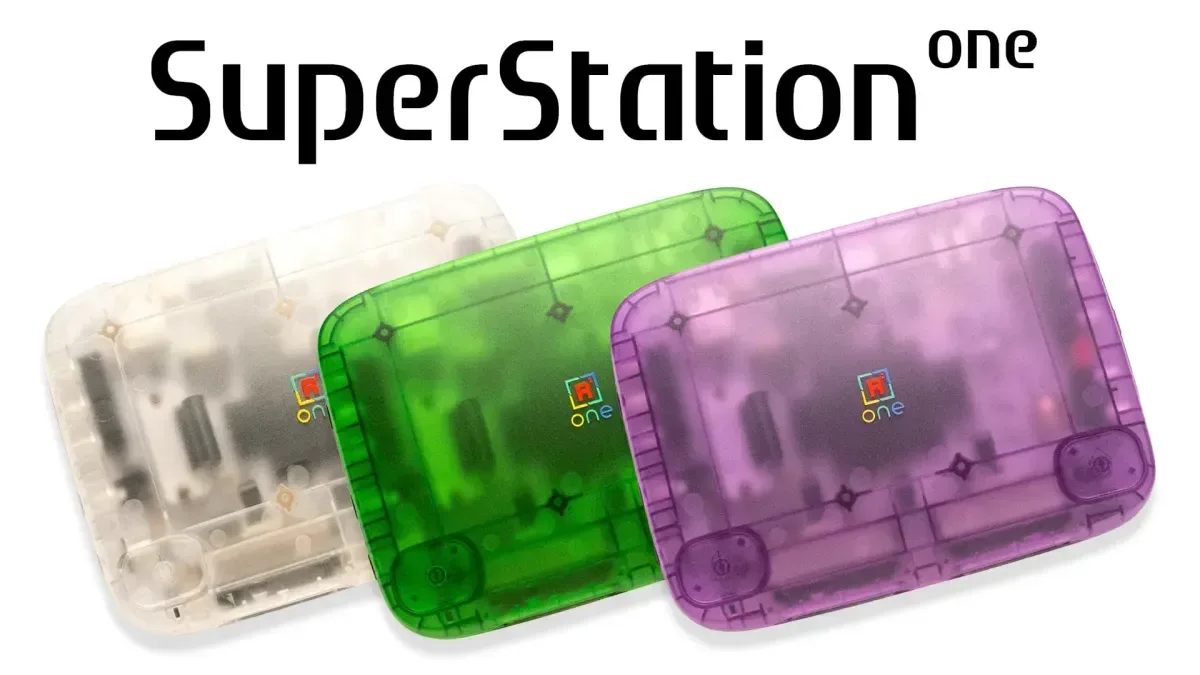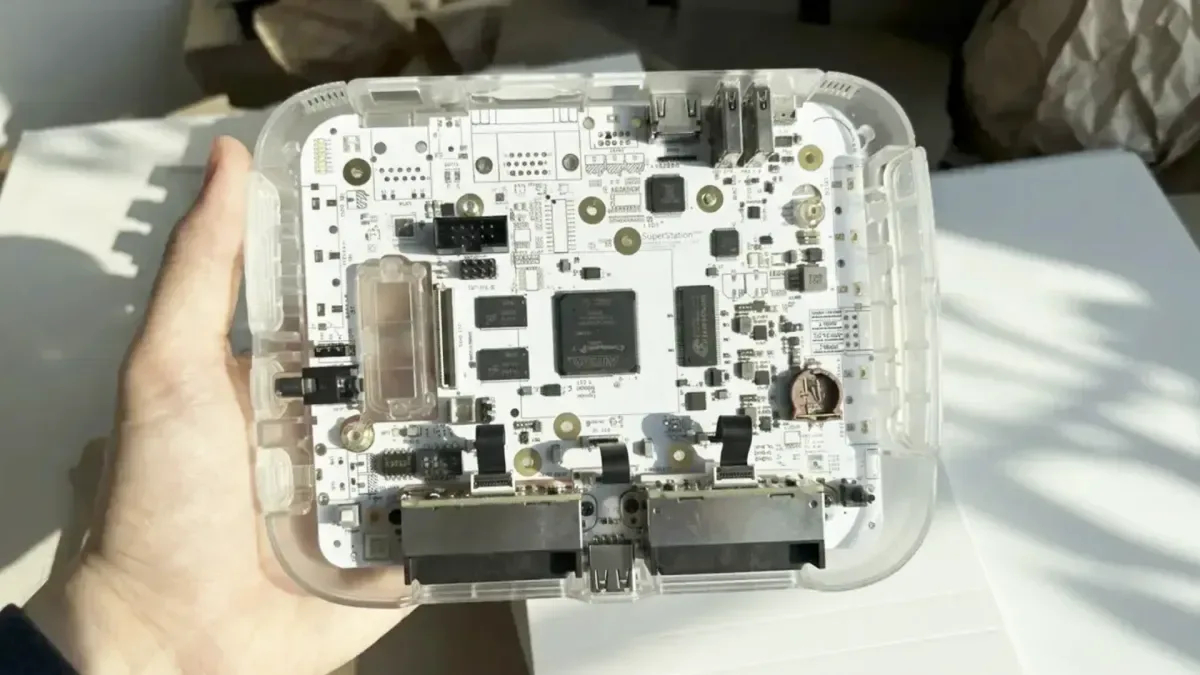
Retro Remake may be considering a more affordable entry point for its SuperStation One FPGA console. A prototype called the SuperStation One Lite, or SS1 Lite, has been described as a $200 version of the machine that removes analogue video output and support for the optional Super Dock.
The important word is prototype. The Lite has been presented as hardware that was built and evaluated, rather than as a formally confirmed retail product with a release date. That distinction matters: the stated price, design and feature set can all change, and there is no firm indication that the SS1 Lite will ultimately be sold.
Still, the outline is clear. The standard SuperStation One is an FPGA-based console styled after the original PlayStation. It is intended to run PlayStation games as well as a selection of MiSTer cores in a modern-format device, while offering a broad collection of connection options. The Lite concept would narrow that approach to an HDMI-focused machine for people who do not need legacy display support or dock expansion.
What the SuperStation One Lite would remove
The proposed Lite configuration has no analogue output and no Super Dock support. In practical terms, it is described as retaining HDMI while losing the video connections that make the regular unit particularly flexible for older televisions, monitors and specialist video setups.
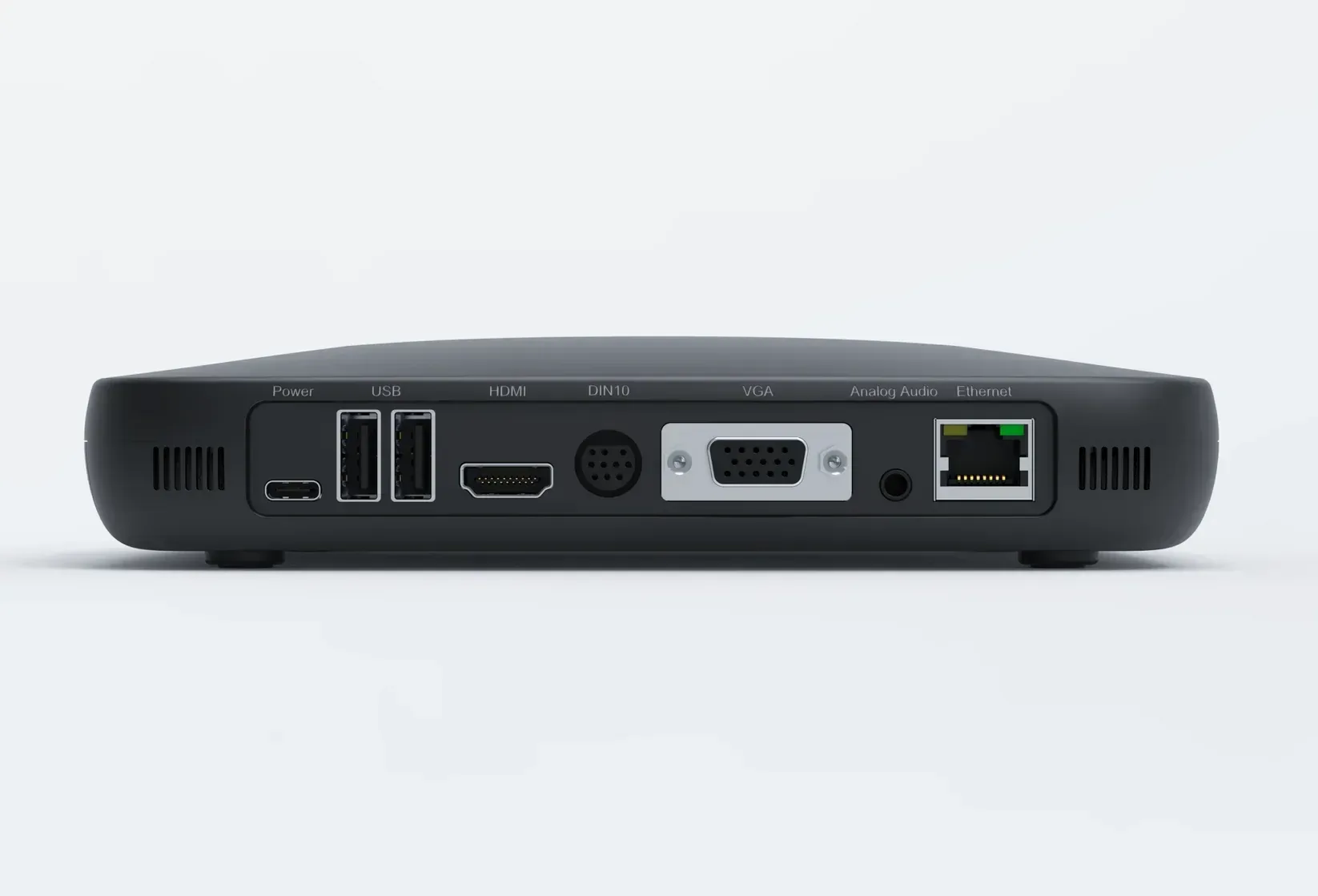
The standard SuperStation One’s listed video and connectivity options include:
- HDMI
- USB-A
- Component video (YPbPr)
- VGA
- 10-pin DIN, supporting RGB, S-Video and composite through compatible cables
- S-Video
- Composite video
For buyers who use a recent TV or monitor with HDMI, the Lite’s stripped-back arrangement could be entirely sufficient. But for enthusiasts with CRT televisions, VGA displays, or a setup built around RGB, S-Video, composite or component video, those omissions are not cosmetic. They are the central trade-off.
Analogue video, explained
Analogue video output is a broad label for the older display standards listed above. Composite is the basic connection found on many older TVs. S-Video separates parts of the signal for a cleaner result than composite. Component video uses YPbPr connections, while RGB is another signal format commonly valued in retro setups. VGA is associated with older computer displays.
The SS1 Lite’s concept is not that those connections are being replaced by an alternative legacy port. Rather, its appeal is simplicity: HDMI-only video in exchange for a lower proposed cost. That makes the Lite a potentially straightforward fit for a contemporary display, but a less natural fit for players specifically seeking direct compatibility with older screens.
Related coverage includes SuperStation One Lite Prototype Points to a $200 HDMI-Only FPGA Option.
The dock is the other major dividing line
The optional Super Dock expands the regular SuperStation One with additional hardware. Its listed capabilities include four more USB ports, an M.2 NVMe SSD slot, an optical disc drive, a dedicated SNAC port, an infrared receiver and an expansion connector.
- Four additional USB ports: more room for compatible peripherals.
- M.2 NVMe SSD slot: a slot for this compact SSD format.
- Optical disc drive: hardware for reading optical discs.
- Dedicated SNAC port: a separate connection included on the dock.
- Infrared receiver: support for infrared communication.
- Expansion connector: a port intended for further expansion.
Because the Lite would not support the dock, prospective buyers should treat it as a separate, deliberately limited configuration rather than a basic unit that can later become a fully expanded SuperStation One. Someone who expects to need the optical drive, extra USB connections, SSD slot or other dock hardware should not assume a future upgrade path exists for the Lite.
That division could make the purchasing decision unusually simple if the prototype becomes a product. The full machine would remain the option for maximum display compatibility and expansion. The Lite would target the player whose priority is HDMI output and a lower up-front price.
How the proposed price compares
The regular SuperStation One has been listed at $249, while a bundle with the Super Dock has been listed at $299. At the stated $200 target, the Lite would sit $49 below the base system and $99 below the dock bundle.
Those figures frame the Lite less as a direct replacement for the existing model than as a pared-down alternative. Saving $49 will be meaningful to some buyers, particularly if their display is HDMI-only and the dock’s features hold no appeal. Others may decide that the gap is too small to surrender analogue outputs and docking compatibility. The value of the Lite therefore depends heavily on the display and accessories a player already owns.
There is also an important caveat: a prototype price target is not necessarily a final retail price. Until a retail version is confirmed, the $200 figure should be read as part of the concept being tested, not as a guarantee.
Lower power use and airflow are part of the pitch
The SS1 Lite prototype is said to use 2–3 watts less power than the other configuration and to have “amazing airflow.” These claims point to a secondary benefit beyond the lower target cost: a simpler hardware design may also alter the machine’s thermal and power characteristics.
It would be premature, however, to turn that into a promise of better gaming performance. Reduced power draw and improved airflow describe power consumption and cooling, not a confirmed change in software compatibility, FPGA behaviour or output quality. No comparative performance results have been provided. The evidence supports saying that the Lite prototype is claimed to use less power and have strong airflow; it does not establish that it will run games better.
What FPGA means here
An FPGA, short for field-programmable gate array, is configurable hardware. In the SuperStation One’s case, the relevant point is that the device is designed around FPGA technology to support PlayStation games and an array of MiSTer cores. A core is the particular hardware implementation or configuration used for a supported system.
For an interested buyer, the Lite’s reported changes appear to concern physical I/O, dock support, power use and airflow—not a newly described change to the basic purpose of the platform. The prototype has been positioned as a more focused SuperStation One, not as a different kind of retro system.
Who the Lite concept appears to suit
If it reaches retail in close to the described form, the SS1 Lite would make the most sense for a narrow but potentially sizeable group: people who want an HDMI-connected FPGA console, do not intend to use an older display, and do not need the Super Dock’s additional connections or optical drive.
The regular SuperStation One remains the more adaptable option on the currently described specifications. Its variety of video outputs accommodates far more display situations, and dock support leaves room for the additional USB ports, NVMe storage, optical drive and other connectors. That flexibility is likely to matter most in a hobby where the display can be as important as the console itself.
The Lite proposition is more disciplined. It asks buyers to give up versatility in exchange for a lower target price, lower stated power use and a design said to improve airflow. For someone whose entire setup begins and ends with HDMI, that may be a sensible reduction. For somebody building around period-appropriate display connections, it likely is not.
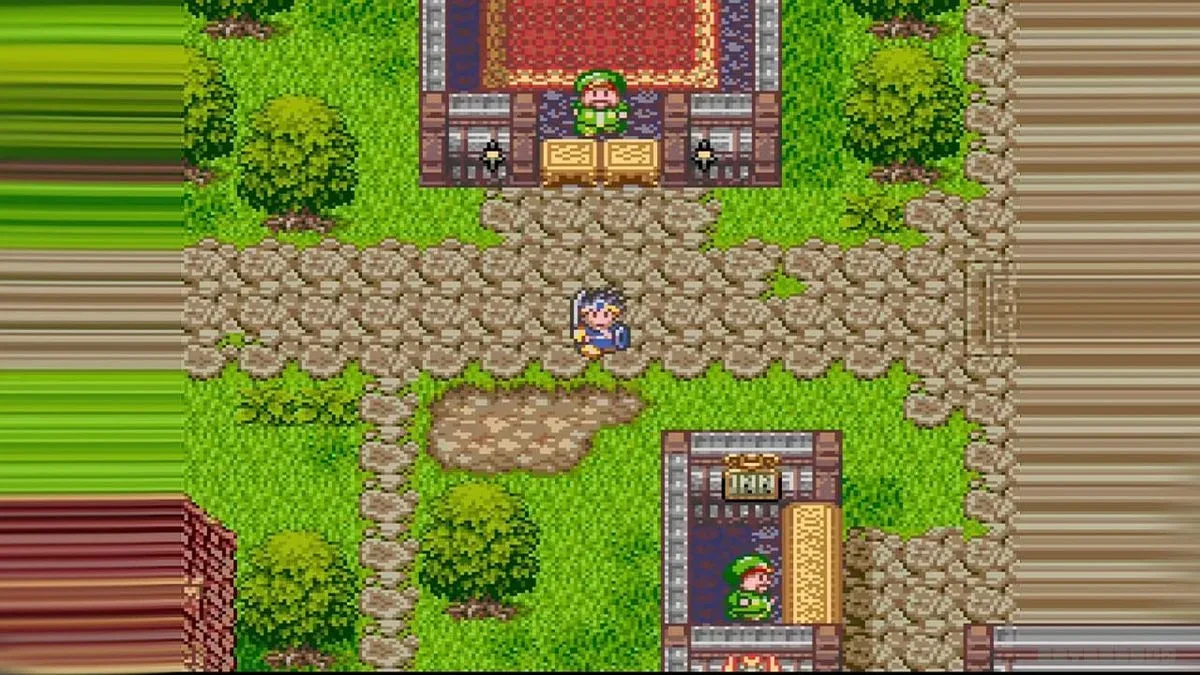
Retro hardware projects frequently live or die by those practical details. An HDMI-only option can reduce the friction of connecting to a modern screen, while an array of legacy ports caters to enthusiasts who want specific video paths. Both priorities are legitimate, but they lead to very different hardware needs. The same broad interest in adaptable retro platforms can also be seen in projects such as an unofficial Dragon Quest III Mega Drive port, where platform-specific technical choices are central to the appeal.
What remains unknown
There is no confirmed launch timing for the SuperStation One Lite, no finalized specification sheet, and no indication that the prototype’s stated $200 target is locked in. Nor is there a confirmed account of every port or feature that would appear on a finished Lite beyond the headline removal of analogue output and Super Dock compatibility.
For now, the SS1 Lite is best understood as a credible hardware direction under consideration: an HDMI-only SuperStation One configuration intended to cut cost and reduce power use by leaving out analogue video and dock expansion. It is an intriguing option for modern-display setups, but buyers should wait for formal product details before treating it as an available alternative to the existing system.