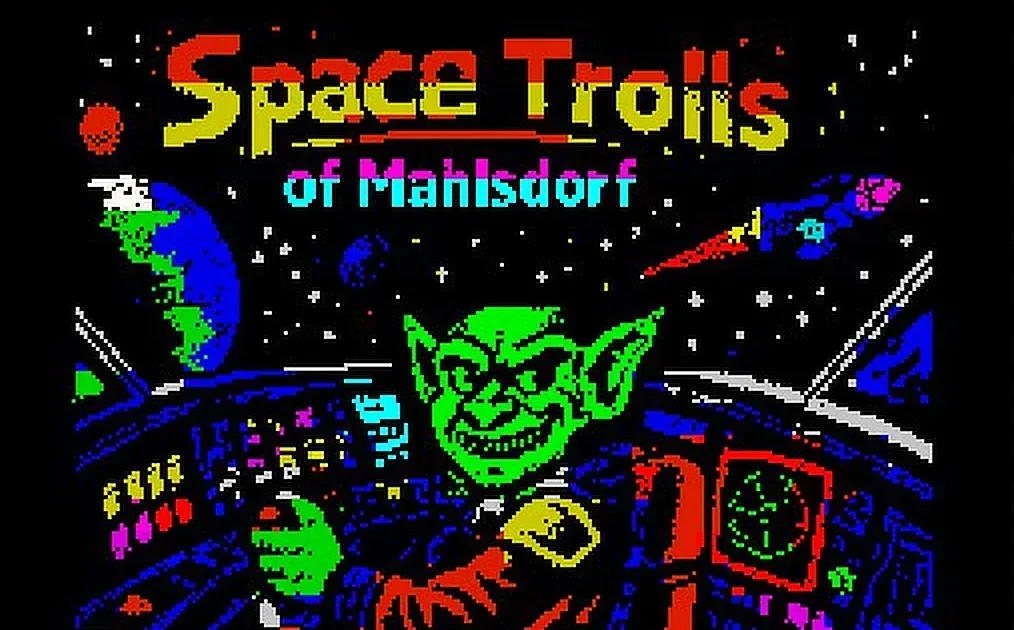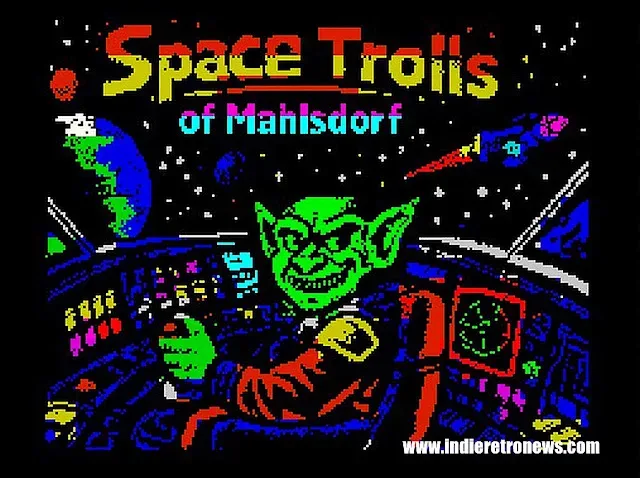
Space Trolls of Mahlsdorf is a new shoot ’em up for the ZX Spectrum from Papi & Sohn, with its development notes placing as much emphasis on the machine ecosystem as on the game’s genre label. The project was built using MPAGD and Shmupkit alongside ZX-Paintbrush, SjASMPlus and MPAGD Musicizer 2.1, and it supports both the standard ULA palette and ULA+.
That is a compact technical list, but it says something worthwhile about modern Spectrum development: a new game for the platform need not be produced through one all-purpose tool, nor does it have to target only one way of playing. Space Trolls of Mahlsdorf was tested on a ZX 128 Toastrack, a Spectrum Next and the Speccy Emulator. For players who move between vintage hardware, newer compatible machines and software emulation, that is a notably broad testing spread.
A shoot ’em up made with a modern Spectrum toolchain
The title identifies Space Trolls of Mahlsdorf as a fully featured shoot ’em up, a genre commonly shortened to “shmup.” In practical terms, that description establishes the game’s broad format: it is action-focused and built around shooting, rather than being presented as a text adventure, puzzle game or role-playing game. The supplied development details do not specify its stage structure, player craft, scoring systems, enemies, controls or release format, so those particulars remain unknown.
What is clear is that Papi & Sohn used several specialist tools during production. MPAGD is named alongside Shmupkit, while ZX-Paintbrush handled art-related work and SjASMPlus was part of the build process. MPAGD Musicizer 2.1, credited to David Saphier, was also used for music implementation.
For readers less familiar with the terminology, an assembler such as SjASMPlus is software that translates assembly-language source into code a compatible machine can run. Assembly is a low-level programming language, closely tied to a processor’s instructions. Its inclusion does not by itself reveal how any individual portion of the game was made, but it does indicate that the project’s workflow extended beyond graphics and audio tools into code assembly.
Likewise, a toolkit’s name is not a complete feature list. Shmupkit clearly signals a shoot-’em-up-oriented component in the workflow, but the available information does not detail which game systems it supplied or how Papi & Sohn adapted it. The responsible reading is that these tools were used to create the game—not that every capability associated with them necessarily appears in the finished project.
Music credits point to a collaborative soundtrack
The music credits name DJ SerG, Nik-O, DJ Max, Bell and Wally. With five credited music contributors, Space Trolls of Mahlsdorf has a soundtrack assembled from multiple creators rather than a single named composer. MPAGD Musicizer 2.1 is also specifically identified as part of the project’s toolset.
No track list, soundtrack length or assignment of individual compositions is provided. Still, the credits matter: on a machine with a long-running enthusiast scene, music is often one of the areas where a project’s collaborators are most visible. Naming the contributors makes their role legible rather than treating the audio as anonymous technical output.
Related coverage includes Space Trolls of Mahlsdorf Targets ZX Spectrum Hardware.
The same applies to the tools. A development credit that includes art, assembly and music software offers a useful snapshot of the production pipeline. ZX-Paintbrush suggests a dedicated graphics step, SjASMPlus points to code assembly, and Musicizer 2.1 identifies a specific route for bringing music into the project. It is a more informative picture than simply calling the game “homebrew,” a broad term that can obscure the actual craft and workflow behind a new release for an older platform.
What ULA and ULA+ palette support means
Space Trolls of Mahlsdorf supports both the standard ULA palette and ULA+. This is among the most concrete compatibility details supplied for the game, although it is important not to overstate it. Palette support concerns the available colours and how they are presented; it does not, on its own, establish that every player will see the same visual result on every setup.
The original Spectrum’s ULA—short for Uncommitted Logic Array—is a key part of the machine’s video behaviour. In ordinary use, “standard ULA palette” refers to the familiar Spectrum colour set. ULA+ is an enhancement that provides access to a wider palette arrangement. Supporting both gives the game a standard presentation path and an enhanced-colour option where ULA+ is available.
That is a practical choice for a project spanning original-oriented Spectrum play and Spectrum Next testing. It respects the standard palette while leaving room for ULA+ presentation. The supplied notes do not say whether ULA+ changes only the colour selection or whether it affects particular screens, scenes or graphic elements, so no stronger visual comparison can be made from the available details.
Compatibility language can easily become muddled in retro gaming because several questions are often collapsed into one: Can a game run? Does it look as intended? Which machine or emulator settings are needed? Here, the confirmed points are narrower and useful: testing covered a ZX 128 Toastrack, a Spectrum Next and Speccy Emulator, while the game supports the standard ULA palette and ULA+.
Testing across hardware and emulation
The ZX 128 Toastrack is the original-hardware system named in the testing notes. The Spectrum Next is a newer Spectrum-compatible platform, while Speccy Emulator represents the software-emulation side. Testing across all three is meaningful because it checks the game in distinct contexts: legacy hardware, a modern compatible machine and an emulator.
It should not be converted into a sweeping compatibility promise. The notes do not list every Spectrum model, every emulator version, all possible configurations or any peripheral support. They also do not state a minimum system requirement. Yet the stated testing still provides more useful guidance than an unspecified claim that a game works “on Spectrum.”
For anyone following the present-day ZX Spectrum scene, that multi-environment approach also reflects why the platform remains active. Players may use a surviving original computer, a newer implementation such as Spectrum Next, or emulation for convenience. Developers face the challenge of accounting for those paths without assuming that the audience has one standard setup.
Space Trolls of Mahlsdorf’s technical notes put that reality in plain view. It has been checked on a 128 Toastrack and Spectrum Next within the creator’s household, as well as on Speccy Emulator. That does not tell us how it performs in every conceivable configuration, but it establishes a deliberate effort to look beyond a single development environment.
A continuing stream of new Spectrum work
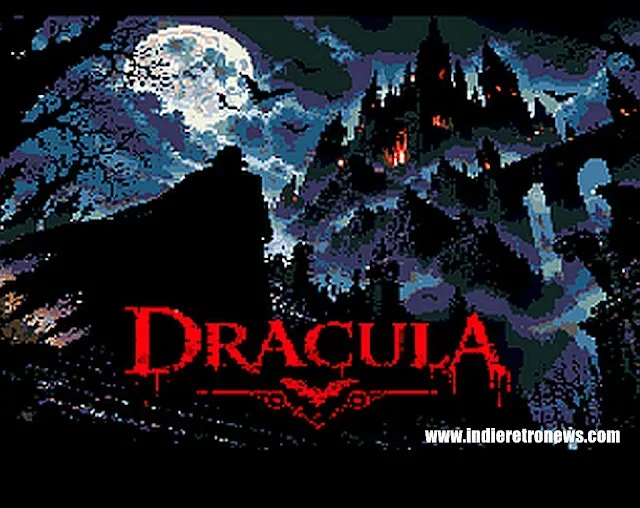
New games and tools continue to give the ZX Spectrum a presence far beyond its original commercial era. Space Trolls of Mahlsdorf arrives as a shoot ’em up, while other recent Spectrum-oriented projects can take very different forms. For example, DJSOFT’s Dracula takes the Spectrum in the direction of a timed illustrated text adventure, underlining the variety of contemporary work associated with the platform.
That variety is useful context, not a claim that every project shares the same technical goals. Space Trolls of Mahlsdorf is explicitly positioned around shooting action and a stack of tools that includes Shmupkit. Its palette support and testing notes are the details that currently distinguish its technical profile. More granular information about gameplay, distribution, controls, loading format or broader hardware requirements has not been provided.
For now, the strongest takeaway is straightforward: Papi & Sohn’s Space Trolls of Mahlsdorf is a ZX Spectrum shoot ’em up developed with a mix of specialist game, art, assembly and music tools; its music credits include DJ SerG, Nik-O, DJ Max, Bell and Wally; and its testing covers a ZX 128 Toastrack, Spectrum Next and Speccy Emulator. Standard ULA and ULA+ palette support round out a project designed with multiple Spectrum play environments in mind.