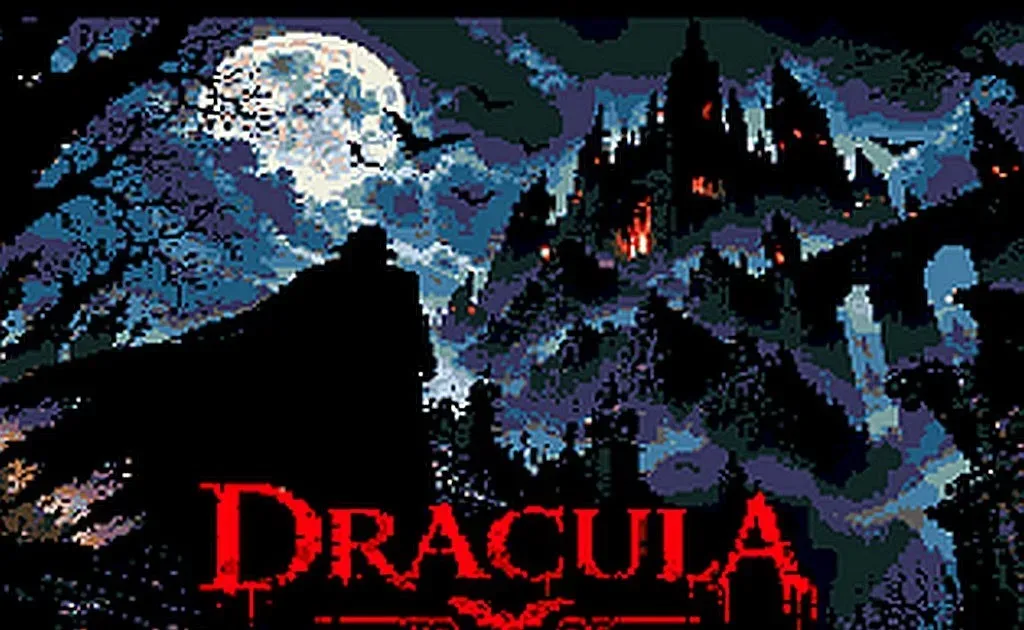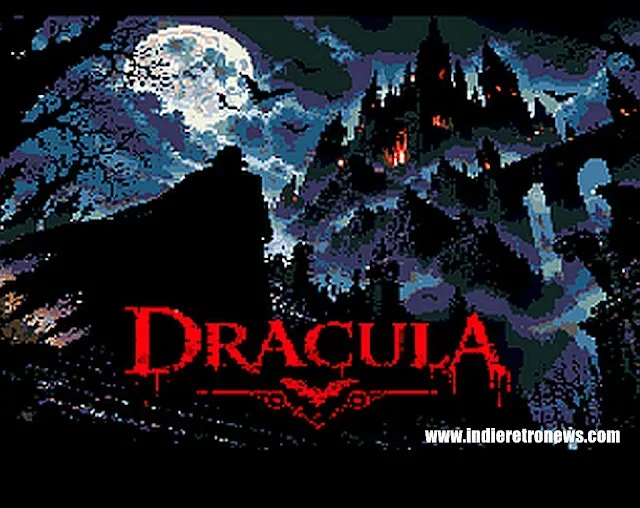
DJSOFT has released Dracula, a new gothic interactive adventure for the Commodore Amiga and ZX Spectrum. Inspired by Bram Stoker’s enduring horror novel, the game takes a deliberately old-school route to suspense: players type commands rather than simply choosing from a fixed set of on-screen actions.
That core decision matters. Dracula is built around a traditional text parser—an input system that interprets written instructions from the player—while also presenting illustrated scenes. The stated aim is not passive selection from a menu, but active investigation. Players will need to explore ominous locations, inspect objects and question characters as they work through environmental storytelling and puzzles.
There is also a real-time element. Events and circumstances can change as the clock advances, turning time itself into part of the adventure’s tension rather than a background detail.
A parser adventure in the literal sense
A text parser is the component of an adventure game that reads a player’s typed input and attempts to convert it into an in-game action. Instead of highlighting a command such as “Examine Door,” a player might write an instruction to look at something, move somewhere, use an object or speak to a character. The interaction can feel more direct because the player is asked to describe an intention rather than pick from an already-visible list.
That format also changes the nature of puzzle solving. Progress is not only about noticing that an object exists; it can involve considering what to investigate, which details may matter and how to phrase an attempted action. In a horror setting, this structure can reinforce uncertainty. A dark room is not merely a backdrop with a few marked hotspots. It is a place the player is expected to interrogate.
Of course, a parser is not automatically difficult simply because it accepts typed language. The meaningful design question is how clearly the game communicates its world and responds to experimentation. DJSOFT’s description points toward observation, conversation and object scrutiny as the major tools available in Dracula. That gives the game a coherent investigative focus: search the scene, read the environment and test deductions through commands.
Illustrations and words share the storytelling work
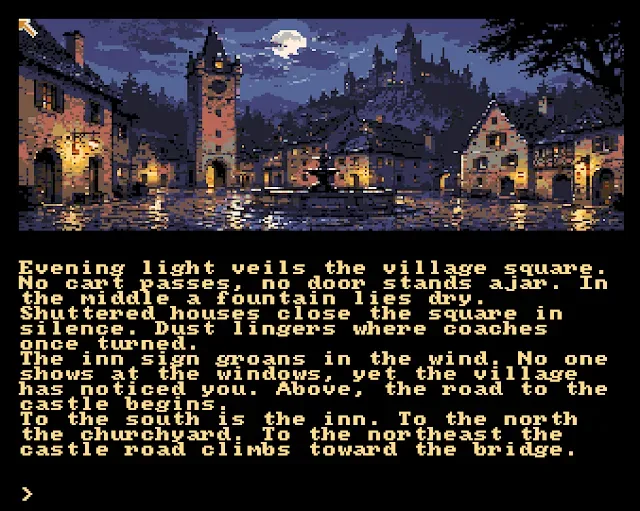
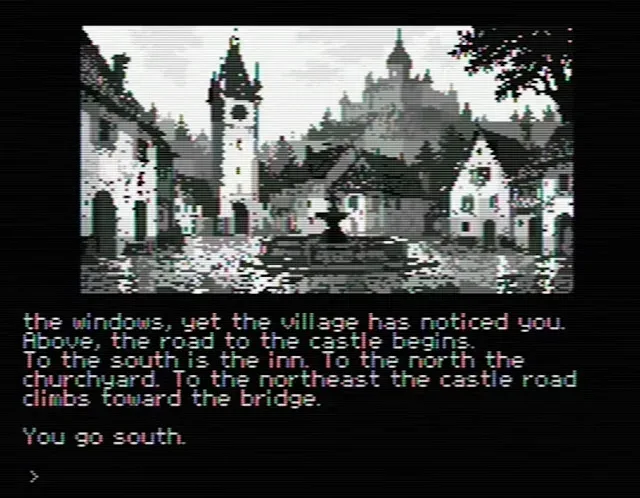
Dracula combines its parser-led play with illustrated scenes. This is a useful fit for gothic adventure because pictures can establish the immediate mood and physical character of a place, while text can supply the finer details a player may need to act on. The illustrations establish what is in front of the player; the written interaction invites a closer examination of it.
The result is distinct from a game driven entirely by static prose and also from one where visuals do all the communicative work. Environmental storytelling—the use of spaces, objects and their arrangement to imply information—appears central to DJSOFT’s approach. Players are asked to glean significance from what they find in the game world, then use that information to navigate its puzzles.
Related coverage includes DJSOFT Releases Dracula for Amiga and ZX Spectrum.
That is particularly suited to a Dracula-inspired premise. Gothic horror thrives on concealed motives, unsettling spaces and the sense that a familiar object or room may hold more meaning than it first reveals. The supplied details do not specify characters, locations or plot beats, so it would be premature to assume how closely the game follows any particular portion of Stoker’s novel. What is clear is that its atmosphere and framework draw heavily from that literary foundation.
The clock is another threat
The most notable mechanical wrinkle is the game’s real-time system. In this context, “real time” means that events and situations do not necessarily wait indefinitely for the player. As time passes, the state of the adventure can shift.
That distinction is important in a genre often associated with slow, methodical thinking. Traditional adventure-game puzzle solving encourages players to pause, reconsider an item and exhaust possibilities. A changing clock adds a competing demand: deliberate investigation may still be needed, but hesitation can carry consequences because the situation is dynamic.
DJSOFT has not detailed exactly which events change, how quickly the timer operates or what form those changing circumstances take. Those unknowns are worth preserving, since they will determine whether the system feels like a constant countdown, an occasional escalation device or something in between. Still, the basic concept has a clear narrative use. A horror story gains urgency when the protagonist cannot assume the world will remain safely frozen while every drawer is searched and every clue is pondered.
For players, the practical implication is straightforward: pay attention early. Inspecting the setting, gathering useful information and forming a plan may matter more when the game can alter the circumstances around an unfinished task. The real-time mechanic suggests that exploration is not purely archival; it is part of managing a living—and potentially increasingly dangerous—situation.
Why the platform pairing stands out
Releasing a newly made adventure specifically for the Commodore Amiga and ZX Spectrum places Dracula in the continuing tradition of software created for legacy hardware. The announcement identifies both machines as the intended platforms rather than treating them as a passing visual reference or a general retro aesthetic.
That makes the game’s command-driven structure feel especially appropriate. A text parser and illustrated presentation are not merely nostalgic ingredients; they are a focused way to create an interactive mystery in which language, observation and imagination all carry weight. The format asks for attention rather than speed alone, even as the time-based system ensures the player cannot become entirely comfortable.
There is a wider practical side to keeping older gaming ecosystems active, too. New projects give owners and enthusiasts a reason to revisit the machines and the styles of play associated with them. That ongoing interest also intersects with modern preservation and compatibility work; for a separate example of current platform-focused development, see new emulator builds for Windows, Linux and macOS.
What players should expect from Dracula
Based on the available description, players should approach Dracula as an interactive investigation rather than an action-led horror game. The essential loop is to take in an illustrated environment, issue typed commands, inspect details, speak with characters and solve puzzles while circumstances evolve over time.
- Typed commands: Players actively enter instructions for exploration and interaction.
- Illustrated scenes: Visuals accompany the text-based adventure structure.
- Environmental storytelling: Locations and objects are meant to provide clues and atmosphere.
- Puzzle solving: Progress depends on close observation and clever use of information.
- Real-time changes: Events and situations can shift as the clock moves forward.
Those ingredients make DJSOFT’s Dracula a notably focused release: it embraces the deliberate vocabulary of classic interactive adventures while giving its horror premise a changing, time-sensitive edge. For Amiga and ZX Spectrum players looking for a new reason to type “look,” “examine” and perhaps something more desperate into a darkened screen, the count is waiting.