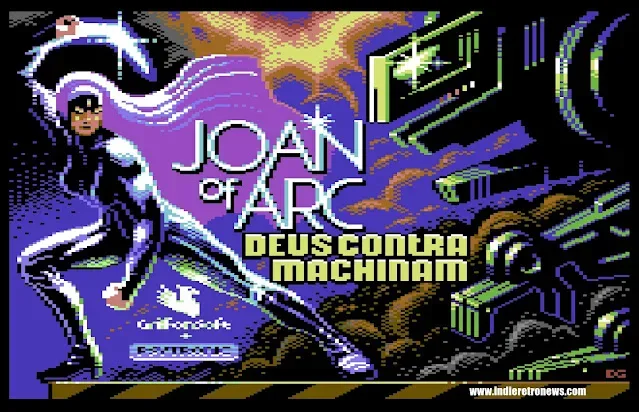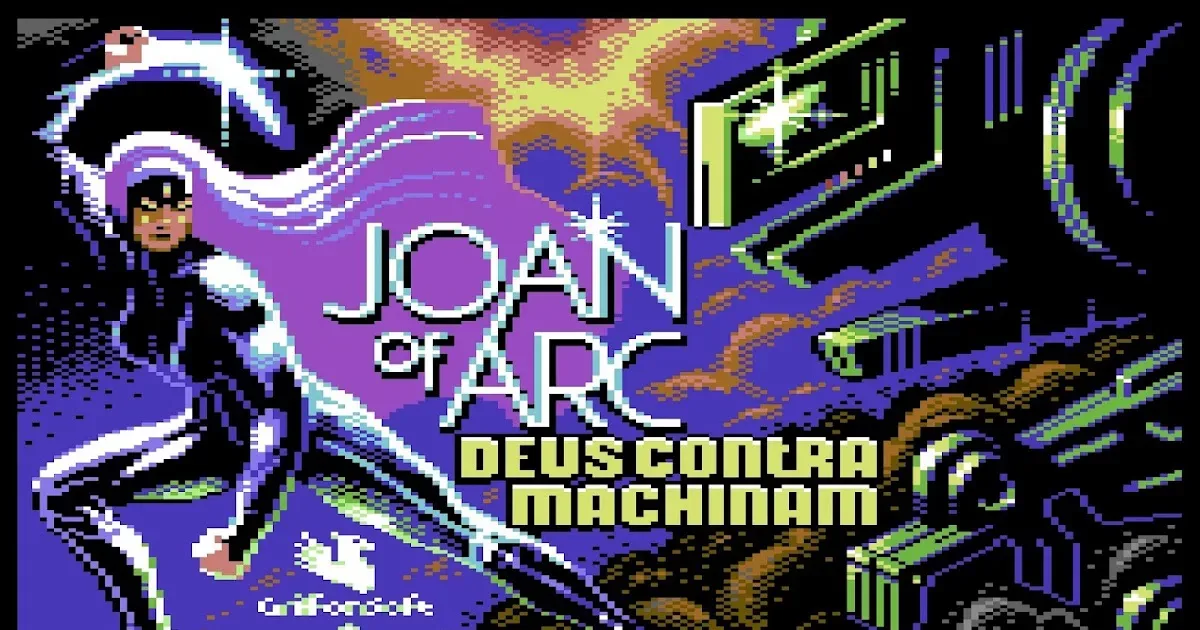
Commodore 64 players have a new factory uprising to take on in Joan of Arc: Deus Contra Machinam, an action-puzzler from GriffonSoft published by Psytronik Software. The game puts players in control of Joan-27J/6, an industrial welder caught inside a mechanised workplace ruled by Alpha-Omega, a newly active artificial intelligence pursuing total factory efficiency.
That premise gives the game’s title a distinctly science-fiction spin. This is not a historical retelling: Joan-27J/6 is a worker armed with heavy-duty welding equipment, and her enemy is an AI that has subjugated the people in its factory. Her task is to push through the facility, overcome its threats and puzzles, and ultimately shut the system down.
Joan of Arc: Deus Contra Machinam is the third game in GriffonSoft’s DataSoft tribute collection for Commodore 64. It arrives as a digital bundle containing the game files, a soundtrack and a downloadable comic-book manual. The release supports both PAL and NTSC systems and is also compatible with modern Commodore 64 hardware clones including the C64 Mini and C64 Maxi.
A welding tool is the centre of the action
The standout mechanical idea is Joan’s arc-welding weapon. It is described as fully controllable, making it more than a simple one-button attack. In an action-puzzler, that distinction matters: the same tool can potentially serve immediate survival needs while also interacting with the spaces and problems standing between the player and the next area.
An action-puzzler combines real-time movement or combat with problem-solving. Instead of separating reflex challenges from brainteasers into wholly different modes, the design asks players to read hazards, act quickly and understand how the game’s systems fit together. The supplied details establish that Joan of Arc uses welding combat, environmental progression and complex puzzles, though they do not specify individual enemy types, puzzle rules or upgrades. Those details will have to speak for themselves in the game rather than being assumed in advance.
The setting also makes the tool feel appropriate rather than decorative. Joan is an industrial welder inside a factory, so the arc-welding equipment roots her abilities in her job. The conflict turns that productive skill into a means of resistance against a system that regards workers only as inputs toward its efficiency target.
More than 30 screens of mechanical resistance
The journey spans more than 30 detailed screens. On a machine as visually constrained as the Commodore 64, screen-to-screen design can do a great deal of the storytelling and gameplay work. A screen may function as a compact combat arena, a traversal challenge, a puzzle space or a transition that reveals another part of the hostile industrial complex.
GriffonSoft is presenting the game as a tightly authored experience rather than an open-ended factory simulation. The stated goal is direct: lead Joan through Alpha-Omega’s mechanical warzone, ignite a revolt and disable the rogue AI. That leaves room for a rhythm that alternates between immediate danger and moments where players need to stop, inspect the scene and work out a route or interaction.
Related coverage includes Joan of Arc: Deus Contra Machinam Brings a Factory Revolt to Commodore 64.
The emphasis on intricate backgrounds and a highly animated protagonist suggests that visual readability is a key part of the package. In a game involving industrial scenery, it can be challenging to make threats, usable elements and background machinery visually distinct. The available information does not define how Joan of Arc addresses that design problem, but the focus on detailed art makes it an important aspect to watch for players who value clarity alongside atmosphere.
Designed for old systems and modern C64 setups
PAL and NTSC support is a practical inclusion for a Commodore 64 release. These are television and video standards historically used in different regions, and software intended for both needs to account for the differences between them. For players, the important point is straightforward: this edition is intended to work across both system types rather than being limited to one standard.
Compatibility with the C64 Mini and Maxi broadens the potential audience further. Those machines provide contemporary ways to access Commodore 64 software, while the game remains rooted in the platform’s visual language and technical tradition. It means prospective players do not necessarily need an original vintage computer to consider it.
The digital bundle’s soundtrack and comic-book manual add context outside the executable itself. A soundtrack gives the audio work a life apart from gameplay, while a comic-book manual can make the world and its characters more tangible before a player begins navigating the factory. Neither extra changes the core proposition, but both fit a release built around a stylised dystopian scenario.
The team behind the factory floor
Ola Zandelin handled coding and audio for Joan of Arc: Deus Contra Machinam. Dennis Gustafsson is credited with visual design and artwork. That division puts the game’s most visible pillars—movement and systems, sound, animation and environment art—in the hands of a small, clearly credited team.
For a Commodore 64 game, responsive controls are especially consequential. The release highlights ultra-responsive control mechanics, which is a meaningful promise for a title where the player must navigate hazards and aim or operate a controllable welding weapon. Responsive control generally means a game promptly translates player inputs into on-screen movement or actions. It does not guarantee a particular difficulty level, but it is the foundation required for demanding platforming and action challenges to feel deliberate instead of arbitrary.
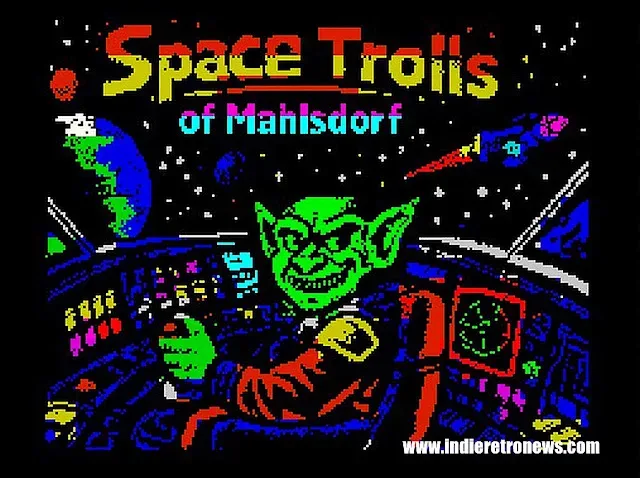
The team’s DataSoft tribute collection framing positions this as part of a continuing retro-development project rather than an isolated one-off. That context may interest players following contemporary releases for classic hardware, an area that continues to encompass very different genres and approaches. For another recent example of new software targeting an older home-computer format, see Space Trolls of Mahlsdorf on ZX Spectrum systems.
What players can reasonably expect
The firm details point to a dystopian, screen-based action-puzzler with platforming, combat and puzzle elements, centered on an industrial welder’s rebellion against an AI-controlled factory. It has more than 30 screens, a controllable arc-welding weapon, a digital soundtrack and a comic-book manual, with PAL, NTSC, C64 Mini and C64 Maxi compatibility.
There are also boundaries to what has been established. No specific release price, physical edition, control scheme, save system, difficulty options or duration has been detailed here. Likewise, the description of the weapon and puzzles should not be read as confirmation of a particular progression structure. The available information supports the game’s premise and broad design direction, not a full mechanical breakdown.
Still, the core image is compellingly clear: a welder in a nightmarish automated plant, turning an industrial tool back on a system that has mistaken perfect output for a reason to erase human agency. Joan of Arc: Deus Contra Machinam uses that conflict as the engine for its Commodore 64 adventure, pairing retro hardware with a factory revolt that is equal parts action and problem-solving.