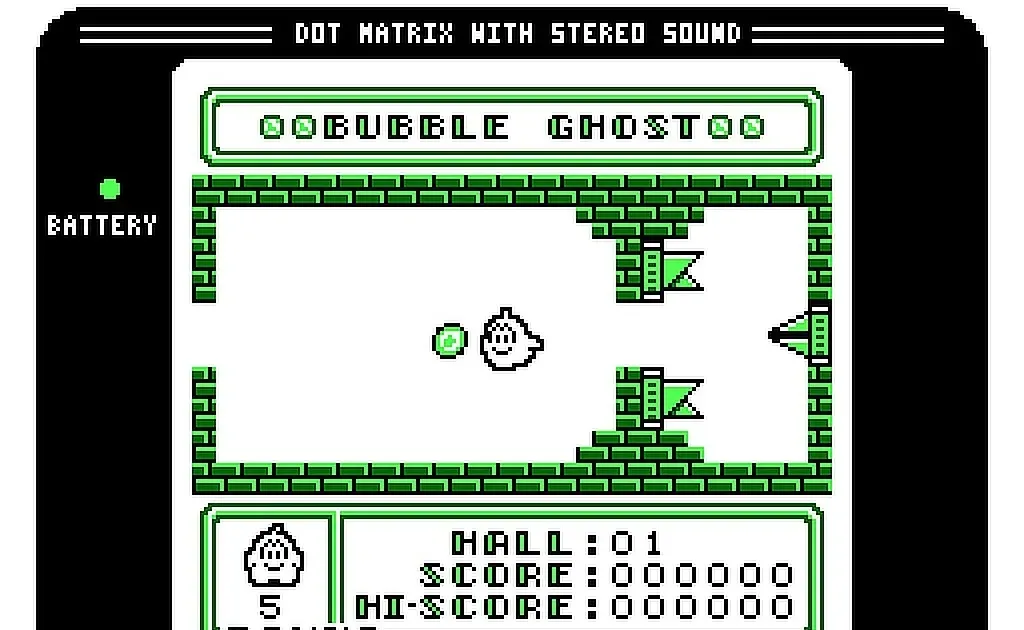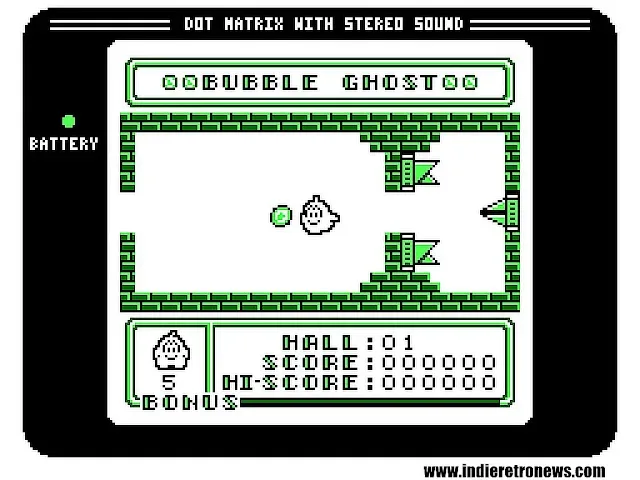
Bubble Ghost, the 1990 Game Boy puzzle game built around the precarious business of guiding a soap bubble through a haunted fortress, has received a fan conversion for the Amstrad CPC 6128. Developed by Kirby2000, the adaptation aims to reproduce the complete original: all 35 rooms, every puzzle mechanism, and the game’s full ending sequence.
That is a meaningful claim for a game whose identity rests less on broad genre conventions than on the exact behavior of one unusually vulnerable object. The player controls a helpful ghost, but the ghost cannot simply grab, carry, or touch the bubble. Instead, the spirit must blow it through each chamber. The result is a puzzle premise with a wonderfully awkward constraint: getting near the objective is necessary, yet careless positioning can be as troublesome as the room itself.
Each chamber asks players to move the bubble past obstacles while also dealing with candles, spikes, moving fans, and rival phantoms. A bonus timer adds another pressure point. The conversion therefore is not merely a cosmetic nod to a Game Boy curiosity; its stated goal is to preserve the room-by-room puzzle structure that made the original distinct.
A puzzle game about controlled momentum
The central mechanic is easy to state and demanding to manage. Blowing a bubble is indirect control. Rather than moving the object with a conventional command, players influence its path from a position nearby. That makes spatial awareness important: the player has to consider not only where the bubble should go, but also where the ghost can safely stand to send it there.
For more context, explore Guillermo del Toro Defends ‘Digger’ as Tom Cruise’s Black Comedy Faces a Rough Opening.
In practical terms, the fortress rooms turn into small route-planning problems. A spike threatens the bubble directly; a moving fan can alter the situation over time; a rival phantom creates another hazard to account for. Candles must be snuffed out as part of the traversal. With a timer running for bonus purposes, a successful route is not necessarily just any route to the exit, but one that can be executed cleanly and efficiently.
This is the value of a complete-stage conversion. If every original chamber and mechanism is present, the game’s progression can retain its intended escalation. Early rooms can establish how blowing works and why direct contact is forbidden, while later rooms can combine hazards and demand more careful execution. The supplied details do not specify the individual layouts or difficulty curve, so it would be premature to rank rooms or promise an exact feel. But maintaining the full 35-stage sequence gives the project a clear preservation-minded scope.
What has been retained for the CPC version
Kirby2000’s version is described as replicating the complete set of 35 stages from the Game Boy game, along with every puzzle mechanism and the ending. That distinguishes it from a reinterpretation that might borrow the concept while replacing room designs or streamlining the original’s structure.
- 35 original stages: The conversion includes the entire room count of the 1990 Game Boy release.
- Original puzzle mechanisms: The stated aim is to carry over the gameplay systems rather than reduce the challenge to basic movement.
- Full ending sequence: Completion is intended to lead into the original game’s ending material, not stop short at a partial set of levels.
- Game Boy-inspired presentation: The graphics retain the visual character associated with the handheld version.
- Custom screen frame and adapted loading art: A themed frame surrounds the presentation, while the loading screen adapts imagery from the original retail box art.
The visual approach is especially notable because it does not frame the CPC version as a total graphical reinvention. Instead, it explicitly honors the Game Boy look, then supplements it with a custom display frame and a loading screen based on the box artwork. For a conversion of a tightly designed puzzle title, that approach keeps attention on the rooms, hazards, bubble, and ghost—the elements players need to read quickly.
AY-chip audio gives the port its own hardware voice
Although the graphics take inspiration from the Game Boy original, the sound is tailored to the Amstrad CPC 6128. The conversion recreates the soundtrack and retro sound effects through the machine’s internal AY audio chip.
AY audio chip here refers to the sound hardware inside the CPC 6128 that is being used to generate the music and effects. The important practical point is not merely that the game has audio, but that its sound is produced with the CPC’s own internal hardware. The project therefore pairs a Game Boy-styled visual identity with sound created for the platform on which this version runs.
That division is a sensible fit for a fan conversion: visual fidelity preserves the source game’s immediately recognizable appearance, while platform-native audio makes use of the target machine’s defining capabilities. It is also a reminder that a port can prioritize different kinds of authenticity at once—faithfulness to level design and appearance on one hand, and technical expression through the destination system on the other.
Storage support without gameplay disk access
The release is designed to load from several setups associated with the Amstrad CPC 6128: an original 3-inch floppy disk drive, a Gotek drive, or an M4 SD card adapter. Once loaded into memory, the game does not access the disk again during play.
That last detail matters because it describes a clean runtime model. The storage device is used at startup to place the game in memory; after that, the 35-room adventure proceeds without additional disk reads. Players using original floppy hardware and those using modern storage replacements are therefore covered by the stated loading options, while gameplay itself is not dependent on returning to the drive between rooms.
Gotek drive refers here to a modern drive solution offered alongside the original floppy option. The M4 SD card adapter is another supported way to load the software. The release description does not make broader claims about setup steps, file formats, or distribution, so prospective players should avoid assuming details beyond the listed compatibility.
For retro hardware users, this is a practical feature rather than a decorative one. A puzzle game based on rapid retries and precise bubble movement benefits from staying resident in memory after the initial load. It keeps the focus on navigating the fortress rather than on repeated storage access.
Why Bubble Ghost remains an unusual conversion target
Bubble Ghost’s premise has a built-in tension that translates clearly across platforms. The ghost is helpful, but cannot handle the object it is trying to protect. The soap bubble must advance, but it is delicate. The rooms are finite puzzle spaces, but hazards and a bonus timer impose urgency. These are concise rules, yet their combination is capable of creating problems that are specific to the game rather than interchangeable with ordinary maze navigation.
The Amstrad CPC 6128 version’s reported completeness is what makes the project particularly interesting. Bringing across every room, mechanism, and the ending means its scope is not limited to a demonstration of the core blowing mechanic. It is a full attempt to place the Game Boy experience onto the CPC 6128 while respecting the source game’s visual language and using the target hardware’s AY sound capabilities.
Readers looking for a brief report on the conversion can find related coverage at this Bubble Ghost Amstrad CPC 6128 update. What is clear from the available details is that Kirby2000’s project is built around preservation of the original game’s 35-chamber design, with a presentation and loading strategy shaped for Amstrad hardware.
For anyone drawn to puzzle games where movement is a matter of influence rather than direct command, Bubble Ghost’s ghost-and-bubble arrangement remains immediately legible: stay close enough to guide the bubble, avoid destroying it through bad positioning or hazards, extinguish the candles, and find a safe route before time erodes the bonus. The CPC 6128 conversion brings that particular balancing act to a new old machine without abandoning the Game Boy game it is adapting.