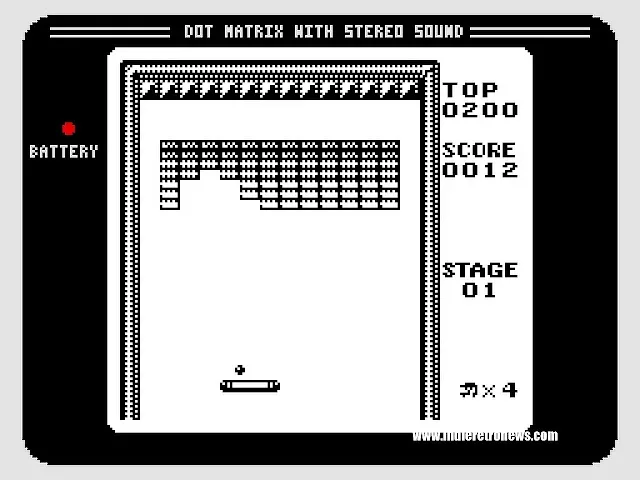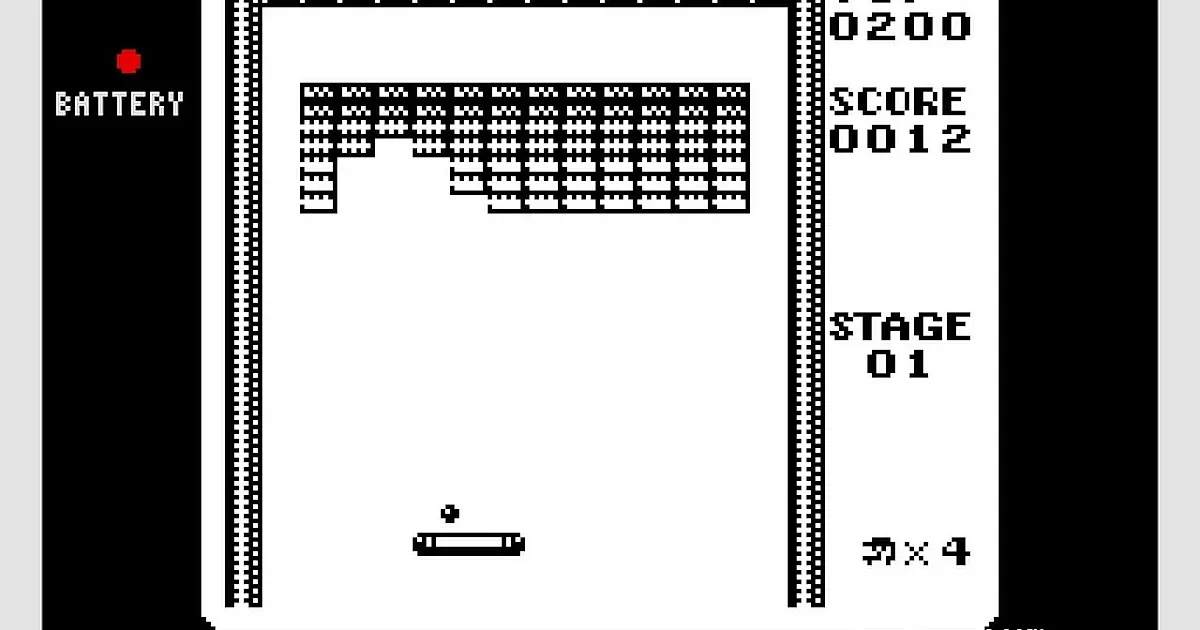
A 1989 handheld block-breaking game has been adapted for Sinclair’s ZX Spectrum line in the form of Alleyway ZX, an unofficial fan-made conversion by Kirby2000. Built for both the ZX Spectrum 48K and 128K, the release aims to reproduce the compact, escalating paddle-and-ball challenge of the original while accommodating the substantial differences between the two Spectrum configurations.
The fundamental objective is immediately legible: move a paddle, return the ball, and clear blocks before the ball escapes past the bottom of the playfield. Yet the conversion is not presented as a single static board repeated indefinitely. Alleyway ZX contains 32 stages, split between 24 standard levels and eight timed bonus rounds. Its block arrangements include ordinary walls, scrolling walls, and advancing walls, giving the basic ball-deflection formula a changing sense of pressure as the game proceeds.
A small arcade premise with a demanding rhythm
Block breakers are built around a simple relationship between player position and momentum. The player does not directly control the ball; instead, they control the paddle that determines whether the ball remains in play. That makes every return a brief positioning decision. A slightly late move can mean a miss, while a well-placed intercept can continue a productive route through the remaining bricks.
In Alleyway ZX, the stated variety in wall behaviour matters because it changes what a player must watch. A normal wall principally asks for clean returns and patience. A scrolling wall adds motion to the target pattern, so the route to an opening is less fixed. An advancing wall raises the urgency by bringing the obstacle closer. Timed bonus rounds add another constraint: performance has to happen within a defined window rather than through slow, careful clearing.
Those elements make the listed 32-stage structure more than a raw level count. The standard stages establish the main progression, while the eight bonus rounds break that progression with a different pacing demand. The conversion concludes with a final triumph after the increasing difficulty, rather than presenting its level sequence as an endless score chase.
What the Spectrum conversion is claiming
Kirby2000 describes Alleyway ZX as a faithful conversion, specifically pointing to its ball physics and stage layouts. Ball physics refers to the rules governing movement and rebounds: how the ball travels, how it reacts to a paddle or block, and how consistently those interactions produce expected trajectories. In a game that depends almost entirely on repeatable returns, physics are not a background detail. They are the core of how the player reads danger, plans a recovery, and learns a level’s rhythm.
The conversion is also said to run at 50 Hz with flicker-free sprites. Here, 50 Hz means the game is designed to update in step with a 50-cycle-per-second display cadence. For a fast-moving ball game, regular updates are especially relevant because the player is tracking a small moving object and repositioning a paddle in response. “Flicker-free sprites” is a claim about the visual presentation of those moving game elements: the stated aim is that they remain stable on screen rather than blinking or disappearing intermittently.
That technical target fits the project’s larger goal of retaining the identity of the handheld original on a very different machine. A conversion is not merely a change of file format or controller mapping. It must translate a game’s stage patterns, timing, audio, controls and visual readability to new hardware. The scope described for Alleyway ZX encompasses all of those areas, though the feature list remains the creator’s own account rather than an independent performance assessment.
Related coverage includes Alleyway ZX Brings 1989 Block-Breaking Action to ZX Spectrum.
Separate audio approaches for 48K and 128K systems
The release differentiates its sound presentation by model. On 128K machines, Alleyway ZX uses AY music and sound effects. AY audio refers to sound produced through the AY chip available on that configuration, allowing the version to offer dedicated music and effects through that hardware. The 48K release instead uses classic beeper music and effects, matching the sound capabilities associated with that model.
This is a practical distinction rather than a cosmetic footnote. The game’s central play loop is visually sparse by design: paddle, ball, blocks, and the immediate threat of a missed rebound. Audio can reinforce that loop by making impacts and game states easier to register. By supporting the distinct sound hardware of the two Spectrum variants instead of reducing both versions to one approach, the conversion is intended to make use of what each target machine can provide.
The project also includes what is described as an authentic original loading screen. Loading screens were a notable part of the ZX Spectrum experience, so preserving that element is consistent with a release designed not only to reproduce the stages but to carry over familiar presentation details from the earlier game.
Controls: keyboard, Kempston and Sinclair options
Alleyway ZX supports keyboard play along with Kempston and Sinclair joystick controls. That broadens the ways in which players can handle an action game where precise left-and-right movement is the whole point. The keyboard option makes the conversion playable without extra hardware, while the joystick support acknowledges the control setups used with Spectrum systems.
The distinction is useful for prospective players because input preference can shape a paddle game’s feel. A keyboard provides discrete directional presses; a joystick supplies a dedicated physical lever. Neither control method changes the stated game structure, but each offers a different way to make the short corrective movements demanded when the ball approaches the paddle.
The inclusion of both Kempston and Sinclair support avoids treating “joystick compatible” as a single vague promise. These are named interfaces, and their explicit support gives Spectrum owners a clearer idea of the setups the conversion is intended to accommodate.
Why the conversion’s faithfulness is the central question
Alleyway ZX is explicitly an unofficial fan-made project. Its interest lies in bringing a known handheld design to the ZX Spectrum’s 48K and 128K environments while retaining the original game’s identified essentials: its layouts, rebound behaviour, progression, and audiovisual character. The project does not claim to reinvent the block-breaker format. Instead, it places value on reconstruction and compatibility.
That also makes its more specific claims worth separating from broad labels such as “faithful.” The supplied details give concrete points by which the conversion defines that ambition: 32 stages; 24 regular levels; eight timed bonus rounds; standard, scrolling and advancing block walls; 50 Hz gameplay; flicker-free sprites; recreation of the loading screen; model-specific sound; and three categories of input support. Together, those features describe a full game conversion rather than a single-screen homage.
Retro ports and homebrew conversions continue to show how one game design can be interpreted through another machine’s conventions. For another recent example of a classic arcade-style game arriving on older hardware, see this Commodore 64 Mappy port built around a 1 MB REU. Alleyway ZX takes a different technical path, targeting two Spectrum memory configurations and adapting its audio accordingly.
What players can expect from the stage design
Based on the stated feature set, players should expect a compact game structure built around progressively less forgiving conditions. The ordinary block patterns establish the base rules, but scrolling and advancing walls keep those rules from becoming passive. The timed rounds add a separate kind of challenge, making speed part of the objective. The final completion point gives the sequence a defined endpoint.
For players approaching it on 48K hardware, the beeper soundtrack and keyboard or compatible joystick controls form the relevant version of that experience. On 128K hardware, AY music and effects provide the stated audio enhancement while the stage content and control choices remain aligned with the conversion as a whole. In either case, Alleyway ZX is framed as a focused attempt to transplant a 1989 handheld block-breaker’s pacing and structure onto the ZX Spectrum.