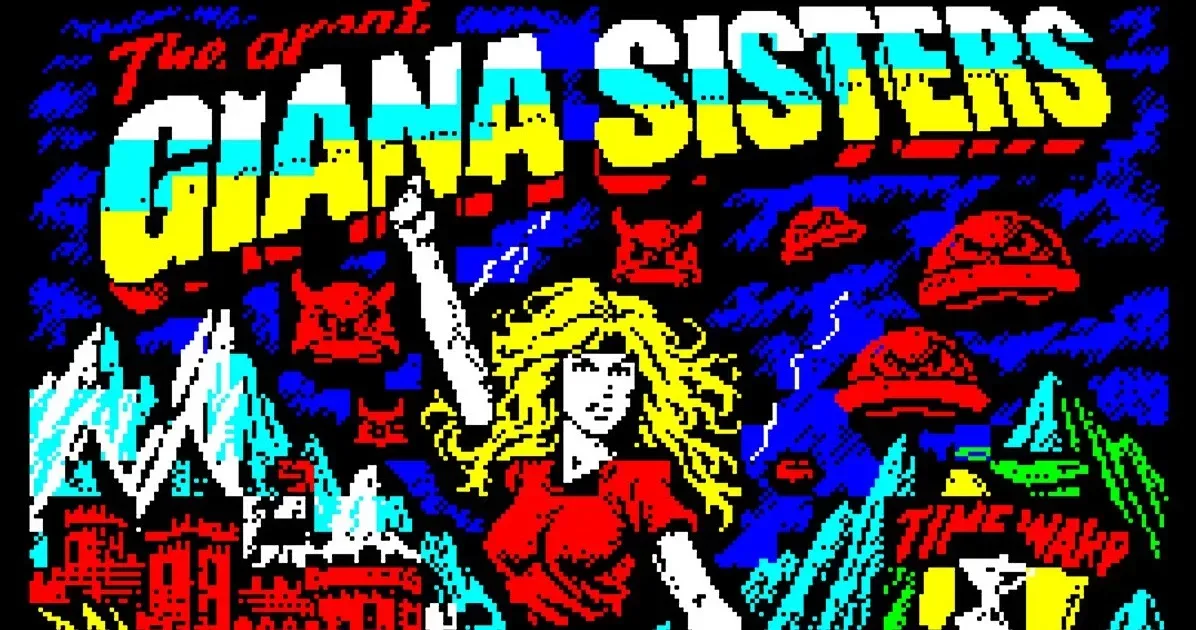
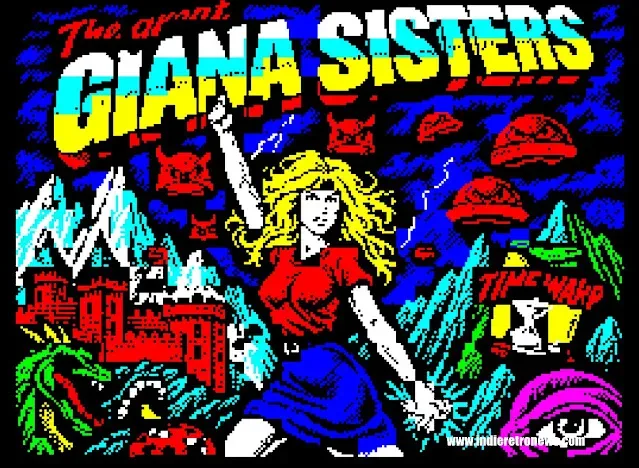
The Great Giana Sisters has received a new unofficial conversion for the ZX Spectrum, created by Kirby2000. It is a particularly intriguing retro release because the Spectrum was once meant to receive the platformer in its original era, only for that version to be withdrawn before reaching shop shelves. No surviving copies of that planned release are known, leaving a conspicuous blank in the machine’s library.
This conversion is designed to answer that long-standing what-if. Rather than being presented merely as a brief technical demonstration, it recreates the full 33-stage platforming campaign and includes secret bonus rooms, hidden warps, eight power-ups, a high-score table and multiple control configurations. A two-player mode is also included, while a multiload edition is available for 48K Spectrum systems.
A missing Spectrum release revisited
The original Spectrum edition had been reviewed by magazines in 1988, indicating that it had progressed far enough to be seen as an upcoming commercial release. Yet it was abruptly withdrawn before it went on sale. That means the platform’s connection to The Great Giana Sisters has occupied an unusual space for decades: there was evidence of an intended version, but not a generally available game for players to preserve, compare or revisit.
Kirby2000’s project does not turn that abandoned commercial edition into a recovered artefact. There are no known copies of the cancelled release to establish that it is a restoration. Instead, it is an unofficial conversion: a newly made version that seeks to supply the kind of complete Spectrum experience that never entered the original retail catalogue.
That distinction matters. A recovered build would be an archival discovery from the period; a new conversion is modern work made in conversation with that history. Both can be valuable to retro players, but they answer different questions. In this case, the appeal is not that a sealed 1988 tape has suddenly emerged, but that a longstanding absence from the ZX Spectrum library has been addressed with a feature-rich playable release.
What the conversion includes
The stated scope is substantial. Players can tackle all 33 original stages, rather than a selected opening segment or a compact reinterpretation. The release also carries over secret bonus rooms and hidden warps. Those elements are important to a platformer built around repeat runs, score chasing and route discovery: bonus areas reward exploration, while warps can alter a player’s path through the game.
The conversion’s feature set includes:
- All 33 original platforming stages.
- Secret bonus rooms and hidden warp routes.
- Eight distinct power-ups to find during play.
- A high-score table for score-focused runs.
- Joystick support for Kempston, Sinclair and Cursor configurations.
- Custom keyboard mapping.
- A multiload version for 48K Spectrum machines.
- A functional two-player mode.
For players approaching it today, the combination of stages, secrets and scores gives the project more lasting value than a simple curiosity booted once to see whether it works. A high-score table creates a reason to revisit completed levels with efficiency and risk in mind, while hidden rooms and warps make knowledge of the game’s layout part of the challenge.
Related coverage includes The Great Giana Sisters Gets an Unofficial ZX Spectrum Conversion.
Control support is more than a footnote
The presence of Kempston, Sinclair and Cursor joystick options is a practical detail with real value for Spectrum users. These names refer to different controller and input arrangements associated with the platform. Supporting several of them gives players a better chance of using the controls already connected to their setup, rather than treating one particular joystick standard as the only option.
Custom key mapping provides a similar benefit for keyboard play. On a system with a long history of distinct hardware habits, choice of controls can substantially affect comfort and consistency. Platform games depend on dependable directional inputs and timely button presses, so accommodating several setups is an appropriate part of making a conversion feel usable rather than merely technically complete.
The 48K multiload version is another reminder that ZX Spectrum releases have to account for specific machine configurations. “Multiload” means the game is arranged to load in more than one part, a practical approach for fitting a larger experience within the constraints of the target hardware. It is not simply a cosmetic label; it describes how the release is structured for compatible 48K systems.
Two-player play changes the proposition
The reported two-player mode is among the most notable inclusions. A conversion of an older single-screen-era-style platformer can be judged on whether its levels, movement and audiovisual identity have been translated, but multiplayer adds another layer of design and technical work. It also changes who the release is for: a player can treat it as a solo score challenge or share the experience locally.
It is worth keeping the scope clear. The available information establishes that the mode is fully functional, but does not detail its rules, character arrangement or exact implementation. Still, its inclusion makes this feel like a broad adaptation rather than a narrowly preserved outline of the original campaign.
Why projects like this matter to retro gaming
Retro-game preservation is often associated with locating old tapes, disks, manuals and advertisements. Those are crucial pieces of evidence, particularly for cancelled or withdrawn releases. But software made now can also have a role in keeping an old platform active. A carefully made conversion lets users experience a game in the technological and control context that players of the period might have expected, even where the historical release did not make it to retail.
That does not erase the original cancellation or settle every archival question about the planned Spectrum version. What it does offer is a concrete, playable response to a decades-old gap. The project gives Spectrum owners and emulation users a version of The Great Giana Sisters tailored to the machine, with its own loading format and controller choices, rather than asking them to imagine what an 1988 retail release could have been.
It also highlights the continued energy around older computers. The ZX Spectrum is not only remembered through its historical catalogue; it remains a target for new technical projects that take its limitations seriously. In that setting, a conversion’s details matter. Stage count, input compatibility, machine support and extra modes are not peripheral bullet points. They determine whether a release works as a complete game on its intended hardware.
What interested players should take from the announcement
The central takeaway is straightforward: the ZX Spectrum now has a newly created, unofficial take on a platform game that was once reviewed for the machine but never commercially released there. It is built around the entire 33-stage game and retains its secrets, power-up hunt and score competition, while adding broad input support and two-player functionality.
For readers following current releases across old and new platforms, the project sits beside the kind of platform-specific development covered in recent PC game news, albeit with a very different technical target. The Spectrum conversion is a reminder that a game’s history is not always fixed at the moment its original commercial plans end. Sometimes, years later, a community developer can make the missing version playable at last.