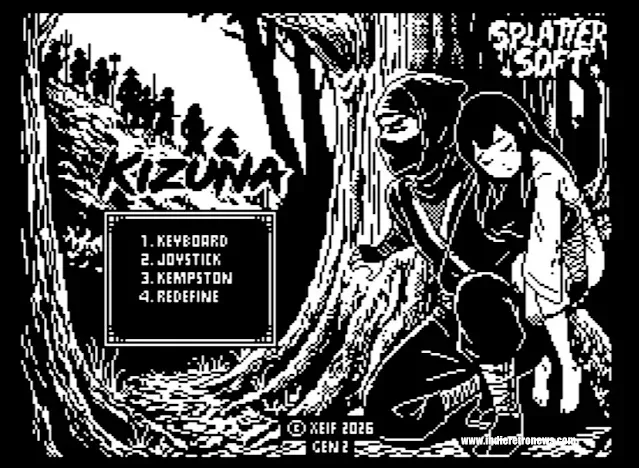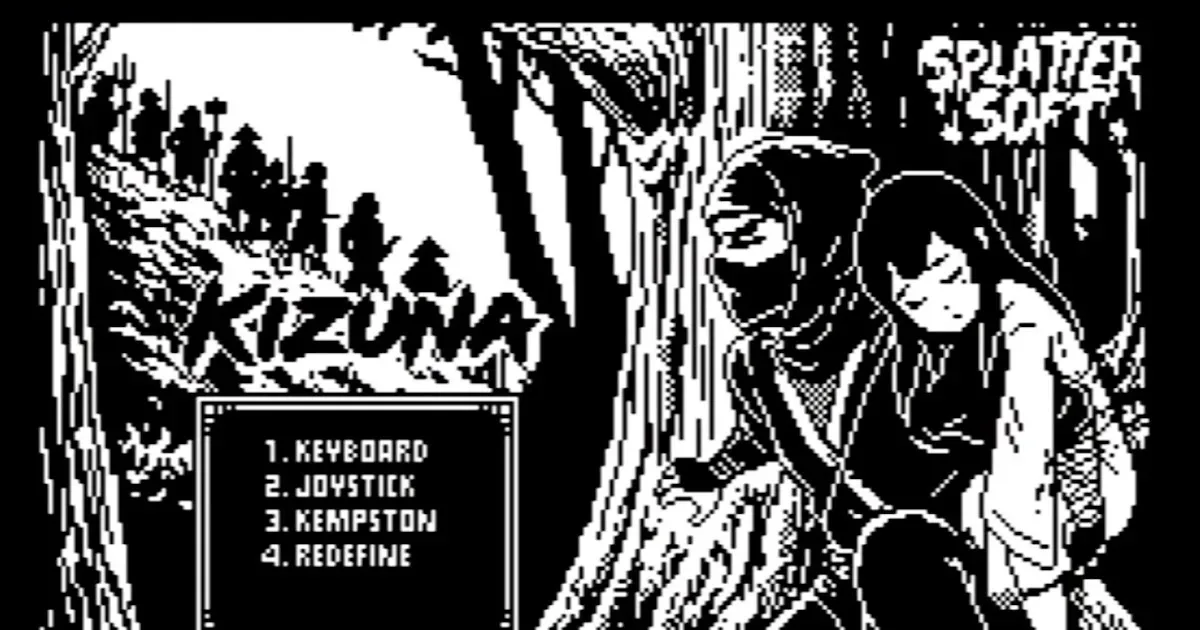
Kizuna is a newly revealed ZX Spectrum platformer from developer Xeif that places a ninja escort mission inside a stark black-and-white comic-book world. Its central pairing is Hanzo, a ninja assigned to protect a young girl named Hana, as the two travel through a dangerous landscape of shadow, enemies and environmental threats.
That premise might initially suggest a simple action game: a sword-wielding hero clears a route while an escorted character follows. The details presented for Kizuna point to a more deliberate design, however. Combat is only one part of the journey. Players will face varied situations and obstacles intended to reward patience and problem-solving, while Hanzo and Hana’s cooperation is positioned as fundamental to getting through the game’s gauntlet.
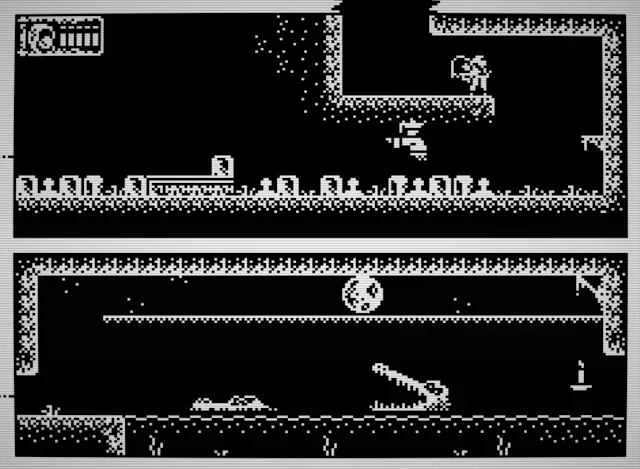
Visually, Xeif is building Kizuna around a monochrome pixel-art style. Each screen is framed as a comic panel, making the comic-book idea more than a theme applied to the story. It is also the game’s visual language: a way to give individual scenes a composed, illustrative identity while working in the ZX Spectrum’s retro context.
A protection mission with two active characters
Hanzo’s initial role is direct: he must escort Hana through a hostile world. Yet Kizuna’s stated story emphasis is the relationship that develops between them. What begins as protection becomes a deeper, fated connection, and the game makes their bond part of its survival premise rather than a detached cutscene-only concern.
That matters because an escort objective can mean very different things in a platformer. In its least engaging form, it is simply a condition to prevent: keep a companion alive while doing everything else alone. Kizuna instead describes Hanzo and Hana as needing to actively cooperate. The available details do not specify their individual abilities, controls or puzzle systems, so it would be premature to assume exactly how that cooperation works. But the stated goal is clear: Hana is not merely there to be guarded; the pair’s connection is meant to be relevant to overcoming the path ahead.
The game also gives its sword a defined limitation. Hanzo’s blade will not solve every crisis. That is a useful signal for prospective players, particularly those expecting a combat-first ninja platformer. Enemies will be present, but the route also includes hazards and obstacles that call for observation and a more careful response than attacking whatever is on screen.
What “monochrome” can do for a platformer
Monochrome here means an image built around black, white and their contrast rather than a broad colour palette. In Kizuna, that restriction supports the comic-panel presentation. Strong contrast can make a character silhouette, a weapon, a ledge or a threatening shape immediately readable, while blocks of darkness can help create the sense of a world literally cloaked in shadow.
Pixel art is image-making in which visible pixels are a purposeful part of the design. For a game presented as a comic, expressive pixel art can do several jobs at once: communicate character poses, establish tension in an encounter, and make a single screen feel like a selected moment from a printed page. Kizuna’s concept leans into that potential by treating each game screen as a panel rather than merely using comic imagery in menus or promotional art.
Related coverage includes Kizuna Brings a Monochrome Ninja Escort Adventure to ZX Spectrum.
There is also a practical storytelling benefit to this approach. A panel is usually composed to direct attention: toward a character, a threat, an exit or an important interaction. The game’s visual framing could therefore reinforce its puzzle and hazard-focused ambitions, provided that its key interactive elements remain clear against the dark-and-light presentation. The supplied information does not detail level layouts or interface design, but the pairing of high-contrast visuals and obstacle-solving makes clarity an especially important consideration.
Patience is part of the pitch
Kizuna is described as asking for patience and clever problem-solving. Those words set an expectation of pacing as much as challenge. A player may need to pause, identify what an obstacle is asking for, and decide how Hanzo and Hana should proceed instead of treating every room as a sprint to the right.
In platform games, environmental hazards are dangers built into the spaces themselves rather than enemies that simply approach the player. They can turn movement, timing and positioning into the central problem. When a game pairs such hazards with cooperation, the meaningful question becomes not just whether Hanzo can survive a route, but whether the pair can negotiate it together. That can make the player’s attention extend beyond combat reflexes to planning and protection.
The information currently available does not set out a specific objective structure, number of stages, difficulty setting or failure system. It also does not identify a release date, distribution method or hardware configuration beyond the ZX Spectrum platform. Those remain open details. What has been established is a focused creative direction: a monochrome comic-book platformer where a ninja’s sword is useful but insufficient, and where the relationship between its two protagonists is central to the game’s stakes.
A small retro-platformer idea with a clear identity
The ZX Spectrum setting is significant because Kizuna is not described as a broad modern-platform release with the Spectrum as an afterthought. It is being presented specifically as a ZX Spectrum game, with its visual identity built around a concise monochrome aesthetic. The black-and-white comic treatment gives the project an immediately recognizable hook without needing to rely on a large cast, elaborate lore or technical spectacle.
Its narrative framing also gives the action a human center. Hanzo is on a high-stakes mission, but Kizuna’s promise is not only about reaching a destination. It is about the bond formed while reaching it. The notion that an emotional connection can be a survival tool turns the protection mission into the game’s primary dramatic idea: the two characters endure because they cooperate, not merely because one of them can fight.
That distinction is worth watching as more detail emerges. Escort stories often risk reducing one character to an objective marker, but Kizuna’s own description makes Hana and Hanzo’s developing connection the point of the journey. If its scenarios consistently ask players to account for both characters, the game’s mechanics and story could reinforce one another rather than competing for attention.
For readers following new games on classic hardware, Kizuna joins a continuing stream of original projects finding distinctive angles through older machines. Another recent example is Skyshift’s alternate-reality biplane adventure for the Amstrad CPC, a reminder that retro releases can pursue very different genres and premises without abandoning their platform-specific character.
Xeif also states that no generative AI was used in Kizuna’s creation. Beyond that declaration, no production details have been provided. For now, the firmest picture is an intentionally stylized ZX Spectrum platformer: two protagonists, a hostile shadowed world, comic-panel pixel art, and challenges designed to demand more than cutting through enemies.