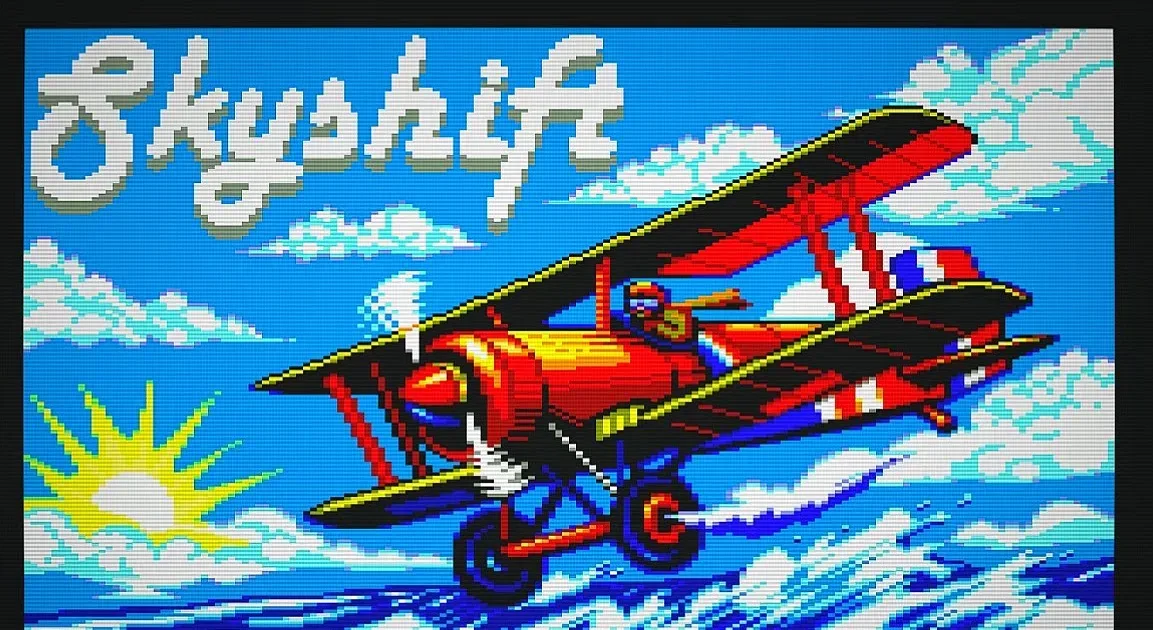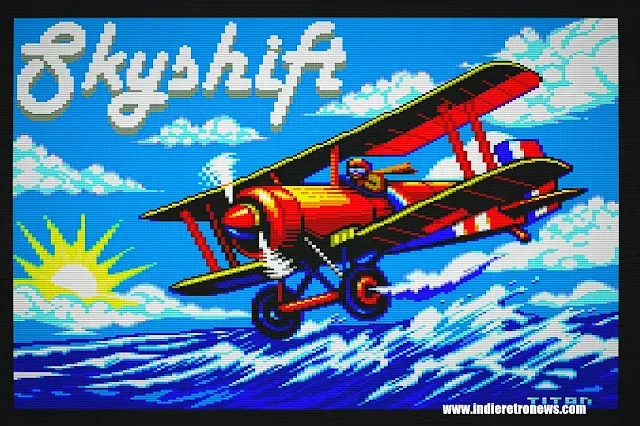
Skyshift is a newly released vertical shooter for the Amstrad CPC from Titan, built around a deliciously unfair aviation premise: a World War I Allied flying ace enters a strange luminous cloud during a dogfight in spring 1918 and comes out facing machines his biplane was never meant to confront.
At first, the pilot believes he has somehow crossed into 1945. The opposition includes propellerless aircraft and jet-powered technology, a staggering jump from the fragile aircraft he knows. But Skyshift’s scenario does not stop at a time-displacement fantasy. As the terrain becomes unfamiliar and the enemy force grows stranger, the pilot realizes the cloud has moved him into a parallel world: a dystopian Earth whose skies are controlled by an alien empire.
That setup gives the game a clear identity beyond its classic arcade-shooter foundation. Skyshift takes the immediate, score-chasing language of vertically scrolling aircraft combat and places a vulnerable period aircraft at the center of an escalating science-fiction war. The player’s machine is not merely outnumbered; it is fundamentally obsolete relative to the forces arriving on screen. That mismatch is the narrative engine behind the action.
An arcade-style shooter with a deliberately focused display
Titan cites classic vertical shooters such as 1943 as an inspiration. In a vertical shooter, the action is oriented around forward movement through a tall combat space, with threats generally arriving ahead of the player and requiring rapid positioning, firing and evasive movement. It is a format particularly suited to aircraft combat because the player continually presses into enemy territory rather than holding a fixed defensive line.
For Skyshift, Titan chose a specialized 128 x 256-pixel gameplay window using the Amstrad CPC’s Mode 0. The developer describes that decision as a way to make programming more efficient while retaining crisp readability. The dimensions matter because they identify a deliberately narrow, tall play area rather than an attempt to fill every part of the display with the active combat field.
Mode 0 is one of the Amstrad CPC’s screen display modes. In this context, the important practical point is not a broad claim about what every CPC game can do, but why the selected mode fits Skyshift’s stated objective: the game is designed around clear action in a compact vertical window. A smaller, purpose-built arena can concentrate the player’s attention on incoming aircraft, bullets and movement lanes. It can also help keep the screen’s most urgent visual information legible when the action becomes busy.
That is a sensible match for the premise. A pilot trying to survive an evolving aerial force needs readable hazards and recognizable silhouettes. The story’s transition from familiar wartime aviation into jets and alien technology should have visual value as well as narrative value: each step away from the biplane’s era can make the player’s displacement feel more immediate.
From a broken timeline to a different world
Skyshift’s opening uses a recognizable piece of speculative-fiction logic. A combatant from 1918 sees technology that appears decades ahead of his own and concludes that he has travelled forward in time. The initial 1945 assumption is understandable from his perspective, even if the hostile machines are already beyond what that explanation comfortably covers.
Related coverage includes Skyshift Takes Amstrad CPC Shooting Into an Alien Alternate Reality.
The scenario then changes the question. The pilot has not simply landed later in his own history. He is stranded in an alternate reality, one in which humanity has surrendered the air to a repressive extraterrestrial power. That distinction raises the stakes in a useful way for a shooter. The player is not travelling toward a known endpoint or fighting through an ordinary war; he is attempting to understand a world whose rules keep becoming less familiar.
Titan describes an increasingly improbable armada made up of jets and alien technologies. The phrase suggests escalation rather than a static enemy roster. In practical genre terms, an evolving military force gives a vertical shooter room to vary its threats and visual themes while keeping the player’s objective instantly understandable: survive the next wave, outmaneuver the opposition and push further into hostile airspace.
The central character is described as an isolated, multi-universal survivor. That is an appropriately lonely frame for arcade flight combat. The player pilots a single aircraft through an overwhelming enemy presence, so the narrative and the mechanical fantasy point in the same direction. The biplane is both the hero’s historical anchor and a constant reminder that this battle is taking place far outside its intended era.
Why the biplane-versus-future premise works
Skyshift’s strongest hook is the collision of two different kinds of aerial fiction. World War I flying evokes exposed pilots, propellers and relatively delicate machines. The later and alien threats in the game’s premise evoke speed, scale and technological superiority. Putting those ideas together gives every encounter an inherent underdog quality before any individual enemy is introduced.
It also avoids requiring a lengthy explanation before the action begins. A luminous cloud, a sudden change in the sky and impossible aircraft are straightforward visual storytelling tools. The player can understand the broad conflict immediately, while the alternate-reality revelation adds a second layer for anyone interested in why the landscapes and enemies no longer fit the pilot’s expectations.
There is a useful tension in the game’s stated goal of uncovering the secrets of the dimension before time runs out. That wording gives Skyshift more than a battlefield destination. The fight is presented as a race to make sense of an impossible displacement, with an alien occupation framing the resistance. Whether the game answers every question is not specified, but the scenario establishes an ongoing mystery rather than treating its science-fiction elements as simple decoration.
A compact production with clear credits
Skyshift credits Titan, identified as Eric Cubizolle, for concept and scenario as well as graphics. Programming and music are credited jointly to Titan and Claude. Those credits indicate a compact collaboration in which the project’s core fiction and visual direction sit closely together, while code and audio are shared responsibilities.
- Concept and scenario: Titan (Eric Cubizolle)
- Graphics: Titan (Eric Cubizolle)
- Programming: Titan and Claude
- Music: Titan and Claude
That arrangement is relevant to Skyshift because its premise depends heavily on cohesion. The display format, the aircraft designs, the alien escalation and the music all need to support a fast-moving arcade game without obscuring the action. The supplied details do not establish how the game plays across every stage or what its scoring systems contain, so it would be premature to infer specific weapons, bosses, upgrades or difficulty features. What is clear is the intended direction: a focused vertical shooter whose storytelling is carried through the contrast between a 1918 biplane and an increasingly alien aerial war.
What Amstrad CPC players can take from the announcement
The key technical detail to watch is the 128 x 256 Mode 0 playfield. It is not simply a number on a specification sheet; it describes the visual boundary within which Skyshift is making its arcade case. Rather than judging it by the modern expectation of a broad, high-resolution action screen, the more useful lens is whether its constrained window makes enemies, projectiles and the player aircraft easy to track during pressure-filled encounters. Titan explicitly connects the choice to programming efficiency and visual clarity.
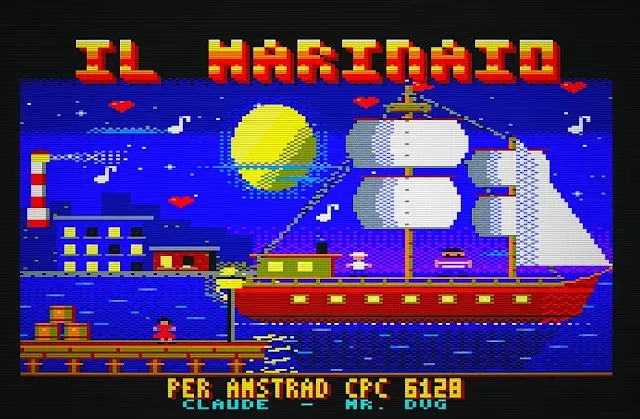
The game also joins a continuing stream of fresh work for the Amstrad CPC. For another recent example of a new project aimed at the platform, see this look at IL MARINAIO’s Amstrad CPC 128K release. The two projects have different genres and creative premises, but together they underline that the machine remains a destination for new ideas rather than only a subject of retrospective discussion.
Skyshift is especially notable for choosing a format that can be grasped at a glance while giving it a more unusual fiction than a straightforward wartime shooter. It begins with a familiar dogfight over the Western Front, shifts through an apparent leap toward 1945, and then overturns that explanation with an alien-controlled parallel Earth. The resulting promise is direct: guide an outclassed biplane through a strange, hostile sky and keep moving long enough to discover what happened to its pilot.