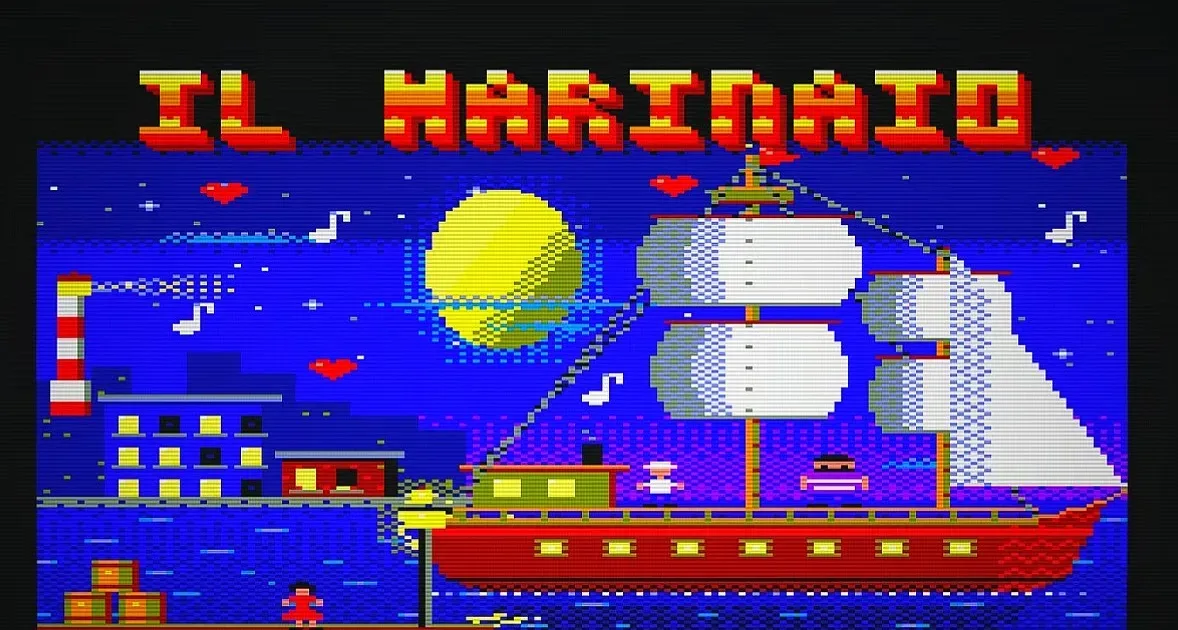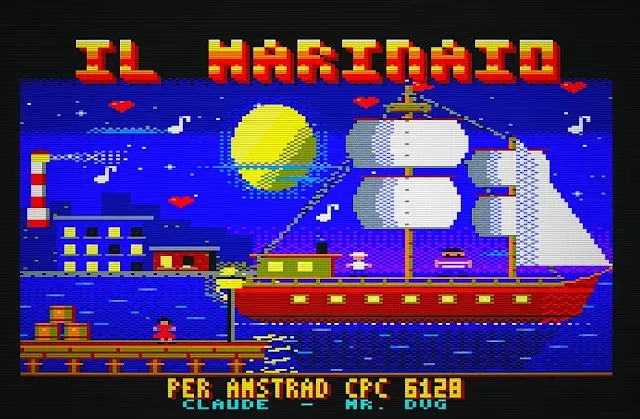
IL MARINAIO is a new game for the Amstrad CPC 128K from Andrea “Mr. DVG” Pastore, built in Z80 assembly language and openly credited as being programmed by Claude (Anthropic) AI under Pastore’s direction. Its premise and structure draw on the 1982 arcade game Popeye: a sailor races to collect tokens dropped by his sweetheart while avoiding hazards and a persistent brute who roams the stage.
The project is notable on two fronts. First, it is a fresh game for a specific retro computer configuration rather than a modern reinterpretation merely using an old visual style. Second, its listed credits put AI-assisted production at the centre of the release: Pastore is named as director, while Claude is named for programming. The supplied details describe the game as made from scratch in pure Z80 assembly language with AI assistance.
For players, however, the immediate focus is recognisable arcade pressure. IL MARINAIO asks its sailor protagonist to grab falling hearts, musical notes and letters, while staying away from the water beneath the platforms. A bully stalks the stages, and a witch adds another threat. At tougher difficulty rounds, the witch throws bouncing skulls, raising the importance of movement, positioning and timing.
Three objective-driven stages
IL MARINAIO is built around three recreated stage types, each with its own collection target and environmental wrinkle. The format matters because it gives the game more than a single survival loop: the player needs to clear a defined objective while navigating enemy interference and stage-specific tools.
- The Docks: Collect 24 hearts. A bucket can be used to trap the bully’s head, creating a tactical way to manage the pursuing opponent.
- The Streets: Gather 16 musical notes beneath the moon. This stage uses a seesaw catapult as part of its environmental mechanics.
- The Ship: Collect the letters needed to spell H-E-L-P. The sailor must avoid a diving bird while climbing the main mast.
Those objectives mirror the escalating, item-focused design associated with the game’s stated arcade inspiration, but the information available does not establish IL MARINAIO as an official adaptation. It is best understood as a Popeye-inspired release with its own title, sailor lead and credited production approach.
The power-up is also deliberately familiar. Spinach grants temporary invincibility, allowing the sailor to punch the bully and knock him into the sea. In practical terms, that turns a normally evasive game into a brief opportunity to seize space, remove immediate pressure and continue collecting. Because the invincibility is temporary, the value is likely in choosing when to exploit it rather than treating it as a permanent answer to hazards.
What the CPC-specific technical details mean
IL MARINAIO uses 16-colour Mode 0 graphics. Mode 0 is a display mode associated with the Amstrad CPC, and the supplied description identifies it as the game’s visual foundation. Rather than making a broader claim about image quality from a specification alone, the meaningful point is that the game is designed around a CPC-native presentation and a 16-colour palette.
The release is also said to run at 25 updates per second with flicker-free double buffering. An update rate describes how frequently the game refreshes its simulation and presentation. Double buffering is a rendering method in which a new frame is prepared in a separate buffer before it is shown, helping avoid the visible partial redraws or flicker that can occur when the display is updated directly. For a game driven by falling objects, mobile enemies and tight platform positioning, that is a relevant implementation detail: visual clarity can directly support a player’s ability to judge movement and hazards.
Related coverage includes IL MARINAIO Brings Popeye-Inspired Arcade Action to Amstrad CPC 128K.
Audio comes through custom sound effects for the AY chip, including a retro-styled crunch for successful hits. The AY is the sound-chip reference given in the game’s feature list; no musical score or wider audio feature set has been specified. The confirmed detail is that IL MARINAIO includes bespoke effects and ties one of them to the spinach-powered punch.
The package additionally includes menus, high-score tracking and gameplay configuration toggles. The latter allow players to alter lives and starting levels. That is useful for two different audiences: someone learning a stage can begin from a chosen point, while a player chasing a better score can use the score system as the recurring competitive measure. The supplied material does not detail every setting or explain whether scores are stored persistently, so those limits should not be assumed.
AI credit is part of the story, not a footnote
The programming credit deserves careful wording. The game’s credits name Claude (Anthropic) AI for programming and Mr. DVG for direction, while the release description says the code was produced in pure Z80 assembly language with AI help. This is a specific attribution supplied for this project, not evidence that development decisions, visual design, testing, audio work or every individual implementation task were performed by an AI system. Those roles are not broken down further in the available details.
What can be said is that IL MARINAIO presents an unusually explicit example of AI involvement in a retro-computing project. Assembly language is a low-level programming language: instructions are closely tied to the processor’s capabilities, and here the target is the Z80. Claiming an assembly-language build therefore identifies the technical form of the code, while the credits identify the tools and direction behind it.
That clarity is useful amid a wider games-industry conversation about AI use, disclosure and quality control. Platform-side concerns around rapidly growing submissions and AI clone risks have also become part of that discussion, as covered in Valve’s updated pre-release checks. IL MARINAIO is a different case: it is described as a purpose-built Amstrad CPC title with named direction, a stated technical target and explicit programming attribution. None of that settles broader debates about AI-assisted development, but it gives players a clearer basis for understanding how this particular release presents itself.
An arcade loop built around pressure and stage knowledge
The confirmed mechanics point to a straightforward but demanding arcade structure. Collectibles descend from above, so progress depends on being in the correct place at the correct moment. The sea makes missed footing costly, while the bully creates moving pressure rather than a fixed obstacle. Higher difficulty adds bouncing skulls, which means the player must account for hazards that do not simply fall in a straight line.
Stage mechanisms add a second layer. The Docks’ bucket is not merely decoration when it can trap the bully’s head; it is a tool for temporarily changing the board’s balance. The Streets’ seesaw catapult implies that movement through the stage is partly determined by its environmental layout. On the Ship, the main mast and diving bird shift the challenge toward vertical navigation and aerial timing. The confirmed stage goals—24 hearts, 16 notes and H-E-L-P—make completion legible at a glance, a strong fit for score-oriented arcade play.
IL MARINAIO therefore arrives with a compact, clearly defined feature set: three stage scenarios, a spinach-enabled reversal of fortune, 16-colour CPC graphics, 25-updates-per-second presentation, AY-chip effects, high scores and adjustable starting conditions. It has been made for the Amstrad CPC 128K, and its production credits pair Mr. DVG’s direction with Claude AI programming. For retro players interested in new software designed around a classic machine and classic arcade priorities, that combination is the release’s central hook.