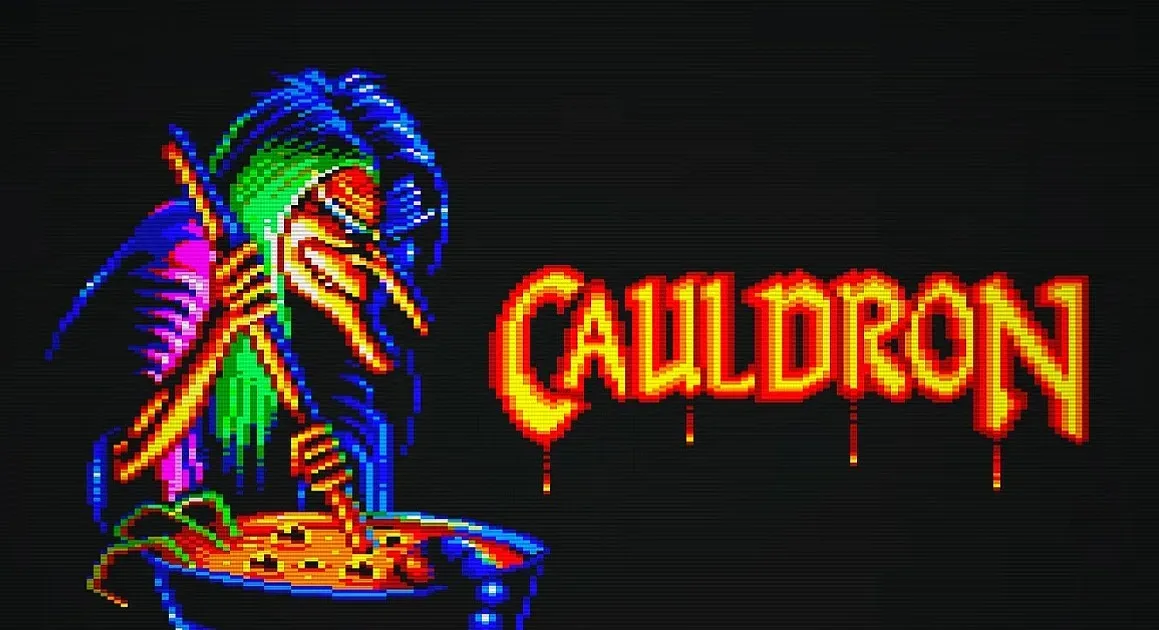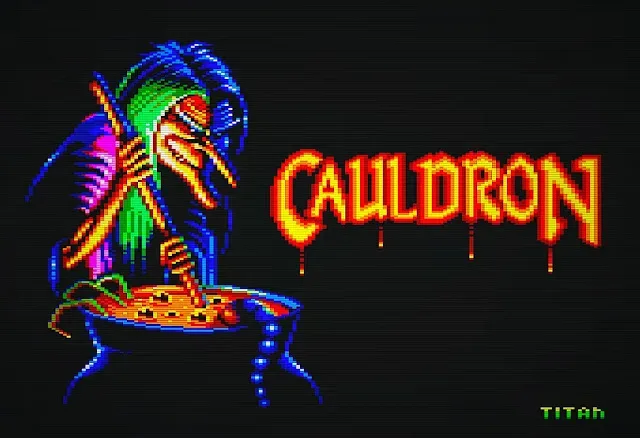
Cauldron: Halloween Edition revisits Palace Software’s 1985 Amstrad CPC game with a clear mission: retain the unusual, spooky identity of the original while giving players more ways to withstand it. The new edition from Devil-System adds selectable difficulty levels, a training mode, a built-in map, saves, a pause function and a choice between Classic and Enhanced visual modes.
That is a substantial change in philosophy for a game remembered not only for combining genres, but also for an often punishing level of challenge. The central premise remains intact: a witch must face the Pumpking in a bid to become Witch Queen. What changes is how much room the player has to learn the world, understand its demands and recover from mistakes.
For a retro release, those quality-of-life features are not merely decorative extras. They alter the relationship between the player and a famously uncompromising game. A map can reduce blind wandering. Saving can turn a long session of attrition into a sequence of manageable attempts. A training mode can let someone explore without the same pressure attached to every movement. And three difficulty settings recognize that curiosity about a classic does not necessarily mean a player wants its harshest version immediately.
A hybrid game with a fearsome reputation
The original Cauldron was designed by Steve Brown and Richard Leinfellner. Its structure mixes platforming with horizontally scrolling shoot ’em up sequences. That means it asks players to operate across two different play styles rather than settling into one loop: navigating platform-focused spaces on the one hand, then taking to the broomstick for side-scrolling combat and traversal on the other.
That dual approach was one of the original game’s strengths. It gave the witch’s pursuit of the Pumpking a broader sense of journey than a single-style action game could offer. Yet it also helped make the experience demanding. Players needed to adjust their timing, movement and priorities between the two modes, all while working through an adventure noted for excessive difficulty.
Horizontal scrolling shoot ’em up is a useful term to unpack here. In this style of game, the action moves sideways through a scrolling environment while the player pilots a character or vehicle, avoiding hazards and often firing at enemies. In Cauldron, that vehicle is a broomstick. The Halloween Edition’s mechanical revisions are therefore particularly relevant: flight is not an occasional novelty but a key part of how the game feels in motion.
Controls and physics are being reworked, not just polished
Devil-System’s update goes beyond presentation. The controls and physics have been completely overhauled, with gradual acceleration, softer braking and more fluid animation listed among the changes. Rendering has also been optimized, while the overall pace of play has been tuned.
“Physics” in this context does not mean an attempt at real-world simulation. It describes the rules that govern movement: how quickly the witch gains speed, how she slows, how changes in direction are communicated and how reliably the game responds to an input. Those details can determine whether a player feels in command during a risky broomstick sequence or feels as though they are fighting momentum they cannot properly read.
Related coverage includes Cauldron: Halloween Edition Revisits a Tough 1985 Amstrad CPC Classic.
Gradual acceleration means speed builds rather than appearing at full force instantly. Gentle braking means stopping or reducing speed should be less abrupt. Neither feature automatically makes a game easy; hazards, enemies and demanding routes can remain threatening. But together they can make failure easier to understand. When movement has a more legible rhythm, players can better identify whether an error came from their timing, route choice or a poor read of the situation.
Fluid animation has a similar practical value. Visual motion is feedback. If a character’s movement clearly conveys momentum and direction, it can help the player judge where that character will be in the next moment. Optimized rendering and adjusted pacing are likewise aimed at smoother navigation rather than at replacing the game’s identity with something entirely different.
Difficulty settings offer a different kind of preservation
The Halloween Edition contains three difficulty levels and a dedicated training mode for more relaxed exploration. This is the most direct answer to the original game’s reputation for severity, but it raises a familiar question whenever an older game is revised: is the goal to preserve the exact challenge, or to preserve the game’s appeal for more people?
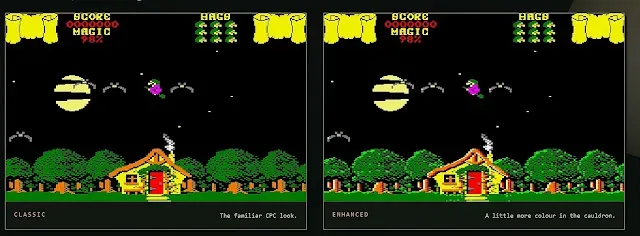
The new version appears to make room for both impulses. Classic mode is available on every disk for players who want the familiar nostalgic look, while Enhanced mode offers a refreshed presentation with updated details, including changes to the trees. The inclusion of both is important because it treats the visual revision as an option rather than a replacement.
On the play side, the additional difficulty settings and training option let the game serve several audiences. Someone who knows the original can pursue a tougher route. Someone arriving decades later can use training to become familiar with the landscape and movement. A player who is interested in the game’s genre blend and visual atmosphere, but not in repeatedly being stopped by its hardest demands, has a more inviting path in.
This does not erase the significance of the original’s difficulty. For some retro players, the friction is part of the memory: the dense challenge, the repeated attempts and the feeling that progress had to be earned. But accessibility options do not prevent that audience from seeking a stern test. They make the work more legible to players whose interest begins with the game’s design rather than with a willingness to endure every historical inconvenience.
Maps, saves and pauses change the pace of an old adventure
Cauldron: Halloween Edition also includes a built-in map, pause functionality, a high-score table and save support. Each feature addresses a separate practical problem associated with difficult games.
- Built-in map: Helps players orient themselves and may reduce the reliance on memorization while exploring.
- Save support: Lets progress carry across sessions instead of requiring one extended run.
- Pause: Gives a player a moment to step away without abandoning an active attempt.
- High-score table: Preserves a competitive, replay-focused element alongside the campaign-style quest.
The save feature may be the most consequential. In a demanding game, saving does not necessarily change the challenge contained within individual encounters or routes. It changes the cost of learning. Instead of treating every setback as a reason to repeat a large stretch of play, the player can return closer to the point where the next lesson is waiting.
That distinction matters in an era when retro games are often revisited by people with limited uninterrupted play time. A preservation-minded release is not only about keeping old code reachable; it can also mean keeping an older game understandable and usable in a new context. That wider issue is explored in this look at why preserving old games involves more than retaining the code.
The four supported languages broaden the practical reach of the edition as well. The supplied details do not identify those languages, but their inclusion signals an effort to make the game workable for more players without changing its premise or genre structure.
Classic and Enhanced modes keep the choice with the player
Visual revisions of old games can be contentious when they overwrite a familiar style. Cauldron: Halloween Edition avoids making that an all-or-nothing decision by including Classic and Enhanced modes on each disk. Classic mode offers the recognizable nostalgic aesthetic. Enhanced mode refreshes the presentation through updated details, with the altered trees specifically noted as an example.
The wording here matters: this is not presented as a wholly new remake with a different game at its center. The original blend of platforms and broomstick shooting remains the framework. The update focuses on options, usability and movement while offering a refreshed visual alternative.
For players attached to an original CPC look, Classic mode is the obvious draw. For those who want a slightly revised presentation while retaining the vintage platform and core design, Enhanced mode provides a second lens. It is a sensible division: nostalgia is not a single setting, and neither is accessibility.
What the Halloween Edition is trying to solve
The case for this edition is not that the 1985 game needed to be made unrecognizable. It is that its strengths—distinctive genre mixing, a witch-on-a-broomstick premise and an ambitious world—could be easier to approach if its barriers were addressed with care.
Cauldron: Halloween Edition’s feature set suggests exactly that approach. Difficulty selection and training support learning. Maps, saves and pause support respect a player’s time. Reworked acceleration, braking, animation, rendering and pacing aim to make flight more controllable. Classic and Enhanced modes acknowledge that players do not all want the same presentation. The high-score table ensures that score-chasing still has a place beside the adventure.
Purists can still value the severe character of the original, especially when viewed through the unmistakable lens of Amstrad CPC-era play. But the new edition makes a strong argument that an old game’s spirit need not be tied exclusively to every old frustration. A witch’s trip to defeat the Pumpking can remain perilous without requiring every newcomer to start by being thoroughly cursed.