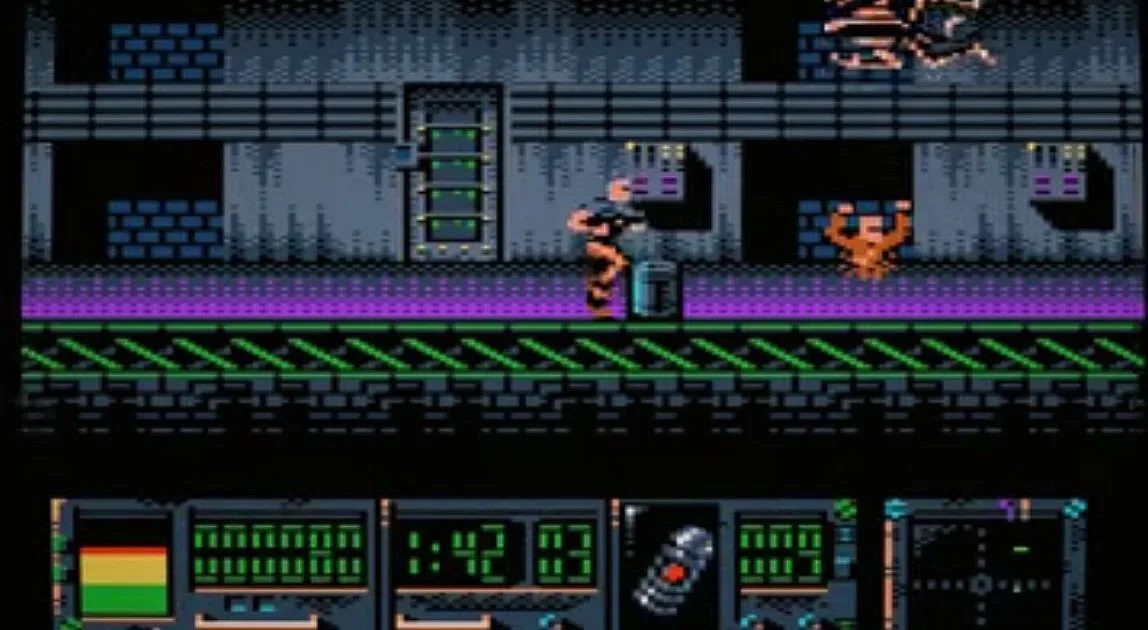
Alien 3, the 1990s platform game from Probe Software, has reached the Amstrad CPC Plus in a new port credited to Devil-System and GPT, with JAMSI credited to Devil-System. Rather than simply moving the Commodore 64 release onto another 8-bit system, the project is designed around capabilities specific to the enhanced Amstrad hardware.
That distinction matters. The new version retains the game’s hostile-colony premise—guide Ellen Ripley through dangerous stages, locate prisoners and confront enemies at the end of objective-led missions—but presents its moving action through the CPC Plus’s hardware sprites, fine pixel scrolling and separate sprite palette. Its sound has also been reworked: the C64 music is adapted for the Amstrad AY sound generator, while explosive effects use the system’s ASIC DMA hardware.
The result, on paper, is not a claim that the original game has been replaced or remade into something fundamentally different. It is an example of a port treating the destination machine as more than a technical limitation. The fifteen-stage game remains built around pressure, limited resources and one chance to finish the mission, but its visual and audio systems have been tailored to the CPC Plus.
A port with a machine-specific identity
Ports are often discussed as if there are only two outcomes: an exact conversion or a compromised version. In practice, a project like this occupies a more interesting middle ground. The design and mission structure stem from the Commodore 64 release, while the CPC Plus hardware determines how characters, enemies, shots, colour and movement are handled on screen.
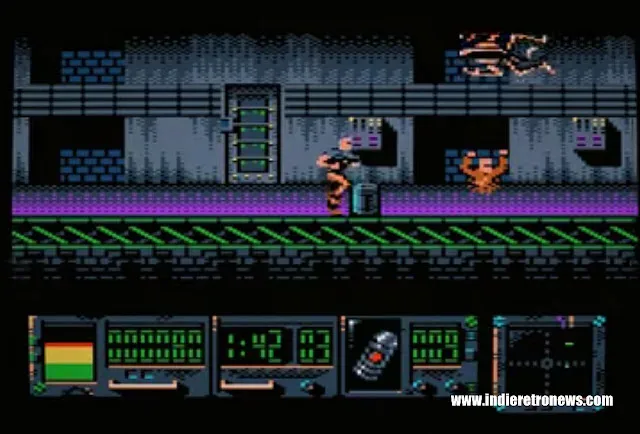
The stated visual feature is the use of specialised hardware sprites for Ripley, Xenomorphs, stage Guardians and weapon bursts. A hardware sprite is a graphic object that the machine can display and move using dedicated display functionality rather than having the game redraw every part of that object into the background image itself. The practical appeal is clear in a busy action game: the player character, monsters and gunfire can remain distinct as the scenery moves beneath or around them.
In this version, those sprites use a palette separate from the background scenery. A palette is the selection of colours assigned to artwork. Keeping sprite colours detached from the backdrop can make actors and projectiles easier to distinguish, particularly in an environment built to feel dark, industrial and dangerous. It also gives the port a visual character of its own rather than requiring every moving element to share the same colour decisions as the scenery.
The project also uses fine hardware pixel scrolling. Put simply, scrolling is the movement of the playfield as Ripley travels through a level. “Fine” pixel scrolling refers to movement in small increments rather than large, visibly stepped shifts. When the hardware supports it directly, the background can glide across the display while sprites remain responsive and clearly layered over the action. That is a meaningful fit for a side-scrolling platformer whose threats arrive during constant movement.
None of that automatically makes a game easier. Smoother motion and clearer contrast can help players read a chaotic scene, but Alien 3 is still described as a game of constrained survival. The technical changes should be understood as changes to presentation and responsiveness, not evidence that its tension has been removed.
Related coverage includes Alien 3 Reaches Amstrad CPC Plus in New Enhanced 8-Bit Port.
Ripley’s mission remains about objectives, not just survival
The game spans fifteen action-focused stages. Each mission asks the player to move through the colony in search of hidden prisoners, then face enemies at the end of distinct objectives. That structure gives the platform action a purpose beyond simply reaching an exit: exploration, rescue and combat all feed into completion.
There is an important difference between a stage with an objective and a stage that is merely a corridor full of opponents. Objective-driven progression asks the player to interpret the space, manage risk and decide whether a detour is worthwhile. When prisoners are hidden, route knowledge and observation become part of the challenge. A player is not only reacting to a Xenomorph in front of them; they are trying to make progress against a wider requirement while the mission’s resources diminish.
The endpoint is also not purely passive. Missions culminate in fighting enemies at their end, including stage Guardians. That term signals a more substantial opposition associated with stage completion, though no further details on their patterns or encounters are established here. What is clear is that the port preserves a structure in which reaching the far end of an area does not necessarily mean the danger is over.
This blend of platform navigation and mission objectives fits the broader pressure of the game’s interface. The on-screen HUD is static, meaning its information stays visible rather than disappearing during play. It tracks health, ammunition, motion radar and a countdown timer. Those four elements establish the core questions players must continually answer: how much damage can Ripley still withstand, how freely can she use weapons, where might threats be, and how much time remains?
The HUD makes resources part of the action
Resource management can sound like a detached strategy-game idea, but here it is directly tied to movement through hostile spaces. Health and ammunition are obvious constraints, yet the motion-tracking radar and timer create a more layered kind of urgency.
A motion tracker, in this context, is a radar-style display intended to provide information about nearby movement. It does not eliminate danger; it adds another stream of information a player must notice while navigating platforms and dealing with threats. The value is psychological as much as practical. Knowing that movement is nearby can force quick decisions, while not having a clear view of an enemy can make every route feel risky.
The countdown timer is equally central. The supplied details describe a strict limit and identify batteries as a vital scavenged resource. Finding a fresh battery can be the difference between continuing and failing the mission. That turns exploration into a calculation: searching may reveal prisoners or needed power, but it may also cost time, ammunition and health. Racing ahead may be no safer if it means missing an essential resource.
The game gives players only one chance to complete the mission. That single-life structure raises the stakes of every mistake and makes information on the HUD more than decorative. It is the player’s running status report in a game where a poor decision cannot simply be erased by immediately returning to the same point with another life.
For people encountering the CPC Plus port, this is the practical takeaway: expect a game that values attention and economy, not carefree rushing. Keep an eye on ammunition before committing to fights, treat the clock as an active threat, and regard batteries as mission-critical rather than optional pickups. The radar exists to be consulted, while the objective structure means exploration must be purposeful.
Audio work is split between music and effects
The adaptation does not stop at graphics. The original Commodore 64 soundtrack has been arranged for the Amstrad’s AY chip sound generator. The AY is the sound hardware used to produce the game’s music in this version. An adaptation is not merely a file transfer: music written around one machine’s sound capabilities needs to be expressed through another system’s voice.
Sound effects take a different route. Explosions are driven through the advanced ASIC DMA hardware. DMA, or direct memory access, is a hardware-assisted method of moving data without asking the main processor to perform every transfer itself. In the context provided, it is used for the explosive effects, separating that role from the AY-based soundtrack.
This division is a useful example of why platform-specific conversion work can be more meaningful than a superficial visual change. The CPC Plus version uses different pieces of the machine for different jobs: sprites and scrolling for the display, the AY generator for music, and ASIC DMA for explosions. The aim is a cohesive presentation where combat, movement and sound each benefit from the system’s particular toolkit.
Why this kind of retro port is worth watching
New work on older machines is sometimes reduced to a novelty headline: an unexpected game has appeared on an unexpected platform. That does not capture what is notable here. This project is specifically framed as an enhanced interpretation of a Commodore 64 game for the Amstrad CPC Plus, with an identity informed by what that machine can do.
It is also a reminder that retro gaming remains active well beyond preserved cartridges, archived manuals and nostalgia for original releases. Developers can revisit a game’s underlying design and reconsider the technical choices through a different platform’s strengths. The original mission pressure—rescue hidden prisoners, survive hostile encounters, manage supplies and beat the countdown—can remain intact even as the route by which it reaches the screen changes.
That same ongoing engagement produces other kinds of discoveries, from enhanced ports to long-studied games yielding new technical findings; for a separate example, see this look at an Ocarina of Time bottle glitch and its potential speedrunning impact.
For Alien 3 on Amstrad CPC Plus, the headline is ultimately one of deliberate adaptation. Ripley, the Xenomorphs, Guardians and weapon fire receive dedicated sprite treatment; the colony scrolls with fine hardware pixel movement; music and explosions are assigned to different audio capabilities; and the demanding fifteen-mission structure remains underpinned by a persistent HUD and a single chance at survival. It is an old 8-bit action game arriving in a form shaped for another old 8-bit machine—and doing so with more ambition than a straightforward transfer.