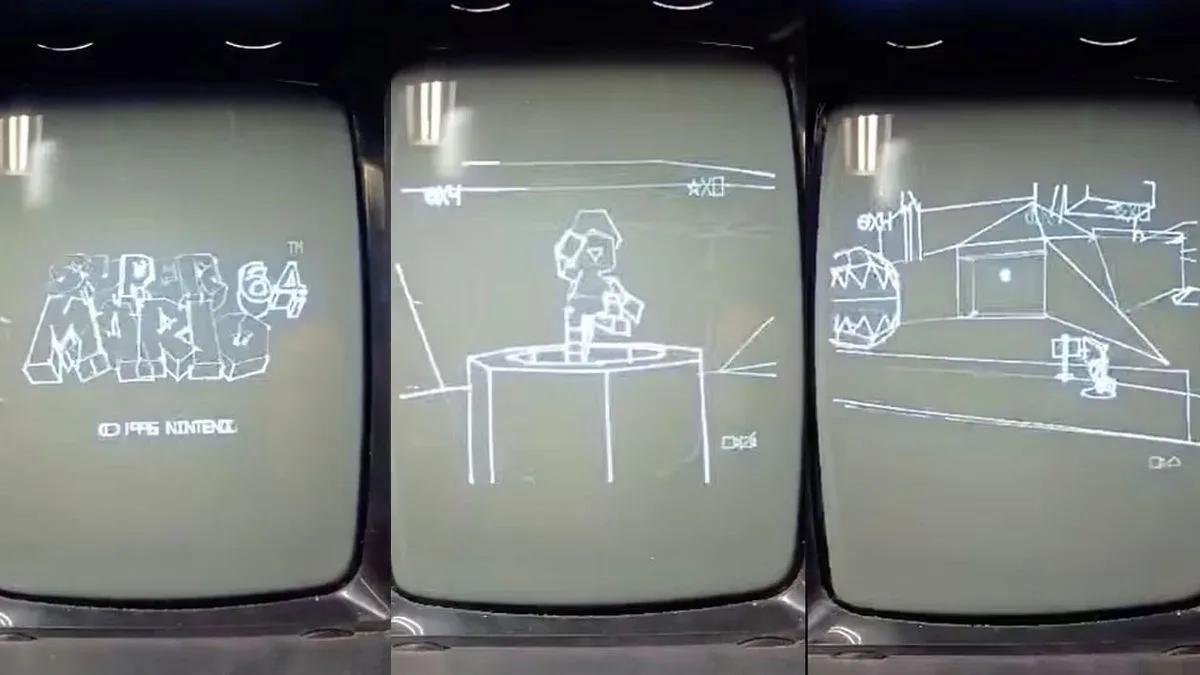
Super Mario 64 has made an unlikely stop on the Vectrex: not as a conventional, feature-complete conversion of Nintendo’s 1996 Nintendo 64 landmark, but as a striking wireframe homebrew experiment running on the 1982 vector-console platform.
The result is immediately recognizable despite the enormous visual and technical gulf between the two machines. Instead of the colorful, textured 3D worlds associated with Super Mario 64, this version presents characters and environments as lines: a simplified vector-style interpretation that prioritizes visible geometry over surface detail. It is a radical reduction, but that is precisely why the project is so compelling. The question is not whether a decades-old vector system can reproduce every part of Nintendo’s original. It plainly cannot do so unaided in the form shown. The more interesting question is how far the familiar shape, movement and identity of a 3D game can be translated when nearly everything about its presentation must change.
A Vectrex project with multiple contributors
The original work is credited to Dani Ferrer, while Arcade Jason added sound. That division matters because the current build is best understood as a collaborative technical demonstration rather than a finished commercial-style port. It preserves enough of Super Mario 64’s visual language to be identifiable while adapting it into the Vectrex’s very different display aesthetic.
In technical terms, a wireframe model displays the edges of 3D objects rather than fully filled, textured surfaces. For a machine and display concept built around vector lines, that approach is a natural fit. It also creates a stark, arcade-like image: players see the skeleton of a scene rather than the detailed objects and materials expected from the Nintendo 64 game.
That does not make the achievement any less ambitious. A wireframe version still has to communicate the essential readability of a 3D space. A player needs to be able to distinguish where a character is, where platforms or walls sit, and how motion relates to the environment. Losing textures, color-rich scenery and much of the original’s detail puts extra pressure on the underlying shapes to do the work.
Why this is not a simple native Vectrex conversion
It is important to keep the project’s likely hardware assistance in view. The Vectrex itself is not believed to be doing all of the work alone. The build may use something similar to UVMC2, described as a Vectrex cartridge that effectively includes a small PC. That possibility has not been presented as a definitive technical teardown, so it should be treated as informed inference rather than a confirmed specification.
The distinction is useful, not dismissive. Retro hardware projects often explore a whole ecosystem of original hardware, cartridges, add-on processing and modern development tools. A cartridge that contributes additional computing capability can allow a classic machine to display or interact with ideas that its base hardware would otherwise struggle to handle. The resulting work can still be a meaningful Vectrex project—especially when its output is designed around what the system’s distinctive vector display can show—without implying that an unmodified 1982 console is internally reproducing a full Nintendo 64 game.
Put another way, “running on Vectrex” and “being calculated entirely by original Vectrex hardware” are not necessarily the same claim. The available evidence supports the first description for this experiment, while also strongly suggesting external help is involved. That nuance is central to appreciating the demo honestly.
Related coverage includes Super Mario 64 Appears on Vectrex in a Wild Retro Homebrew Experiment.
The appeal is translation, not duplication
Calling this a port can create expectations that the project has not claimed to meet. The demonstrated version is nowhere close to the detail of the Nintendo 64 original, and its wireframe presentation makes that obvious at a glance. Yet it still communicates Super Mario 64. That recognition is the accomplishment.
For enthusiasts, unusual demakes and hardware experiments are often most exciting when they expose what is essential about a game. Super Mario 64 is associated with three-dimensional movement, recognizable characters and navigable spaces. Strip away texture work and the original’s dense presentation, and a surprising amount can remain if the animation, outlines and scene composition are legible.
The Vectrex is also a particularly apt canvas for this kind of reinterpretation. Rather than asking it to imitate a conventional television-based console image, the project leans into its vector identity. The line art is not merely a compromise; it is the visual device that makes the contrast between source game and target platform fascinating. The same Nintendo 64 inspiration would mean something very different on a raster-based system designed around pixel graphics.
For broader context on Nintendo’s continuing cultural reach, including the franchise beyond games, see our coverage of Rosalina’s role in The Super Mario Galaxy Movie.
Completion remains uncertain
There is no guarantee that this Vectrex experiment will become a completed project. Arcade Jason has indicated a desire to move on to something else, leaving open the possibility that the work remains a proof of concept rather than becoming a full, finished adaptation. At the same time, an invitation has been extended for interested people to get in touch if they want to help carry it forward.
That uncertainty should temper expectations. There is no confirmed release plan, completion date, feature list or indication that the full Super Mario 64 experience will be recreated. The current project is valuable on its own terms: a public example of how an iconic 1996 3D game can be recognized in an extremely stripped-back form on hardware from 1982.
What the experiment says about retro development
The Vectrex is considerably more niche in modern retro discussion than systems such as the NES, Mega Drive, PlayStation or Nintendo 64. Projects like this help explain why its community remains invested. A platform’s relevance is not only about mass-market popularity or a large commercial library. It can also come from its unusual capabilities and the creative constraints those capabilities impose.
Here, the constraint is productive. The Vectrex cannot present Super Mario 64 in the way the Nintendo 64 did, so the work reimagines the game as luminous-looking line geometry and sound-enhanced movement. It is a reminder that preservation, homebrew and retro experimentation are not limited to maintaining old software exactly as it was. They can also produce new interpretations that make the old hardware’s personality more visible.
For now, the sensible way to view the project is as an ambitious technical showcase with a recognizable Mario-shaped silhouette, collaborative roots and an unfinished future. Whether another developer picks it up or it remains a dazzling glimpse of possibility, the Vectrex version has already achieved the difficult part: it makes a 1982 system and a 1996 game feel unexpectedly connected.