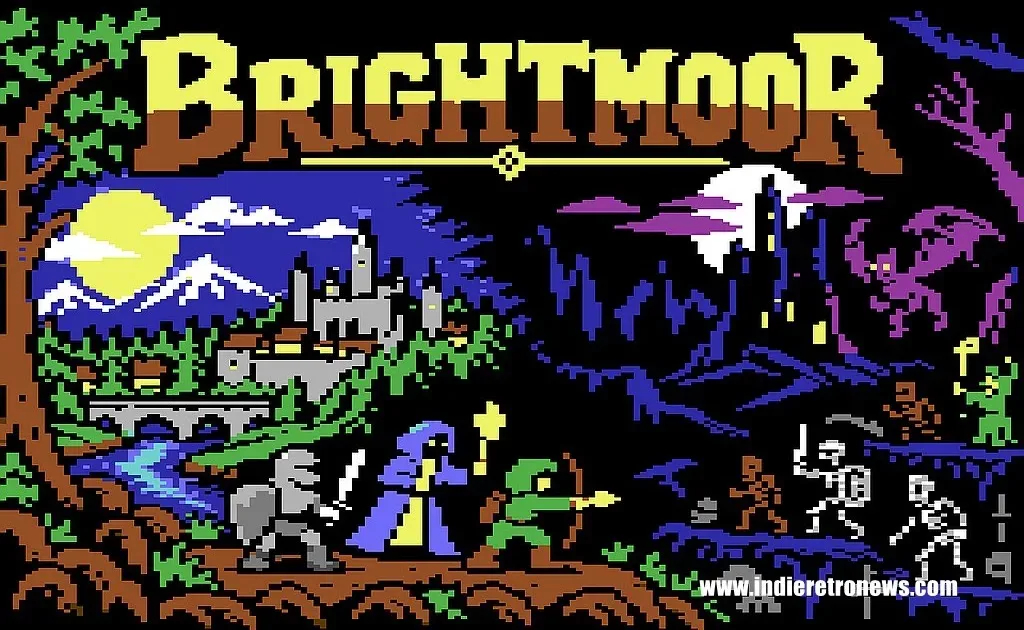
BRIGHTMOOR is a new Commodore 64 fantasy role-playing game from J5 that frames an old-school, open-world quest around an unusually bleak architectural idea: its great enemy strongholds do not rise over the landscape. They descend beneath it.
Built in 6502 assembly on the GloomKeep II engine, BRIGHTMOOR is described as an Ultima-style RPG set in a realm locked in perpetual twilight. Its central mission is direct but weighty. King Mordran, trying to escape mortality, makes a disastrous bargain with an ancient force beneath the earth. The kingdom’s dawn bell falls silent, Mordran becomes the Hollow King, and a lone hero must reclaim the light by overcoming six inverted black towers called Gloomholds.
The project’s stated world size is 64 by 64 tiles, giving the adventure a 4,096-tile map. That figure does not, by itself, explain how dense the game is or how its locations are structured, but it does establish the intended scale of the overworld. In a Commodore 64 RPG, the promise of a wide tile-based realm is meaningful: exploration, navigation and the relationship between landmarks are likely to be central to how players experience the journey.
More detail on the project is available in this BRIGHTMOOR overview.
For more context, explore Bob Buziak, Former RCA Records and TriStar Music Group President, Dies at 83.
A classic RPG framework with a subterranean twist
Calling BRIGHTMOOR “Ultima-style” sets expectations for a fantasy adventure driven by traveling across a world map, visiting dangerous locations and progressing through a larger restoration narrative. It should not be read as confirmation that every system from any particular Ultima game appears here; the available details do not specify BRIGHTMOOR’s combat rules, party mechanics, equipment systems, dialogue structure or save format.
What is clear is the game’s narrative shape. The threat begins with a ruler’s fatal bargain, then radiates outward into a kingdom-wide condition: daylight itself has been displaced. The player is not merely entering isolated dungeons for treasure. The six Gloomholds are tied to a stated goal of restoring dawn.
The Gloomholds’ “inverted” design gives that structure a fitting visual and thematic identity. Conventional fantasy towers signal power by stretching upward, overlooking a region from above. BRIGHTMOOR’s black towers instead burrow down, placing the corrupting force literally below the surface. That idea neatly matches the story’s ancient power sleeping beneath the earth, while making descent—not ascent—the recurring direction of the campaign.
There is no supplied detail on whether the six Gloomholds may be approached in any order, whether they have distinct themes, or what happens after each is conquered. Players should therefore treat the premise as a story and world-design promise, rather than a full walkthrough of the game’s progression.
What 6502 assembly means here
The 6502 is the processor family associated with the Commodore 64. Saying BRIGHTMOOR was built from the ground up in 6502 assembly means its low-level program logic was written close to the machine’s native instruction set rather than through a higher-level programming language.
That description is useful context, not a shortcut to assumptions about quality or scope. Assembly language gives a developer very direct control over how code works on the hardware, but it also demands careful management of the system’s limited resources. In practical terms, a game built this way requires the creator to be deliberate about the work behind movement, map handling, visuals, sound and loading.
BRIGHTMOOR uses the GloomKeep II engine. An engine is a set of reusable technical foundations that can support game-specific content and rules. Here, the engine connection indicates that J5 is developing on a framework associated with GloomKeep II rather than beginning every underlying system from nothing. The new game is nevertheless presented as its own production, with its own world, premise, art and music direction.
That distinction matters in retro development. Reusing an engine can provide a reliable base for core technology, allowing a creator to focus more effort on new maps, narrative framing, encounters, audiovisual work and game-specific design. It does not mean a new project is simply a reskin, and the supplied information does not claim that it is.
AI assistance is credited, alongside human development work
J5 credits AI assistance from Claude, while also identifying the project as mostly designed, coded, illustrated and scored by J5 with help from other developers. The wording is important. AI is named as an aid within the development process, not as the sole author of the game.
There is no breakdown of which tasks involved Claude, so it would be inaccurate to assign it responsibility for a particular gameplay system, asset or track. What can be said is that BRIGHTMOOR makes that assistance part of its development attribution at a time when retro projects are increasingly willing to discuss the tools behind their work.
The game’s credits also identify several established tools used in the build pipeline: Krill’s loader, GoatTracker 2 by Cadaver and Exomizer by Magnus Lind. A loader handles bringing game data into memory. GoatTracker 2 is associated here with the game’s music workflow. Exomizer is a compression tool, meaning it can reduce data size for storage or loading purposes. These credits offer a glimpse at the practical toolset surrounding the hand-authored assembly work.
For players, those names are less a feature checklist than evidence of a project assembled through multiple specialized tools. For developers and retro enthusiasts, they underline how contemporary C64 releases can combine direct hardware-focused coding with well-known utilities for delivery, audio production and data management.
Asset attribution and what it tells players
BRIGHTMOOR also explicitly credits inspiration or source material for its monster art: assets after Kenney and Hexany under CC0, plus Kcaze’s 1-Bit Fantasy Creatures 2 under CC BY 4.0.
Those license labels are worth separating. CC0 is a public-domain-style dedication intended to permit very broad reuse. CC BY 4.0 permits reuse provided attribution is given. The visible acknowledgements are therefore not incidental fine print; they are part of the project’s stated record of where elements of its visual foundation came from.
The supplied information does not say exactly how each credited monster-art resource was adapted, altered or deployed in BRIGHTMOOR. It does, however, make clear that the game’s creature visuals were not presented without context. In a small-scale retro production, forthright licensing and asset credit are a practical part of responsible development, especially where a project draws on shared creative resources.
The appeal is scope married to a focused objective
BRIGHTMOOR’s strongest stated hook is the intersection of its scale and its clarity. A 64-by-64 tile world suggests room to roam, while the six Gloomholds provide an understandable long-term destination. The story supplies an immediate emotional register—an extinguished dawn, a fallen king and an underground evil—without needing a dense encyclopedia of lore to establish the stakes.
Its technical identity is equally central. This is not merely a modern fantasy game adopting pixel imagery. It is a Commodore 64 project made in 6502 assembly and supported by a specific existing engine and period-relevant development tools. For retro RPG fans, that combination makes the creation process part of the appeal: BRIGHTMOOR is trying to deliver a large dark-fantasy journey within the particular constraints and character of C64 development.
Questions remain around practical play: no platform distribution details, release timing, control information, screenshots, system requirements beyond its C64 identity, or detailed feature list are established in the available material. Those are important unknowns, so the safest early read is to focus on what has been set out: a J5-led, AI-assisted C64 RPG, a 4,096-tile world, and a campaign built around six downward-reaching Gloomholds.
For now, BRIGHTMOOR stands out because its premise understands that darkness can be geographic as well as narrative. The route back to daylight is not a climb toward a shining citadel. It is a descent, six times over, into the places where the realm’s twilight has taken root.