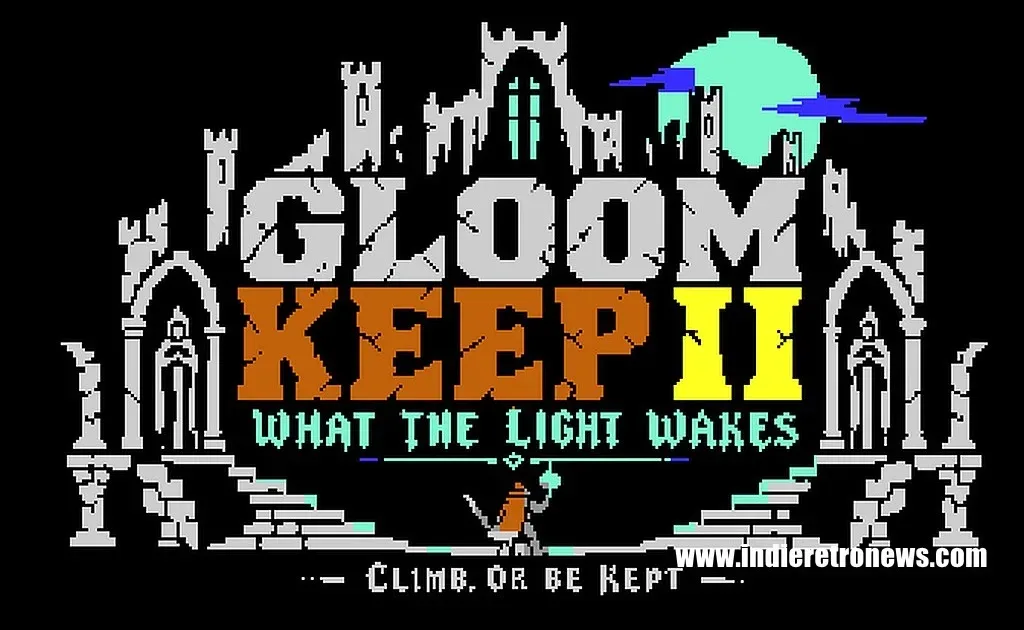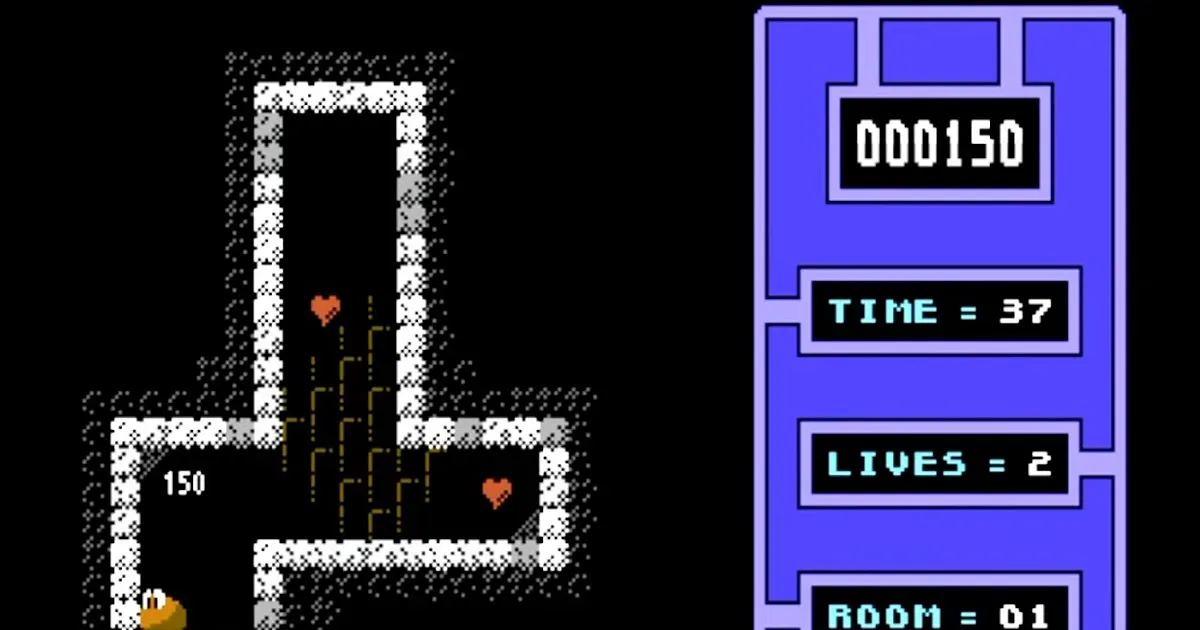
GloomKeep II: What the Light Wakes turns a familiar dungeon-crawling comfort—being able to see where you are—into the central problem. The Commodore 64 sequel begins immediately after the escape from the first GloomKeep with the stolen Idol of Orcus in hand. The relic is not simply treasure or a plot token. It burns like a lantern, and that illumination draws the attention of the dungeon’s lethal guardians.
The objective is clear but deliberately uncomfortable: climb through ten monster-filled floors and reach the surface before dawn. The complication is that the Idol is required to progress, while the light it provides makes the player easier to find. That creates a survival loop based less on permanently clearing rooms than on deciding when information is worth exposure.
It is an especially fitting premise for a turn-based dungeon crawler. In real-time games, light and detection can become a matter of reflexes. Here, each move can be considered as part of a route: carry the Idol to understand a floor, put it down to reduce danger, move through darkness, then return for the artifact when it is time to approach the exit. The stairs remain sealed unless the Idol is being carried, so abandoning it is never a permanent solution.
The Idol is both tool and liability
At the heart of GloomKeep II is a contradiction that gives every floor its tension. The burning Idol illuminates the dungeon map, providing the information a player normally needs to plan movement around monsters and obstacles. Yet carrying it wakes sleeping enemies, including the game’s ten guardians, and reveals the player’s location to them.
In other words, the same item that reduces uncertainty also increases pressure. The darkness is safer because it allows the character to vanish from hostile attention, but it is less useful for navigation. Light makes the layout legible, but it changes the dungeon from a place of hidden threats into a place where threats have a direct lead on the intruder.
This structure gives the sequel a strong hide-and-seek quality. It asks players to use visibility selectively rather than treating it as a baseline state. The Idol can help map a route, identify a passage or establish where a guardian may be. Once that knowledge has value, dropping the relic can make stealth possible again. But because progression is locked behind possession of the Idol, the player must eventually make the dangerous return trip.
What “turn-based” means for this escape
A turn-based game advances in discrete actions rather than continuously. The player takes a move, then the game state and other actors respond in turn. In GloomKeep II, that format supports the core light-and-shadow design because decisions can be approached as a chain of consequences: where to carry the Idol, where to leave it, how far to travel while hidden, and when to risk retrieving it.
The stakes are not limited to a single confrontation. A player who turns on the equivalent of a beacon to investigate a floor may create trouble that matters several moves later, when the objective requires them to come back to the same spot. The key question is therefore not simply whether it is safe to carry the Idol now. It is whether doing so makes the eventual route to the stairs more manageable or more dangerous.
Related coverage includes GloomKeep II Turns the Idol of Orcus Into a Dangerous Light Source on Commodore 64.
Mapping, misdirection and the forced return
The floor design is built around a purposeful backtrack. Players can drop the Idol and navigate blind in order to slip through the dark without advertising their position. But the locked stairs ensure that the relic must be recovered before the climb can continue. That requirement prevents a low-risk strategy in which the player simply discards the dangerous object and escapes alone.
As a result, exploration and escape are tied together. A sensible plan may involve using light to learn enough of the layout to form a route, placing the Idol in a location that can be revisited, and moving without it to reduce the immediate threat. The later retrieval becomes its own tactical event: the player must return to a known point while knowing that taking the Idol again reactivates the danger attached to its glow.
The design also gives the ten guardians a broader role than ordinary enemies. They are not described merely as obstacles positioned in rooms. Their response to the Idol makes them part of the information economy of the dungeon. Carrying the relic tells them where the player is; dropping it removes that certainty. The game’s drama comes from switching between those states rather than relying on a single, all-purpose approach.
That makes the sequel’s premise easy to understand while leaving meaningful uncertainty in each floor. Visibility may be necessary, yet visibility is costly. Darkness may conceal the player, yet darkness limits what can be safely learned. Neither condition is presented as an automatic win, and the sealed stairs ensure the decision cannot be avoided.
A sequel that retains its own visual identity
GloomKeep II follows the original GloomKeep directly in story and draws on its established style for monster glyphs, guardians, dungeon character art and music. The sequel’s assets are newly created, however, including new music arrangements and dungeon effects. Stonework tile sets are credited to willibab and monsteretrope under a CC BY licence.
For a dungeon crawler, glyphs and tile work do more than establish atmosphere. A glyph is a small graphic symbol used to represent something in the game world, such as a creature or object. Clear visual symbols matter in a tactical game because the player is frequently reading a compact playfield and making choices from the information visible there. The new arrangements and dungeon effects likewise support the sequel’s separate identity while keeping its connection to GloomKeep’s original presentation.
The explicit focus on a glowing relic also makes the visual concept functional rather than ornamental. The Idol’s light is part of the rule set: it exposes the map and signals the player’s position to enemies. The game’s look and its mechanics are therefore working toward the same idea—illumination is valuable, but it comes with a cost.
Built for the Commodore 64
GloomKeep II was written in 6502 assembly, built with ACME and tested in VICE. The 6502 is the processor family associated with the Commodore 64, and assembly language is a low-level programming language that works closely with a machine’s instruction set. That development detail places the game firmly in the tradition of purpose-built software for the hardware rather than treating the C64 as a purely aesthetic destination.
ACME is identified as the build tool used for the project, while VICE was used for testing. VICE is an emulator, meaning software that recreates the behavior of a different computer environment so programs can be run and checked outside the original machine. These details do not themselves indicate how the game is distributed or what hardware configurations it supports, but they do document the development path behind this Commodore 64 release.
The project also includes a disclosure that AI assistance was used for code, graphics, sounds and text. That is useful context for anyone evaluating the work’s production process. It should not be read as a technical description of which parts were generated, edited or authored through particular tools; no such breakdown is provided. What is established is that the game makes the assistance explicit alongside its stated use of newly created sequel assets and credited tile sets.
Why the premise matters for dungeon-crawler strategy
Dungeon crawlers often ask players to manage space, enemies and incomplete information. GloomKeep II narrows those concerns into one tangible object. The Idol of Orcus is simultaneously the map light, the alarm and the key needed to open the way upward. That compression has practical consequences: route planning is inseparable from risk management, and a moment of safety cannot be permanently banked because the player must reclaim the source of danger to use the stairs.
It is also a distinct spin on the usual roguelike-adjacent expectation that better visibility is automatically beneficial. Here, knowledge changes the behavior of the dungeon. A lit route may be easier to read but harder to survive; a dark route may be safer but require confidence in the player’s earlier observations. The goal across ten floors is not just to move toward the exit, but to determine when the dungeon can be studied and when it must be escaped unseen.
For more coverage of tactical games built for classic hardware, see General of Panzers, a hex-based strategy project for Amiga 1200 AGA. GloomKeep II approaches tactics from a very different angle, but its Idol mechanic similarly makes position, information and the consequences of each decision central to the experience.