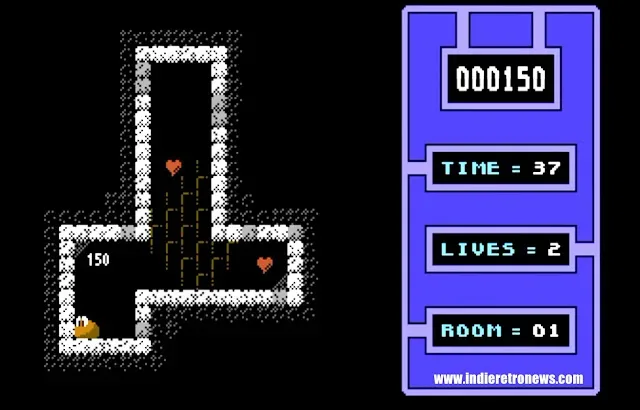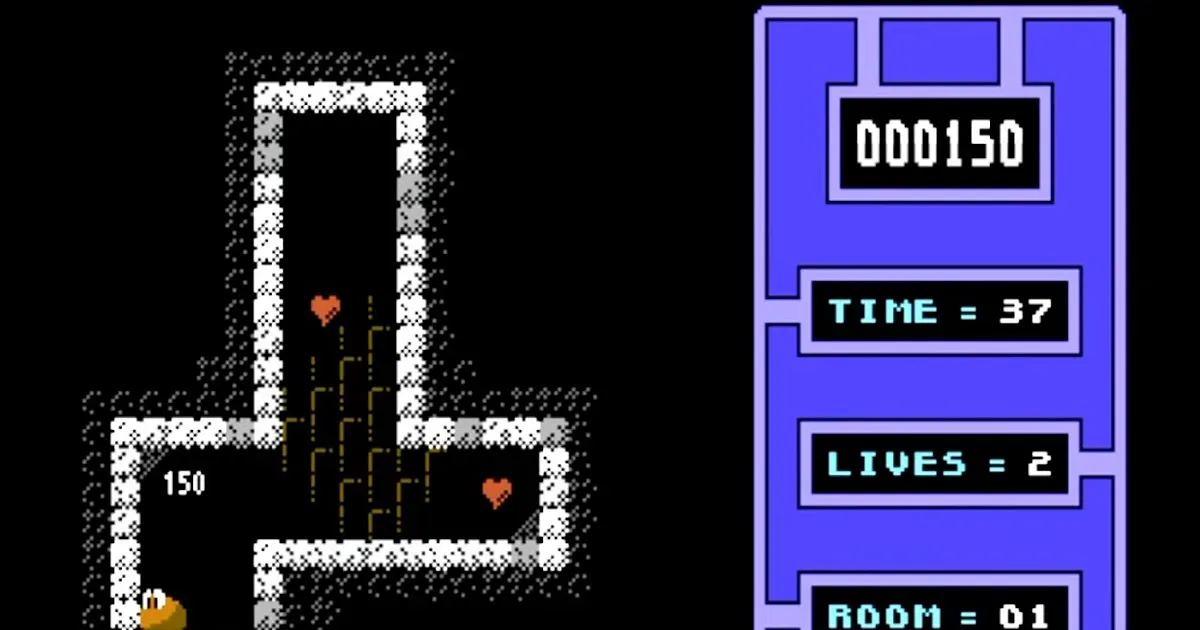
There is something beautifully direct about a Commodore 64 game that introduces its hero, its villain, and its central trick without wasting a second. EyedBall, the latest C64 release from LC-Games, puts players in control of a tiny rescuer entering a fortress ruled by Horloth. The assignment is urgent: the villain has abducted the inhabitants of a formerly peaceful land and imprisoned them in his dark domain, where their life force is being extracted and converted into beating hearts that fuel his kingdom.
That grim little premise has the sort of heightened, storybook-spooky energy that suits the machine especially well. EyedBall is not arriving as a conventional run-and-jump action game, though. It is presented as a puzzle-platformer built around room-by-room problem solving, perilous descents, collecting every transformed heart, and finding a way out before a timer expires. Its defining mechanic is a magical power that rotates the hero’s surroundings, reframing routes that were inaccessible a moment before.
For retro players who still enjoy games that make a single strong idea carry the whole adventure, that setup is immediately promising. The C64 has a long history of games that demand precision and patience from a joystick, and EyedBall appears designed to continue that tradition with a puzzle hook at its center.
A rescue mission inside Horloth’s fortress
The stakes of EyedBall are unusual enough to make the collectibles feel meaningful within its fiction. The hearts scattered through the fortress are not simply abstract score items: they represent Horloth’s victims after their captured life force has been transformed. EyedBall’s job is to recover them while pushing deeper through the stronghold.
The game spans 45 distinct rooms. Rather than describing one continuous world, that structure suggests a focused sequence of individual obstacle courses and puzzles. Each chamber can establish its own arrangement of platforms, hazards, enemies, exits and collectible hearts, asking players to understand the local problem before moving on. Room-based design has always worked well for compact retro puzzle games because every screen can function like a self-contained challenge, while the broader campaign retains momentum through steadily changing layouts.
The basic movement goal is also notably specific: EyedBall drops from platform to platform as players avoid threats below and around him. The hero does not have traditional weapons, so enemies and hazards cannot simply be cleared away with attacks. Survival depends on navigating their placement, choosing safe timing, and using the room-rotation ability intelligently.
That limitation matters. When a game removes combat, enemies become part of the puzzle’s geometry rather than targets to erase. A hostile creature can block an obvious landing spot, pressure a player to act quickly, or turn a seemingly simple route into a difficult sequence. Hazards serve a similar purpose. They establish areas that must be routed around, not powered through, and they make every decision about rotation potentially consequential.
Rotation is the key, not brute force
EyedBall’s central magical ability lets players rotate the surrounding environment. This is the mechanical idea that gives the game its identity: platforms and pathways that do not connect in one orientation may become usable after the room is turned. A heart that seems stranded beyond reach can become part of a viable descent. An exit that looks blocked may be approached from a new direction. The player is effectively asked to reconsider the entire screen whenever a route appears impossible.
Related coverage includes EyedBall Brings Rotating-Room Puzzle Platforming to Commodore 64.
That is a satisfying premise for a puzzle-platformer because it changes the question from “Can I make this jump?” to “What does this room need to look like for the jump to exist?” The distinction is important. Platforming skill still matters, especially when enemy avoidance and a time limit are involved, but the correct path begins with a spatial insight. In a game with 45 rooms, the potential variety comes from how each layout responds to the same core power.
Rotation also creates a natural tension between experimentation and commitment. A player may need to turn the environment to reveal a path, but any change can alter the relationship between platforms, dangers and the hero’s immediate position. With no weapon available to recover from a bad encounter through combat, planning becomes especially valuable. The intended rhythm appears to be observation, rotation, descent, collection and escape—followed by an increasingly urgent race as the clock keeps moving.
Teleporters add another wrinkle. EyedBall occasionally uses these devices to move across the screen, providing a way to traverse space that is separate from ordinary platform drops. In a game built around changing the room’s orientation, teleporters can make a layout feel less predictable: reaching one may be essential, but where it fits into the route depends on the state of the environment and the hazards nearby.
Every heart, then the exit
Each room has a clear completion requirement. Players must collect all of the transformed hearts and reach the exit before the time limit runs out. That combination means the shortest-looking route is not necessarily the winning one. A player still needs every required heart, so a route must be complete as well as safe. The exit becomes the final step in a route that has to account for the entire chamber.
Strict timers can make puzzle games feel intimidating, but they also give the format a strong replay loop. Learning a room’s solution is only part of mastery; executing it cleanly and without wasted movement is the next layer. A room that first seems like a confusing tangle can become a compact routine once its sequence is understood. In that sense, EyedBall’s timer does not merely threaten failure. It emphasizes efficiency and gives players a reason to return to a layout they have already solved.
Score progression provides additional incentive. An extra life is awarded at 20,000 points, followed by another extra life for every additional 30,000 points. Those thresholds give score-chasing a practical value alongside the obvious appeal of climbing a leaderboard or beating a personal best. Players working through a challenging fortress can potentially extend a run through careful, successful play.
There is no need for a giant checklist of systems when the systems already point in the same direction. Hearts establish the objective. The exit confirms completion. Timers create pressure. Teleporters complicate movement. Enemies and hazards punish careless routes. Rotation turns the whole chamber into a shifting puzzle. The extra-life scoring marks reward sustained performance. That is a lean framework, but it is one with plenty of room for tightly designed screens.
LC-Games returns to the C64
EyedBall follows prior work from LC-Games on unofficial C64 ports including H.E.R.O. Is Back, Lock'n'Chase, and Dig Dug. This new project takes a different path by foregrounding an original hero, original villain and a puzzle-platform concept centered on environmental rotation.
That distinction is welcome in the modern C64 scene. Familiar arcade concepts can be a great fit for the platform, but a new game can also use the language of classic design without simply recreating a remembered cabinet or cartridge. EyedBall’s room-count structure, score thresholds and hazards feel at home beside older action-puzzle traditions, while its rotation mechanic provides the feature around which its levels are organized.
The continuing flow of smaller projects across active and legacy platforms is one reason it remains worthwhile to watch the wider indie landscape; our look at indie games to keep on the radar shows how much variety can emerge when creators build around a defined idea. EyedBall belongs to a different hardware era, but its appeal rests on the same principle: a memorable mechanic can be more compelling than a pile of interchangeable features.
A compact concept with plenty of pressure
EyedBall’s description suggests a game that understands the particular pleasures of the C64: instantly legible rules, dangerous screens, score-driven persistence and a steadily escalating demand for control. Its cute-sounding hero and fantastical setting are paired with a mission that is darker than it first appears, while the rotating-world power promises the sort of “wait, what if I turn it?” problem solving that can make a single-room challenge stick in the mind.
With 45 rooms to clear, all hearts required for progress, teleporters to factor into routes, and a ticking deadline on every escape, Horloth’s fortress is positioned as a deliberate test of both puzzle awareness and joystick composure. EyedBall may be charming on the surface, but its rescue operation sounds built to keep players under pressure.