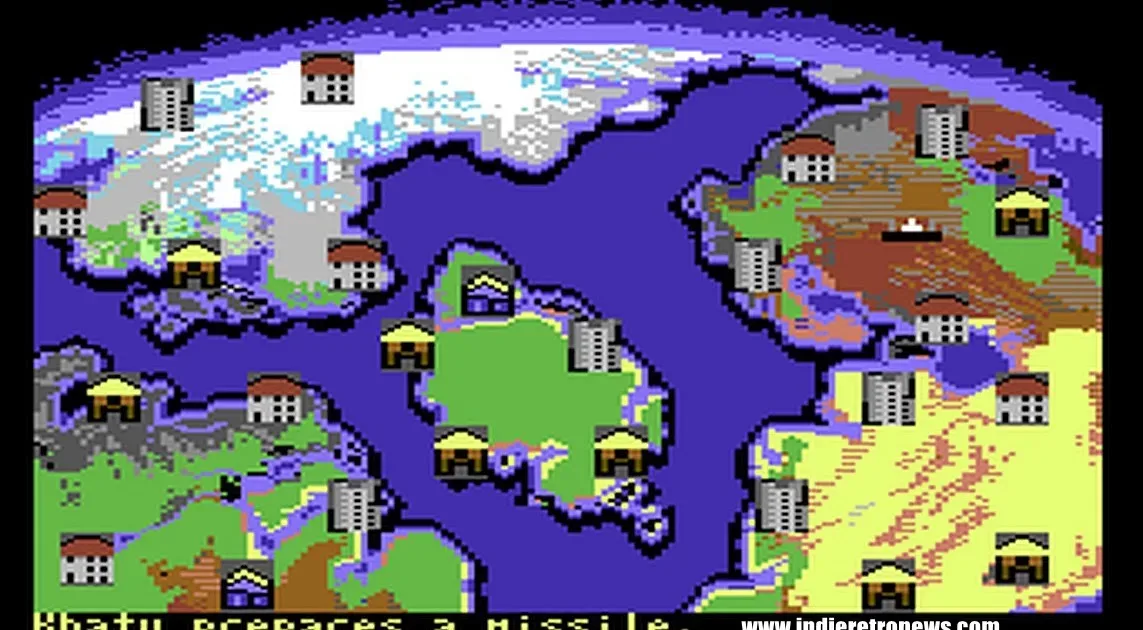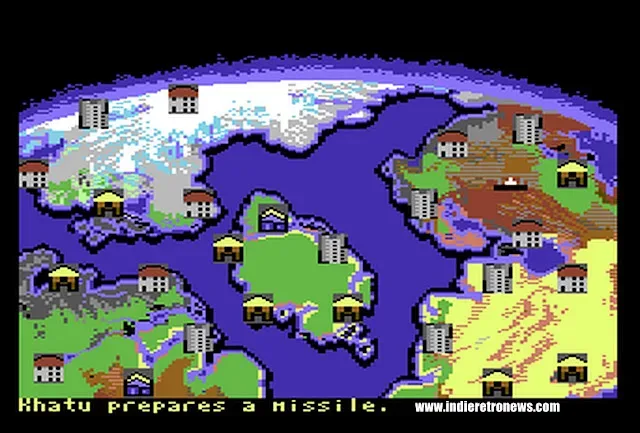
Commodore 64 players have a new cold-war-flavoured strategy contest on the horizon of the homebrew scene. Nuclear Party, from Vector5 Games, is a single-player turn-based game entered in the ZOO Party ’26 game-development competition. It takes clear inspiration from the classic Nuclear War concept: several hostile powers compete in a destructive contest, and only one is expected to remain.
The premise is deliberately blunt, but its play structure sounds more measured than a simple button-pressing race. Players face four AI-controlled opponents and must outlast them through round-by-round choices. The pivotal restriction is that warheads cannot simply be launched whenever a player wants. A delivery system must first be prepared on an earlier turn, forcing players to plan ahead before they can attack.
That preparation can take one of two forms: a bomber or a missile. Each has its own payload limits, so the decision is not merely aesthetic. The carrier chosen has to match the intended warhead. Nuclear Party’s basic loop, then, is about setting up an attack, committing to a delivery option, and weighing that commitment against the moves likely to come from four separate computer opponents.
A turn-based game built around commitment
Turn-based strategy means that the action is divided into discrete rounds rather than unfolding continuously in real time. Players make a choice, the game processes that choice, and the next decision point follows. That format can make even a small ruleset demanding, because the cost of a poor decision may not become obvious until several turns later.
Nuclear Party’s delivery-system rule is the most important stated example. Setting up a bomber or missile before a warhead can be deployed creates a visible gap between intent and execution. In practical terms, that means an attack is a plan rather than an instant reaction. If a player spends a turn readying one carrier, they have revealed—at least in broad strategic terms—that they are moving toward an offensive option. The remaining question is whether that setup will still be useful by the time the next turn arrives.
Payload constraints make the same choice more consequential. A player cannot treat every carrier as an all-purpose solution; they need to account for the size of the warhead they hope to use. The available evidence does not specify individual warhead sizes, carrier capacities, defensive options, or the exact effects of a strike, so those details remain for the game’s documentation rather than assumption. Still, the underlying design is clear: planning a delivery system and planning a payload are linked decisions.
That link should give the game a tactical rhythm. Smaller or differently constrained payload choices may change which carrier makes sense, while a player considering a larger warhead must first ensure their chosen method can carry it. The meaningful part is not raw destruction alone, but managing the prerequisites that make destruction possible.
Four AI rivals change the calculation
Nuclear Party is a solo game, but it is not a one-on-one duel. The player takes on four ruthless AI opponents. A five-way contest changes the normal logic of turn-based conflict: the player must consider not just whom to target, but who might benefit from every exchange.
Related coverage includes Nuclear Party Brings Turn-Based Nuclear Strategy to Commodore 64.
With multiple opponents, attacking one rival can leave another untouched and better positioned. Committing a turn to prepare an offensive delivery system can also be a strategic gamble if the board changes before that system is used. The stated victory condition—outlasting the rest until only one survivor remains—puts survival on equal footing with aggression.
This is where forward planning matters most. The game’s premise suggests that the best decision is not automatically the fastest route to an immediate strike. A player may need to judge when to spend a turn setting up a carrier, which payload requirement is worth accommodating, and how to avoid becoming an easy target while other AI combatants remain active. Those are familiar pressures in multiplayer free-for-all strategy, translated here into a single-player contest against computer-controlled factions.
The available game information does not establish how the AI prioritizes targets, whether it can be manipulated into fighting other opponents, or how much information a player receives about rival plans. Those unanswered points will shape the eventual depth of each match. What is already established is that four opponents ensure the player’s choices are being made within a crowded battlefield rather than a straightforward head-to-head exchange.
The manual is part of the game’s strategy layer
Vector5 Games directs players to the manual’s Command Center section for the full explanation of turn options. That is worth emphasizing for anyone approaching Nuclear Party expecting its premise to explain every system immediately. The game’s stated setup contains several interconnected decisions, and its documentation is positioned as the place to understand them properly.
For a new player, the useful starting point is likely to be identifying the order of operations: what can be done during a turn, when a delivery system becomes ready, and how payload restrictions affect the next move. From there, players can build a basic decision process:
- Read the Command Center rules before relying on assumptions drawn from the game’s theme.
- Choose between a bomber and missile with the desired warhead in mind.
- Remember that preparing the carrier uses an initial turn and delays the actual attack.
- Evaluate survival against all four AI rivals, not only the most obvious immediate target.
- Plan more than one round ahead, because the setup requirement makes last-second reactions less flexible.
None of these steps guarantee a win, but they follow directly from the game’s stated mechanics. In a system where delivery and payload must be compatible, an attack plan begins before the launch turn. In a game with four AI enemies, the player also has to preserve enough flexibility to respond when the wider contest changes.
A new C64 homebrew entry with familiar design roots
Nuclear Party arrives from the developer behind other 8-bit homebrew titles including Santa’s Workout, Zookeeper, and Splatch. “Homebrew” in this context refers to newly created software for older hardware rather than software released during that platform’s original commercial era. The Commodore 64 remains a destination for such projects, allowing creators to build new games around the machine’s constraints and audience decades after its original lifespan.
Its relationship to Nuclear War is described as a nod rather than a claim of identical systems. That distinction matters. Fans of the older game can reasonably expect a similarly darkly comic strategic framework and a nuclear-standoff theme, but they should look to Nuclear Party’s own manual for its specific rules. The confirmed systems are turn-based play, four AI enemies, carrier preparation, and differing payload constraints; anything beyond those should be treated as unconfirmed until documented by the game itself.
The appeal of a project like this is the compression of strategy into a restricted format. There are no stated sprawling campaign features, online modes, or vast factions to learn. Instead, Nuclear Party focuses attention on the exact decision that precedes an attack: what is being prepared, what can it carry, and whether the player can afford to commit now. That clarity can be valuable in a retro strategy game, where a few rules can produce tense consequences when opponents and turn order are involved.
For more on how a focused rules system can turn individual combat choices into meaningful resource decisions, see our look at Phantom Blade Zero’s weapon refund system. Nuclear Party approaches strategy from a very different era and format, but its carrier-and-payload restriction similarly makes preparation central to decision-making.
What players can take from the announced rules
Nuclear Party’s core promise is not simply a retro visual or hardware novelty. Its design asks the player to make an offensive commitment before the strike is possible, then survive long enough for that commitment to matter. The bomber-versus-missile selection is therefore the centre of its tactical identity, particularly because neither delivery method is presented as universally compatible with every warhead.
For Commodore 64 strategy fans—and especially players curious about a modern game that acknowledges Nuclear War—the clearest next step is to study the Command Center material, then approach early rounds with patience. The game rewards forward planning by design. With four AI opponents still standing, a prepared delivery system is only the beginning of the problem.