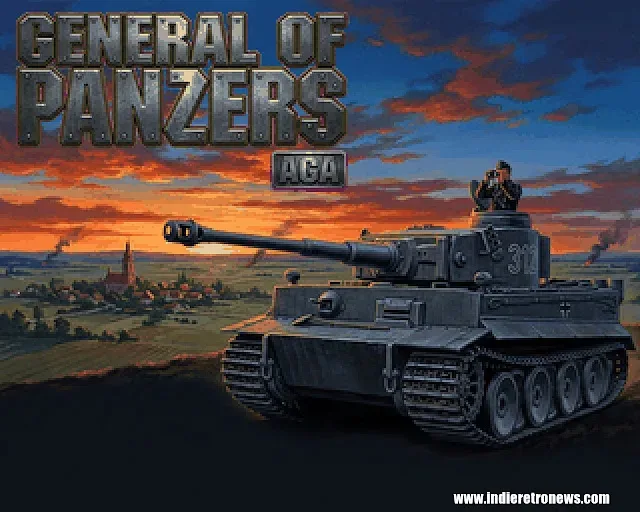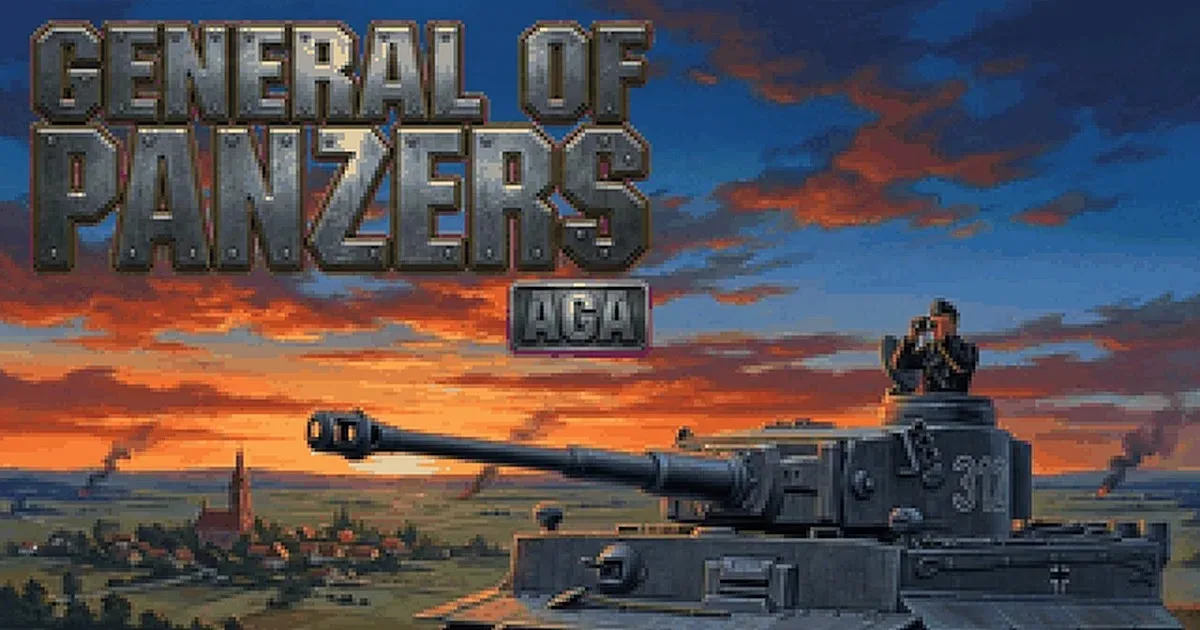
Amiga strategy fans have a new battlefield to survey: General of Panzers, a turn-based Second World War game from Fliegeralarm built for the Amiga 1200 and its AGA graphics chipset. The newly launched version 0.5 demo offers the opening two missions of both its German and American campaigns, presenting warfare from 1939 through 1943 on a hex-based map.
Its central idea is deliberately familiar to players who enjoy classic computer wargames. General of Panzers takes substantial inspiration from the Panzer General style of design: maps are divided into hexagons, turns are taken one side at a time, and successful play depends on positioning, supply and preserving useful troops rather than simply rushing toward an objective.
That is a particularly interesting fit for the Amiga. The project is designed specifically around AGA-era hardware rather than treating the machine as an afterthought, with a 256-colour palette, music and animated environments. It was made with the ACE engine for Amiga and with AI support. The game’s developer is explicit about the latter point, which gives players useful context when assessing the project and its development approach.
A hex map where placement is the plan
At its most basic, a hex grid is a map built from six-sided spaces. Strategy games often use hexes because each space has six neighboring directions, making movement and attack ranges more even than they would be on a square grid. A unit’s route, its surrounding terrain and the adjacent friendly or enemy positions can all matter. That turns every advance into a question: move quickly, hold ground, or create a safer line for the next turn?
General of Panzers also divides its battlefield into separate ground and air layers. The reported unit roster includes infantry, armor, paratroopers and warships, alongside air operations on their own layer. In practical terms, that suggests players will have more to consider than a single line of tanks rolling across a map. Ground troops can contest territory, while aircraft occupy a connected but distinct part of the tactical picture.
The setting supplies historical units and period photography, but the game also draws a clear boundary around its subject matter. It allows players to command armies of the period, including the German Wehrmacht, while stating that Nazi symbols are not shown. Its named “Aces” are fictional characters rather than real people.
The systems that can make a turn matter
The demo is described as featuring fog of war, supplies, morale, entrenchment and changing weather. These terms can sound like a dense checklist, but they describe the kinds of connected pressures that give turn-based military strategy its tension.
- Fog of war limits what the player can see about the battlefield. Rather than having perfect information, commanders must make decisions without knowing every enemy position or immediate intention.
- Supply lines represent the resources needed to keep a force operating. A unit may be in a strong-looking position yet become vulnerable if it cannot be supported.
- Morale concerns a unit’s fighting condition or resolve. It gives battles another possible consequence beyond immediate losses.
- Entrenchments are defensive preparations. They make the choice to pause, fortify and absorb an attack potentially as important as the decision to advance.
- Weather changes the conditions of a battle. Because the game has both ground and air layers, weather is positioned as part of the wider tactical puzzle rather than mere scenery.
Those systems are meaningful because they discourage a one-note approach. An armored unit may look like the natural spearhead of an offensive, but an attack could carry different risks when visibility is limited, a defensive position is prepared, or the unit has outrun its support. Likewise, a force that survives but loses its readiness can leave an opening on a later turn.
The computer opponent is described as planning counter-moves with a chess-like focus. That comparison should not be mistaken for a claim about any specific AI technology or difficulty level. It does, however, indicate the intended rhythm: a player’s turn is not a safe moment to perform a series of isolated actions. Every exposed flank or overextended advance can become something the opposing side tries to exploit.
A campaign force, not disposable counters
One of General of Panzers’ most important features is its emphasis on maintaining a core army. Units that survive can gain experience, medals and specialized refits over time. This makes the game a campaign strategy experience, not just a collection of unconnected scenarios where every battle begins with a blank slate.
Experience gives a practical reason to protect formations that have already proven themselves. Refits imply that a unit can be adapted or improved as the campaign develops. Together, those mechanics make losses matter beyond the immediate tactical damage. Sacrificing a veteran unit to capture a position may be possible, but it may also mean giving up a piece of the force that has accumulated value across prior missions.
The Ace system adds another layer to that risk. Units can be joined by individual fictional Aces with biographies and special combat bonuses. An Ace is tied to the unit carrying that character; if the unit is lost, the Ace is gone permanently. That is a sharper stake than losing a generic counter, and it may encourage a more conservative use of prized formations.
There is a useful distinction here. Persistent progression does not automatically mean a campaign is easier over time. It means choices have longer-lived consequences. Players may need to weigh immediate victory against a unit’s survival, decide which formation deserves a refit, and determine whether a special bonus is worth placing near a dangerous objective. The game’s stated combination of morale, supply, weather and persistent veterans is aimed squarely at that kind of planning.
An undo feature changes the learning curve
General of Panzers includes an integrated undo feature. In a strategy game with several interlocking systems, undo can be more than a convenience. It can help players learn why a particular move fails: perhaps an advance left a formation exposed, perhaps an enemy response was more dangerous than expected, or perhaps a different order of operations produces a better result.
It is not yet clear from the available details how broadly undo works, how many actions it covers, or whether it is restricted in particular circumstances. Still, its inclusion is notable for a game that asks players to handle separate air and ground layers while tracking battlefield conditions. It could make the demo more approachable for newcomers to hex-based strategy without changing the underlying demand for careful decision-making.
What version 0.5 actually contains
The current demo is version 0.5, and its playable content is specifically described as the first two missions in each of the German and American campaigns. That is four opening missions in total, not confirmation of complete campaigns or a final feature set. As a demo, it is best understood as an opportunity to see the game’s core map, unit and campaign systems in action rather than a definitive statement on the finished scope.
Multilingual support is included, alongside historical detail, music, period imagery and animated environments. The reported battlefields span the 1939–1943 period, establishing the time range covered by the material described so far. No further campaign length, mission count or release schedule is established by the available information.
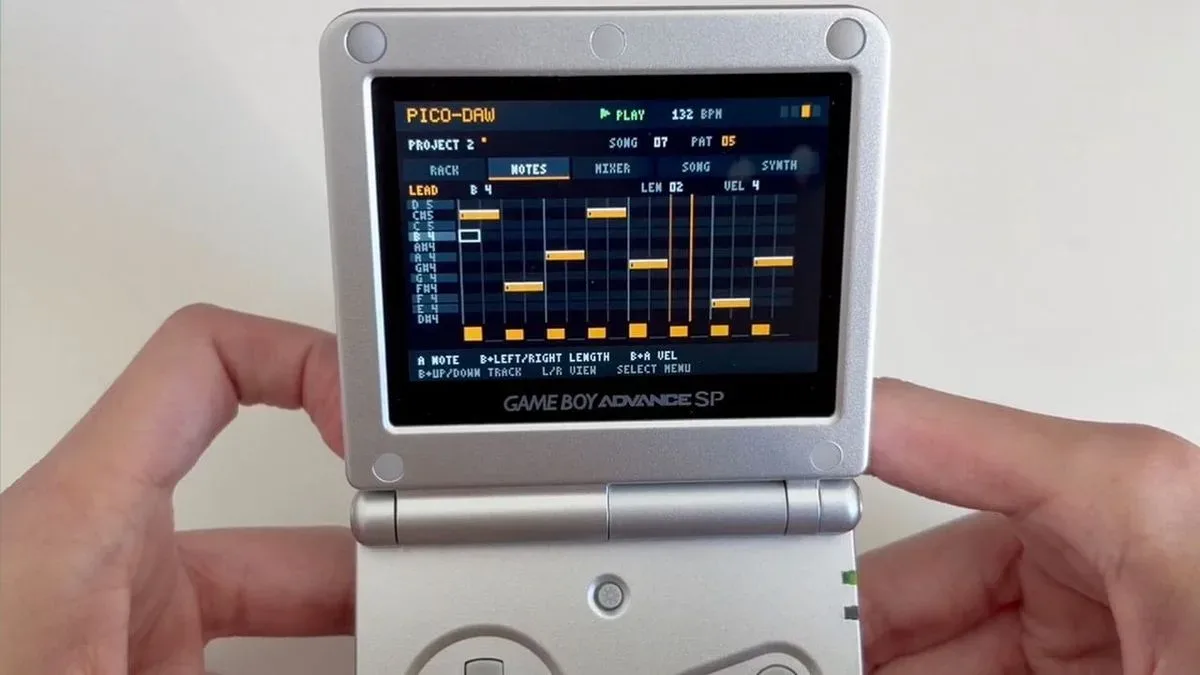
For the broader retro scene, General of Panzers is another reminder that period-targeted software can still pursue genres usually associated with larger computer systems. The focus is not nostalgia alone: it is a modern project attempting to fit a substantial, rules-driven strategy design into an Amiga-native package. Other current projects likewise keep older machines in active technical conversation, from games to tools such as this Game Boy Advance music sequencer.
Hardware requirements for the demo
General of Panzers is intended for an Amiga 1200 or compatible system with the AGA chipset and a 68020 processor or better. The listed memory requirement is 2 MB of Chip RAM plus 2 MB of Fast RAM. It also calls for hard-disk installation space of roughly 10 MB, with mouse and keyboard input.
- System: Amiga 1200 or compatible AGA machine
- Processor: 68020 or better
- Memory: 2 MB Chip RAM and 2 MB Fast RAM
- Storage: approximately 10 MB on a hard disk
- Controls: mouse and keyboard
“Chip RAM” and “Fast RAM” are distinct Amiga memory categories, so both figures matter when checking a compatible setup. The hard-disk requirement is equally worth noting for users whose configuration is closer to an original-era machine than a modernized Amiga environment.
For now, version 0.5 is the point of entry: four introductory campaign missions, a purpose-built Amiga strategy framework, and enough interconnected mechanics to show whether Fliegeralarm’s campaign of supply, survival and veteran units can establish a durable foothold on the hex map.