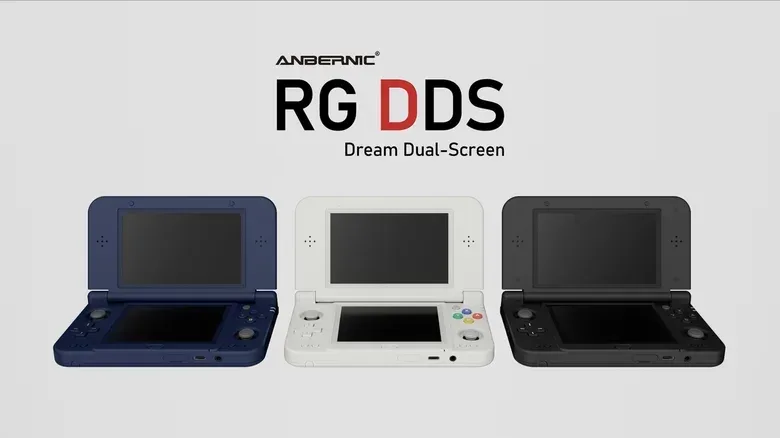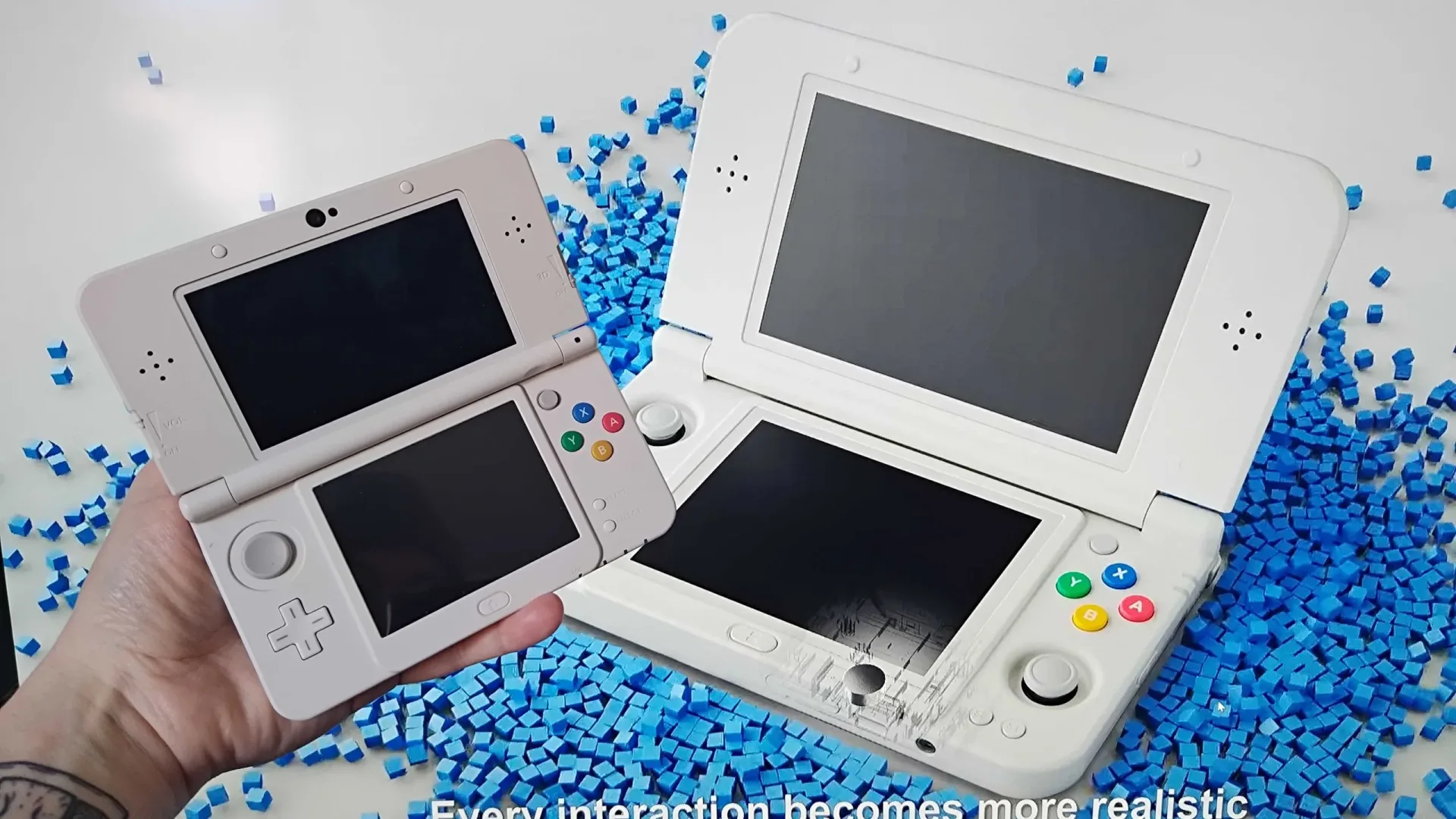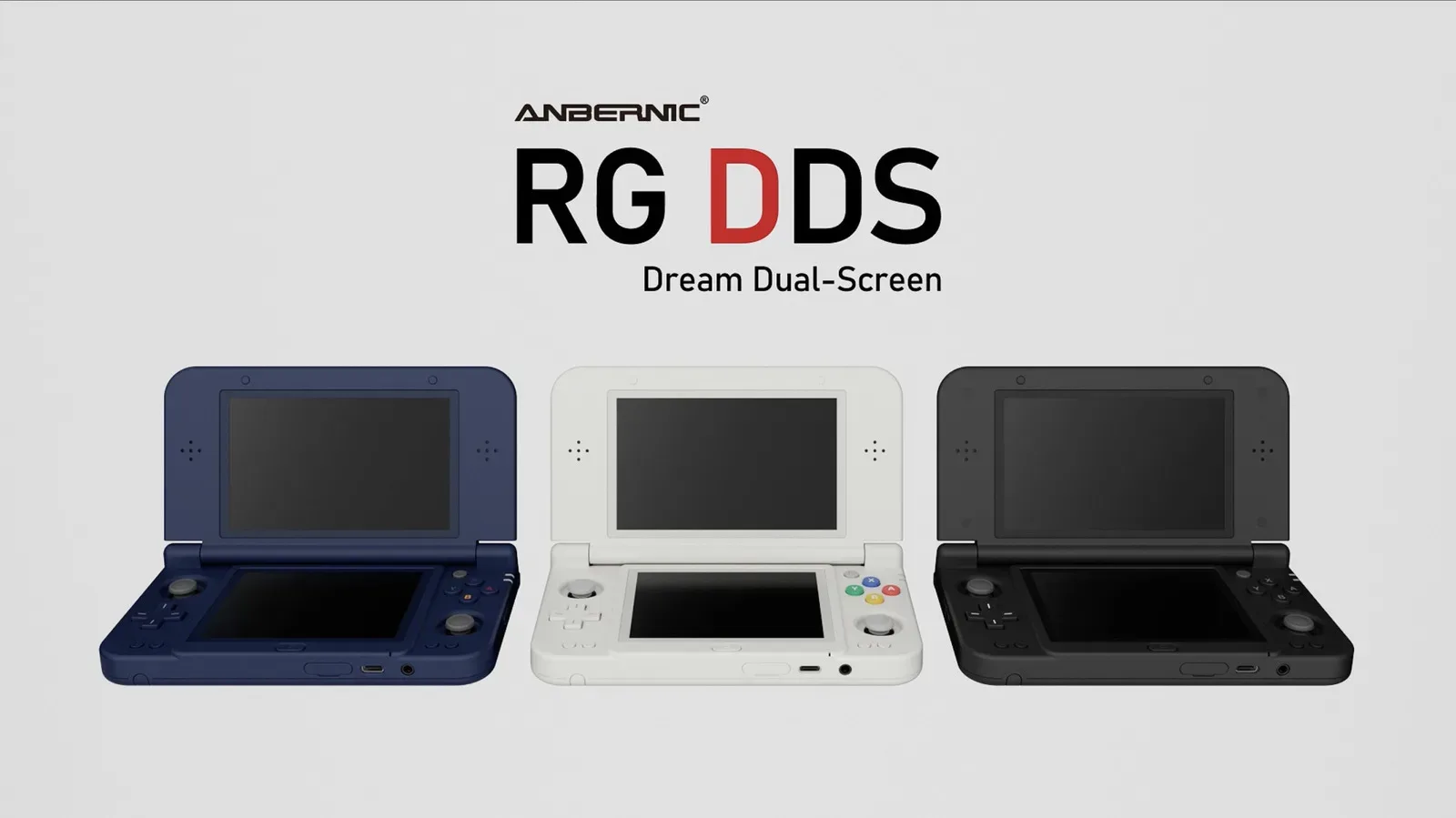
Anbernic has revealed the RG DDS, a new clamshell handheld whose “Dream Dual-Screen” name and physical layout unmistakably point toward the Nintendo 3DS format. The company has not announced a release date or price, and several important specifications remain unknown. Still, the details shared so far make its intended use unusually clear: this is a dual-screen machine built to make the proportions of 3DS-era software feel far less compromised than they can on a single modern widescreen display.
The central design decision is the display pairing. The RG DDS has a 4.7-inch upper screen at 1,200 x 720, producing a 5:3 aspect ratio, alongside a 4-inch lower screen at 960 x 720 in 4:3. Those shapes match the respective screen proportions associated with the 3DS layout. It is a practical choice rather than a mere visual callback: games designed around separate upper and lower panels are easier to present faithfully when each screen’s geometry resembles the original target.
Anbernic is also moving beyond the hardware used in its earlier RG DS. The RG DDS is set to use Qualcomm’s Snapdragon G2 Gen 2 chip, while the company has confirmed a 6,000mAh battery. Its controls broadly follow the familiar dual-screen handheld blueprint but add a second analog stick on the right. There is an extendable capacitive stylus that stores in the device, plus a dedicated AI button whose function has not been explained.
Why the screen ratios are the important specification
“Aspect ratio” describes the relationship between a display’s width and height, not its physical size or sharpness. A 5:3 panel is wider relative to its height than a 4:3 panel. In the RG DDS, the upper 1,200 x 720 display is shaped for the wider top-screen presentation, while the lower 960 x 720 display keeps the squarer proportions used for touch-oriented menus, maps and other secondary information.
That distinction is meaningful for software designed around two non-identical screens. On a single 16:9 handheld screen, an emulator may need to shrink both displays, place them side by side, stack them with unused space, crop them, or let the player switch focus between them. Every option involves a trade-off. Text can become small, touch interaction can feel less natural, and the relationship between top-screen action and bottom-screen information can be disrupted.
The RG DDS approach does not establish its final emulation quality by itself. Display shape is only one part of the experience. Software support, screen configuration controls, touch handling, performance and operating-system design will all matter. But matching the basic physical arrangement and panel ratios removes a conspicuous obstacle before the user even reaches a settings menu.
Resolution adds another part of the story. The upper panel provides 1,200 x 720 pixels, while the lower offers 960 x 720. Both screens share a 720-pixel height, which should make vertically stacked presentation visually coherent. The differing widths preserve the intended 5:3 and 4:3 shapes rather than forcing two same-size rectangles into a design that was not made for them.
A more ambitious chip, with questions still attached
Anbernic says the RG DDS uses Qualcomm’s Snapdragon G2 Gen 2. That is a substantial change from treating the device solely as a low-power retro system. The stated expectation is that the handheld should be capable of emulating games up through Nintendo Switch and PlayStation 2 libraries.
Related coverage includes Anbernic RG DDS Revealed With 3DS-Focused Dual-Screen Design.
That wording deserves care. “Emulation” means software recreates the behavior of one system on different hardware. It is not a single on/off feature based only on processor power. Results can differ dramatically from one emulator to another and from one game to the next. A more capable chip can create greater headroom, but it does not by itself confirm that every title on a named platform will perform correctly, look right, or have usable controls.
Nothing revealed so far confirms which software environment the RG DDS will ship with, which emulators it will support, how dual-screen layouts will be configured, or what level of compatibility users can expect across any platform. It is also not yet clear whether the device’s extra right analog stick will receive dedicated mappings in all relevant applications. Those unanswered details are especially important because this handheld is pitching itself on a format, not simply raw horsepower.
For potential buyers, the most sensible reading is that the Snapdragon G2 Gen 2 gives the RG DDS broader potential than its predecessor, while the actual experience will depend on implementation that has not been detailed. The strongest concrete claim at this stage is the hardware configuration itself: dual displays, their resolutions and ratios, the chip family, the battery capacity, the stylus and the control layout.
The controls preserve the two-screen premise
Anbernic’s control arrangement remains close to the Nintendo-style design that inspired the product, with one notable adjustment: a second analog stick on the right side. Extra analog input may be useful for systems and games designed with more modern control schemes in mind, particularly if the company’s performance ambitions extend beyond earlier handheld libraries.
The extendable capacitive stylus may be just as consequential for the device’s core audience. A capacitive stylus works with a capacitive touchscreen, the common touch-input technology used by many modern devices. Its inclusion and built-in storage suggest that touch interaction is being treated as a normal part of the handheld rather than an optional accessory use case. That matters for dual-screen software where the lower display may be central to navigation, inventories, maps, puzzle input or menu actions.
At the same time, the announcement does not specify the lower screen’s touch behavior beyond the presence of that stylus. Buyers should avoid assuming details that have not been announced, such as screen finish, latency, pressure sensitivity or the exact behavior of any touch interface in the system software.
The mysterious AI button is not yet a feature list
The RG DDS also has a dedicated AI button, but Anbernic has not said what it activates. This is the most conspicuous unknown in the revealed control set. A dedicated button implies an intended shortcut or system-level function, yet there is no basis yet to say whether it relates to assistance tools, interface features, voice functions, game-related utilities or something else entirely.
That uncertainty is worth separating from the rest of the announcement. The displays, battery capacity, processor and physical stylus are described hardware details. The AI button is currently an unelaborated promise of functionality. Until Anbernic explains it, it should be viewed as a labeled control rather than a confirmed reason to buy the handheld.
Price and timing remain the biggest practical unknowns
Anbernic has not provided either a launch date or a price for the RG DDS. The earlier RG DS was priced at $99, and the newer model is expected to cost more. That expectation follows the move to Snapdragon G2 Gen 2 hardware and the more explicitly 3DS-oriented screen design, but no official figure has been supplied.
The announced device may also compete for attention with the Retroid Pocket Duo and its Lite variant, which starts at $149. Whether the RG DDS ultimately undercuts that entry point, matches it, or lands above it remains unknown. Anbernic’s reputation for relatively affordable handhelds provides context, not confirmation.
Pricing will be especially important because the RG DDS is selling a combination of design choices rather than one headline specification. A buyer who mainly wants a small general-purpose emulation handheld may weigh processor performance and cost most heavily. Someone specifically interested in games structured around two vertically stacked screens may place much more value on the matched 5:3 and 4:3 panel layout, physical clamshell form, stylus and touch-ready lower display.
The broader dual-screen-device conversation also shows why demonstrations, final software and real availability matter as much as an initial reveal; similar practical questions have surfaced around dual-screen hardware retail plans. For the RG DDS, the unanswered questions are more product-specific: final internals, software support, AI-button behavior, price and release timing.
What the reveal establishes—and what it does not
The RG DDS is not simply another compact handheld with a nostalgic control layout. Its two displays have intentionally different shapes, with a 5:3 upper screen and 4:3 lower screen that align with the 3DS-style arrangement it is evoking. The 4.7-inch and 4-inch panels, Snapdragon G2 Gen 2 chip, 6,000mAh battery, extra analog stick and stowable stylus form a coherent design centered on that use case.
But it remains an early reveal, not a complete technical briefing. There is no release date, no official price, no full internal-specification list, no explanation of the AI button and no confirmed compatibility breakdown. The processor’s stated potential makes the RG DDS interesting beyond a single generation of games, yet its most distinctive strength is much simpler: it gives dual-screen software a purpose-built pair of screen shapes instead of asking it to adapt to one generic rectangle.