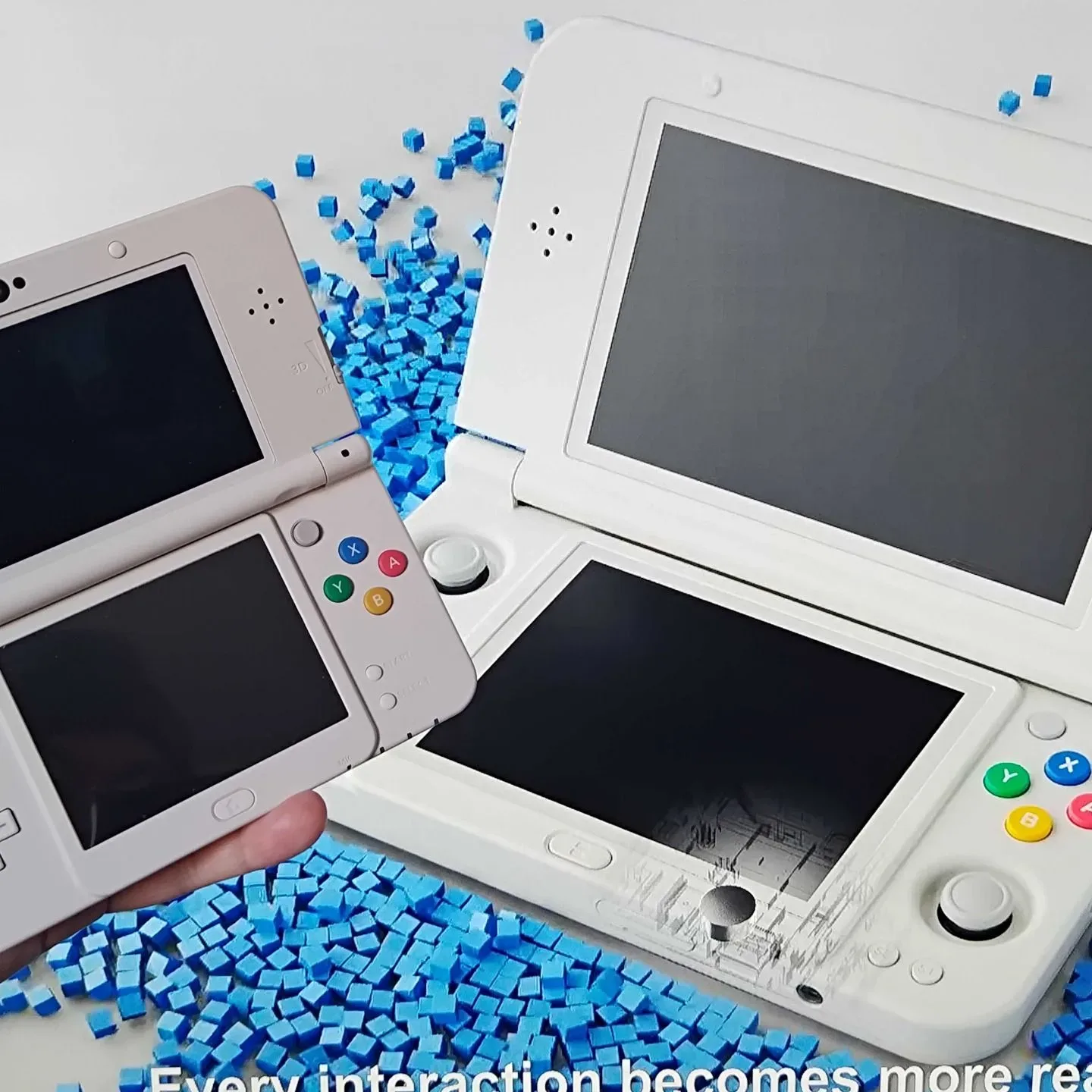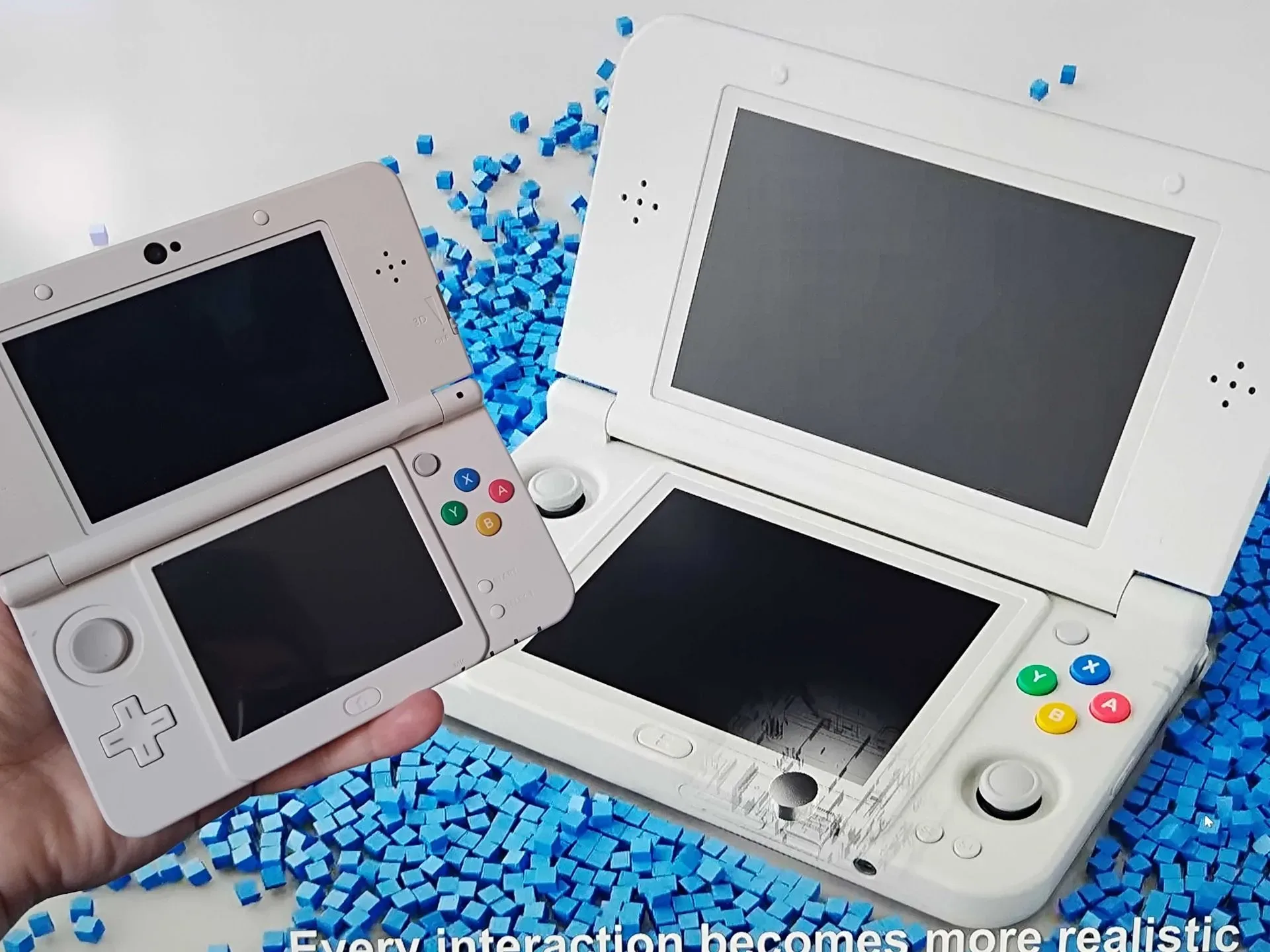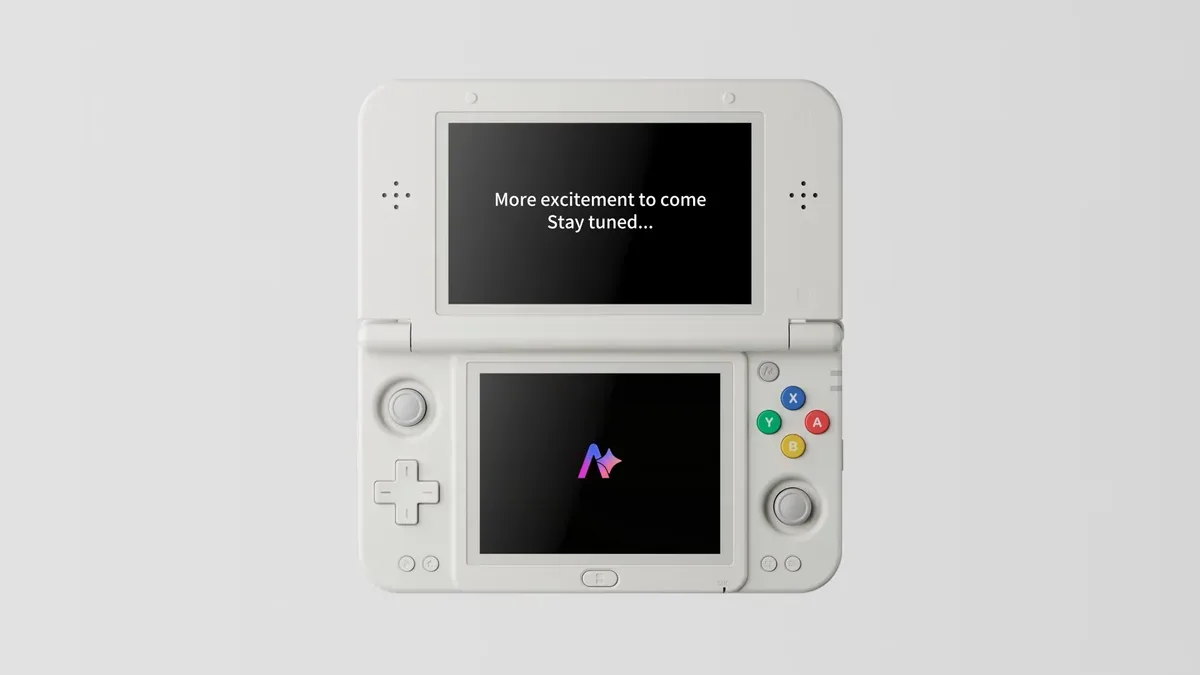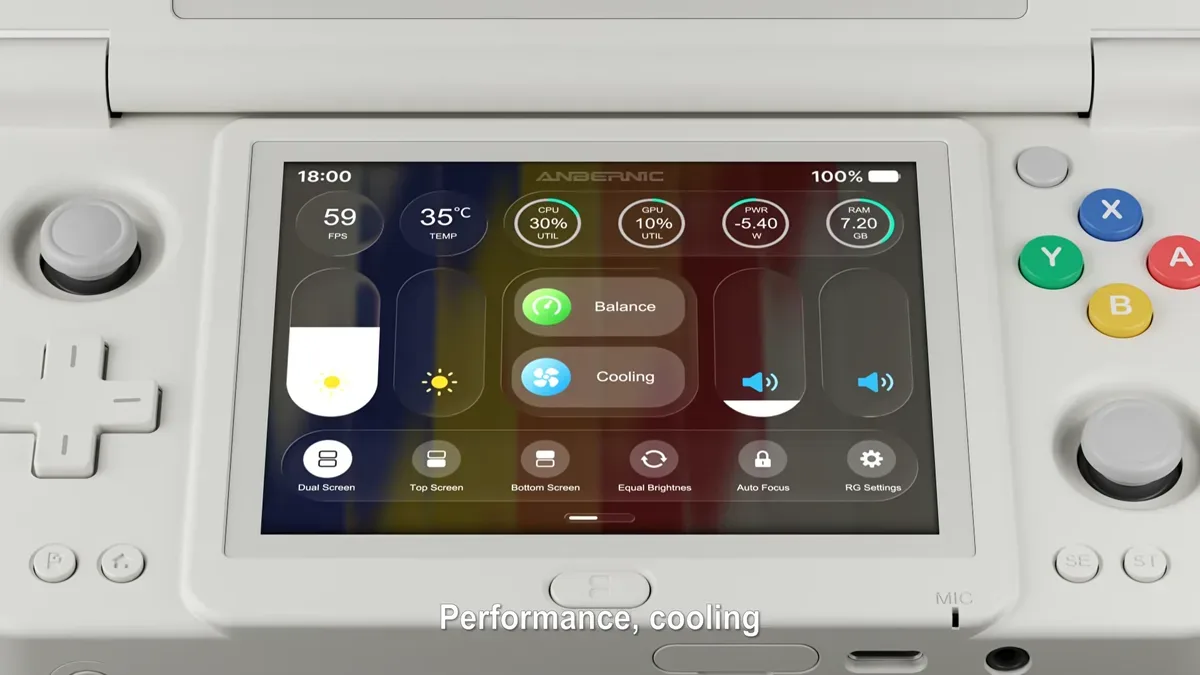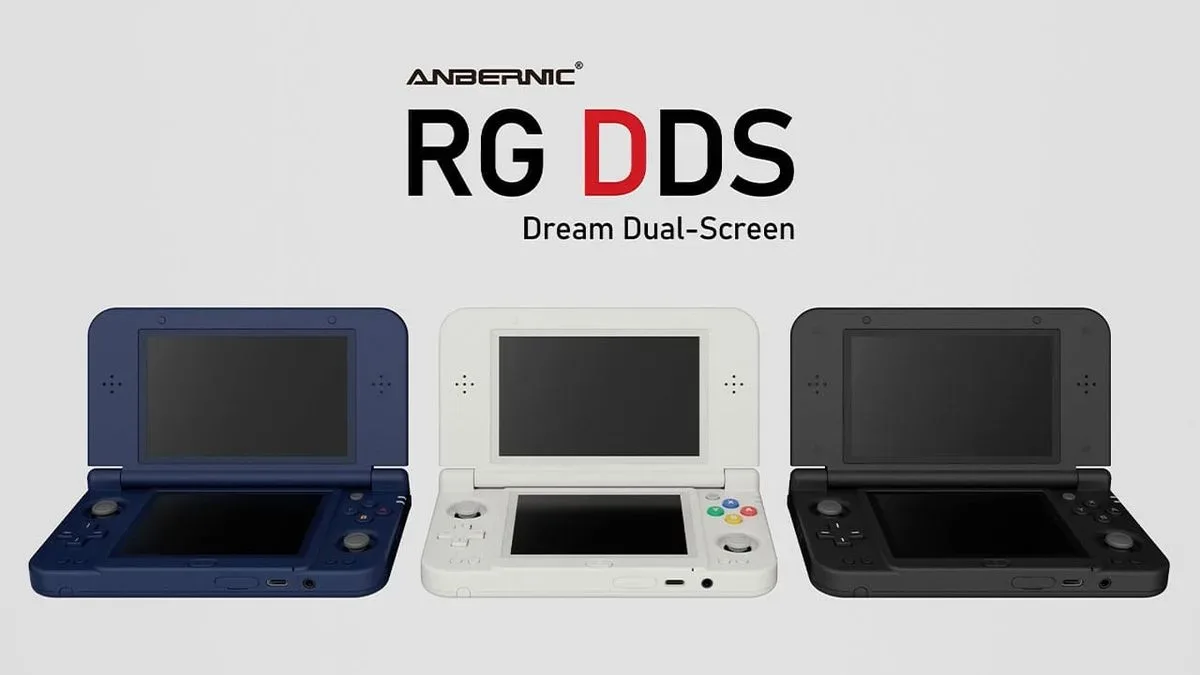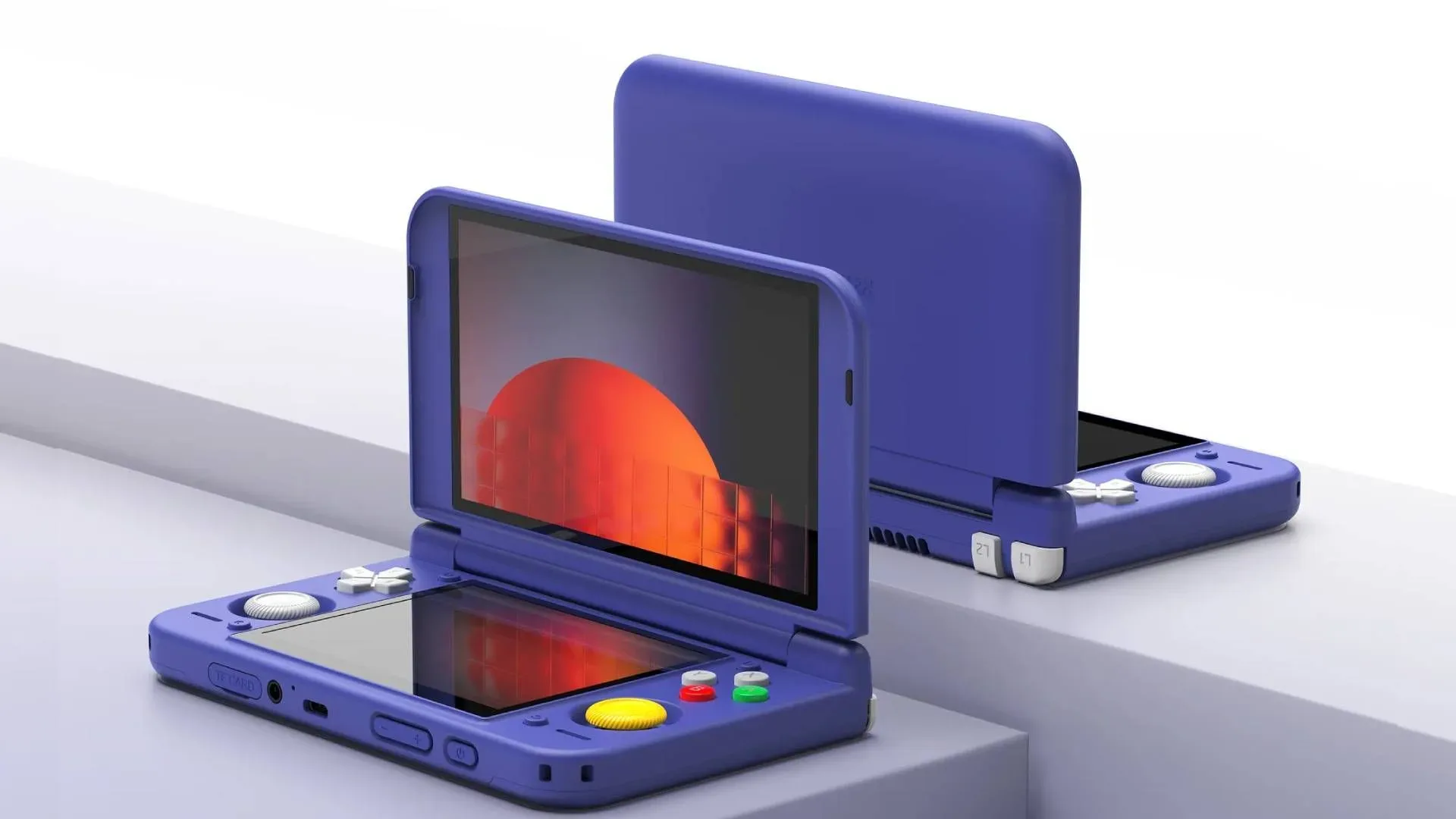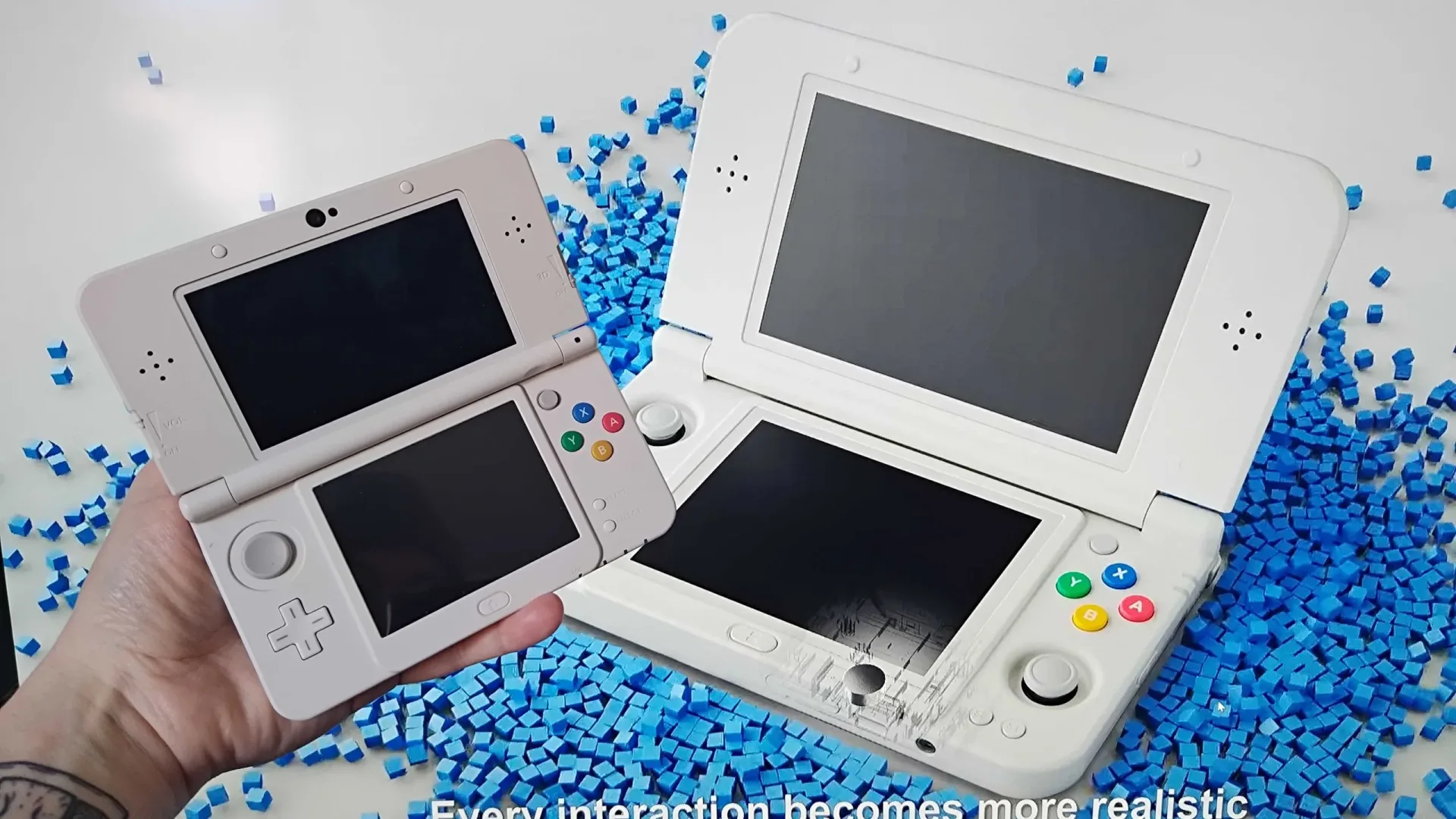
Anbernic’s next dual-screen handheld appears to be aiming well above a basic Nintendo DS-style throwback. The newly teased RG DDS takes conspicuous visual cues from the 2014 New Nintendo 3DS, but its stated hardware suggests a more ambitious purpose: running games designed around the 3DS’s two-display format at substantially increased internal resolution.
The central claims are a Qualcomm Snapdragon G2 Gen 2 chipset and support for “true” 3x integer scaling for 3DS content. The device does not include the original 3DS family’s stereoscopic 3D effect, so this is not a literal recreation of Nintendo’s handheld. It is instead a clamshell Android-style emulation device built around a familiar layout, with larger, sharper screens and modern controls.
There is no confirmed price, release date, RAM configuration or complete specifications list yet. Those omissions matter. Still, the teaser provides enough detail to place the RG DDS as a potentially more premium companion to Anbernic’s existing and recently discussed DS-oriented hardware rather than a replacement for an entry-level system.
A familiar clamshell, but not a one-to-one 3DS replica
At a glance, the RG DDS looks deliberately close to the New Nintendo 3DS design language: a compact folding shell, vertically stacked displays, face buttons and a centrally familiar handheld silhouette. But the measurements separate it from the original inspiration.
The upper screen is listed at 4.7 inches with a 720 x 1200 resolution, while the lower display is 4 inches at 960 x 720. That means the RG DDS is larger than the machine it resembles, and its panels offer far more pixels than the 3DS-era hardware. The display arrangement is important for dual-screen software, where the second screen is part of the game interface rather than merely an optional menu.
Higher resolution alone is not a guarantee of better results. The system also needs enough processing headroom to render software at increased resolution without producing unacceptable slowdowns. That is where the Snapdragon G2 Gen 2 claim becomes significant. Anbernic is positioning the chip as the engine for more demanding 3DS-oriented emulation, rather than solely the older DS library.
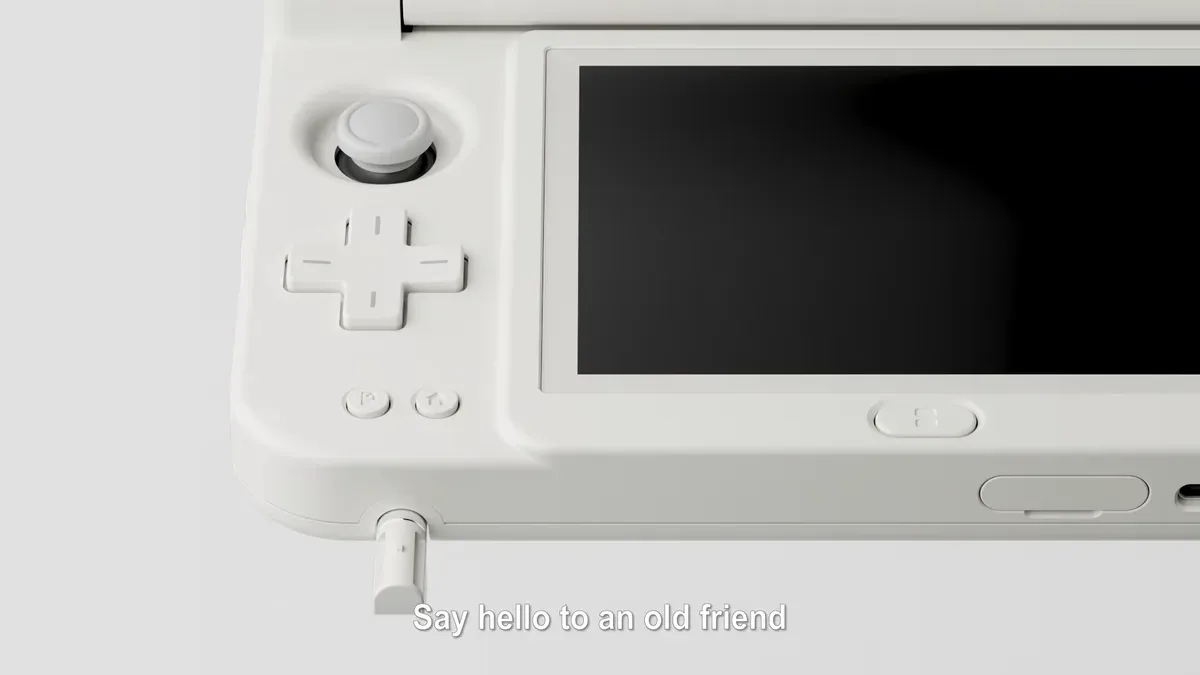
The design changes are not purely internal, either. Instead of copying the original 3DS control setup exactly, the RG DDS uses two full-size recessed thumbsticks. That is a practical departure from the 3DS’s small C-Stick nub and should give the device a more conventional modern-handheld control arrangement. Whether the sticks, buttons and hinge feel good in use cannot be determined from a teaser, but this is clearly not an attempt to reproduce every quirk of the older design.
What 3x integer scaling means
“Integer scaling” is a useful term to unpack because it is one of the headline specifications. In simple terms, it means expanding an image by a whole-number multiple—such as two times or three times—rather than stretching it by a fractional amount. Whole-number scaling can preserve an evenly structured image because each original pixel maps cleanly to a consistent block of display pixels.
Related coverage includes Anbernic Teases RG DDS, a Dual-Screen Handheld Built for 3DS-Style Emulation.
For emulation, that can matter aesthetically. Older games were built for specific screen resolutions and display characteristics. Rendering them at a higher internal resolution can make the image appear cleaner on modern panels, while integer scaling is intended to avoid some of the unevenness that can come from arbitrary resizing.
In the RG DDS’s case, Anbernic’s stated 3x target lines up particularly neatly with the lower panel’s 960 x 720 resolution. The original 3DS lower screen resolution is 320 x 240, and tripling each dimension reaches 960 x 720. The upper panel’s 720 x 1200 layout likewise reflects the unusual wide-screen geometry associated with the 3DS family. The company is therefore not merely advertising higher-resolution screens in isolation; it appears to have selected resolutions that fit the intended dual-screen use case.
That does not mean every game’s performance is settled by the screen math. Rendering at three times the original resolution increases the graphics workload. Compatibility, emulator software, operating-system setup, memory capacity and thermal behavior will all help determine how consistently a device can meet such a target. Since Anbernic has not yet detailed the RG DDS’s RAM or wider software configuration, the 3x claim should be viewed as a stated goal and capability rather than proof of identical results across an entire library.
Hardware details revealed so far
The RG DDS teaser identifies several physical features beyond its displays and processor:
- An integrated stylus, placed along the left side of the clamshell.
- A headphone jack on the right side.
- MicroSD storage access and USB-C along the bottom edge with the other input/output hardware.
- Front-firing speakers, which place sound toward the player rather than underneath the device.
- A 6,000mAh battery.
- A z-axis linear vibration motor, described as providing stronger, more nuanced feedback.
- Dedicated front buttons for the emulation suite and operating system, including Home, R, ST and SE controls.
- A dedicated AI button at the upper-right area of the interior.
The stylus deserves particular attention. A dual-screen machine can imitate the shape of a DS or 3DS, but touch input is where many games turn that form factor into something more than a novelty. An integrated stylus makes the accessory less likely to be separated from the handheld, and its left-side placement is a noticeable layout decision. It also mirrors a feature shown for the recently announced RG DS Plus.
The lack of a cartridge slot is equally unsurprising for this category of handheld. Storage will instead rely on microSD media, while USB-C covers charging and potentially other connectivity functions. Prospective buyers should not confuse a 3DS-inspired chassis with compatibility for original game cards; no such slot has been shown.
The 6,000mAh battery is a sizable capacity on paper, but capacity should not be confused with a verified battery-life figure. Actual endurance depends on display brightness, processor load, speakers, vibration and software behavior. Until Anbernic publishes runtime estimates or the hardware reaches users, it is more accurate to treat the battery figure as a capacity specification, not a promise of a certain number of hours.
The AI button is the biggest unanswered design choice
One of the stranger inclusions is a dedicated AI button, positioned where the older 3DS design had a small camera-related feature. The teaser identifies the button but does not explain what it will activate, whether its behavior can be changed, or how useful it will be within the device’s operating system.
That makes it difficult to judge as a feature rather than a label. A physical shortcut can be helpful when it launches a function used frequently, but it can also become wasted surface area if the feature is poorly defined or rarely needed. Anbernic will need to clarify the button’s purpose before it can be counted as meaningful value.
More broadly, this is an example of why full specifications matter. A product teaser can communicate the broad ambition of a device—larger panels, stronger silicon, a folding shape—but it cannot answer every practical question. Storage options, RAM, software support, wireless features, charging behavior, dimensions, weight and price will all affect the eventual comparison with competing dual-screen systems.
Where the RG DDS fits among Anbernic’s own options
Anbernic already sells the RG DS at around $100, positioned for older Nintendo DS-era games. It has also recently shown the RG DS Plus. Elsewhere in the lower-cost clamshell space, the MagicX Zero 40 has been cited at $75 for a similar broad DS-style experience.
The RG DDS looks set apart by its stated focus on the more demanding 3DS generation, the Snapdragon G2 Gen 2 chipset and its higher-resolution display pairing. In other words, the decision is not simply between a clamshell and a non-clamshell: it is between an affordable device aimed at simpler DS workloads and a machine designed to pursue a higher visual and processing target.
That context also explains why price will be decisive. No official RG DDS price has been revealed. A figure around $200 has been speculated, but it remains speculation rather than a confirmed MSRP. The device is being discussed alongside the Retroid Pocket Duo and Ayn Thor, and its appeal will hinge on whether Anbernic can offer comparable dual-screen capability at a convincing cost without cutting corners that undermine the larger displays or processor.
For Nintendo fans, the renewed interest in hardware shaped around two screens is a reminder that design formats can remain compelling long after a platform’s original cycle. It also sits alongside broader conversations about Nintendo’s catalogue and remakes, including the changing role of remakes in Nintendo’s release strategy. The RG DDS is not an official Nintendo product, but its entire pitch depends on the lasting appeal of an interface that made separate screens, touch controls and a clamshell body central to how games were played.
What to watch before treating it as a premium contender
The teaser makes the RG DDS look like a credible candidate for the higher end of dual-screen retro handhelds, particularly for players who value a native two-panel layout over using a single widescreen display with virtual screen arrangements. Its proposed strengths are clear: screens designed around 3DS scaling, a modern Qualcomm chip, full-size sticks, front-facing audio, an included stylus and a large stated battery capacity.
But the unanswered details are just as important. There is no official launch timing, no MSRP, no RAM figure and no comprehensive software or performance breakdown. The “true” 3x scaling statement is promising, yet users should wait for more complete information before assuming the same experience in every title or configuration.
For now, the RG DDS is best understood as a teased premium-leaning dual-screen handheld: a device that borrows the New Nintendo 3DS’s outline while making a case for larger displays, different controls and substantially more powerful internals. Its final standing will come down to the details Anbernic has not revealed yet.
Shop the products
Check current price, model and availability at the retailer.