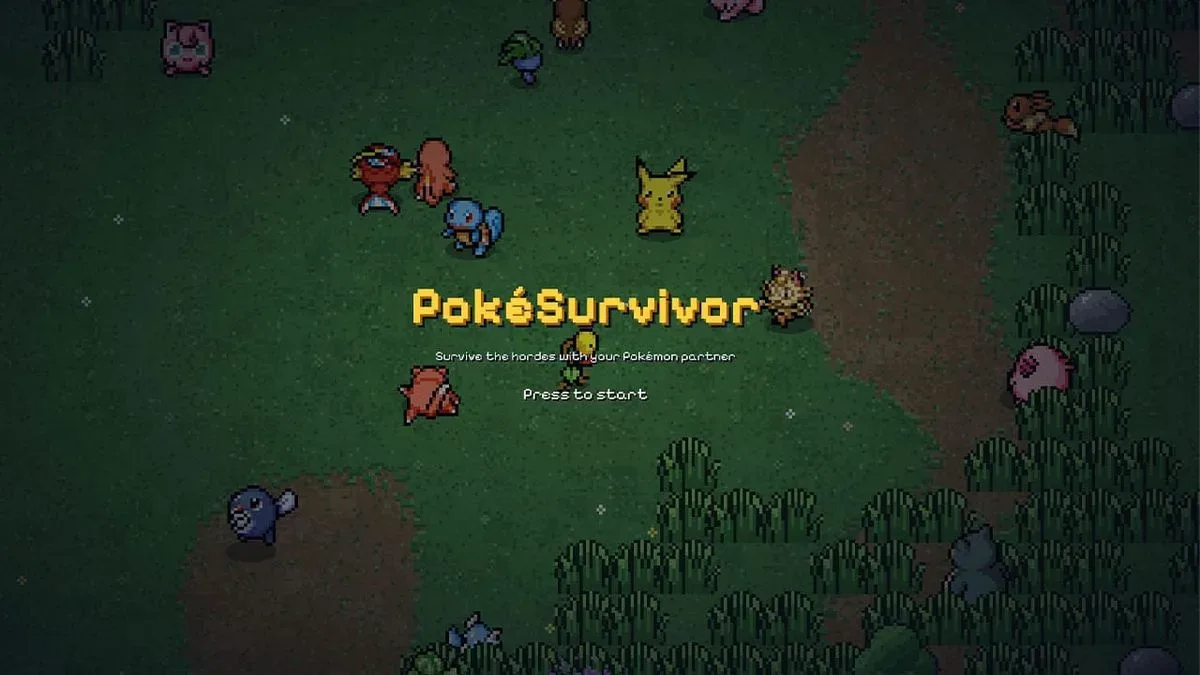
PokéSurvivor is a browser-based survival game that applies a familiar monster-battling look to the escalating, auto-attacking structure popularized by Vampire Survivors. Players guide a Pokémon through densely populated stages while attacks happen automatically, with the central objective being simple in theory and hectic in practice: remain alive as enemies close in from every direction.
The project is described as free to play, playable on any device through a browser and without ads. It reportedly drew 38,000 sign-ups on its first day, an early indication that there is a substantial audience for a quick-to-access Pokémon-style spin on the survival formula.
A survival format built around movement and pressure
Vampire Survivors launched in 2022 and helped cement a particular action-game loop: the player chiefly controls positioning, while the character fires attacks automatically. Rather than relying on precise aiming as the main skill, the player weaves through waves of foes, manages space and attempts to last as long as possible.
PokéSurvivor appears to follow that framework. Its combat is top-down, its presentation uses retro-style sprites and the screen can become crowded with opponents. That combination makes movement the decisive input. Finding a clear path, avoiding an encirclement and leaving enough room to react are likely to matter more than selecting every individual attack.
Auto-attacking does not mean a game plays itself. It means offensive actions trigger without requiring the player to press an attack button for each strike. The strategic pressure shifts toward navigation: where to stand, which route through enemies is safest and how to keep a constantly shrinking pocket of space from disappearing altogether.
That structure is well suited to short browser sessions. A player can understand the immediate rule set quickly—move, survive and keep the enemy mass from boxing the character in—while the rising intensity supplies the challenge. The retro sprite work also gives the game a distinctly old-school visual frame even though it is designed for modern browser access.
Starters, Pikachu and evolution
The available information indicates that players begin with a Kanto starter Pokémon or Pikachu, then evolve their choice as they advance. Evolution is a particularly natural fit for a survival game because it creates visible progression within a run: a familiar starting form can become a stronger one as the surrounding threats mount.
PokéSurvivor is said to include 986 Pokémon from all nine regions. That is a large claimed roster for a browser game, especially one centered on rapidly moving sprite-based encounters. It also sets expectations beyond a single Kanto-focused novelty. The initial character options may lean on immediately recognizable faces, but the stated selection reaches across the broader regional span.
Related coverage includes PokéSurvivor Brings Pokémon-Style Survival Action to the Browser.
The description does not establish exactly how every Pokémon is obtained, how each one functions, or whether all 986 are directly playable. It is therefore best to treat the roster figure as a broad scope claim rather than assume details about unlock conditions, move sets or progression systems that have not been outlined.
Still, an evolution-driven run offers an easy-to-read progression hook. It connects a defining Pokémon concept to the survival genre’s need for mounting player power. As enemy pressure increases, a static character would eventually be overwhelmed; evolving along the way provides a logical answer to that escalating difficulty.
Browser access is part of the appeal
PokéSurvivor’s browser-first setup is important. No separate platform installation is required in the supplied description, and the game is positioned as playable at any time on any device. That lowers the barrier between curiosity and a first session: instead of a download process, a player can sign up and begin from a browser.
Browser games have long benefited from that immediacy, but the format is especially compatible with survival action. The core loop communicates itself quickly, while repeat attempts can invite players back without requiring a large time commitment. A game can be approachable in its controls and still become demanding once crowds begin arriving from all sides.
It also arrives during a busy period for smaller-scale games accessed on PC-adjacent platforms. For another example of a compact, collection-minded PC project, the Rip It! Card Collector demo is also targeting players looking for an immediately understandable loop with room for repeat play. The two games are not the same genre, but both reflect how focused premises can work well when the route to play is straightforward.
Multiplayer is a stated possibility, not a confirmed feature list
There is said to be scope for online multiplayer in PokéSurvivor. That wording leaves key questions unanswered: whether multiplayer is currently available, how many people could participate, whether it is cooperative or competitive, and how progression would function alongside other players.
Those distinctions matter in a survival game. Cooperative play could turn a fight for safe space into a shared problem, while competitive play would demand a very different structure. Until more is established, online multiplayer should be viewed as an area of potential rather than a fully specified mode.
The same restraint applies to gameplay specifics beyond the basic premise. Fast-moving enemy swarms, automatic attacks, starting choices and evolution are all part of the described concept. Claims about particular upgrades, exact balance, long-term progression or performance on particular devices would go beyond the details currently available.
What has and has not been established about AI
Questions have been raised about whether artificial intelligence played a role in making PokéSurvivor, amid a broader influx of browser-based Pokémon games. But there is no confirmed detail here establishing the use of AI, identifying what tools may have been involved, or showing how much of any project work was assisted by those tools.
That uncertainty is worth preserving. AI-assisted development can refer to many very different activities, from generating early code or placeholder art to helping with text, testing or asset workflows. It is not a precise production credit on its own, and it cannot responsibly be inferred from a game’s browser format, visual style or speed of appearance.
For players, the practical questions are more concrete than speculation: Does the game communicate its systems clearly? Does it perform reliably in a browser? Are the evolution and survival loops satisfying? Is online play actually implemented, if it is offered? Those are questions that can be answered through confirmed information and direct play, rather than assumptions about its development process.
A clear premise with a crowded battlefield
PokéSurvivor’s appeal is easy to parse. It takes the automatic-offense survival structure, places Pokémon at the center, uses retro-style sprites and builds around the recognizable idea of starting small before evolving under pressure. The enemy threat is not framed as a traditional turn-based duel; it is a surrounding mass that forces constant movement.
That makes the project a different proposition from a conventional Pokémon adventure. The emphasis is not on carefully paced one-on-one battles. It is on sustained survival, directional awareness and the satisfaction of outlasting an increasingly hostile screen full of adversaries.
With 986 Pokémon claimed across nine regions, Kanto starters and Pikachu identified as entry points, and reported interest from tens of thousands of first-day sign-ups, the game has a strong headline hook. Its free, no-ad browser positioning gives that hook an unusually direct route to players. More detail will be needed to clarify its multiplayer plans and wider systems, but the basic pitch is already unmistakable: guide a Pokémon, evolve while progressing and try not to get swallowed by the swarm.