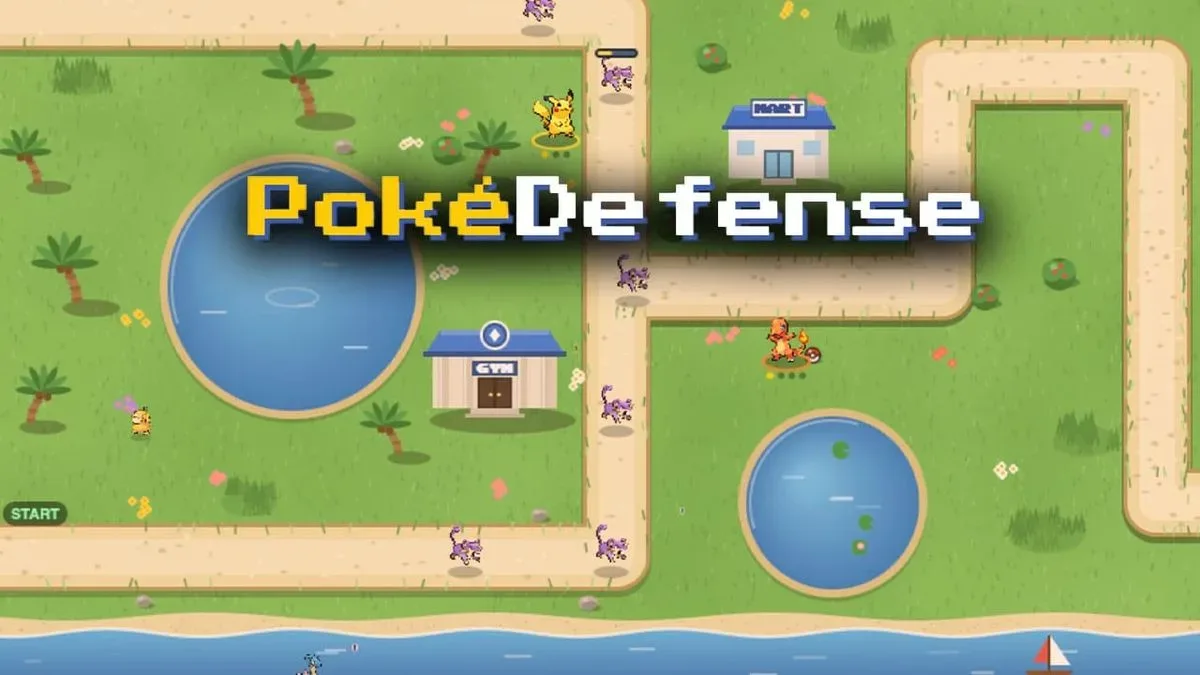
Pokémon have been asked to do plenty of jobs over the years: battle, race, photograph one another, make sandwiches, and occasionally stand very still while somebody tries to organize a living dex. PokéDefense gives them another assignment with no room for excuses: hold the line.
The free browser-based game turns Pokémon into a tower-defence roster. Rather than directly piloting a single character, players place Pokémon around a fixed route and attempt to prevent incoming enemies from reaching the exit. The premise is wonderfully blunt. An enemy gets through the gate, and the run ends. No “it was a learning experience” medal. No polite warning. Just a tiny tactical disaster wearing the face of a familiar creature.
That clean failure condition is a large part of why tower defence works. The rules are easy to grasp, but the decisions keep escalating. Every placement has a cost, every section of a route presents a different opportunity, and every bit of money spent now is money that may not be available when later waves arrive. PokéDefense frames those choices with Pokémon and Poké Dollars, making the genre’s familiar pressure immediately legible.
Players looking for the game can find more on PokéDefense’s browser tower-defence format. Its appeal is also rooted in that browser-first setup: it is positioned as something playable freely without a conventional download-and-install routine, which suits a game structured around repeat attempts, short decisions and the eternal promise of “one more wave.”
For more context, explore Castlevania: Belmont’s Curse Opens With an 86 Aggregate Score, Near the Series’ Modern Critical Peak.
What PokéDefense asks players to do
Tower defence is a strategy format in which enemies travel along a designated path toward an objective. Players build or position defenders near that path, aiming to eliminate the attackers before they reach their destination. The tension is usually not about aiming quickly; it is about anticipating how attacks overlap, identifying the valuable parts of a route, and allocating finite resources before a problem becomes impossible to contain.
In PokéDefense, the protected objective is the exit at the end of the preset path. Players receive a limited pool of Poké Dollars and spend it to add Pokémon to the map. That creates three connected questions at the centre of every run:
- Which Pokémon should be deployed? A choice has to fit the immediate threat and the available budget.
- Where should it go? A Pokémon positioned where it can engage enemies repeatedly has greater practical value than one whose attacks only connect briefly.
- How much should be held back? Spending everything early can stabilize the current wave, but it may leave too little flexibility for what follows.
The placement point is particularly important. A route may bend, double back or otherwise pass close to a defender’s attack area more than once. Putting a Pokémon beside one of those high-traffic sections can give it multiple opportunities to attack the same enemies. That is not merely a neat optimisation; it can determine whether a limited roster covers the route efficiently enough to survive.
Related coverage includes PokéDefense Turns Pokémon Battles Into a Tense Browser Tower-Defense Challenge.
It also makes a simple board look less simple once the waves begin. A placement that appears sensible in isolation may prove wasteful if it only covers a narrow stretch. Conversely, a defender that can repeatedly target passing enemies can effectively stretch every Poké Dollar further. The genre is full of those small, compounding efficiencies, and PokéDefense puts them at the centre of its Pokémon-themed loop.
A six-Pokémon starting selection
The available starting choices are the three Kanto starters—Bulbasaur, Charmander and Squirtle—alongside Gastly, Pikachu and Geodude. It is a concise group, but one that gives the game an immediately recognizable identity. These are not obscure deep-cut selections being drafted into a tax audit; they are Pokémon many players can identify at a glance.
The reported starting list matters because it establishes the tactical vocabulary available at the outset. Tower-defence games generally ask players to weigh coverage, timing and cost. PokéDefense does not need a screen packed with dozens of options to make that choice meaningful. Six starting options, limited spending money and a route that allows better or worse placement are already enough to make every deployment a commitment.
There is a useful distinction here between choice and complexity. A large roster can offer a lot of choices, but it can also obscure the essential question: what helps this defence right now? A smaller, recognizable starting selection makes the basic loop easier to read. The depth comes from the board state—where the path goes, what wave is arriving, what has already been spent and where existing defenders can still contribute.
Modes for a quick run or a longer stand
PokéDefense offers multiple modes: weekly challenges, story journeys, classic maps, Hardcore and Endless. Together, they suggest a game designed to support different moods rather than a single fixed campaign structure.
Classic maps set a clear endurance target. Players are tasked with surviving 20 waves across eight themed screens. A wave is a grouped sequence of incoming enemies; surviving one provides the chance to prepare for the next. Twenty waves gives each map a defined arc: establish a defence, reinforce weak points, then try to avoid the humiliating moment when one tiny intruder slips through what looked like an absolutely airtight plan.
Weekly challenges offer a recurring reason to revisit the game. Their key value is cadence. A game with repeatable maps can be satisfying on its own, but a weekly format invites players to return with a fresh puzzle in front of them rather than simply repeating a familiar solution.
Story journeys provide another way into the game beyond classic-map survival. The available information identifies the mode but does not spell out its narrative structure, so expectations should stay measured. What is clear is that it sits alongside the core map-based modes as part of the game’s broader selection.
Hardcore is explicitly for players seeking a tougher test. Details on its exact rules are not specified, but its presence is meaningful: it gives players who have learned the essentials a place to pursue a more demanding version of the defence challenge without making the standard experience inaccessible by default.
Then there is Endless, the mode for anyone who hears “survive the current threat” and answers, “fine, but what if it never stops?” Endless play removes the comfort of a fixed final wave and shifts the goal toward sustaining a defence for as long as possible. In strategic games, that can change player priorities dramatically. A setup that is adequate for a known number of waves may not be robust enough for a run with no obvious finish line.
Why the format suits browser play
PokéDefense’s format fits the browser unusually well. Tower defence is built on readable systems: a map, a route, defenders, currency, waves and a clear loss state. Those elements can be understood quickly, while the actual strategy emerges over repeat play. The browser setting supports the low-friction side of that equation. It is a natural home for a game someone might open for a brief attempt and then discover has quietly converted an hour into a sequence of increasingly determined retries.
That does not mean the game is only a time-filler. The severity of its rule—one enemy through the exit means game over—gives every decision weight. It creates jeopardy without requiring a vast rulebook. Players can comprehend the stakes instantly, then spend their attention on better positioning, more disciplined spending and preparation for later waves.
There is a practical lesson for newcomers, too: do not think of the board as empty space that needs filling. Think of it as a route that needs to be covered efficiently. Prioritize locations where a Pokémon can attack passing enemies more than once, be cautious about exhausting the Poké Dollar supply too early, and treat each wave as information about whether the current layout is actually doing its job. The exact best approach will depend on the map and enemies, but that framework follows directly from the game’s core systems.
The Pokémon strategy game’s no-nonsense hook
PokéDefense does not need to overcomplicate its pitch. It has Pokémon, a path, a limited budget and an exit that must remain untouched. Its range of modes adds room for players who want a structured 20-wave objective, a recurring weekly challenge, a harder test or an indefinite survival session.
Most importantly, it recognizes the essential drama of tower defence: a plan can look perfect right up until one enemy reaches the gate. That last detail is the genre’s wonderfully cruel magic. The defeat is immediate, the flaw in the layout is suddenly obvious, and the next attempt begins forming in your head before the previous one has properly ended.
For fans of browser strategy games and Pokémon-themed projects, PokéDefense’s mixture of familiar characters and route-management pressure gives it a focused, accessible hook. Just be aware that “I’ll only see how the first few waves work” is precisely the sort of sentence a gate-defence emergency likes to hear.