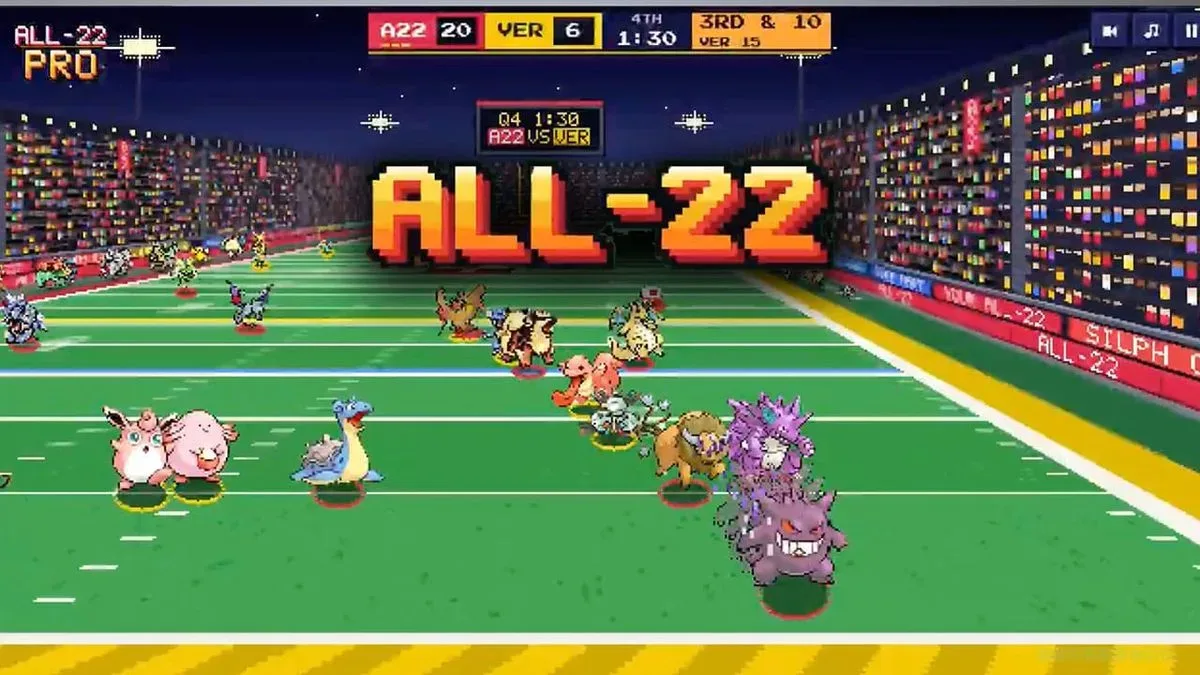
All 22 is a free browser game from Cole Thereum that puts Pokémon-themed teams on an American football field. Its central pitch is wonderfully direct: choose a roster drawn from all nine generations, take on Gym Leaders, and chase victory through football rather than the series’ familiar turn-based battles.
The project is designed to be played in a browser, removing the need to set up an emulator or patch a ROM before getting started. Cole Thereum has also said the game will remain free to play, with no fantasy-football betting or other monetised component planned.
It is an unusual fit on paper, but that is exactly the appeal. Pokémon have long been adaptable mascots for games with very different structures, and All 22 shifts the focus from selecting attacks in menus to understanding space, controls and the flow of an American football play. The game even offers two perspectives aimed at making that action readable in different ways.
Pro and Bowl offer two ways to view the field
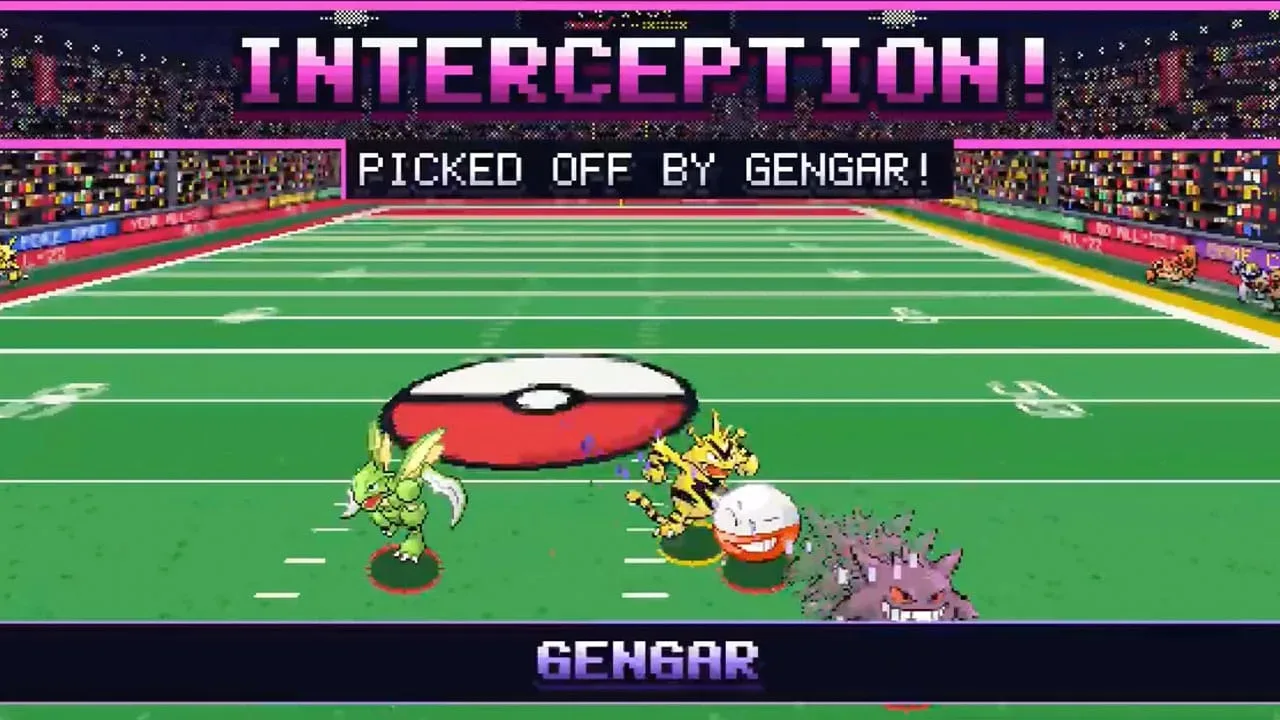
All 22 includes Pro and Bowl modes. Pro uses an All-22-style camera angle associated with American football viewing. In football terminology, “All-22” refers to a wide tactical view intended to show every player on the field, rather than concentrating only on the ball carrier. That perspective is useful for seeing formations, routes and open space develop across a play.
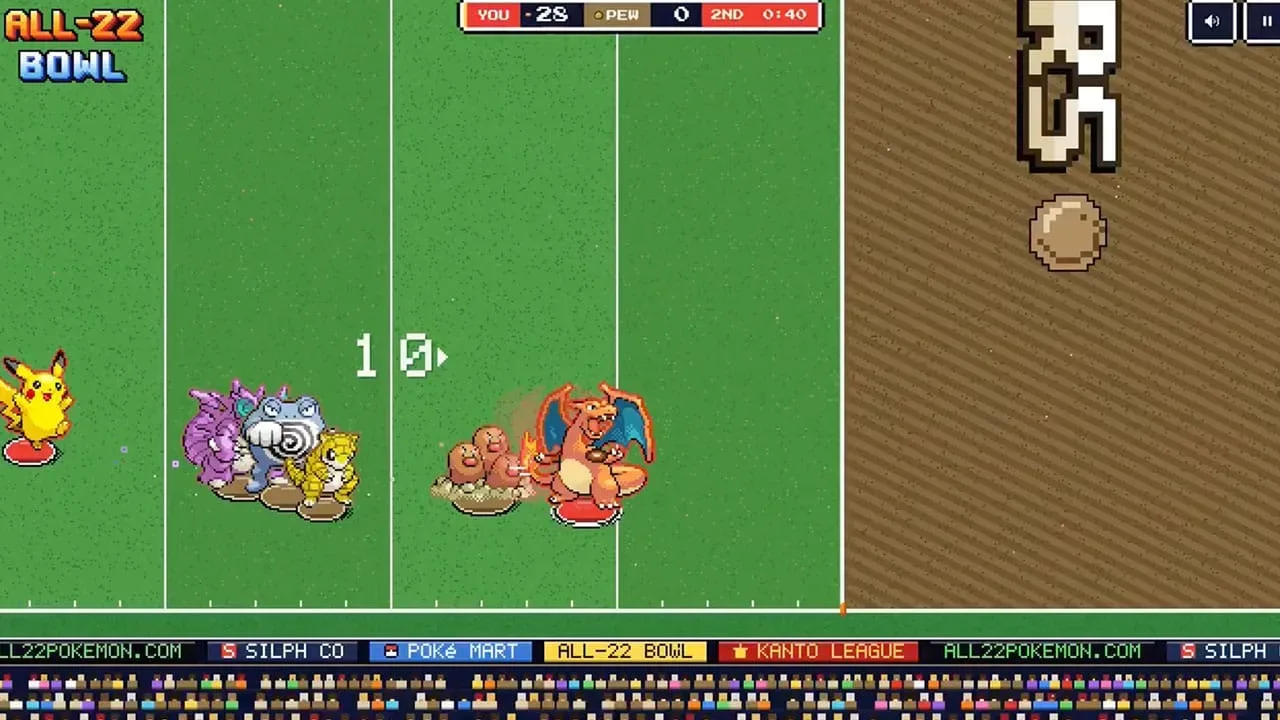
Bowl instead presents the action from above, giving it a look closer to older SNES-era sports games. A top-down camera can make positional information immediately clearer: players are laid out across the screen, lanes are easier to spot, and the viewer has a stronger sense of how much territory lies between the offense and the end zone.
The two modes appear to change the presentation rather than the overall objective. In either view, players assemble a Pokémon team, face Gym Leaders on the gridiron and attempt to come out on top. That consistency matters because it lets players pick a preferred visual language without splitting the game into separate concepts.
A football premise built around a huge character pool
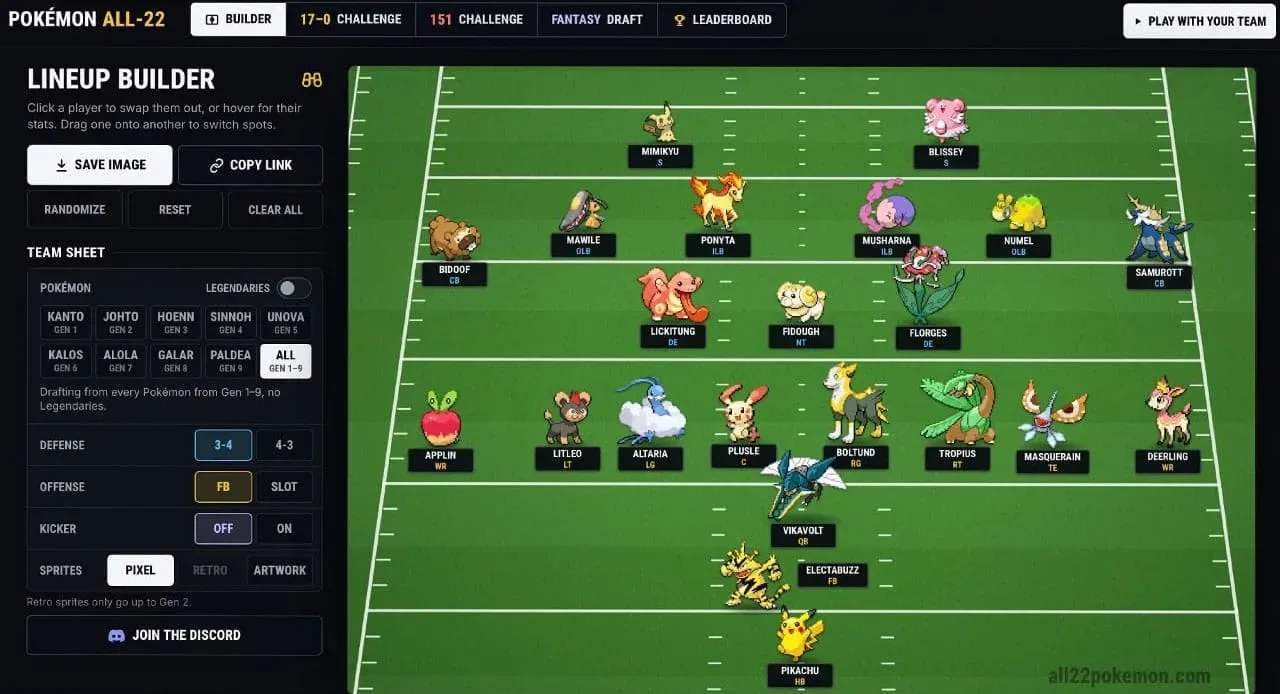
The game’s roster selection covers Pokémon from all nine generations, giving players a substantial number of possible choices before a match even begins. All 22 includes a randomiser to help deal with that abundance. Rather than labouring over each selection, a player can use the tool to produce a team and work with the result.
That option has a practical benefit beyond novelty. Large character pools can make a game inviting for dedicated Pokémon fans while creating friction for anyone who simply wants to begin. A randomiser shortens the path from browsing to playing. It can also encourage lineups that a player might not have selected manually, which is particularly fitting for a game that is already recasting familiar creatures in an unexpected sporting format.
Related coverage includes All 22 Turns Pokémon Battles Into a Free Browser Football Game.
Gym Leaders serve as the opposition. Their inclusion gives the football structure a recognisable Pokémon framing: instead of a conventional league schedule alone, the opponents are characters associated with a progression challenge. The supplied details do not establish how individual Gym Leader matches differ, how teams are balanced, or what rewards are offered for wins, so players should treat the broad goal—build a team and beat the Gym Leaders—as the confirmed outline.
American football knowledge may make the learning curve easier
All 22 is not presented as an instant-pickup arcade game with only one or two actions to learn. Its controls take some adjustment because there is a lot to remember, and familiarity with American football is likely to help. For newcomers, that is worth keeping in mind before interpreting early confusion as a problem with the game itself.
American football is built around set plays and territorial progress. In broad terms, a team attempts to move the ball forward toward the end zone, while the defense tries to stop that advance. Players who already understand why positioning, passing options and field coverage matter may find it easier to interpret what they are seeing from the Pro view and to make decisions under pressure.
For people coming to All 22 primarily for the Pokémon angle, Bowl may be a more approachable starting point simply because its overhead view makes the field layout easier to parse at a glance. That is an interpretation of the two camera styles, not a stated difficulty recommendation. The important point is that both views are available, and neither changes the game’s core premise.
What the browser format changes
Browser play is a meaningful part of All 22’s proposition. It makes the game accessible without the setup associated with emulation and ROM patching, and it does not require a dedicated console application in the supplied description. In practical terms, the entry barrier is lower: a compatible browser and an internet connection are the key starting points implied by the game’s format.
That convenience does not necessarily mean it will be playable everywhere. School, workplace and public networks can impose their own restrictions, while browsers and device policies may affect access. Those are general realities of browser games rather than confirmed limitations specific to All 22, but they are sensible considerations for anyone hoping to play away from their usual setup.
The game also arrives amid continued discussion of how creators use AI tools in game production. The available information does not establish that generative AI was used in All 22’s art, code or development process. It also does not establish the opposite. In the absence of a clear, direct disclosure from the creator, it is more accurate to leave the question unresolved than to make a claim either way. For broader context on why creator disclosures and AI-made assets have become an industry talking point, see this look at AI-made material and the questions it raises.
What is confirmed, and what remains unclear
There is a useful distinction between the project’s announced basics and assumptions players may be tempted to make from its premise. All 22 is described as a free browser game; it has Pro and Bowl viewing modes; it lets players pick Pokémon across nine generations; it features Gym Leader opposition; and it has a randomiser for team picking. It is also described as having no planned monetisation or fantasy-football betting.
Other details are not established in the supplied information. There is no confirmed breakdown of the full control scheme, no stated list of playable Pokémon, no verified explanation of whether every selection has unique gameplay properties, and no stated plan for updates. There is likewise no supplied information about online multiplayer, save systems, mobile support, accessibility settings or browser compatibility. Those omissions are not evidence that any feature is absent; they are simply areas where the available description does not provide an answer.
That measured approach is particularly important for a fan-made or unofficial-feeling concept using a major entertainment property. The provided material credits Cole Thereum and Game Freak in image captions, but it does not state the project’s licensing status, nor does it confirm an official relationship. The safest reading is to focus on what is actually described: a free browser football game that uses Pokémon and Gym Leaders as the basis for its teams and opponents.
Why the concept stands out
The strongest idea behind All 22 is not merely placing Pokémon in a sports game. It is choosing a sport whose camera angles and tactical vocabulary create a different way to read those characters. A traditional Pokémon battle asks players to assess matchups and choose actions. Football asks players to think about movement across a field, timing and space. Switching between a wide tactical camera and a top-down retro-like view reinforces that change in perspective.
There is also a clear contrast between choice and speed. A roster covering nine generations gives the player an enormous menu of possible team members, while a football match asks them to process action in the moment. The randomiser is a small but smart bridge between those two elements: it limits pre-match indecision and pushes attention back toward learning the on-field systems.
For Pokémon fans who understand American football, the game’s appeal is easy to identify: a familiar collection of characters placed into a format where football literacy can matter. For sports-game players who are not deep into Pokémon, the team randomiser and the Bowl camera could offer a low-friction way in. And for anyone curious solely because “Pokémon football” sounds like a sentence produced by a dare, All 22 at least provides a free, browser-based route to see how the concept plays out.
Its clearest promise is accessibility of setup rather than a sprawling list of confirmed systems. Players can pick a team, choose Pro or Bowl, take the field against Gym Leaders and learn how its controls translate American football into this Pokémon-led setting. That is enough of a hook to make All 22 a distinctive curiosity—and potentially a better fit for players willing to learn the sport’s fundamentals than for those expecting a conventional Pokémon battle game.