Factory games have taught players to respect a tidy conveyor belt. Substructure appears ready to teach a harsher lesson: a tidy conveyor belt is only the beginning when the thing being automated is an entire planet with several hostile floors, radically different conditions, and an apparent appetite for turning every simple production chain into a logistical argument.
Developed by Dubious Design and published by Hooded Horse, Substructure is planned for PC, with a release date still listed as TBC. Its premise begins when a rogue planet enters the solar system and the player is sent down to find out what, exactly, is going on. That investigation starts conventionally enough for the genre: collect nearby materials, establish the first infrastructure, and begin turning a patch of alien terrain into an increasingly organized industrial operation.
The twist is that Substructure’s factory is not designed to spread only across a flat map. Its systems are built around descending through the planet itself, then making each discovered layer work with every other one. It is an automation game where vertical distance is not background flavor. It is a production problem, a transport problem, and potentially the central source of both triumph and panic.
From silica to a planetary production web
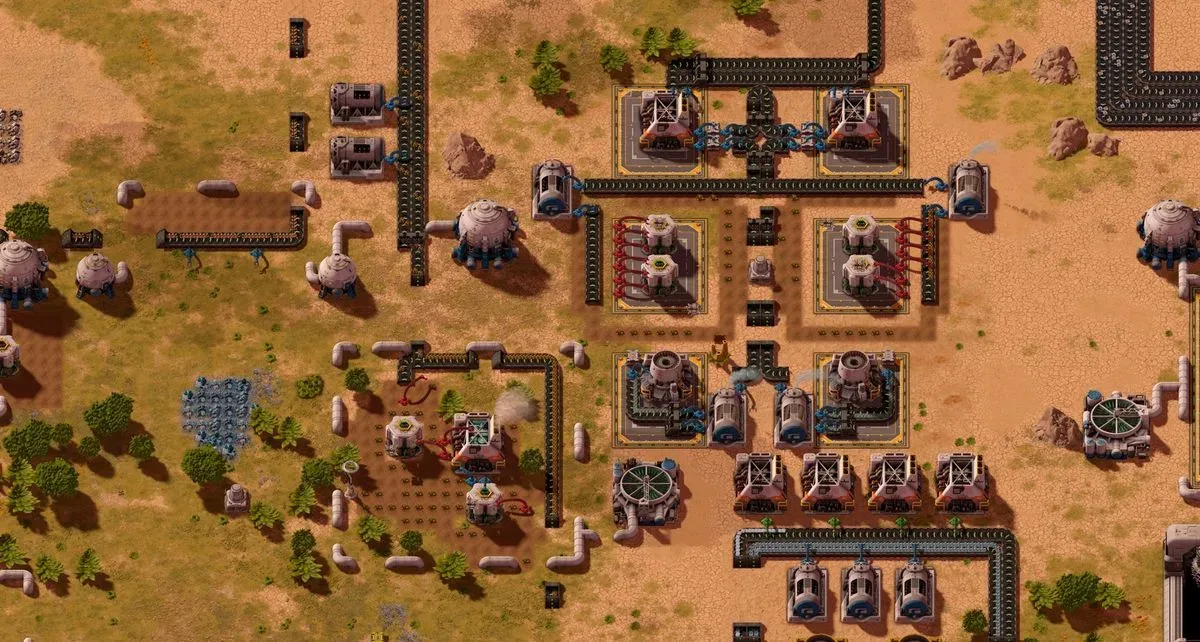
Early construction relies on silica, a basic material used to establish the tools needed to cultivate local fauna. That fauna can then be burned as biofuel, providing energy for more sophisticated structures. It is a familiar automation-game rhythm: harvest a resource, convert it into a useful component, feed the result into a more advanced stage, and replace manual labor with machines wherever possible.
Conveyor belts and robotic arms handle much of the heavy lifting. They move fuel, raw ingredients, and seeds, including seeds intended to replant the world around the player’s growing operation. On paper, this gives Substructure some of the inviting rhythm associated with farming and production games. There is cultivation, resource processing, expansion, and the satisfying visual language of a base beginning to run under its own power.
But the game’s version of agricultural calm has a deadline hanging over it. One resource is a rock that can be extracted only at night and will disappear if it is not processed efficiently. That means the factory cannot merely be correct; it must be correct at the correct time. Storage, routing, throughput, and processing capacity become connected to a material’s limited lifespan. A belt backing up is no longer just an eyesore. It may mean an opportunity has literally dissolved.
That kind of constraint helps explain why the game’s inspirations point beyond the usual “make numbers rise” factory formula. Substructure takes a broad idea associated with Factorio’s Ultracube mod—where production is constrained around a crucial cube and bottlenecks demand careful planning—and turns it into a standalone planetary adventure. Rather than simply rewarding unrestricted sprawl, the design puts pressure on the player to solve a sequence of limitations.
The real map begins below the surface
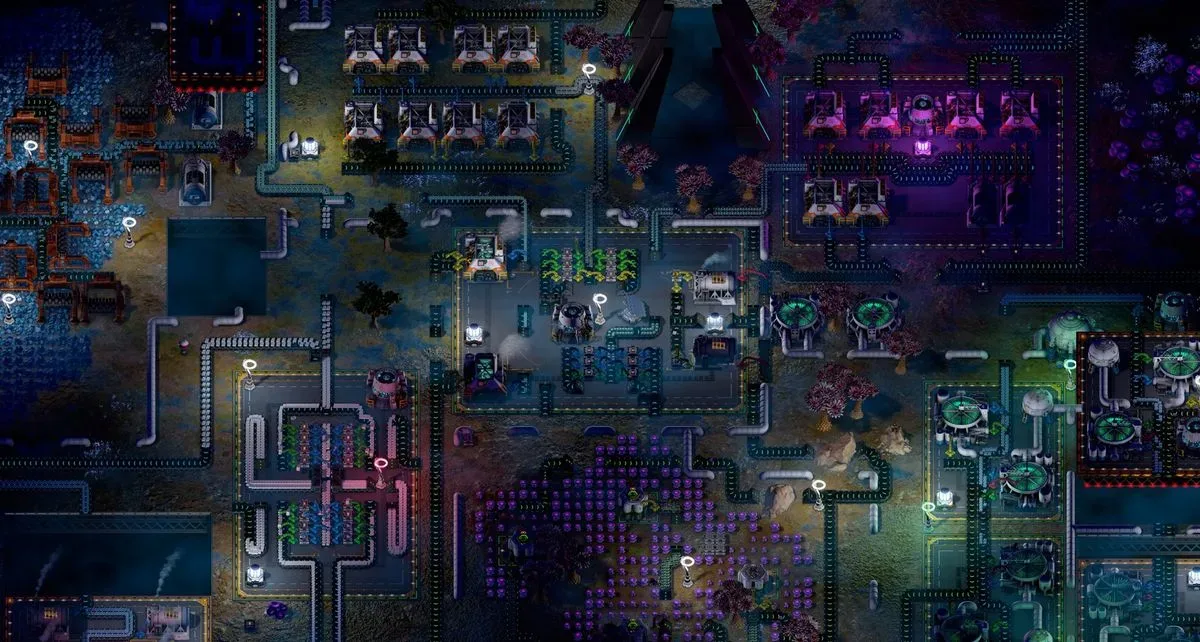
Drilling through the surface opens the route to Substructure’s deeper layers. The underground areas are not presented as interchangeable basement floors. Each has its own atmosphere and environmental character. One lower zone is dark and humid, with bioluminescent fungi in the gloom. Further down, glowing crystals appear alongside increasing toxicity, making the surroundings more severe.
Dubious Design has indicated that the trip ultimately reaches the planet’s core. The descent also serves the game’s mystery: clues encountered along the way suggest this wandering world may not have always been empty. That thread gives the industrial mission a reason to continue beyond optimization for optimization’s sake. The player is not just constructing a machine because a factory game needs a factory; they are plumbing the anatomy of an unfamiliar planet that may be hiding a history.
More importantly, each depth changes the practical meaning of the machinery above it. A valuable material from a deep layer may be needed at the surface to support new construction. Meanwhile, surface-made components may have to travel back downward to unlock further operations. Progress is therefore not simply a downward arrow on a map. It is a continuing exchange between locations with distinct resources and conditions.
That design should make a single production line feel less like a line. It becomes a route through space, with transport time and destination mattering just as much as recipe inputs. The same basic item may demand different decisions depending on where it is manufactured, where it is refined, and where the final result is required.
Elevators are infrastructure, factories, and moving puzzles
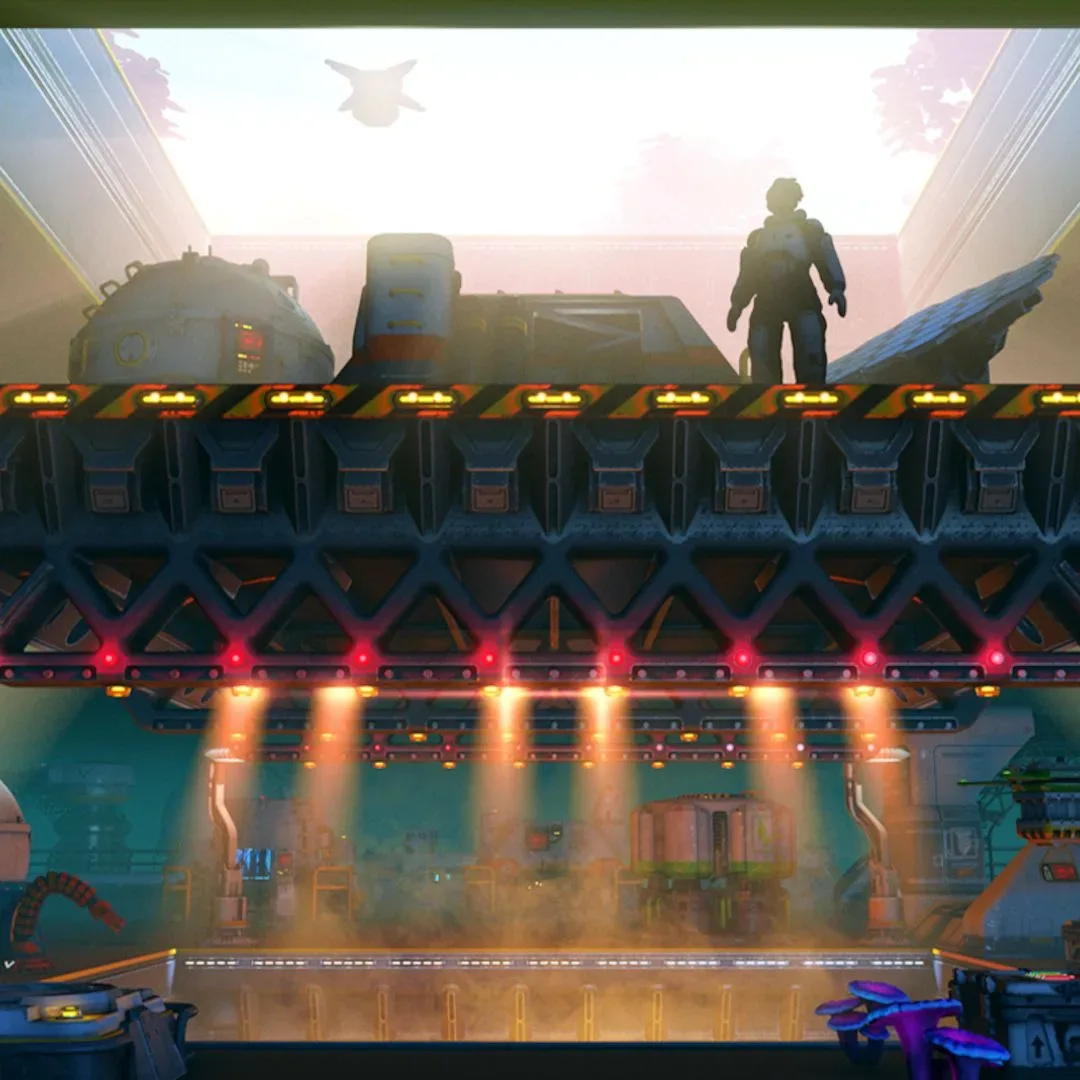
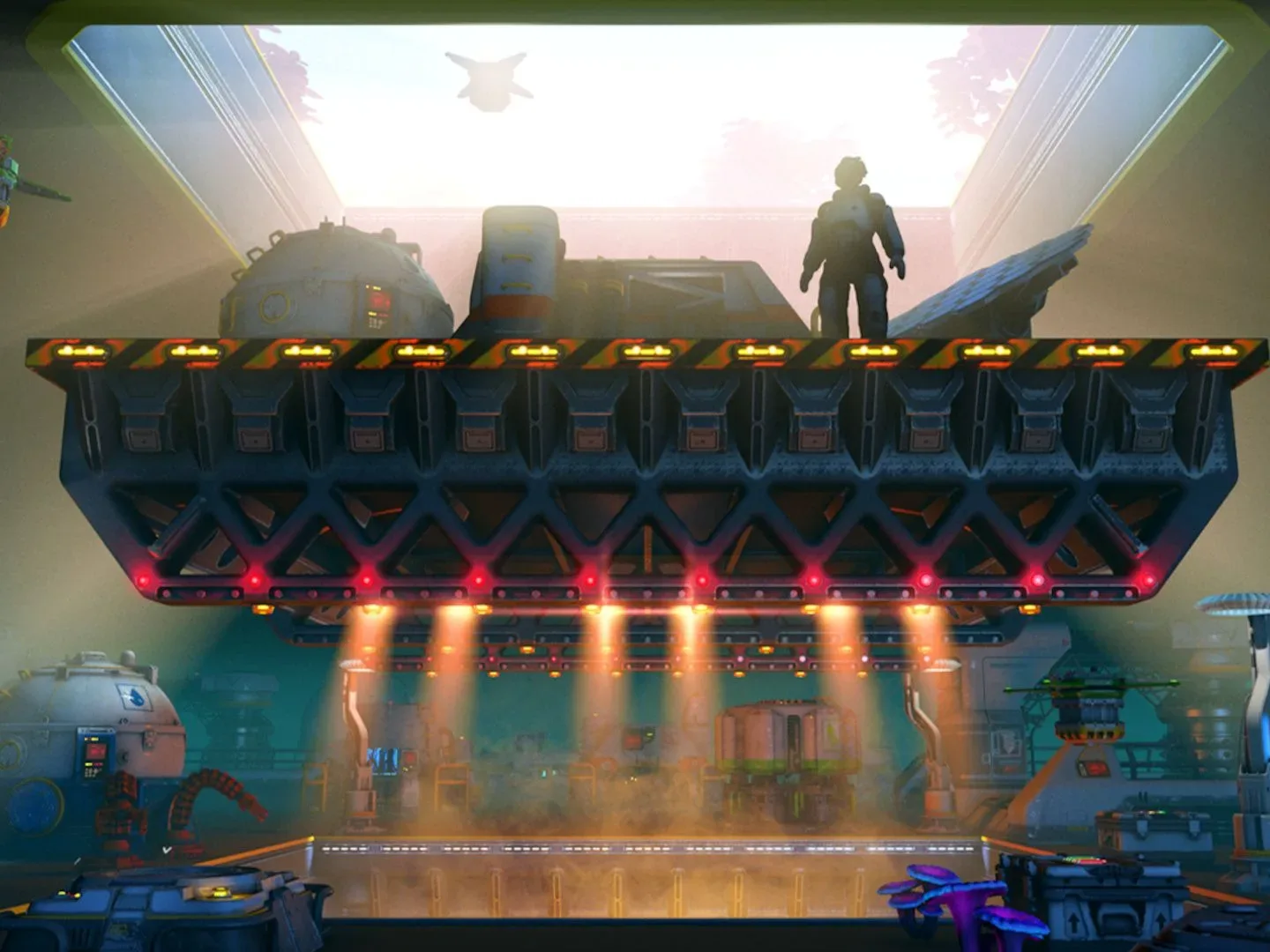
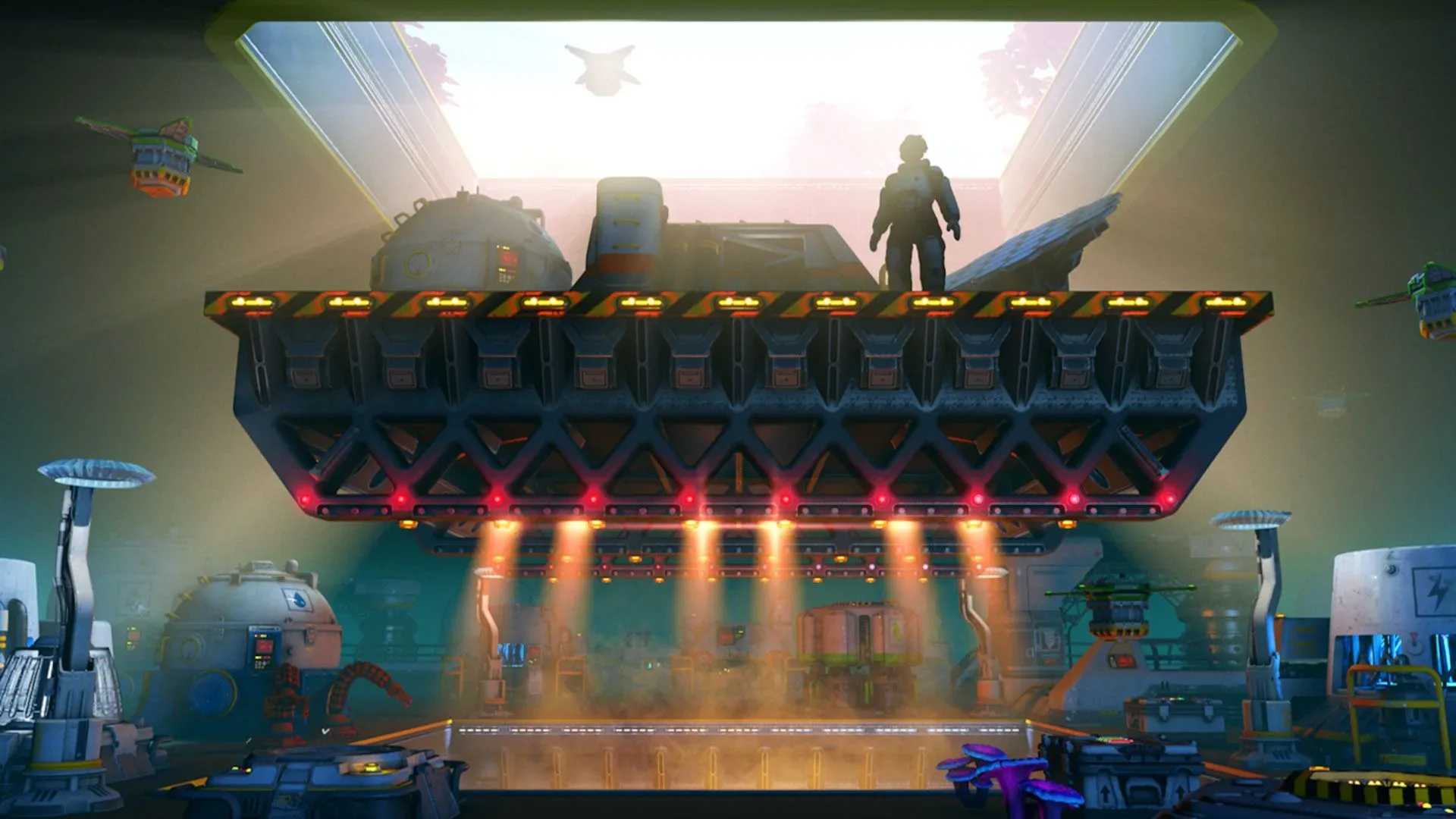
The big connective tissue is the elevator system. The drills used to break through the crust also establish enormous elevator shafts, allowing cargo to move between the explored layers. This is not merely a loading-screen substitute or a decorative lift carrying ore upward. Elevators can become part of the production architecture themselves.
As a factory grows more complicated, an elevator can shuttle between environmental zones to exploit conditions favorable to certain processes. Sunlight, for example, accelerates plant growth in fields, while darkness slows that work. That creates a genuinely strange and compelling question for an automation game: where should a factory section physically be at a given moment?
Managing an elevator means considering its movement thresholds, where its output is directed, and how its schedule aligns with the wider chain. A lift moving cargo at the wrong time can slow the system; a lift positioned wisely may turn environmental variation into an advantage. Substructure’s apparent challenge is not simply routing item A into machine B, but arranging mobile pieces of infrastructure around changing production conditions.
That makes the game’s verticality sound less like a feature bullet point and more like a governing principle. The planet is a stack of different economies. Its elevators are trade routes. The player’s task is to keep those economies supplied without allowing one delayed input or badly timed trip to choke everything upstream.
Fans of systems-heavy games may recognize why that can be appealing. The best factory-game problems are often not about a lack of options; they arise because every available answer introduces a fresh trade-off. Substructure seems poised to build those trade-offs into its geography. Its world is not a neutral surface on which to place machines. It is an active participant in whether those machines succeed.
A game that intends to make players earn understanding
Studio co-founders Mike Donoghue and Stu Taylor have described a deliberate effort to resist complexity that becomes excessive for its own sake. At the same time, the team wants to introduce demanding concepts gradually, rather than remove the friction that gives logistics puzzles their character.
The internal approach is described as “all game”: the goal is to avoid interrupting the player’s learning process with elements that pull them away from play. That does not mean the systems are intended to be effortless. Quite the opposite. Catalysts, perishable resources, changing climates, and multi-level transportation are meant to provide resistance. Learning why a setup failed, then building a better one, is part of the intended payoff.
That philosophy is a useful distinction in a genre where “accessible” can sometimes be mistaken for “free of pressure.” Substructure seems interested in making its challenges readable over time without making them trivial. The player may not be walked directly through every solution, but the objective is for mastery to emerge through experimentation and problem-solving.
There is a small social parallel here with the unspoken coordination that turns a group session into either harmony or disaster, a subject explored in The Unwritten Rules of Couch Multiplayer, Now Written Down. In Substructure, the teammates are belts, arms, lifts, fields, drills, and processors. None of them will complain aloud when the plan goes wrong, which may somehow make the silent judgment of an idle machine even worse.
Why Substructure could stand apart
There are plenty of games about constructing bigger factories, and plenty about descending into strange underground worlds. Substructure’s most notable idea is the way it binds those concepts together. The deeper the player goes, the more places their supply network must meaningfully connect. Expansion does not leave the old map behind; it makes the surface and earlier layers more important because they remain part of the loop.
Its farming-adjacent opening may invite comparisons to more relaxed resource games, but its broader structure sounds built for players who enjoy being challenged by interlocking systems. The tone may begin with seeds, silica, and biofuel, then escalate into an enormous inter-level balancing act involving elevators and climate-dependent output.
For PC players who like their progress measured in both machines placed and puzzles untangled, that escalation is the promise. Substructure is not yet dated, and much remains to be seen about the scale of its final campaign and tools. Still, its stated direction is clear: build a self-sustaining industrial organism, send it down into a planet’s unknown interior, and keep it alive while every layer asks for something different.
It is a concept that could make the humble elevator one of gaming’s most stressful pieces of equipment. And that is a compliment. Anyone who has watched a supposedly flawless factory collapse because one tiny resource arrived late will understand the appeal of a game willing to make the route between floors as important as the machines at either end.