There are ordinary PC performance problems: a demanding new release, a driver conflict, an unruly background process, or settings pushed a little too far. Then there are the problems that arrive after a player constructs a warehouse-scale rubber-duck detention center next to a bottomless industrial pit.
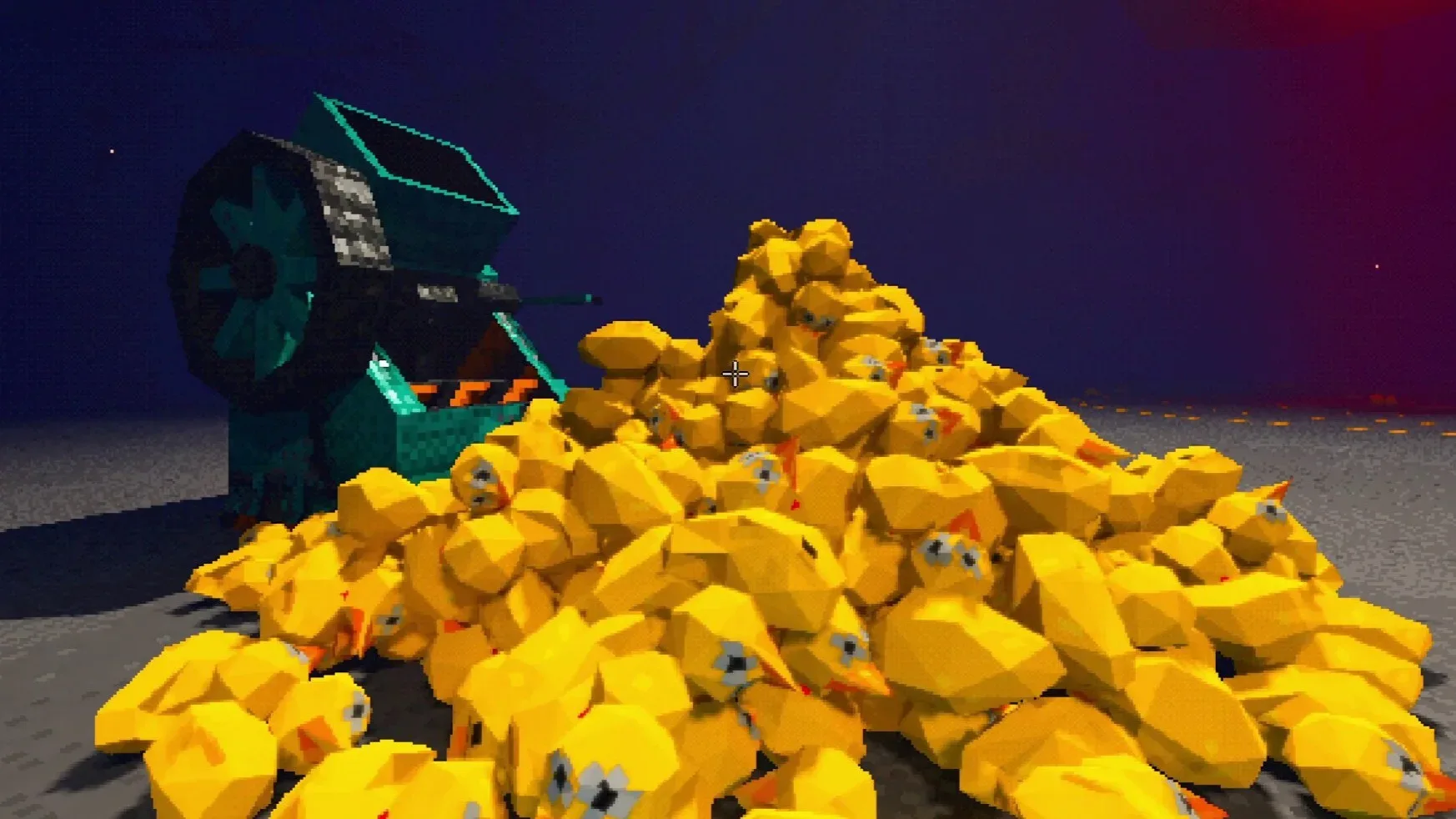
That latter scenario is apparently possible in Project P.I.T.T., the automation sandbox from developer Froke. A player attempting to maximize a scoring combo reportedly amassed thousands of rubber ducks in a custom holding area, producing a wonderfully silly physics disaster. At roughly 3,000 ducks, the computer’s fans began to work conspicuously hard. By 5,000, performance had fallen to around 10 frames per second.
On one hand, this is a tale of a game being brought to its knees by an extremely specific use case. On the other, it is exactly the kind of player-made calamity that makes physics-heavy sandbox games memorable. Give people conveyors, magnets, fans, movable objects, and a score counter, and eventually somebody will ask an innocent question: what happens if we save up all of the ducks?
An automation game built around feeding a giant pit
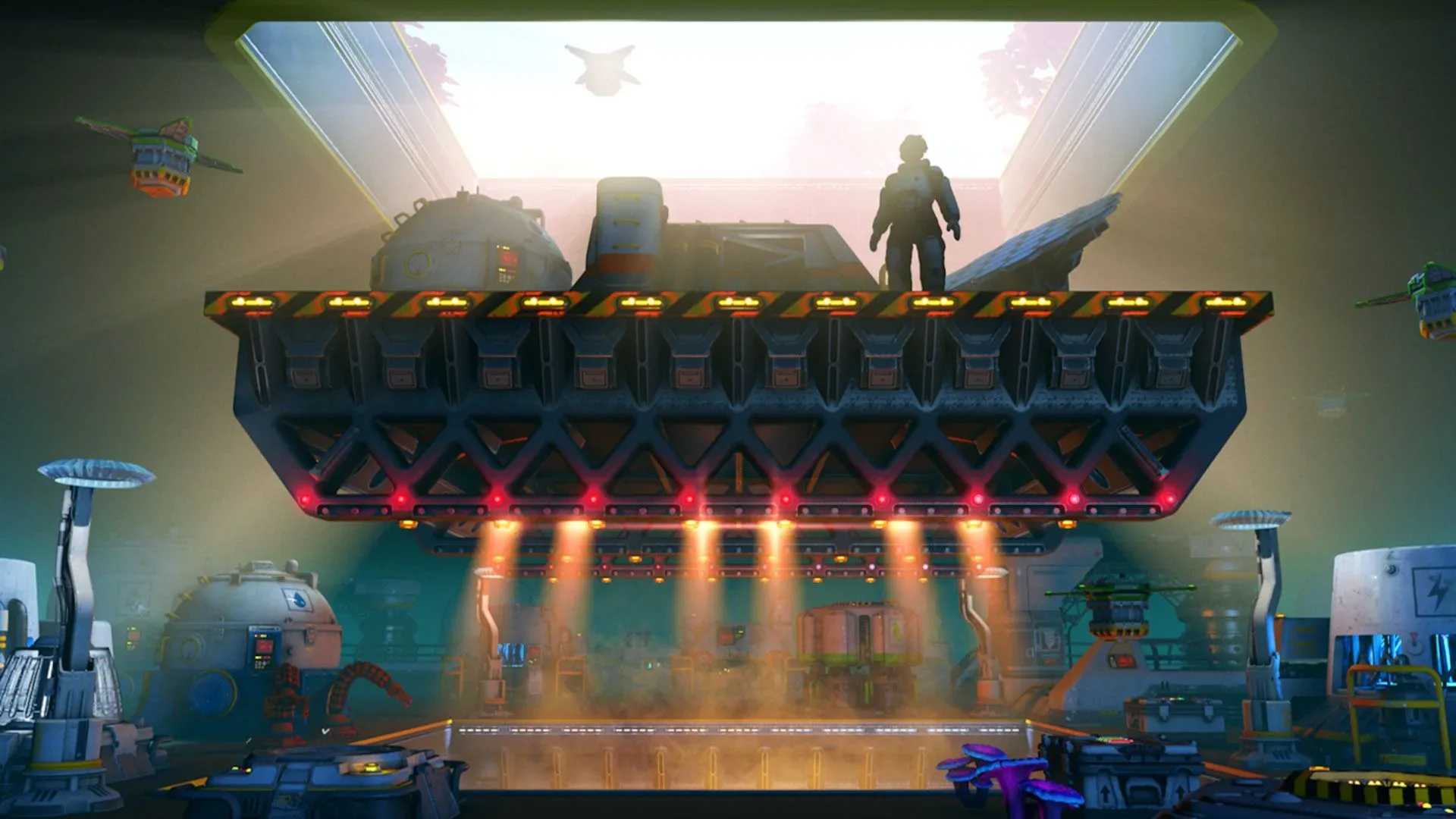
Project P.I.T.T. is a parody-minded entry in the automation genre. Its central workplace horror is the Maw, an enormous pit positioned in the middle of an otherwise barren facility. The Maw requires products without end, while invisible corporate management applies the expected pressure. The job, then, is to manufacture objects and send them into the pit.
The products are knowingly absurd: rubber ducks, cash registers, piñatas, and other items that make the machinery of industrial efficiency look a little less dignified. Players can build systems using physics-based tools including magnetized ramps and passages powered by fans. The point is to create a facility that handles its own output, ideally reducing the player’s personal labor to almost nothing.
That is a sharp comic premise for an automation game. Rather than treating manual intervention as the hero’s special skill, it makes obsolescence the prize. The most successful factory is the one that no longer needs its architect hovering over it.
But automation and optimization are not always the same thing. In this case, the game’s combo mechanic created a reason to interfere with the clean, hands-off ideal.
The combo counter creates a dangerous business opportunity
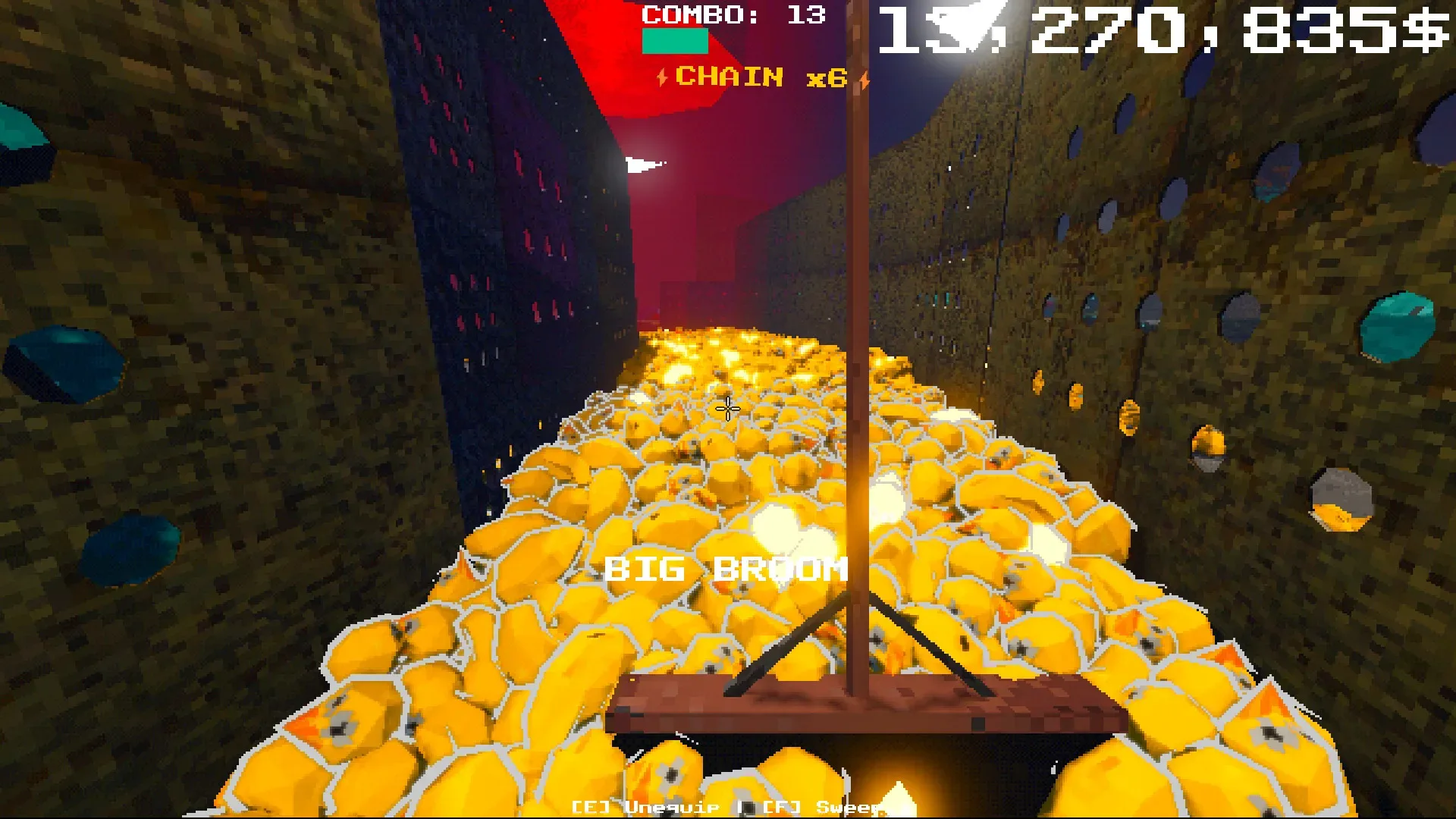
Products delivered to the Maw in rapid succession can build a combo and multiply the resulting score. Yet the combo decays more quickly as it gets higher, meaning a fully automated line will ultimately struggle to preserve it forever. That limitation naturally encourages experimentation: instead of sending every item directly into the Maw as soon as it is made, why not bank an enormous volume of them and release the whole pile at once?
Related coverage includes Project P.I.T.T. Turns Rubber Duck Hoarding Into a PC Stress Test.
That was the logic behind the duck stockpile. The Maw was sealed off on every side, turning the surrounding area into a temporary pen for output. A broom was used occasionally to nudge wandering ducks back toward the bulk of the collection. In principle, the arrangement was a sensible solution to the combo problem. In practice, it was a collision simulator waiting for a final straw.
It is worth emphasizing that this was not a low-end system encountering an unusually demanding game. The reported PC used a Ryzen 7 7700X processor, an RTX 4080 graphics card, and 64GB of RAM. Project P.I.T.T. also uses a deliberately retro, PSX-inspired visual style and reportedly ran smoothly through nearly all of the playthrough. The slowdown appeared once an extreme number of physics objects had been gathered into one cramped place.
Graphics style and simulation cost are not the same thing. A game can look like it was rescued from a late-1990s memory card while still asking a modern computer to calculate the movement, contact, stacking, and chain reactions of thousands of individual objects. Every duck in the pen may be simple, but a huge crowd of them becomes complicated very quickly.
Why releasing the ducks made everything worse
The obvious rescue plan was to remove the barriers and let the Maw consume its tribute. Unfortunately, the game had become so sluggish that moving through the facility and reaching the relevant walls was already difficult. When the enclosure was finally opened, the huge duck mass began to shift, spill, bounce, and collide on the way to the pit.
That meant the attempted cleanup created an even more chaotic moment for the physics system to process. Rather than instantly restoring performance, freeing the ducks initially drove the frame rate lower. The spectacle unfolded in tiny increments: a wall of rubber ducks pouring into the Maw at something closer to a slide presentation than a smooth game.
Eventually, as more ducks disappeared into the pit, the simulation had less to manage and performance began to recover. The punchline was cruelly appropriate. The combo that motivated the entire operation reportedly did not even reach 1,000 before the stored stock was gone.
It is a classic sandbox-game lesson. A plan can be clever, functional, and disastrously expensive all at once. The player had created a factory designed to exploit a scoring system, only for the physical evidence of that success to become the actual final boss.
Is this an optimization issue or an excellent bad decision?
Games absolutely deserve scrutiny when they perform poorly under normal, expected conditions. PC players have every reason to expect clear settings, reliable behavior across reasonable hardware configurations, and thoughtful technical support. A physics sandbox, however, exists partly to let players push at its rules. There is a difference between routine play exposing a flaw and a self-directed experiment that turns the facility into a crowded duck singularity.
Based on the reported details, this seems closer to the latter. Froke gave players tools to create strange automated systems; it did not require anyone to place several thousand moving objects in a single holding cell and then trigger their simultaneous escape. Planning for every imaginable player contraption is not a realistic standard, especially when the contraption is effectively a deliberately built benchmark test.
Still, the incident says something complimentary about the game’s systems. The ducks were not just decorative inventory counters. They could be collected, redirected, contained, disturbed, and released in a way that produced a real cascading result. The game allowed a ridiculous strategy to exist long enough for it to fail spectacularly.
Player freedom has always carried this risk. A famous old Skyrim video showed thousands of cabbages being launched through the world until the game became effectively unusable. The exact objects differ, but the spirit is identical: players see a simulated world, identify a harmless item, and immediately begin researching the volume required to turn it into a computational emergency.
Small changes to a game’s controls or systems can reshape how people approach it, as discussions around a newly added jump button in an Ocarina of Time remake also illustrate. In Project P.I.T.T., the decisive design ingredient is not a button but a combo multiplier. It gives players permission to reject steady efficiency in favor of a high-risk burst of excess.
The real enemy was unregulated duck capitalism
The story is also unusually well aligned with Project P.I.T.T.’s satirical framing. A facility demands endless products. An employee finds a way to make production increasingly automatic. A scoring incentive encourages hoarding and a dramatic quarterly-style release. The result is a near-total collapse of the system, with the worker left trying to sweep up an impossible mess.
That is more than a funny frame-rate anecdote. It is the logical endpoint of an automation game about feeding an insatiable corporate pit. The effort to extract a better multiplier transforms a clean production line into a landfill of high-velocity novelty bath toys.
For anyone playing on PC, there is a practical takeaway: if a physics sandbox gives you the option to warehouse thousands of loose objects, consider making a save before testing the warehouse’s structural integrity. Watch for early frame-time stutters, escalating fan noise, and any moment when a simple pile begins behaving like a natural disaster. Most importantly, do not assume a powerful CPU, flagship-class GPU, and plenty of memory can protect a machine from an idea that bad.
And yet, the temptation is understandable. The Maw is hungry. The combo counter is ticking down. The ducks are right there. Some experiments deserve to be conducted, even when the likely reward is a failed score run, a queasy stomach, and a fresh search for replacement GPU prices.