Mac shipments moved lower in the third quarter of 2026, but Apple still emerged with a larger slice of a sharply contracting PC market. Preliminary industry estimates put Mac shipments at 5.9 million units from July through September, down 11.3% from 6.7 million in the same quarter a year earlier.
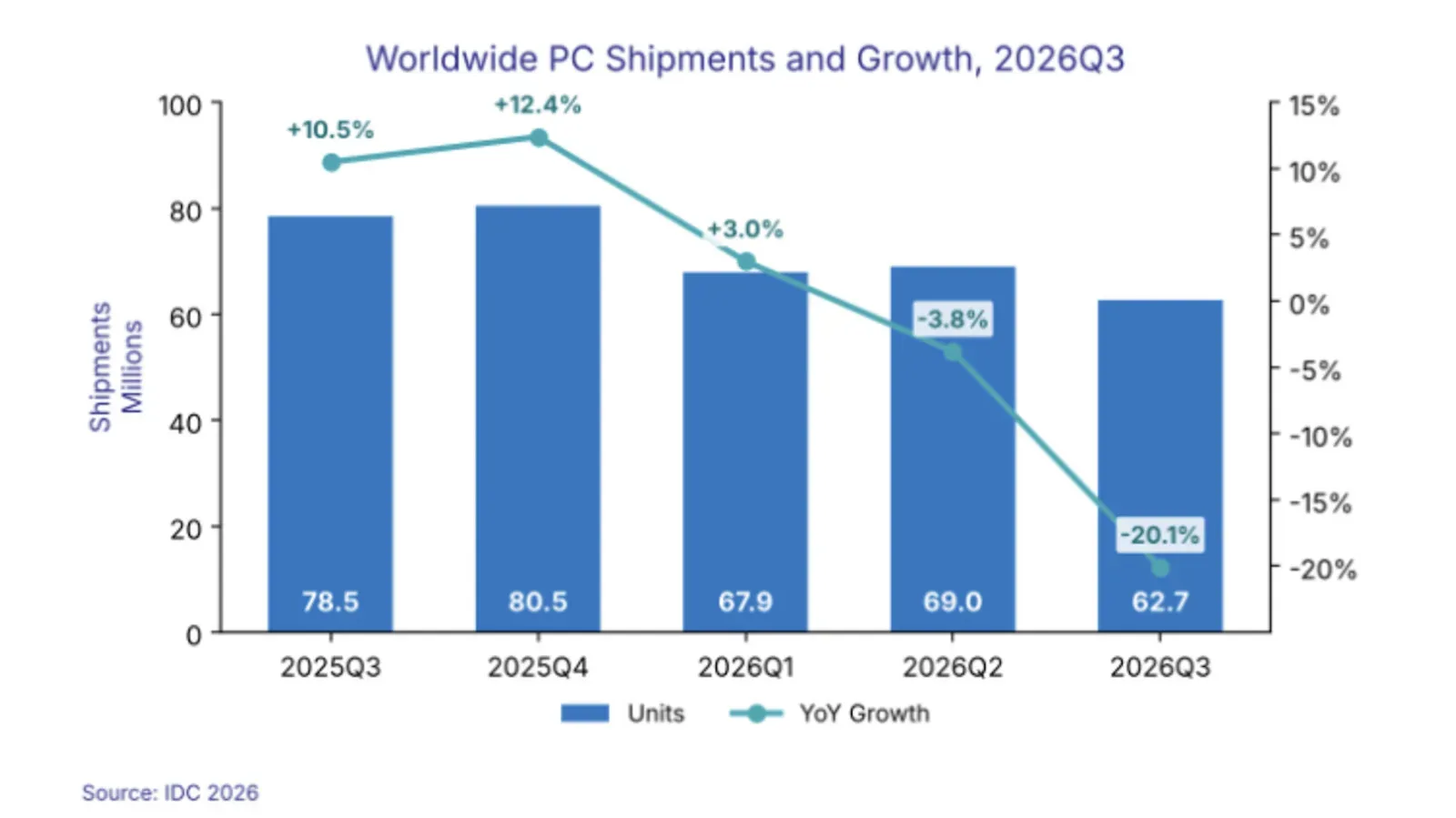
That is plainly a decline, not a surge disguised by friendly arithmetic. But context matters: total worldwide PC shipments dropped 20.1% year over year, falling from 78.5 million units to 62.7 million. Apple therefore lost fewer shipments, in percentage terms, than the market around it. Its estimated market share rose from 8.5% in the third quarter of 2025 to 9.5% in the third quarter of 2026, while it remained fourth in the vendor rankings.
For people shopping for a computer—or simply watching how the PC business is reacting to higher component costs—the key point is that a rising market-share number does not necessarily mean more Macs reached customers. It means Apple’s shipments declined less severely than many of its biggest rivals during a difficult period.
A smaller market changes the meaning of market share
Shipments are an estimate of devices sent through the supply chain, rather than a direct count of retail purchases or active computers in people’s homes. This distinction is especially important in a quarter shaped by earlier inventory orders. A manufacturer may ship fewer machines to retailers and distributors because those partners already have stock, even if the underlying appetite for PCs has not vanished at exactly the same pace.
Market share, meanwhile, is a vendor’s portion of all estimated shipments. When the total market declines faster than one company’s own volume, that company can gain share even while shipping fewer computers. Apple’s quarter is a clear example:
- Mac shipments were estimated at 5.9 million, down 11.3% year over year.
- Worldwide PC shipments were estimated at 62.7 million, down 20.1% year over year.
- Apple’s share consequently increased by one percentage point, reaching 9.5%.
That relative resilience did not move Apple from fourth place. Lenovo led the market at an estimated 14.9 million shipments. HP followed with 10.3 million, Dell recorded 7.6 million, Apple came next at 5.9 million, and ASUS placed fifth with 5.5 million.
The percentage changes illustrate why Apple gained ground without adding volume. Lenovo’s shipments fell 22.6%, HP’s fell 30.9%, and Dell’s fell 25%. ASUS declined 8.6%, making it the only other company in the top five—and the only one besides Apple—with a smaller percentage drop than the overall PC market. ASUS also posted a marginally smaller decline than Apple.
The quarter was weak even compared with the previous one
The third-quarter result also worsened from the immediately preceding quarter. Total PC shipments were 9.1% below the second-quarter total, following a 3.8% year-over-year decrease in that earlier period.
That sequential dip matters because the third quarter is usually a more active stretch for the industry. Instead of the usual seasonal lift, the market saw lower shipment volume. The available figures point less to one vendor-specific problem than to a broad reset in ordering, inventory, component supply, and pricing.
Apple’s improved share should therefore be read as a comparative performance measure, not a declaration that the wider computer market is healthy. It says Apple held up better than several major competitors in this particular shipment environment. It does not erase the estimated loss of 800,000 Mac shipments from the year-earlier quarter.
Why ordering earlier may have emptied the third-quarter pipeline
A major factor behind the weak quarter appears to be timing. Manufacturers and distribution partners ordered inventory earlier than normal to reduce their potential exposure to rising memory costs. In simple terms, buying stock before expected cost increases can protect a company from paying more later. But it can also shift orders out of a subsequent quarter.
That seems to be what happened here. Sellers reportedly had inventory already on hand after those earlier purchases, reducing the need to make further orders during July through September. Since shipment estimates track devices moving through that channel, a well-stocked pipeline can make the later quarter look softer.
This does not automatically mean every seller is overflowing with unsold machines or that every product line has the same stock position. The estimates describe an industry-wide pattern and do not provide a detailed inventory picture for each Mac model, region, retailer, or buyer type. Still, it is a useful warning against treating quarterly shipment totals as a one-to-one proxy for consumer demand.
It also provides a practical lens for deals. Retailers carrying more inventory may choose to discount some configurations in order to move them, particularly when newer stock is expected or carrying that inventory becomes costly. Buyers should not assume discounts imply that all PC prices are returning to previous levels, however. There can be a difference between a temporary promotion on available stock and a permanent reduction in the underlying cost of making new systems.
Recent Mac shopping offers are worth assessing model by model rather than as proof of a broad price reversal. For example, some M5 MacBook Air configurations have been listed at $200 off. A specific sale can be useful to a buyer who already knows the memory, storage, and screen size they need, but it does not settle the wider question of where PC pricing will head.
Memory costs and AI data centers are part of the pressure
The industry’s supply problem is closely tied to memory. Memory is a general term for components used to hold data for quick access while a system is running. PCs need it, and data-center hardware needs it too. When supply is constrained and demand is strong, memory can become more expensive, increasing a computer maker’s costs.
The available estimates connect component shortages and higher prices to the expansion of AI data centers. Those facilities use large amounts of computing hardware, and the growth in AI infrastructure is placing pressure on supply and costs. The impact reaches beyond servers: PC makers must source components in the same broader market.
Apple raised prices in June. During the company’s July earnings call, former CEO Tim Cook cited rapidly increasing memory expenses. That is an unusually direct connection between a component-cost problem and the price a buyer sees for a finished device. It also helps explain why a lower-shipment quarter should not automatically lead to expectations of cheaper Macs across the board.
There are several moving parts in a final computer price: components, manufacturing, distribution, inventory, competition, currency conditions, and a seller’s willingness to accept a lower margin to clear stock. This quarter supplies evidence for pressure from memory prices and shortages, as well as the possibility of seller discounts. It does not provide enough detail to calculate how much any individual Mac’s price is driven by memory, nor does it establish that every model will rise or fall by the same amount.
What the figures suggest for PC buyers
For prospective buyers, the most grounded takeaway is to separate the immediate purchase decision from the broader market narrative. A shrinking shipment market can produce conflicting signals at once: higher costs on newly produced hardware, discounts on inventory already in the channel, and uncertainty about future demand.
- A deal may be real without indicating a permanent price reset. Sellers can lower prices to reduce existing stock while the cost of replacement inventory remains higher.
- Waiting is not guaranteed to improve pricing. The expectation is not that prices will return to the level seen a year earlier, even if some retailers discount selected machines.
- Configuration matters. Buyers should compare the actual memory and storage options they need, rather than relying solely on a headline starting price.
- Shipments are not sales receipts. Quarterly shipment estimates show the flow of devices through the channel, so inventory timing can amplify or soften the picture from one quarter to the next.
People who need a computer now may find value in targeted discounts, especially where a configuration already fits their needs. People who do not need to buy immediately should be cautious about assuming a broad market slump will force a return to older price levels. The pressure from higher component costs makes that outcome far from certain.
Apple’s position: better than peers, but still exposed to the market
Apple’s 9.5% share gives it a stronger relative position than it had a year earlier, but the company is not isolated from the forces affecting the PC business. Its shipment estimate declined by 11.3%, and it remained behind Lenovo, HP, and Dell in total volume.
The more meaningful distinction is that Apple’s decline was less severe than the 20.1% contraction across all brands and less severe than the drops reported for Lenovo, HP, and Dell. ASUS was the notable top-five exception, declining 8.6%.
This is why percentage comparisons need care. A 9.5% share is an indication of relative standing within the quarter’s total market, while 5.9 million estimated shipments is the more direct measure of the volume attributed to Apple. Both figures are true, and each answers a different question: how large was Apple’s position compared with competitors, and how many Macs were estimated to have been shipped?
The outlook remains constrained
The outlook described for the rest of 2026 and into 2027 remains cautious. Sellers may discount inventory to reduce stock, but PC prices are not expected to fall back to where they were a year earlier. A weakening economy could also suppress demand further.
That leaves the market in an awkward middle ground. There may be occasional savings for buyers, while the wider cost base stays elevated. There may be a recovery in order flow once existing channel inventory is reduced, while broader economic conditions could limit how much demand returns. And a vendor can gain market share even during an objectively poor shipment quarter.
For Apple, the third quarter offers a modest relative win inside a substantial industry pullback: fewer Macs shipped, but a larger share of the PC market. For buyers, it is a reminder to focus on the actual system, configuration, and price in front of them rather than relying on one headline statistic to predict the entire market.