Dupery: A Game of Solo Deduction will launch on Steam on October 15, 2026, from developer Gilded Rune Games and publisher Yogscast Games. The solo detective game will receive a 20% launch discount, earned by its Discord community after players completed a community ARG.
The date and discount were revealed during the Convergence Showcase. The promotion is tied to an effort by the community’s self-styled Discord Detectives, who solved the clues in the alternate-reality game. The result is a launch incentive that is already confirmed, though no end date for the discount or base Steam price has been specified.
A social-deduction structure built for one detective
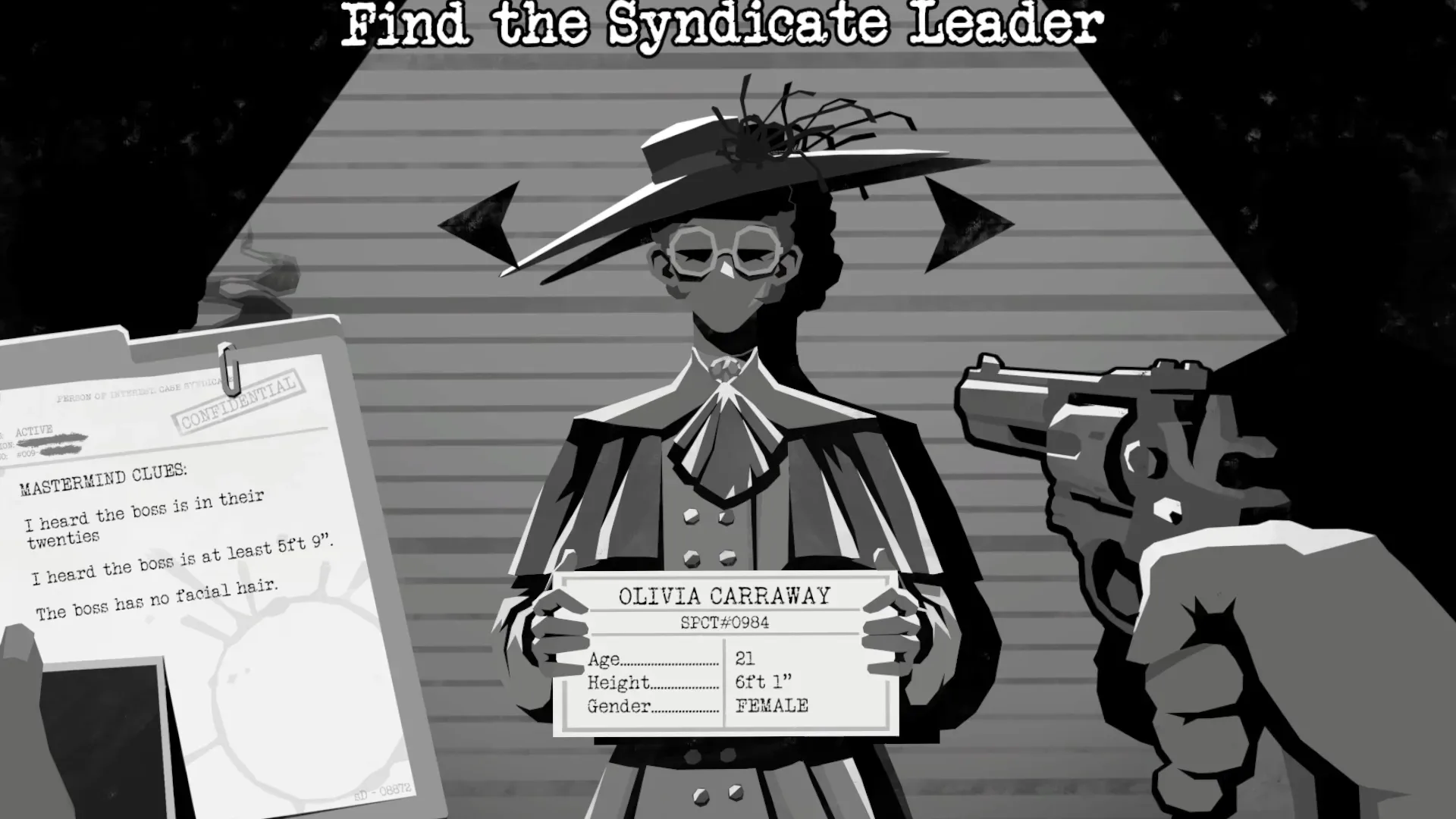
Dupery’s central hook is unusual on its face: it combines social deduction with roguelite and puzzle systems, but presents them as a single-player detective experience in a film noir mystery setting.
Social deduction is usually associated with games in which a group of players tries to identify hidden roles, allegiances or deception through evidence, behavior and deduction. Dupery instead frames that kind of role-reading as the work of one investigator. The essential question is not merely whether a case can be solved, but whether players can correctly interpret a cast of possible suspects and their defining traits before committing to an arrest.
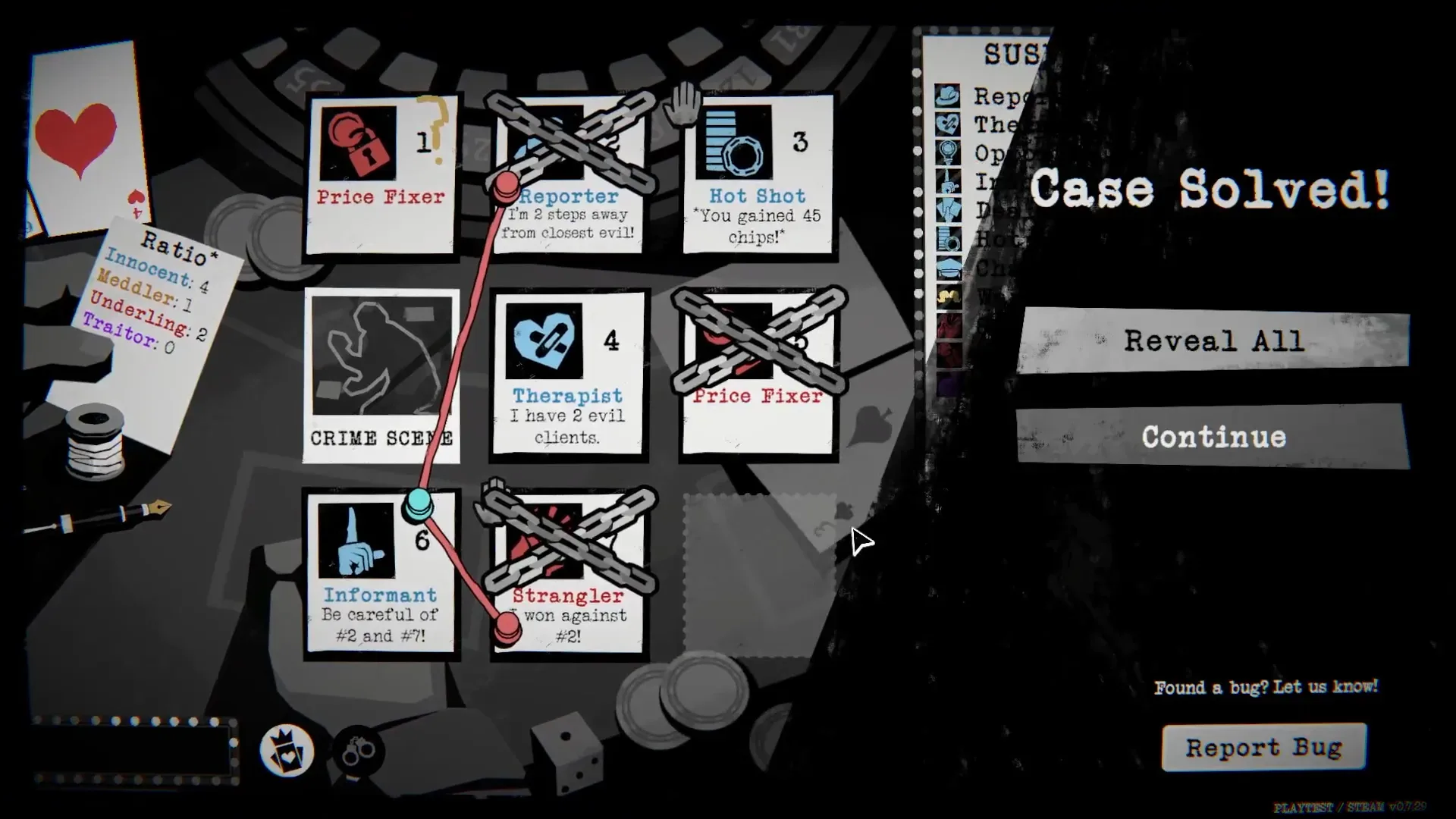
That commitment appears to have consequences. Dupery includes a reputation meter that must be managed while making arrests. In practical terms, that system should make each accusation more meaningful than a simple guess: an incorrect or poorly supported arrest could carry a cost within a run, while careful deduction should help preserve the detective’s standing. Exactly how reputation rises or falls, and what thresholds it affects, has not been detailed.
The game’s noir presentation is also more than a decorative promise when paired with that mechanic. Noir mysteries frequently turn on uncertainty, incomplete information and the pressure to make a judgment before every loose end is resolved. Dupery’s stated design suggests it wants players to sit in that uncomfortable space: organize the clues available, decide whom to trust, and accept that an arrest is an action with stakes rather than a button pressed after a perfectly tidy reveal.
175-plus handcrafted roles aim to make each case readable—and difficult
Gilded Rune Games says Dupery includes more than 175 handcrafted roles. The word handcrafted matters here. Rather than simply using an endlessly random pool of labels, the game is positioning its roles as deliberately authored pieces of a wider deduction puzzle.
Roles are expected to form a large part of how players understand a case, while quirks and modifiers add further variables between missions. A role may establish the basic function or behavior associated with a character, while a quirk or modifier can alter the circumstances around that character or investigation. The game has not broken down the exact relationship between those systems, so players should not assume specific role powers or conditions beyond what has been announced.
Related coverage includes Dupery: A Game of Solo Deduction Sets October 15 Steam Launch.
Still, the stated volume points to a design with considerable room for combinations. A detective game needs clues that can be interpreted, but it also needs enough uncertainty that a solution is not immediately obvious. A large authored role pool can support that balance by giving individual cases distinct patterns without making the player learn entirely unrelated rules every time.
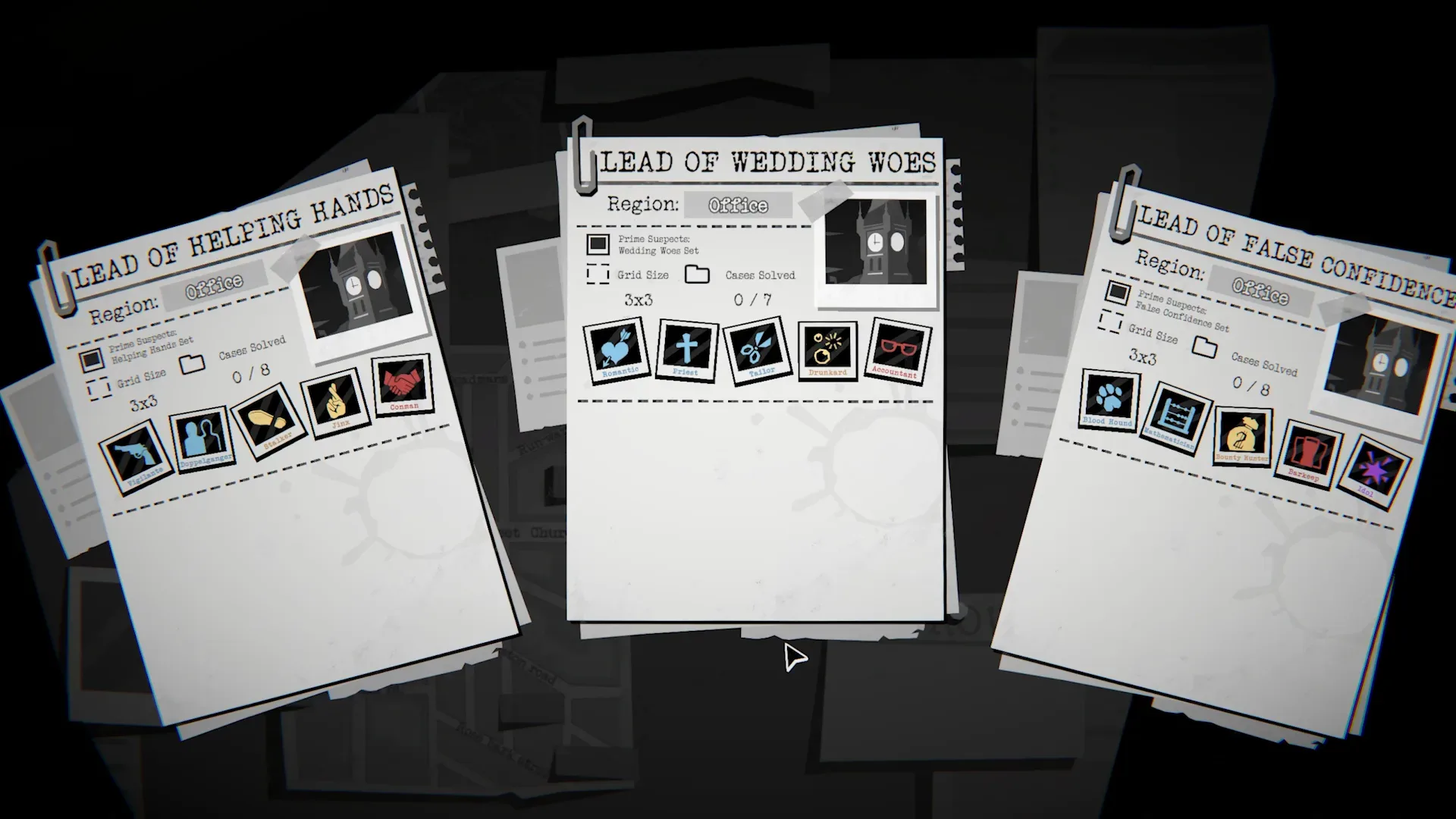
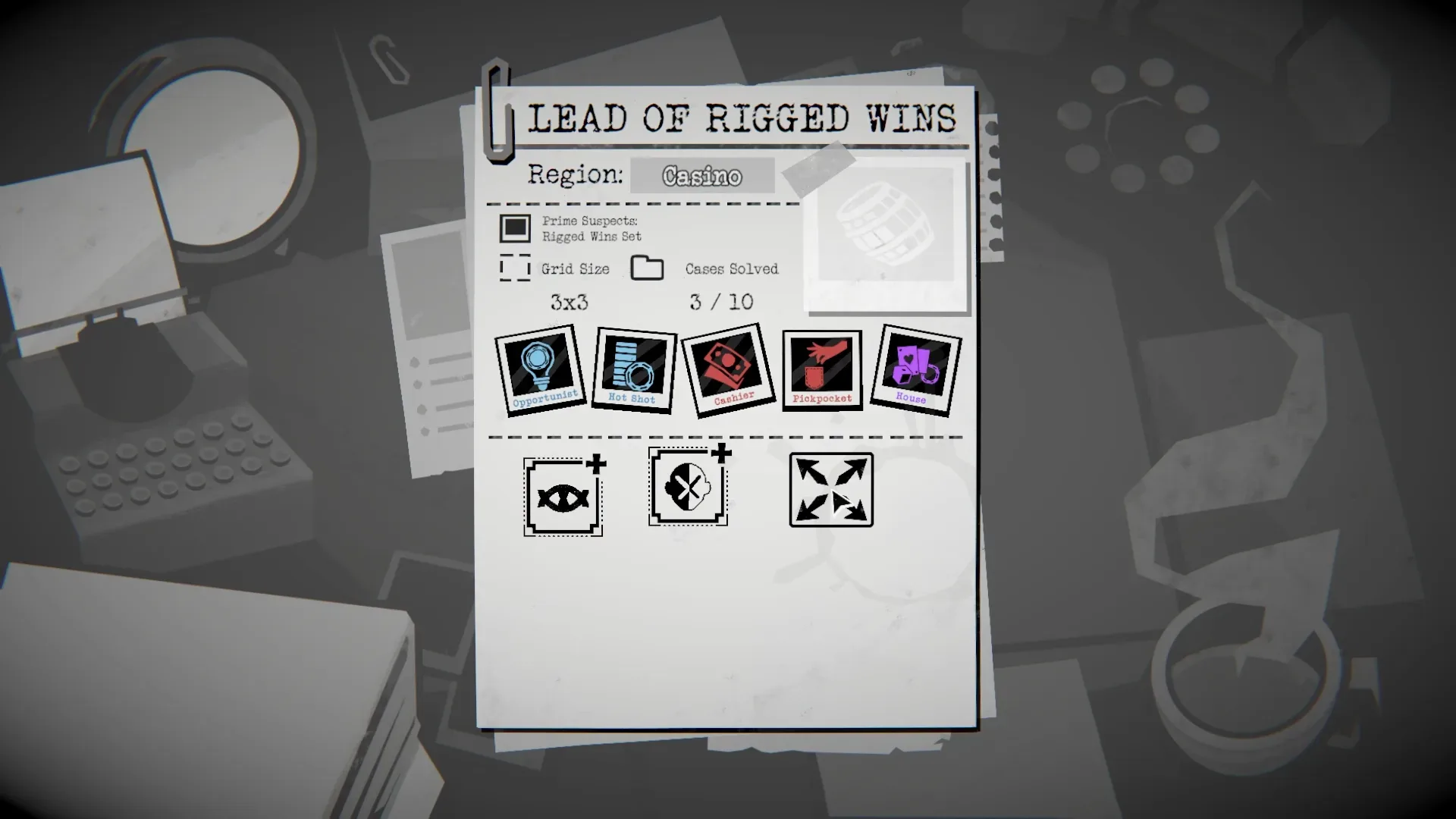
There will be three regions, each with its own mechanics and roles. That regional split suggests that Dupery’s ruleset will not stay completely static as players move through its world. Different regions can change the information a player prioritizes, the types of people under suspicion, or the complications surrounding an arrest. The developers have not outlined the regions themselves, their order, or whether they are selected freely, so those details remain unknown.
Procedural cases, but with an authored foundation
Dupery promises procedurally generated cases, with the stated aim that no two runs are the same. Procedural generation means that a game uses systems to assemble elements into a fresh scenario rather than delivering one fixed sequence of cases in the same arrangement every time.
For a deduction game, procedural generation raises a clear design challenge: a case needs to be variable, but it must also remain understandable and solvable. Dupery’s announced mixture of generated cases and handcrafted roles is notable because it implies a hybrid approach. The circumstances of a run can shift, while the components used to read those circumstances are designed rather than wholly random.
The roguelite label reinforces that structure. A roguelite is generally built around repeatable runs in which failures, successes or new choices lead into another attempt, often with changing conditions. Dupery will let players choose from roles, quirks and modifiers between missions. That indicates there is a strategic layer outside the immediate act of studying a crime board: players will make selections that shape the next investigation.
What has not been confirmed is the nature of long-term progression. There is no announced information on permanent upgrades, unlock requirements, run length, failure states or whether a successful case chain has a definitive endpoint. The roguelite description establishes replayability and between-mission decisions, but not the precise form of its progression economy.
A crime board designed for actual note-taking
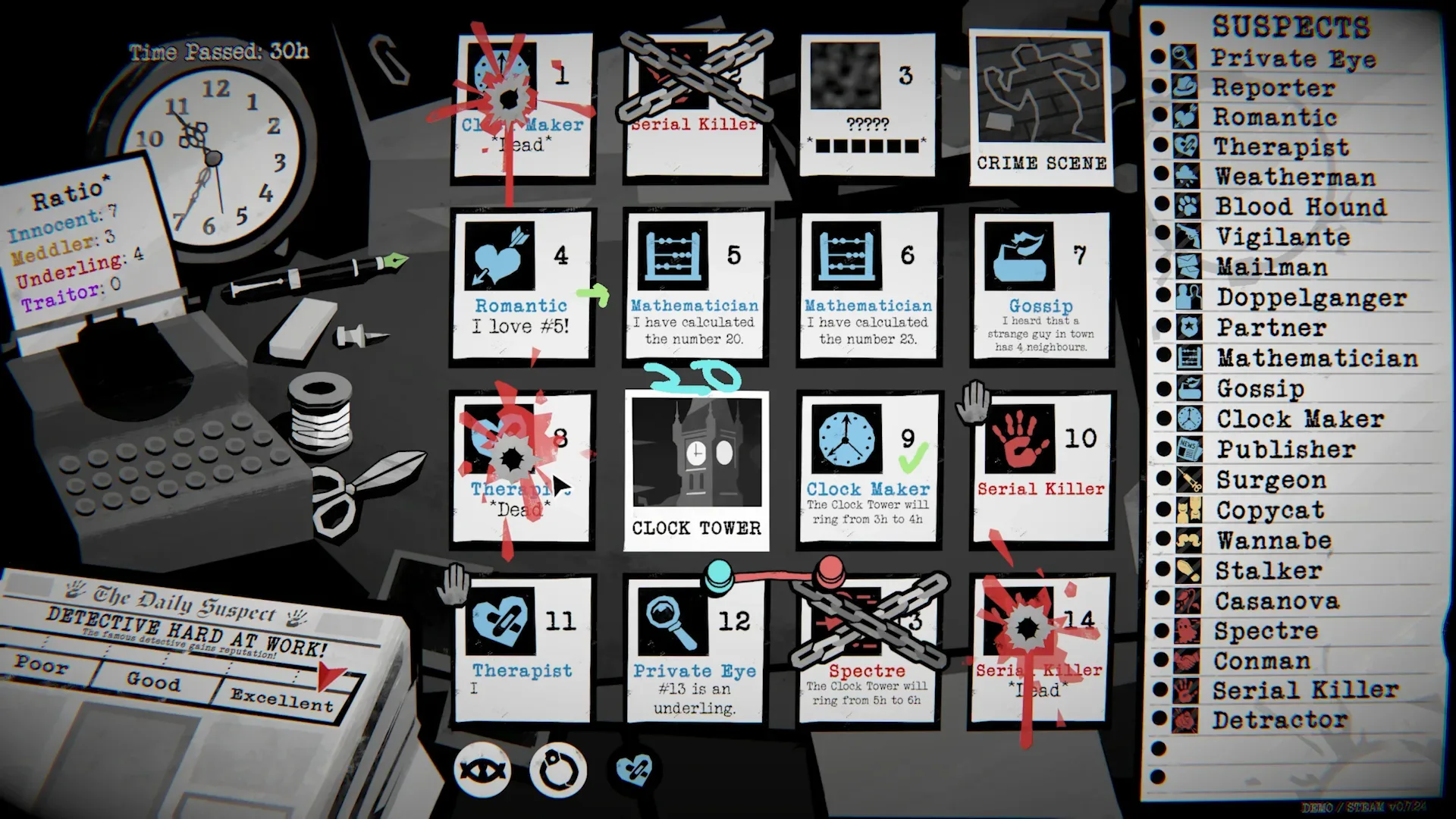
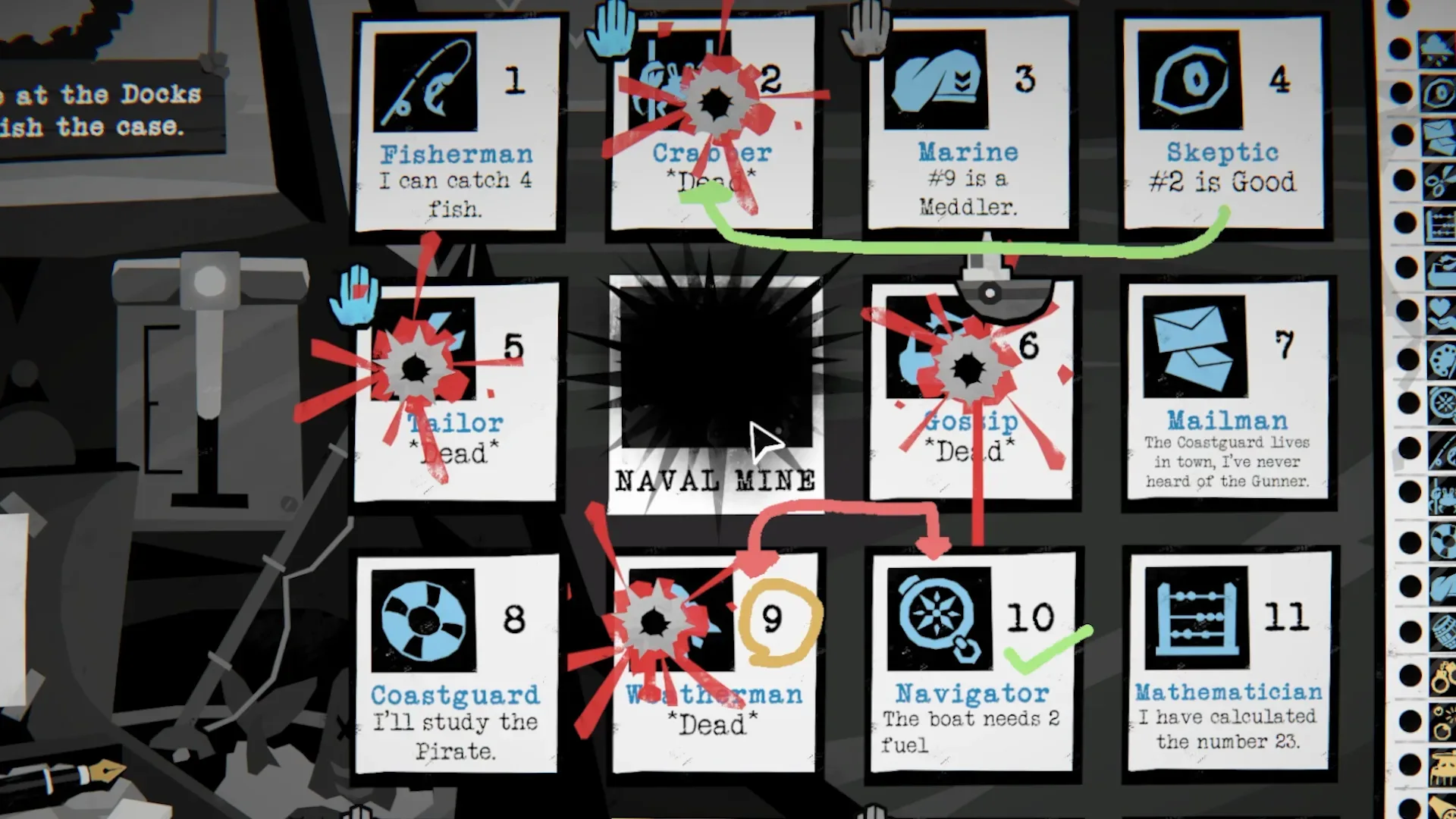
One of Dupery’s more concrete tools is its notation kit. Players will be able to use strings, pins and notes to map out an in-game crime board. That is a particularly fitting feature for a detective game founded on deduction, because it gives players a way to externalize their reasoning rather than rely entirely on memory.
In a social-deduction puzzle, information often has value only in relation to other information. A note can record what a suspect claims. A pin can mark a person, detail or potential lead. A string can make a visible connection between two pieces of evidence. The announced toolkit appears designed to support that familiar investigation-board language within the game itself.
It also has practical implications for players. With more than 175 roles in the game and procedural cases changing the circumstances from run to run, keeping a written theory may be as important as noticing an individual clue. The board could help separate confirmed facts from suspicion, track conflicting statements, or preserve a theory while new evidence arrives. Those are examples of how such a toolkit can support deduction, not confirmed rules for its use.
The feature is worth watching because it addresses an occasional tension in mystery games. Many detective games want players to feel smart, yet reduce the investigation to selecting a highlighted dialogue option or following a prescribed marker. A flexible notation interface signals a different intention: Dupery appears to want the player to construct and revise a case theory. Whether the game supplies enough clarity and feedback to make that process satisfying will only be answerable after release.
What the community ARG changed
The completed ARG did not reveal an additional platform or alter the release date. Its confirmed result is the 20% Steam launch discount. That makes the event a community-driven pre-launch challenge with a direct benefit for purchasers, rather than an in-game reward or a gameplay unlock.
An ARG, short for alternate reality game, is a puzzle experience that presents clues across formats or spaces beyond a conventional game session. Here, the relevant outcome is straightforward: the Discord community solved the challenge, and Steam buyers will receive the launch discount.
It is an apt promotional format for Dupery, whose premise revolves around interpreting clues and making connections. More importantly, it offers a confirmed reason for players interested in the game to pay attention to its launch window. Those looking for another game arriving on the same day can also see how Torchlight: Infinite’s Tartarus season is scheduled to begin October 15, though it is a separate release and unrelated to Dupery’s promotion.
What is confirmed before launch
- Release date: October 15, 2026.
- Platform: Steam.
- Developer: Gilded Rune Games.
- Publisher: Yogscast Games.
- Launch offer: 20% discount, unlocked through the Discord community ARG.
- Core format: A solo film noir detective game combining social deduction, roguelite and puzzle elements.
- Announced systems: More than 175 handcrafted roles, a reputation meter, three mechanically distinct regions, procedural cases, between-mission choices involving roles, quirks and modifiers, and an in-game crime-board notation toolkit.
Dupery’s pitch rests on an intriguing contradiction: social deduction without a roomful of human opponents. Its success will depend on how convincingly its roles, clues and consequences create the pressure of a live deception game for a player working alone. The announced crime board, procedural case structure and reputation-based arrests all point toward a game that expects players to reason through uncertainty instead of simply uncovering a preset answer. Steam players will be able to begin doing that on October 15.