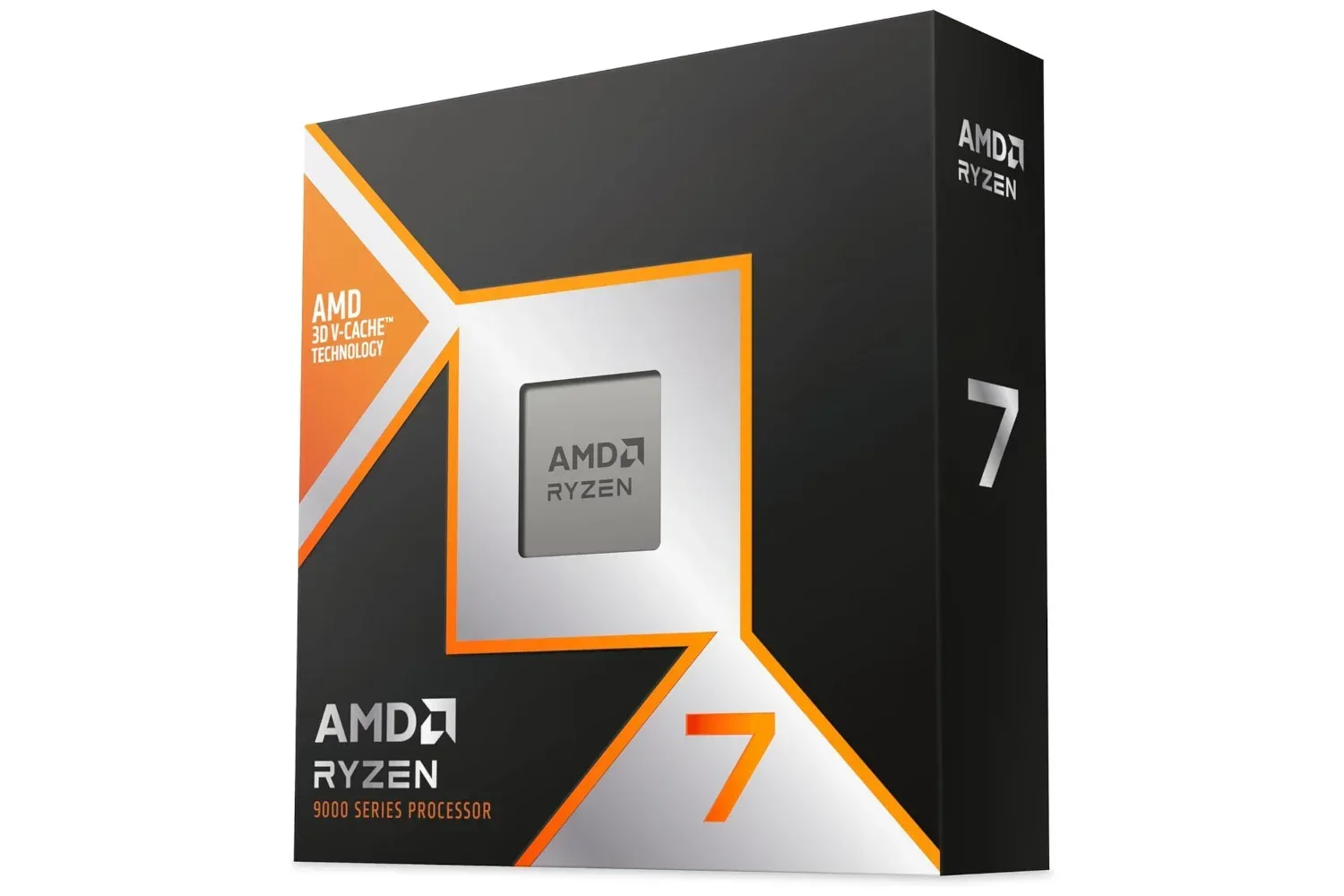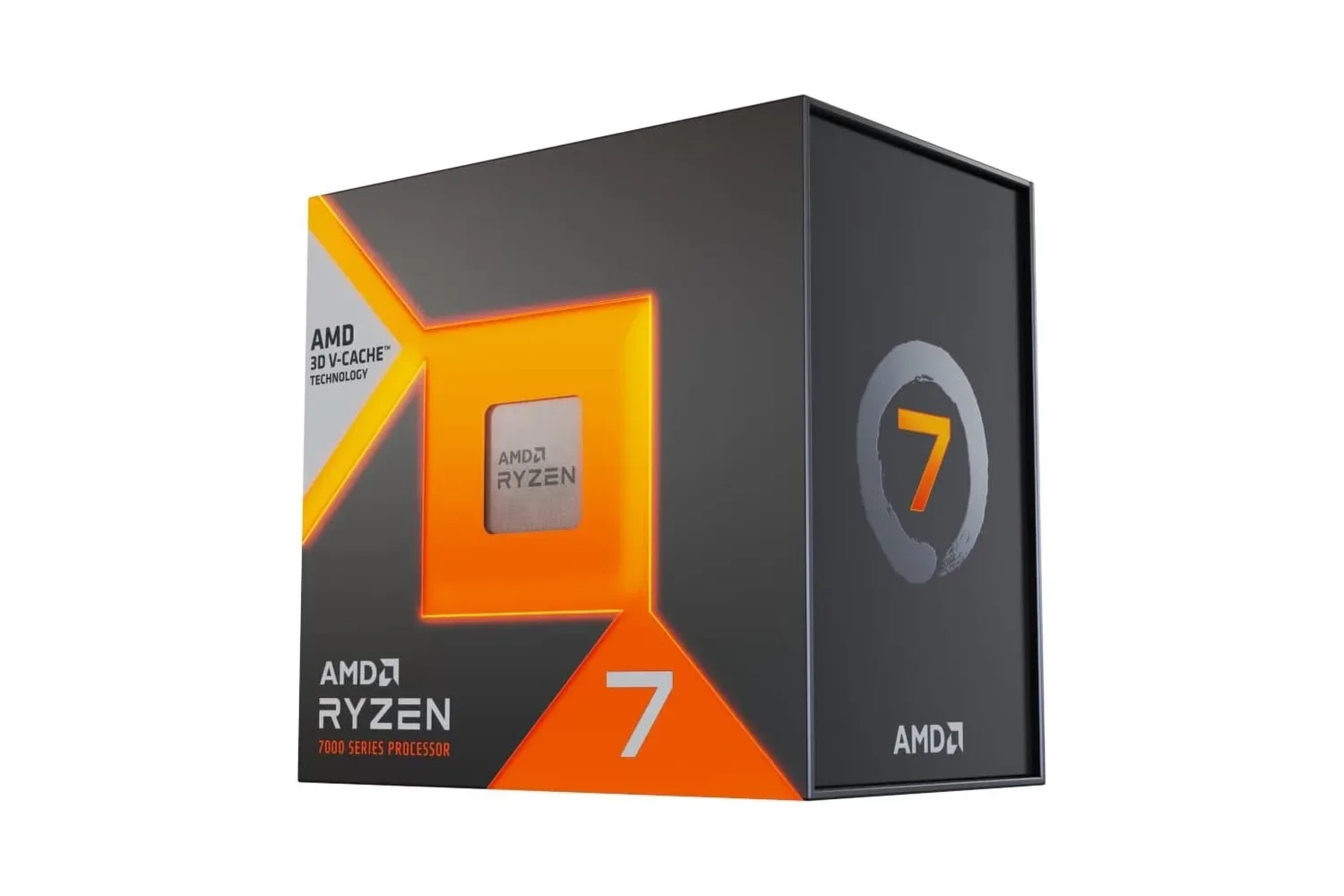
AMD’s Ryzen 7 7800X3D desktop processor is listed at $348, reduced from $449. That is a $101 price difference, or 22% off the stated regular price, for an eight-core gaming-focused CPU built for AMD’s AM5 motherboard platform.
The meaningful part of this particular component is not simply its clock speed or core count. It is AMD’s 3D V-Cache design: the Ryzen 7 7800X3D has 96MB of L3 cache stacked near its Zen 4 processing cores. Together with its L2 cache, AMD lists 104MB of combined L2 and L3 cache. For a gaming PC, that cache-heavy approach is intended to keep repeatedly needed game data nearer to the CPU, reducing the time spent waiting on main system memory.
That can matter most to players pursuing high frame rates and steadier delivery of frames rather than just a strong average frame-rate number. Competitive shooters are an obvious use case, but the same priority can help in demanding single-player games where CPU work and frequent data access contribute to smoothness. It is not a standalone route to better performance, however: the graphics card, game settings, resolution, installed memory and the game itself all remain part of the equation.
What the Ryzen 7 7800X3D includes
The Ryzen 7 7800X3D combines eight Zen 4 cores with 16 threads. A core is a processing unit capable of carrying out work; threads describe the work streams the processor can manage. Eight cores and 16 threads gives this chip room for a game alongside background applications and live-streaming workloads, though the real benefit will depend on what is actually running at the same time.
Its stated base clock is 4.2GHz and its maximum boost clock is 5.0GHz. Clock speed is one measure of how quickly a processor operates, but it should not be treated as a direct scorecard between different CPU designs. In this processor’s case, the large cache is a central part of why it is positioned for high-end gaming rather than an incidental specification.
- Architecture: 5nm Zen 4
- Core configuration: 8 cores, 16 threads
- Clocks: 4.2GHz base, up to 5.0GHz boost
- Cache: 96MB L3 cache; 104MB combined L2 and L3 cache
- Platform: Socket AM5
- Memory support: DDR5
- Expansion support: PCIe Gen 5.0
- Rated TDP: 120W
- Graphics: Built-in Radeon graphics
Why 3D V-Cache is relevant to games
Cache is extremely fast memory associated closely with the processor. A CPU uses it to hold data it expects to need again soon. System RAM has far more capacity, but a processor must wait longer for it than it does for cache. Games often revisit portions of data, so a larger nearby cache can help cut those waits.
AMD’s 3D V-Cache stacks additional L3 cache directly above the processing cores. The purpose is straightforward: increase the pool of quickly accessible data without asking the processor to continually reach out to system memory for the same information. The practical target is smoother execution and stronger frame rates in games that respond well to the extra cache.
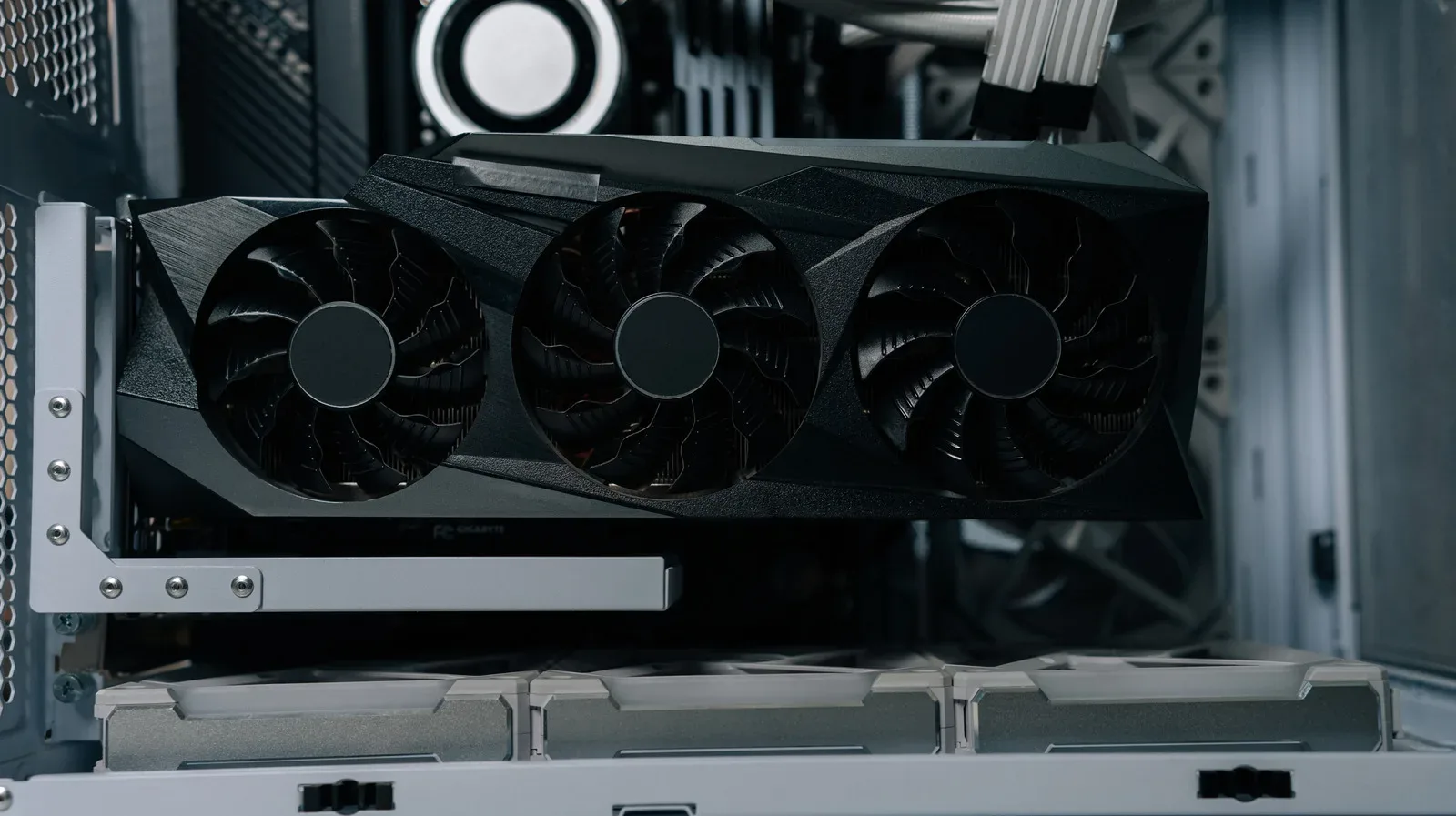
It is important to distinguish that design from raw graphics horsepower. A CPU prepares and coordinates work for the system, while the graphics card is responsible for rendering the images seen on screen. A Ryzen 7 7800X3D can be a strong foundation for a high-frame-rate system, but it cannot remove a graphics bottleneck by itself. Someone gaming at high settings in visually demanding titles still needs a graphics card suitable for those settings.
Related coverage includes AMD Ryzen 7 7800X3D Falls to $348 in Major Gaming CPU Deal.
AM5 means a DDR5-only build path
This processor uses AMD’s AM5 platform, so it is for a new AM5 build or an upgrade to an existing AM5 system—not a drop-in replacement for an older motherboard. The listed compatible chipset families include X670, B650 and X870, among others. Before buying, builders should confirm their board uses AM5 and check the motherboard manufacturer’s CPU support information.
AM5 also brings support for DDR5 memory and PCIe Gen 5.0. DDR5 is the required memory generation for this platform, so anyone moving from a system using older RAM should include new memory in the upgrade budget. PCIe, meanwhile, is the connection standard used by components such as graphics cards and SSDs. Gen 5.0 support gives a build access to that newer interface standard, although a component must itself support it to use it.
The processor supports AMD EXPO, short for Extended Profiles for Overclocking. In practical terms, EXPO is a memory-profile feature designed to help compatible DDR5 kits run at their rated settings through a simpler setup option rather than requiring manual tuning. It is useful to know what it is, but it is not a substitute for confirming memory compatibility with the chosen motherboard.
For readers putting together the rest of a setup, smaller practical accessories can matter too, whether it is storage transfer hardware or cable management around a desk. A four-port USB hub listed at $7 is a separate, lower-cost option for expanding accessible USB connections; it has no bearing on CPU performance, but it illustrates the kind of peripheral need worth considering when planning a complete PC space.
Built-in graphics are useful, but not the main gaming plan
The Ryzen 7 7800X3D includes built-in Radeon graphics. For a processor aimed at high-end gaming systems, that should primarily be viewed as a convenience and troubleshooting feature rather than the centerpiece of a gaming build. It can provide video output while a new system is being assembled, help diagnose an issue involving a discrete graphics card, or keep a PC usable while a graphics card is absent.
That capability can be especially helpful for first-time builders. If a new build does not display an image, integrated graphics can help separate a possible GPU issue from other installation or configuration problems. Still, players looking for high settings in demanding modern games should plan around a separate graphics card.
Do not overlook cooling and total build cost
The Ryzen 7 7800X3D has a 120W TDP and does not include a stock cooler. TDP, or thermal design power, is a thermal specification used to inform cooling requirements; it should not be read as a complete picture of every power scenario. The immediate purchasing implication is simpler: this $348 processor requires a separately selected cooling solution.
Buyers can choose air cooling or liquid cooling based on their case, budget and noise preferences. The supplied information does not identify a specific recommended cooler, so the responsible approach is to verify that the chosen cooler fits the PC case and supports AM5. A compatible motherboard, DDR5 memory, a cooler, storage, power supply, case and—if high-end gaming is the goal—a discrete graphics card are all still needed for a complete new PC.
That makes the reduced processor price most compelling for two groups. First are builders already planning an AM5 system who can apply the $101 reduction to another necessary part. Second are existing AM5 owners considering a CPU upgrade, provided their motherboard supports the chip. For someone on an older platform, the deal is only one part of the cost because the platform change can involve a motherboard and DDR5 memory as well.
Who this deal fits
The Ryzen 7 7800X3D is geared toward players prioritizing high-refresh gaming, particularly when paired with a current graphics card. Its eight cores and 16 threads also leave capacity for multitasking and streaming. The AM5 platform’s DDR5 and PCIe Gen 5.0 support offers a current foundation for future changes to memory, storage and graphics hardware.
But “gaming CPU” does not mean every shopper should make it the default pick. The best fit depends on the platform already owned, the budget remaining after a cooler and other parts, and whether the system’s target use actually benefits from a cache-focused high-end CPU. Buyers should also verify the live listing price and compatibility before checking out, since retail pricing and inventory can change.
At the listed $348 price, AMD’s Ryzen 7 7800X3D presents a notably lower entry cost for an eight-core AM5 processor with 96MB of 3D V-Cache. For a carefully planned gaming build, the main checklist is clear: match it with an AM5 board, DDR5 RAM, appropriate cooling and a graphics card that suits the games and settings you intend to run.
Shop the products
Check current price, model and availability at the retailer.