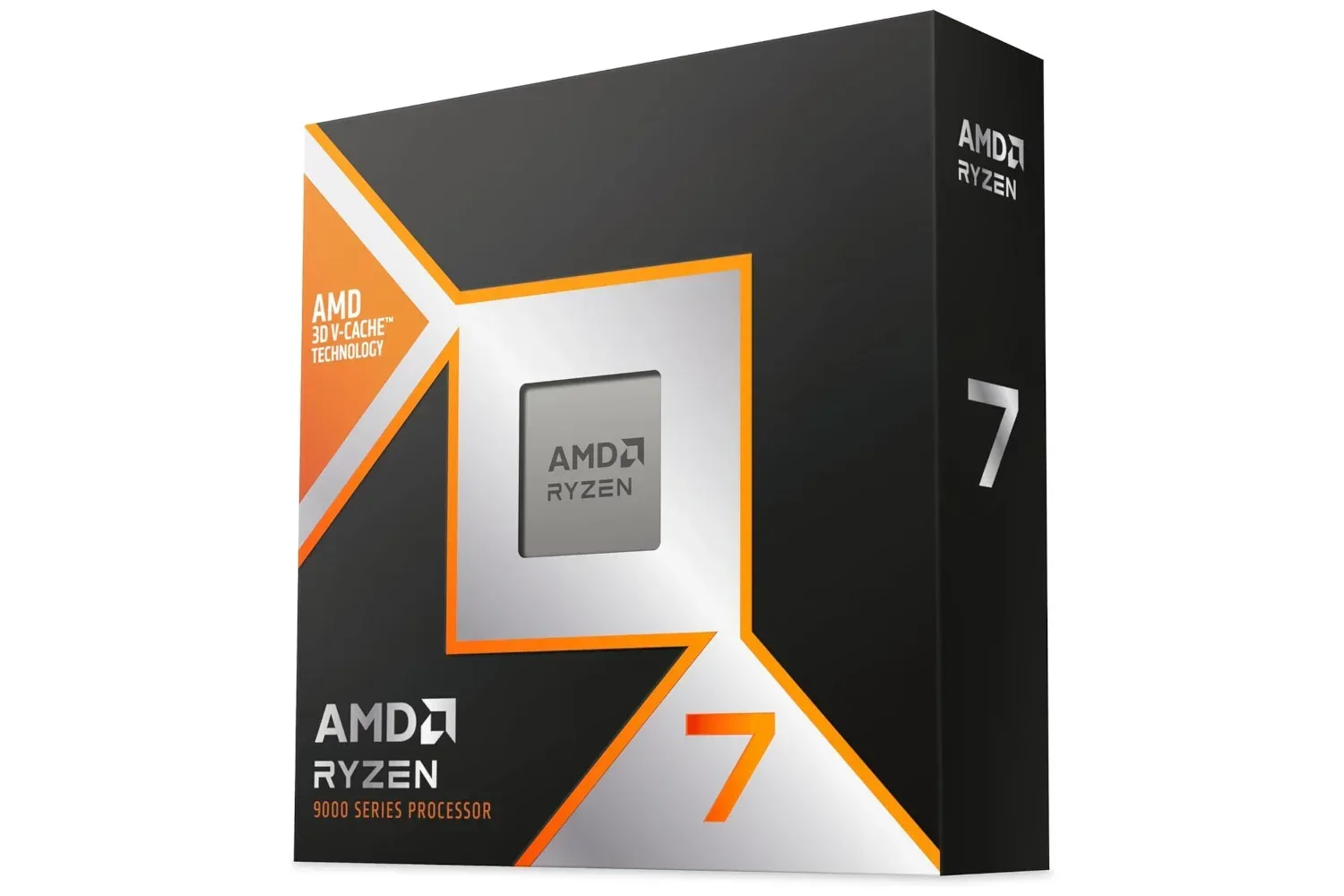
The AMD Ryzen 7 9800X3D is listed at $411 during Amazon Prime Big Deal Days, a reduction from its stated $479 price. That is a $68 difference, or roughly 14% off the listed price, for a processor positioned around gaming performance rather than a no-frills desktop refresh.
There is one important catch before anyone begins mentally spending the savings on a suspiciously large case fan: the $411 listing is limited to Amazon Prime members. Deal pricing can also be short-lived, particularly during a major sales event, so the listed price should be treated as a snapshot rather than a guarantee that will remain in place throughout the promotion.
The Ryzen 7 9800X3D has eight CPU cores, 16 threads and 96MB of cache. Those specifications help explain why it is a notable discount for people planning a gaming PC build or a CPU upgrade, although a processor is only one part of the performance equation. The graphics card, memory, storage, cooling and the rest of a system all influence the final experience in games.
What the $411 price means
At $411, the Ryzen 7 9800X3D is $68 below the supplied $479 reference price. For a component at this tier, that is enough of a gap to matter to builders balancing an overall PC budget. It may free up room for another part of a build, but it is not automatically the cheapest route to a playable gaming computer. It is a premium processor still carrying a premium price, just a meaningfully lower one than its stated usual figure.
The real value of a CPU sale depends on the buyer’s starting point. Someone assembling a system around a gaming-oriented processor may view the lower price as a chance to reduce the total cost. Someone replacing an existing CPU needs to account for the practical side of an upgrade: the processor must suit the rest of the PC, and installation may require hands-on work or help from a local technician.
That distinction is worth keeping in mind because processor deals can encourage an all-or-nothing mentality. A low price on one crucial component does not eliminate the need to check the broader build before ordering. The sensible question is not merely whether $411 is lower than $479; it is whether this particular CPU fits the system a buyer intends to build or update.
Why the specifications matter for games
Eight cores means the processor has eight primary processing units available to handle work. Sixteen threads refers to the processor’s capacity to manage 16 concurrent execution threads. In plain terms, the chip is built to work through more than one task at a time, which is relevant to modern games and the everyday background activity of a PC.
That does not mean every game will use all of those resources in precisely the same way. Games differ in how they use a CPU, and performance will vary based on the complete hardware configuration and the software being run. Still, an eight-core, 16-thread design gives the Ryzen 7 9800X3D substantial headroom for a system expected to play demanding games while dealing with normal desktop tasks.
Related coverage includes AMD Ryzen 7 9800X3D Falls to $411 During Prime Big Deal Days.
The headline feature for gaming is its 96MB cache. Cache is a small, very fast pool of memory located close to the processor. It can retain data the CPU needs frequently, reducing the time spent waiting for that information to arrive from elsewhere in the system. More cache does not function as a universal “make everything faster” button, but it can be especially meaningful in gaming workloads where rapid access to recurring data is valuable.
That focus makes the 9800X3D a more targeted purchase than a processor chosen purely for a basic office machine. It is intended for buyers who care about smooth game performance and want a CPU designed with gaming demands in mind. A recent PC-game issue involving visual glitches is a useful reminder that hardware horsepower alone cannot solve every problem: a reported missing-face bug in The Witcher 3 Remastered, for example, is a software problem rather than something a faster processor can simply erase.
Performance claims need the right expectations
The supplied details characterize the processor as capable in demanding games and generally energy-efficient, while also emphasizing that it is designed to remain cool. Those are appealing traits for a gaming-focused build, but they should not be read as a promise of identical temperatures, power use or frame rates in every setup.
Cooling behavior depends on how a PC is assembled and used. Likewise, game smoothness is influenced by settings, resolution, graphics hardware and the game itself. The Ryzen 7 9800X3D’s specifications suggest strong gaming intent, particularly through its 96MB cache, but buyers should keep their expectations centered on the full system rather than treating the CPU as the sole determinant of results.
“Energy-efficient” also has a practical meaning beyond a specification sheet. Lower energy use can matter over time, but it should not be converted into a precise savings claim without details on a user’s workload, electricity cost and the other parts in the computer. The most supportable takeaway is simply that efficiency is among the processor’s stated strengths, alongside its gaming focus.
A deal for builders, not a plug-and-play upgrade
A desktop processor is not an accessory that can be dropped onto a desk and immediately enjoyed. Installing one requires opening the system and working with its internal hardware. For a first-time builder, that can be a project; for others, it can mean arranging installation help. Buyers should make compatibility checks before purchase and plan for the installation rather than assuming the discounted CPU will slot into every existing desktop without preparation.
That is also why the sale is most useful to shoppers who have a clear build plan. If the Ryzen 7 9800X3D is already on the list, $411 is a straightforward reduction against the cited $479 price. If a buyer has not yet determined what their PC needs, the discount is a reason to investigate, not a reason to skip the planning stage.
The promotion additionally includes a free Onimusha code with qualifying AMD purchases, as described with the deal. That bonus may be welcome for anyone already choosing AMD hardware, but it should remain secondary to the CPU decision. The processor’s value rests on whether its eight cores, 16 threads and 96MB cache make sense for the intended system; a game code is an extra, not a substitute for compatibility and budget checks.
Who should pay attention to the listing
- Gaming PC builders: The 96MB cache and gaming-oriented positioning make this a relevant option for a new performance-focused desktop.
- Planned upgraders: The $68 reduction is most meaningful when the processor already fits an upgrade plan and installation has been considered.
- Prime members: The stated $411 price is specifically tied to Prime membership, making eligibility central to the deal.
- Buyers interested in the AMD game offer: The included Onimusha code can add value for qualifying purchases, but should not override the core hardware decision.
For shoppers who fit those groups, the Ryzen 7 9800X3D listing is a notable Prime Big Deal Days component offer: a $68 reduction on a processor with eight cores, 16 threads and a substantial 96MB cache. For everyone else, it is still a useful signal of the kind of savings that can appear during the event—but not a reason to let a countdown timer build a PC plan on their behalf.
Shop the products
Check current price, model and availability at the retailer.