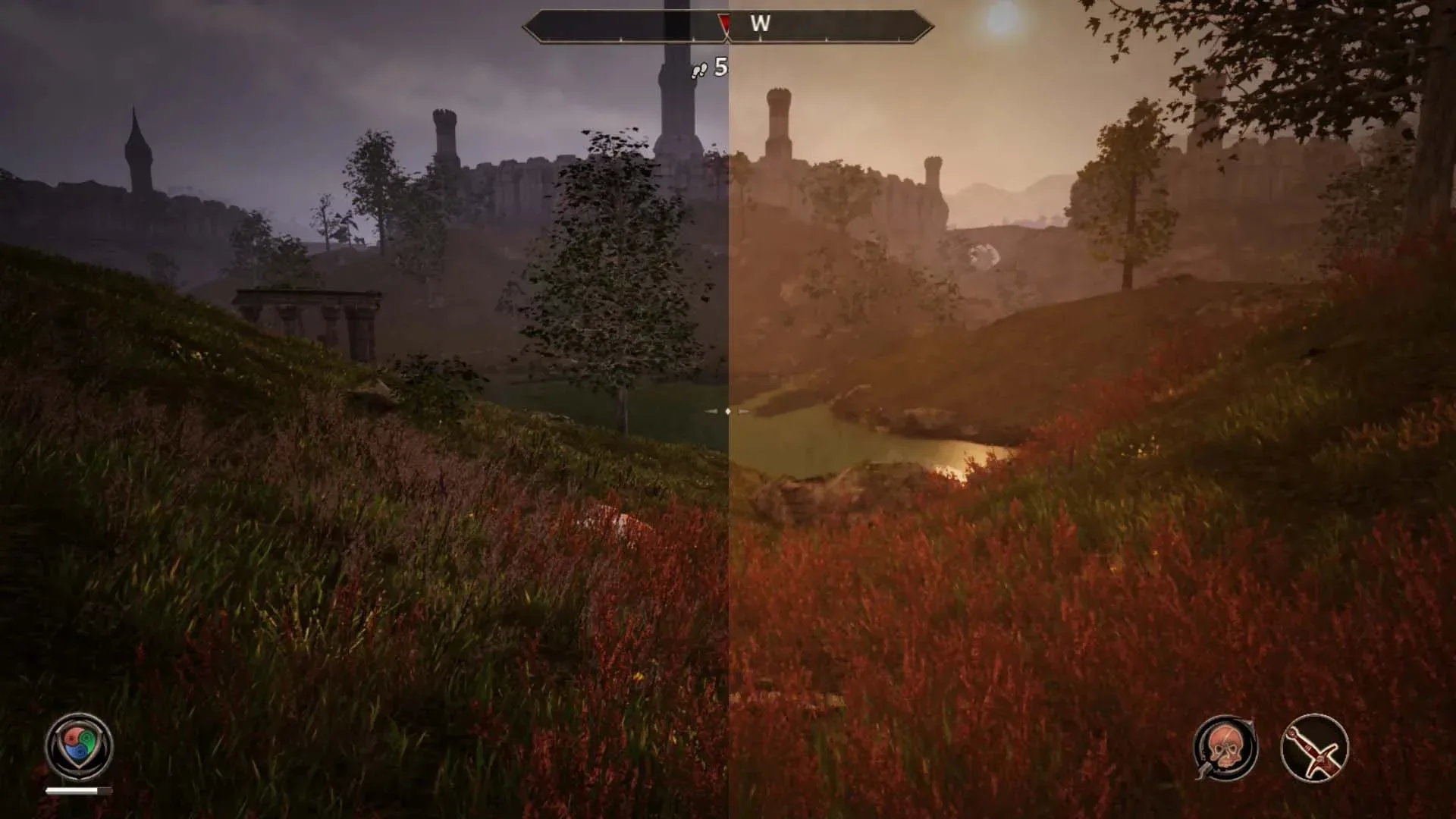
The Elder Scrolls IV: Oblivion Remastered has received another Switch 2 update, and this one is intended to undo the visual harm caused by the previous patch. Bethesda said the October 13 update resolves a “global visual degradation issue” discovered after September’s update—a welcome clarification after players reported that the game had become noticeably blurrier and showed distracting ghosting.
That makes this a corrective patch rather than a feature-led update. The late-September download had appeared to be a relatively small maintenance release, with the reasonable expectation of minor fixes. Instead, players began documenting an obvious regression: the game’s image looked softer than it had before, while ghosting was visible during motion. Some players reportedly chose not to install that earlier patch specifically to preserve the prior presentation.
The new Switch 2 update changes the immediate advice for affected players. If a system is still waiting on the latest Oblivion Remastered patch, Bethesda’s statement indicates that it is now the version designed to restore the game’s intended visual quality. Early player impressions also suggest the results are much closer to the pre-September build. A few players have gone further, suggesting performance may feel improved, but that part remains anecdotal rather than a detailed, official performance claim.
What Bethesda says the update fixes
The key wording is important: Bethesda identified the issue as global visual degradation. That indicates a problem affecting the game’s overall presentation rather than one bad area, quest, character model, or menu. In practical terms, a global problem can be seen across normal play wherever the relevant rendering behavior occurs, which helps explain why the September change became so quickly noticeable to players.
The October 13 patch does not come with a supplied technical breakdown of exactly what changed in the rendering pipeline, nor does it list a complete set of graphics adjustments. It would therefore be speculation to declare a precise cause. The available facts are simpler: the late-September update was followed by widespread reports of blur and ghosting; Bethesda subsequently acknowledged a broad visual issue in that prior update; and the new patch is meant to correct it.
That sequence matters because it separates a subjective disagreement about a game’s art direction from a regression. Players were not reacting to an announced new visual style. They were comparing the patched game with the Switch 2 version they had been playing and finding it worse in motion and clarity. Bethesda’s acknowledgement confirms there was an issue to be fixed.
Blur and ghosting, explained
Image blur is the loss of fine visual definition. It can make distant scenery, foliage, architecture, textural detail, and object edges appear less distinct. Blur is not automatically a defect: games may deliberately use motion blur as an effect, and many modern rendering techniques involve trade-offs between performance and image detail. But when the entire image unexpectedly appears less sharp after a patch, it is usually perceived as a downgrade—especially in an open-world role-playing game where players spend significant time looking across large landscapes and intricate environments.
Ghosting describes residual or duplicate-looking traces that appear behind moving objects or as the camera moves. Rather than a clean image transition from one frame to the next, a faint history of an earlier frame can seem to linger. It can be especially visible around character silhouettes, trees, bright edges, or high-contrast objects against a darker background.
Related coverage includes Oblivion Remastered Switch 2 Update Repairs Visual Problems From September Patch.
Ghosting is often discussed alongside temporal rendering. “Temporal” techniques use information from earlier frames to help construct the current one, which can be useful when a game is balancing image quality and performance. If that process is not behaving correctly, the result may be smearing, trails, or an image that looks less stable in motion. That is general rendering context, not confirmation that any one technique caused Oblivion Remastered’s Switch 2 problem. Bethesda has not publicly specified the underlying technical fault.
Players interested in the broader vocabulary around modern rendering can also read our guide to DLSS, frame generation, and image-quality trade-offs. Those technologies should not be assumed to be part of this particular Switch 2 issue, but the core lesson applies broadly: a higher or smoother performance target does not automatically mean the resulting image will look better.
Why a small patch can create a large visual problem
Patch size and player-visible impact are not reliably connected. A comparatively modest update can change a shared setting, rendering behavior, or asset-processing rule that touches every part of a game. Conversely, a much larger download may contain data that has little obvious impact on how the game looks moment to moment.
That helps make sense of the unusual situation here. The September update was small enough that many expected ordinary maintenance work. Yet the reported effect was broad enough that players could spot it while exploring the game normally. The corrective update is reportedly larger than some expected, but download size alone cannot tell players what was changed internally or why the earlier regression occurred.
It is reasonable to want a fuller technical explanation, particularly when the defect concerns visual quality across the game. However, the practical result is more significant than a guess at the cause: Bethesda has identified the previous update as the source of the degradation and issued a replacement patch to address it.
What Switch 2 players should do
For players who installed the September patch and noticed the softer, ghosted image, the current update is the relevant fix. Install the latest available Oblivion Remastered update on Switch 2, then assess the game after the download has completed. The stated purpose is to repair the prior global visual problem, not merely to make a vague incremental improvement.
- If the game updated in September: check that the newest update has also been installed; the October 13 patch is the corrective release.
- If automatic updates were avoided: the latest patch is now the one Bethesda has identified as resolving the prior visual regression.
- If the image still seems unusual afterward: distinguish between the game’s ordinary visual characteristics and the specific broad blur and ghosting reported after September. Bethesda has not provided a detailed list of every visual behavior or a platform-wide diagnostic process.
There is one sensible note of caution around the reports of better performance. Community impressions can be useful for flagging a change, especially with an obvious image-quality issue, but they are not the same as a controlled comparison. Without official frame-rate targets, technical notes, or like-for-like measurements, it is more accurate to say some players perceive smoother behavior than to claim a confirmed performance upgrade.
A repair patch is still meaningful
For a remaster, presentation is not a superficial concern. The point of revisiting an older role-playing game in a modernized form is closely tied to how the world reads on screen: the clarity of environments, the stability of motion, and the legibility of fine detail all influence the experience. A global loss in image quality can undermine that purpose even when the game remains playable.
The important news, then, is that the visual regression was not left as an unexplained new normal for the Switch 2 release. Bethesda has explicitly linked the problem to the earlier update and deployed a fix. Reports from players who have installed it indicate that the game again resembles its pre-September state far more closely.
That does not answer every technical question about what went wrong, and it does not turn informal performance impressions into confirmed benchmarks. It does, however, give Switch 2 owners a clear outcome: the patch that degraded Oblivion Remastered’s visuals has been followed by an update intended to restore them.