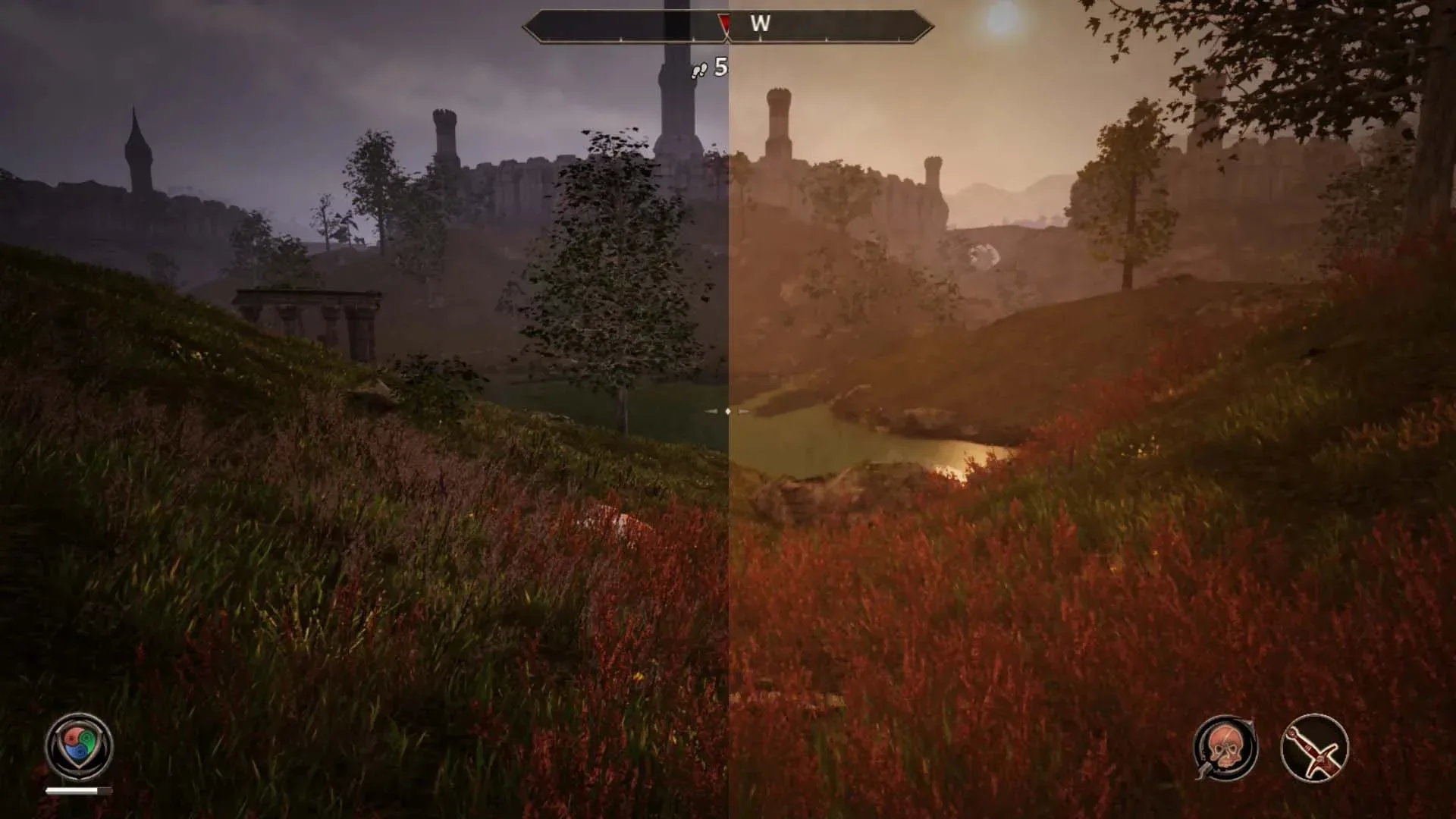
The Elder Scrolls IV: Oblivion Remastered has become an awkward case of a patch intended to make a game better apparently making its presentation worse for some Nintendo Switch 2 players. Following the small 1.1 update, players have shared screenshots and video clips that appear to show a softer image, smeared scenery, conspicuous lines, and stronger ghosting than they saw before installing the patch.
The reports matter because this is not a complaint about an individual quest, a subjective art-direction decision, or the ordinary compromises expected of a game running on different hardware. Players are specifically comparing the same Switch 2 version before and after the update, with grass and other environmental detail among the areas said to have lost clarity.
Bethesda’s published notes for 1.1 are brief and describe minor fixes. They do not flag a deliberate overhaul of image quality, resolution behavior, or visual processing. That disconnect is why the current complaints are best understood as a possible unintended regression: a change introduced by an update that leaves the game looking or behaving worse in a visible way.
What Switch 2 players say changed
The most consistent reports center on image sharpness. Screenshots circulated by players show vegetation and world detail looking less distinct after version 1.1, with fine detail appearing blurred rather than cleanly resolved. Short video clips have also been used to point out unusual lines and a more pronounced ghosting effect.
Ghosting is a visual artifact in which remnants of an earlier frame seem to linger as the camera or objects move. Instead of motion reading as one crisp, stable image replacing another, a player may see faint trails, doubles, or smears. It can be especially distracting in an open-world RPG, where the camera is frequently panning across foliage, buildings, roads, and distant scenery.
Blur can have several meanings in games. It may be an intentional motion-blur effect, an aggressive anti-aliasing result, a lower-resolution image being reconstructed for a larger display, or a side effect of an upscaling pipeline. The player reports here do not establish which mechanism is responsible. What they do establish is that affected users perceive a clear downgrade after the patch, and that they are documenting it through comparisons rather than merely describing a vague impression.
Visual stability matters alongside raw sharpness. A softer image can sometimes be an acceptable tradeoff if it holds frame rate steady or prevents distracting shimmer. But the complaints about both blur and ghosting describe a less stable-looking picture, not simply a different balance between performance and detail. That distinction is important: a technical compromise can be deliberate, while a regression is an unwanted result that needs correction.
The DLSS explanation is only a player theory
One widely discussed possibility is that the game’s use of DLSS on Switch 2 may have been disabled, changed, or otherwise affected by the patch. DLSS is a rendering and image-reconstruction technology associated with Nvidia hardware. In broad terms, these systems can render a game internally at one resolution and reconstruct an output image intended to look clearer at a higher resolution, helping a developer manage performance demands.
Related coverage includes Oblivion Remastered Switch 2 Update Draws Complaints Over Blur and Visual Artifacts.
That theory should be treated carefully. Players have not demonstrated that DLSS is the cause, and Bethesda has not publicly identified a specific rendering feature as the culprit. The available evidence supports the conclusion that players are observing worse visual results after 1.1; it does not support declaring exactly why those results are occurring.
There are many reasons a game's image can change following an update, including altered settings, an unexpected implementation problem, or interactions within the rendering pipeline. Assigning blame to any particular technique without confirmation risks turning a useful player diagnosis into an unsupported certainty. For now, the concrete symptoms are the stronger story: lower perceived clarity, smeared assets, visible lines, and ghosting reported by Switch 2 owners.
Why some players are trying to avoid the update
The reports have prompted a practical, if imperfect, reaction. Some owners are disabling automatic updates and taking their systems offline to keep their game from moving to version 1.1 while they wait for a correction. Owners of physical copies have also described deleting the installed game and reinstalling from the cartridge offline in an effort to return to an earlier state.
That second approach carries meaningful risk. Bethesda support reportedly warned at least one player that deleting and reinstalling in this manner could corrupt save data. A save file is the record of a player’s character, progress, inventory, quest state, and world changes. Losing it in pursuit of a potentially sharper image would be a severe tradeoff, particularly in a role-playing game built around long-term progression and exploration.
Players considering workarounds should therefore distinguish between preserving an existing installation and performing a more disruptive reinstall. The reports provide no guarantee that any rollback-style attempt will work, nor do they establish that it is safe. Avoiding automatic updates may prevent installation for people who have not yet updated, but it does not repair an installation that is already on 1.1, and taking a console offline can affect access to features that depend on a connection.
The most conservative route for affected players is to protect their save data and wait for an official patch rather than treating an unofficial reinstall process as a proven fix. That is less satisfying than an immediate workaround, but it avoids converting a graphics problem into a potential progress-loss problem.
Bethesda is reportedly working on a fix
Multiple Switch 2 owners who contacted Bethesda support have shared messages saying the company is aware of the issue and is working on a fix. That is encouraging, although it is not the same as a public timetable, a confirmed technical explanation, or a promise that every visual complaint has the same root cause.
Until Bethesda details the issue, several points remain uncertain:
- Whether every Switch 2 copy on 1.1 is affected in the same way.
- Whether the blur, lines, and ghosting come from one underlying problem or several separate issues.
- Whether a particular image-reconstruction setting or technique is involved.
- When a corrective update will arrive.
- Whether any temporary workaround can be recommended without save-related risks.
Those unanswered questions make careful language essential. The update has drawn player complaints and Bethesda support has reportedly acknowledged the issue. It is not yet possible, from the information available, to define the exact scope or diagnose the rendering failure from outside the development team.
A small patch can still create a large problem
Patch notes are useful, but they are not a complete account of every consequence an update can have across a game’s configurations. In this case, version 1.1 was presented as a small collection of minor fixes. The player response shows why visual validation remains vital even when a patch seems routine: image-quality problems can be immediate, highly visible, and difficult for players to ignore once they have seen a before-and-after comparison.
For Switch 2 owners, the concern is not merely technical jargon. Oblivion is an expansive fantasy RPG whose appeal is closely tied to surveying its environments, traveling through its landscapes, and spotting details in the world. If the scenery becomes hazier and moving imagery produces distracting trails, that changes how the game feels moment to moment even if quests and core systems remain intact.
It also illustrates the fragile relationship players can have with automatic updates. Patches are normally installed because they are expected to eliminate bugs, improve compatibility, or add refinements. When a newly installed build appears to introduce a conspicuous visual fault, the instinct to freeze a working version is understandable. But as the save-corruption warning illustrates, trying to outmaneuver a patch can introduce a different category of problem.
The sensible benchmark now is an official correction that restores image quality without asking players to gamble with their saves or disconnect their systems indefinitely. Bethesda’s reported awareness is the key development, but the next update will need to do more than arrive: it will need to make the Switch 2 version look reliably right again.
For broader Bethesda-related news, see our coverage of Bethesda’s response to Doomsol and $DOOM promotion concerns.