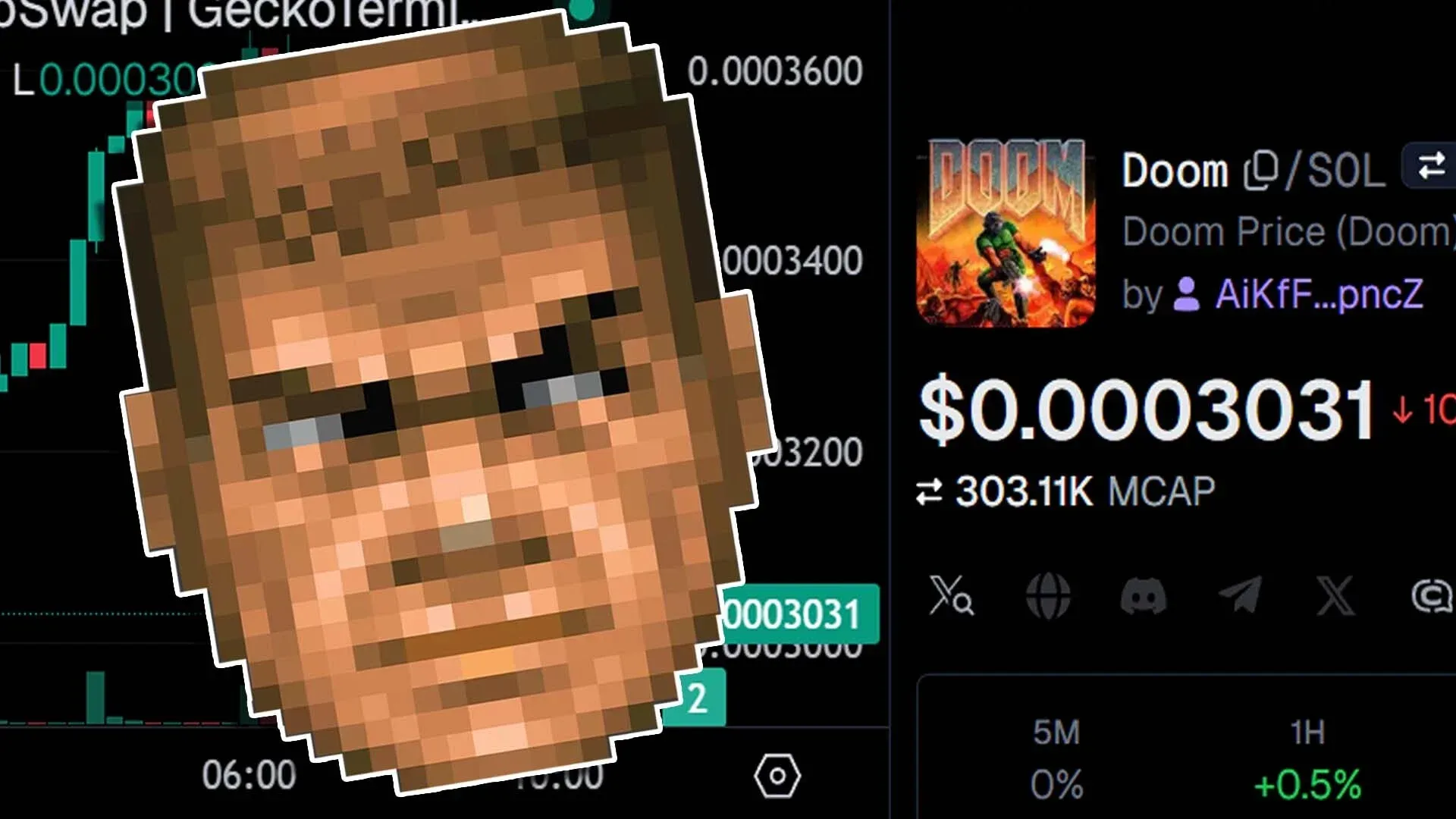
Bethesda is taking legal action connected to Doomsol, a browser-based Doom-related project that was promoted alongside a $DOOM memecoin. The company says its central concern is consumer clarity: players should be able to distinguish official Doom material from unaffiliated projects, especially where Doom imagery is being used to market a commercial crypto venture.
The precise form and recipient of the legal communication have not been made public. Bethesda has said legal counsel is confronting the individual behind Doomsol, but did not identify that person or disclose the contents of the letter. A cease-and-desist demand is widely presumed, but it has not been confirmed.
The situation has drawn attention not simply because it involves a crypto token, but because Doomsol was publicly associated with Sandy Petersen, a designer known for level contributions to Doom, Doom II, and Quake. Petersen was listed as Doomsol’s creator on an archived version of its site. His exact responsibility for the $DOOM token itself remains unclear.
How Doomsol and $DOOM were promoted
On August 3, Petersen posted videos promoting $DOOM through his social-media account. One showed him purchasing more than $187 worth of the token through the crypto-trading platform Fomo; another showed an additional $1,000 purchase later that day.
He also linked to Doomsol, which was presented as a browser-playable Doom experience that could let users earn Sol, the native cryptocurrency of the Solana blockchain platform. Petersen continued to promote the token and game in subsequent days, at one point saying the game had thousands of players.
“Memecoin” is a useful term to unpack here. It generally describes a cryptocurrency token whose attention and value are driven heavily by online community, branding, personality, and speculation rather than a defined practical use. That does not itself establish that a project is illegitimate. But it does mean a familiar name, a famous logo, or an apparent connection to an established entertainment property can have outsized influence on how audiences interpret the project.
That is the key pressure point in Bethesda’s position. Doom is a major game property, and $DOOM plus a website called Doomsol can sound official at a glance. The company says it is acting where there is a risk that people may believe a project is produced, affiliated with, or endorsed by Bethesda or id Software when it is not.
“The strength of Doom comes from its passionate community, and we believe players deserve clear information about what is and isn’t an official Doom experience,” a Bethesda spokesperson said. “Our focus is on helping fans understand which projects are produced by Bethesda and id Software, and which are not affiliated with or endorsed by Bethesda or id Software. When there is a risk of confusion around affiliation or endorsement, we take appropriate steps to preserve that clarity.”
Related coverage includes Bethesda Moves to Challenge Doomsol and $DOOM Memecoin Promotion.
What is known about Petersen’s involvement—and what is not
Petersen’s posts indicate that he was at least promoting Doomsol and $DOOM, and appeared to be involved with designing Doom levels for the project. Arthur Petersen, his son, also appeared to be connected to the promotion. Arthur reshared a post summarizing an X Spaces conversation in which another account claimed Sandy Petersen was receiving fees and was being paid to create new Doomsol levels.
Those claims do not settle ownership, control, or authorship of the token. The public record described here leaves major questions unanswered, including who created $DOOM, who ran Doomsol, and how any payments or fees may have been structured. It also does not establish whether Petersen created the token merely because he was listed as Doomsol’s creator on an archived site.
That uncertainty matters. Promotional participation, creative contribution, and ownership of a token can overlap, but they are not automatically the same thing. Bethesda’s action is directed at the person behind Doomsol, yet the company has not publicly specified who received the legal outreach.
Attempts were made to seek comment from both Sandy and Arthur Petersen about Doomsol, $DOOM, and the legal development. No response was received in time for publication.
Why the footage caused further alarm
Some of the promotional material increased scrutiny rather than resolving it. A video presented as Petersen playing Doomsol was identified as footage of Freedoom, a separate fan project. Freedoom’s official account responded to make clear it had no involvement with the promotion and said it did not endorse cryptocurrency scams, urging people to stay away from them.
That response is important for a narrow but meaningful reason: it separates Freedoom from Doomsol and $DOOM. It should not be read as an independently verified account of every person’s intent or role in the token’s creation. However, using footage from an unrelated project in promotion creates a straightforward problem for viewers trying to work out what they are being shown and who stands behind it.
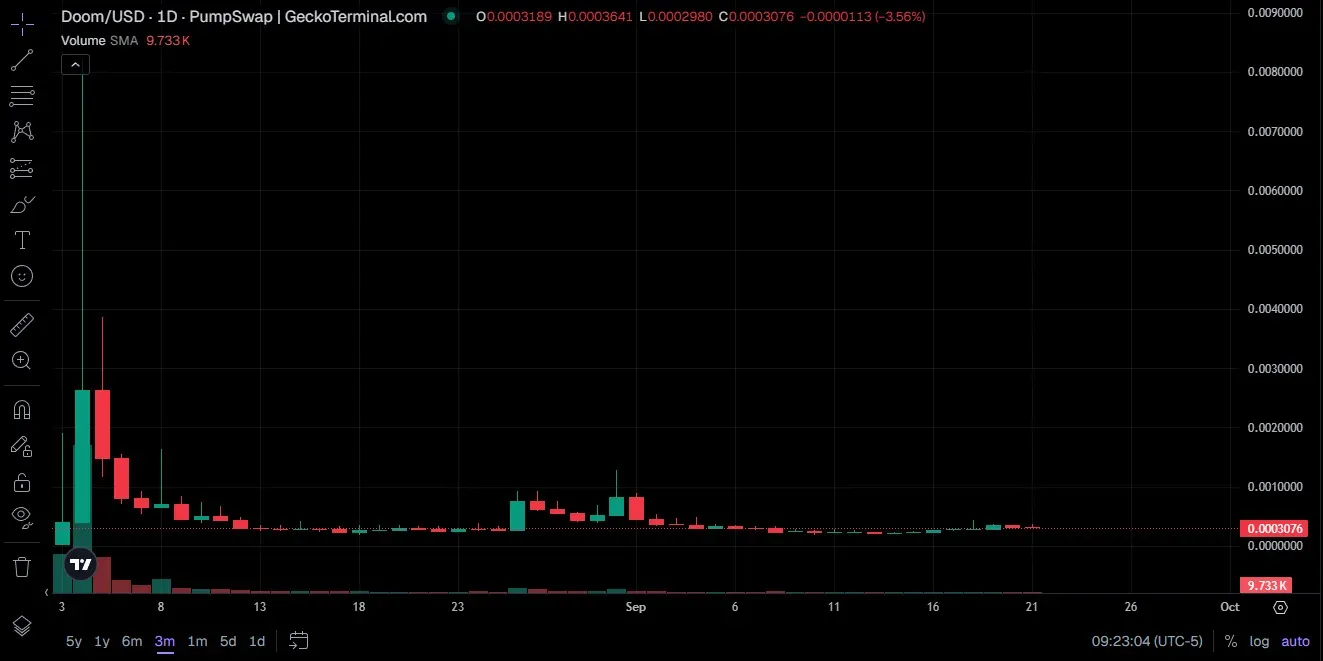
The coin’s trajectory brought another complication. The token fell sharply after its creator apparently departed, a pattern often described in crypto circles as a “rug pull” or “rugging.” That phrase generally refers to a situation in which a project’s operators withdraw support or liquidity, leaving buyers with a token that can lose significant value. The available reporting does not establish who created the token or assign that conduct to Petersen.
Petersen stopped posting about both Doomsol and $DOOM after the decline. At the end of August, he mentioned them again amid an apparent effort by several people claiming to work on Doomsol to revive promotion after the original creator had left. The token saw a short-lived rise but did not return to its earlier high, and both Petersens then stopped discussing it again.
For anyone encountering a revival campaign around a game-branded crypto asset, the practical lesson is not to treat a recognizable game title, familiar artwork, or a developer’s social post as proof of official approval. Check whether the rights holder has identified the project as official, whether the project clearly identifies its operator, and whether the game footage and assets actually belong to the people using them.
Open-source engine does not mean open commercial branding
Petersen has argued that Doomsol was legally safe because Doom has an open license. Bethesda rejects that conclusion. The company’s position is that continued creative and academic work involving the open-source Doom engine remains acceptable, including making new games and porting the engine to different hardware or platforms. What it objects to is recreating and redistributing Doom through a browser in order to sell and promote a memecoin, while using Doom assets and branding commercially.
This distinction is easy to lose amid the broader crypto dispute. An engine is the technical framework that runs a game: the underlying software responsible for functions such as rendering, input, and game logic. Assets are the specific expressive elements used in a particular commercial game, such as its logo, art, sounds, and other content. An open license for engine code can allow developers to build technical projects without granting a blanket right to reuse every associated asset or market a product under the original brand.
In Bethesda’s view, Doomsol crossed that boundary. The company specifically points to use of Doom assets, including the Doom logo on the project’s website, as part of a commercial venture. This is not framed as a broad rejection of Doom’s creative community or its long history of technical experimentation. It is instead a claim that experimentation cannot create consumer confusion around a commercial token or reuse protected branding for that purpose.
That distinction is also why the issue has relevance beyond this one project. Retro game engines and communities often support ports, mods, new maps, and technically ambitious fan projects. A project can be innovative, playable in a browser, or built around an old engine without becoming an authorized product. Once a project adds token sales, financial promotion, or highly recognizable brand presentation, the question of what players believe they are buying into becomes much more consequential.
Similar sites have since disappeared
Archived Doomsol material listed Petersen as its creator, though the project’s live site was no longer available at the time of the reporting. Two similarly structured projects, Quakesol and Wolfensteinsol, also surfaced with comparable-looking websites. It is not clear whether Petersen was involved with either of those projects, and all three sites appeared to have been taken down, though archived versions remain accessible.
The similar naming is notable because it amplifies the same basic risk Bethesda describes: a game title combined with “sol” can suggest a crypto-linked offshoot of a well-known franchise. Without clear, prominent disclosure of who operates such a project and whether the rightsholder has authorized it, a casual visitor may draw conclusions the creators cannot support.
For readers looking to understand the practical security side of crypto apps and wallets more broadly, Joking Joystick’s comparison of Google Wallet and Samsung Wallet explains some of the distinctions between convenience features, crypto support, and account security. Those tools do not answer whether a token project is official, though; that requires checking the project’s claims and the relevant rights holder’s statements.
What Bethesda’s intervention does—and does not—settle
Bethesda’s move does not publicly resolve who created $DOOM, what exact role Petersen or Arthur Petersen held in the project, or what legal remedy the company is seeking. It also does not make every Doom fan work, browser port, or open-source engine project suspect. Bethesda has expressly differentiated creative and academic use of the open-source engine from a commercial project using Doom material to promote a memecoin.
What it does establish is Bethesda’s stated line: fans should not be put in a position where Doom branding and a well-known creator’s involvement make an unofficial crypto venture look like an official Doom experience. With the underlying Doomsol, Quakesol, and Wolfensteinsol sites apparently offline, the next meaningful development will be whether the recipient of Bethesda’s legal outreach responds publicly or changes the project’s use of Doom material.