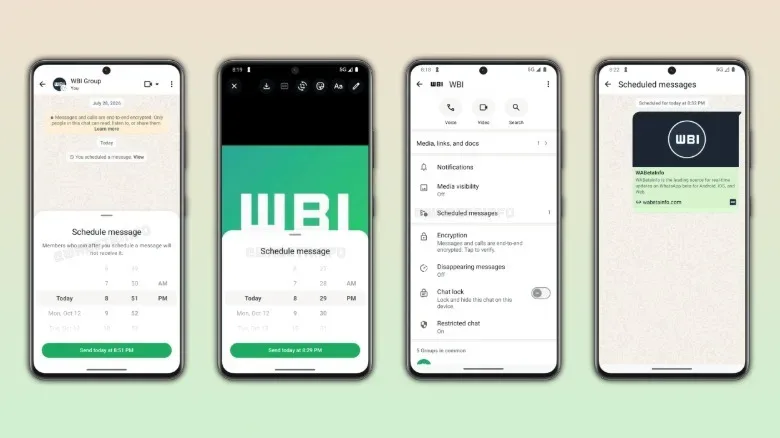
WhatsApp may finally be preparing a native answer to one of messaging’s most perennial requests: write something now, then have it arrive later. A scheduled-message tool has appeared for some testers in the Android beta version 2.26.8.11, pointing to a possible future addition for people coordinating across time zones, setting reminders or trying to keep work chats from spilling into personal hours.
The feature is not a general release yet. It is currently available only to some Android beta testers, and a wider rollout has not been confirmed. Still, a visible beta implementation is more meaningful than a menu label or an unverified mock-up: it indicates that the feature is being tested in the app, even if its final interface, timing and availability could still change.
How WhatsApp’s scheduled messages are expected to work
The interaction described in the beta is deliberately close to the ordinary act of sending a message. Rather than finding a separate automation screen, a user taps and holds the send button. That action opens a panel where they can select a delivery date and time.
After a message has been queued, WhatsApp provides a dedicated place to manage scheduled messages before they are delivered. That management area matters because scheduling is only useful when people can check what they have lined up and, presumably, avoid losing track of a note written days earlier. The available details establish that such a section exists, but do not spell out every editing or cancellation option it will include.
The supported content types mirror regular conversations: scheduled messages can include text, links, photos and videos. The feature also works in group chats, so it is not limited to one-to-one conversations. That expands its potential beyond a simple “don’t forget” note to uses such as arranging an online session, sending a planned update to a team or sharing media at a chosen time.
The important practical detail: your phone does not need to be online
The most consequential stated behavior is that a scheduled message will be sent at its selected time even when the sender’s device is offline. In plain terms, scheduling does not require leaving the phone powered on, connected and running WhatsApp until the deadline. A person could queue a message before a flight, turn off their device, and the intended delivery should still happen on time.
That distinction separates a proper scheduling system from a local reminder. A reminder merely prompts the person to return and send something manually. Scheduling handles the delivery at the set time. For anyone using messaging as a lightweight planning tool, that removes the very step that reminders often fail to solve: remembering to act once the alert appears.
Scheduled messages are also said to retain WhatsApp’s end-to-end encryption. End-to-end encryption means the message content is protected so that it is intended to be readable by the participants in the conversation, rather than broadly exposed in transit. The beta report does not provide implementation-level detail on how scheduling is handled behind the scenes, so it would be premature to draw conclusions beyond the stated protection.
A 10-minute to two-week scheduling window
The initial range is relatively bounded. Users can choose a delivery time as soon as 10 minutes from the present moment or as far as two weeks ahead. The short end is useful for sending a quick follow-up later without forgetting it; the two-week ceiling covers many near-term plans, deadlines and time-zone handoffs.
It does not, however, turn WhatsApp into a long-range calendar or a full campaign-planning system. The reported limit means a person cannot queue a birthday message months ahead or prepare a seasonal announcement far in advance through this tool alone. That is not necessarily a weakness—short scheduling horizons can reduce the chance of stale messages arriving after circumstances have changed—but it defines the feature’s likely role as a conversational convenience rather than a deep automation suite.
One phrase associated with the feature is “recurring reminders,” but the concrete beta details only confirm choosing a delivery date and time for scheduled messages. They do not establish whether repeat patterns—daily, weekly or custom intervals—are present in the current build. Until that is shown, recurring scheduling should be treated as a possible use case rather than a confirmed capability.
Why timing changes the tone of a message
Message scheduling is a modest tool with an outsized social effect. A carefully timed note can respect a recipient’s local hours while still letting the sender write it when the thought is fresh. For groups spread across regions, it can make an update arrive during a workable part of the day instead of being buried overnight.
The same applies to professional boundaries. A person may need to prepare information after hours but prefer not to signal that an immediate reply is expected. Delayed delivery makes it possible to draft the message now and send it during the recipient’s workday. Of course, a feature cannot solve every expectation around availability, but it gives users more control over when their communication enters a chat.
For gaming communities, group-chat compatibility could be especially handy for organizing a recurring social habit even if recurring sends themselves are not yet verified: a player can prepare a raid reminder, tournament check-in or patch-night message ahead of time and have it land shortly before the event. It is a small quality-of-life option, much like choosing the right peripheral can remove friction from everyday play; our coverage of the Razer Viper V3 HyperSpeed’s value-focused wireless specifications looks at a different kind of practical convenience.
WhatsApp is catching up in a familiar area
Telegram has offered message scheduling since 2019, making WhatsApp’s apparent move less about inventing a new messaging behavior than closing a longstanding feature gap. The comparison is useful because it sets expectations: scheduling is already an established feature in competing messaging software, and people understand its value without needing a major redesign of how chats work.
WhatsApp’s prospective version appears to take a similarly direct approach: hold Send, select a time, then manage the pending item separately. Familiarity can be an advantage here. Scheduling should not require a tutorial when the task is simply deciding that a completed message belongs in the future rather than the present.
What to watch before treating it as available
For now, the sensible status is Android beta testing for a limited set of accounts. People who do not see the option should not assume their app is malfunctioning, nor should they rely on it for an important time-sensitive message. Beta features can reach more testers gradually, be altered, or arrive in a later public update.
There are also several unanswered questions. The current information does not confirm an iPhone beta or public rollout, whether scheduled entries can be edited after being created, or how the feature will display to recipients. It likewise does not confirm repeating schedules. Those details may matter a great deal to users deciding whether the tool can replace an existing workflow.
What is clear is the core proposition: WhatsApp is testing scheduled delivery for ordinary encrypted chat content, including media and group messages, over a window from 10 minutes to two weeks. If that reaches the full app in substantially the same form, it will address a conspicuous everyday omission with a feature that is simple, useful and long overdue.