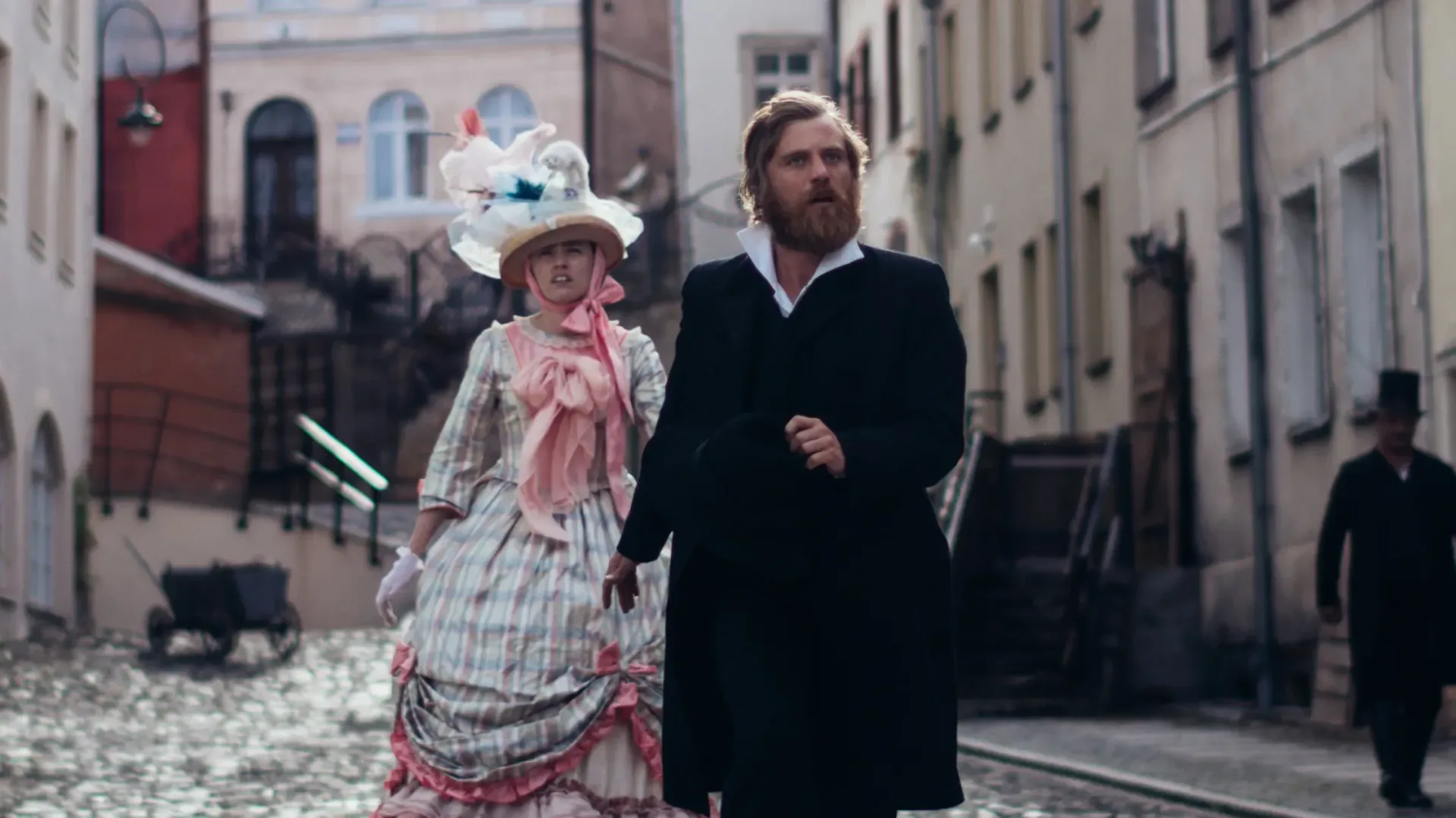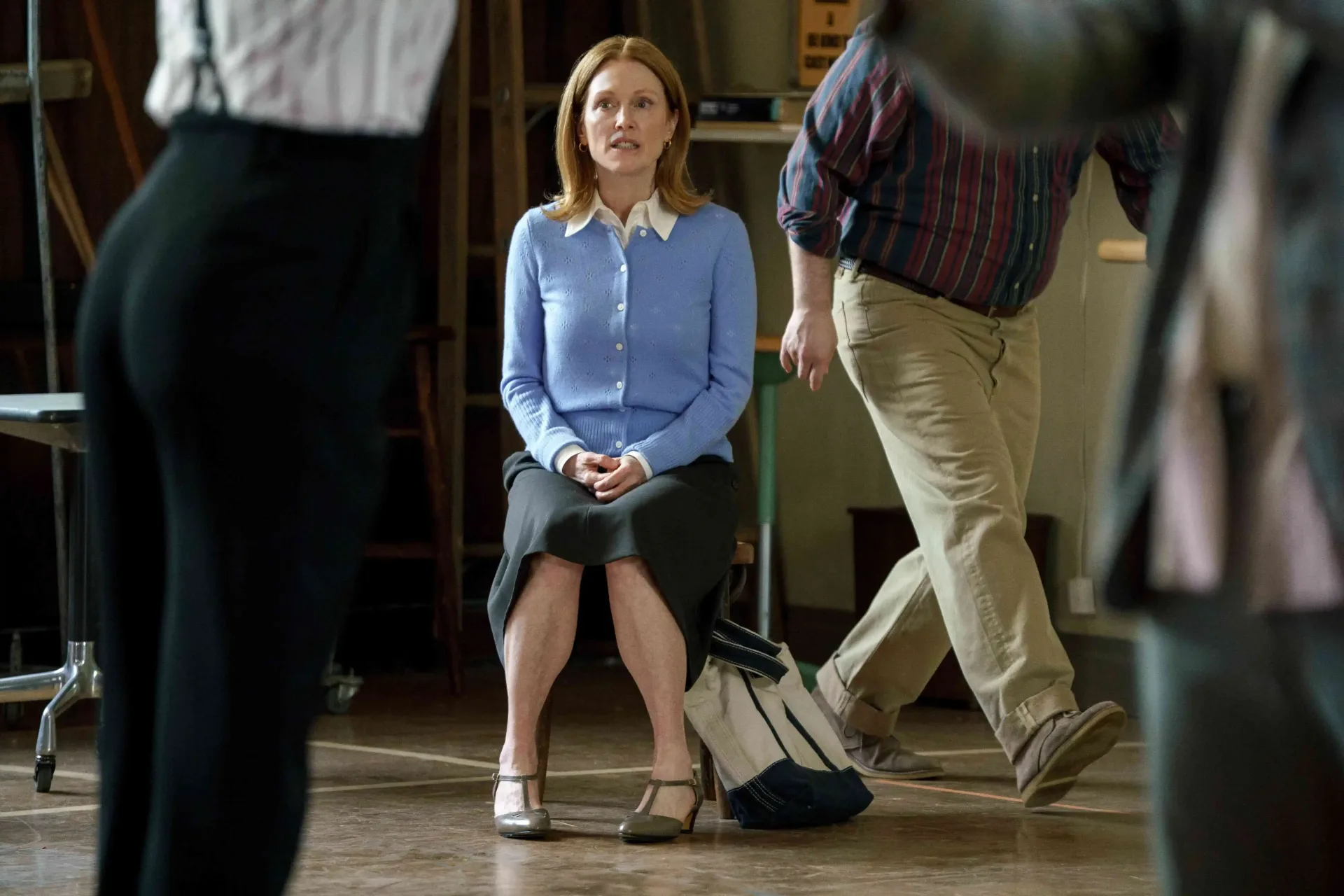
Independent cinema has never lacked ambition. Its recurring challenge is getting an ambitious movie through production, into a distribution plan, and finally in front of the people most likely to embrace it. Topic Studios is heading into the 2026 fall festival season with three films positioned at different points on that journey: The Debut, Club Kid, and Wicker.
The company will present Jesse Eisenberg’s The Debut at the Telluride Film Festival in Colorado. The dramedy stars Julianne Moore and Paul Giamatti and follows Eisenberg’s A Real Pain. Meanwhile, Jordan Firstman’s Club Kid is returning to the festival circuit after its Cannes Film Festival premiere in May. Wicker, which debuted at Sundance in January, is set for release by Black Bear a month after the Telluride weekend.
It is a notably active slate for Topic, a First Look Media division founded in 2017. The studio’s past credits include Pablo Larraín’s Spencer, Michael Angelo Covino’s The Climb, and the Oscar-winning Spotlight. But the current run also makes a useful case study in what a smaller film company is trying to do when audiences have abundant viewing choices and theatrical attention can be exceptionally concentrated.
Three films, three stages of a festival-to-audience path
The Debut arrives with obvious interest around its creative team. Eisenberg’s prior film, A Real Pain, provides a clear point of reference, while Moore and Giamatti bring two major acting names to a story described as a dramedy. Topic has been involved with the project since the release of A Real Pain, and A24 is its distribution partner.
That combination places the movie in a familiar but demanding position for a prestige-minded fall title: attention can be an asset, but it can also become an expectation the film itself must meet. Topic film and documentary head Ryan Heller has said the company is less interested in attempting to control that outside anticipation than in reaching the moment when viewers can see the work. The focus, in practical terms, is on helping the movie find the broadest audience possible through its partnership with A24.
Club Kid has a different kind of momentum. Firstman not only wrote and directed the film but also appears in nearly every scene. Topic regards it as a comedy with substantial emotional stakes, rather than a light diversion that stops at its jokes. The film deals with self-destructive behavior and the idea that changing one’s choices can lead to a happier life. Its Cannes showing in May put it before an early international festival audience; Telluride now offers another prominent setting for attention to build.
The company’s response to the screenplay suggests why the project became a priority. Heller described the script as unexpectedly affecting for the Topic team, with readers ending in tears. That is not a promise of how every viewer will react, of course, but it does clarify the balance Topic saw in the material: big laughs alongside big feelings, with the emotional turns intended to be earned rather than pasted on after the comic material.
Wicker rounds out the near-term trio. Following a Sundance debut in January, the film is scheduled to be released by Black Bear in roughly a month. Its route underlines an important reality of the indie business. A festival screening, even a successful one, is a beginning rather than an endpoint. The eventual release depends on distribution partners, positioning, and the sustained effort to make a specific title visible amid a dense calendar.
Why specificity matters more than passive discovery
Heller’s assessment of today’s moviegoing landscape is straightforward: audiences are increasingly turning out for particular movies, rather than simply arriving at a theater looking for something to discover. That does not mean discovery is dead. It does mean smaller companies cannot rely on it as their main plan.
For an outfit like Topic, the response is to choose projects where it believes it can offer something specific. Independence, under this approach, is not merely a budget category or a fallback position outside major studios and streaming services. It is a characteristic that shapes what a movie can be, how it is financed, and how it reaches viewers.
The strategy favors distinctive, filmmaker-led work that may need to fight for attention but can still connect with a meaningful audience. Topic often develops projects that are moving toward production or finances them through the process, and it is particularly drawn to writer-directors. That preference makes sense for films built around a singular tone, voice, or formal point of view; the creative connection between script and direction can be unusually direct.
There is also an emphasis on movies that invite conversation. In the crowded entertainment economy, a conversation is not simply promotional noise. It can be the difference between a film briefly registering at a festival and gaining enough cultural life to carry beyond a premiere. The aim is not just to get a person into a seat once, but to make the experience worth talking about afterward.
That communal dimension has become more valuable in the post-COVID era. Moviegoing behavior changed sharply during that period, and the effects remain. Heller’s view is that a theater attendance should never be assumed or treated casually. In other words, a viewer’s time, ticket, travel, and willingness to leave the house are part of the bargain. The movie needs to offer a reason for that commitment.
The evolving relationship between audiences and shared experiences is also visible outside conventional theaters. For a different look at how immersive storytelling is trying to build collective experiences through emerging formats, see Venice Immersive’s exploration of shared spaces, smart glasses, and storytelling. The formats are different, but the broad question is similar: what makes an audience choose to gather for a story now?
Comedy, discomfort, and the films that stick
There is a temptation to read a deliberate confrontational streak into Topic’s current output. Splitsville engages with insecurity and marriage, while Club Kid confronts self-destruction. Heller does not present confrontation as a formal company mandate. His description is more instinctive: the difficult part is locating the projects, and when the team finds one it deeply responds to, that attachment can become the starting point.
Still, the patterns are worth noticing. Movies that have something at stake tend to ask more from an audience than simple agreement. They may be funny, painful, uneasy, or emotionally exposed. The best version of that approach is not provocation as a marketing device. It is a story with enough conviction that viewers come away arguing, reflecting, laughing, or perhaps doing all three in an awkward order.
That is especially relevant to comedies with dramatic weight. A film can use comedy to lower defenses, only to reveal emotional material that would feel too heavy if presented without humor. It is a difficult tonal mix: if the laughs are too broad, the serious material can seem abrupt; if the drama overwhelms the comic current, audiences may wonder why the movie was framed as a comedy at all. The stated appeal of Club Kid is that it attempts both sides of the equation.
For readers interested in another recent example of a filmmaker tackling difficult artistic material without sanding away the messiness, The Idiot(s) offers a useful point of comparison. Different subjects and styles can still share a belief that an unruly story may be more alive than a perfectly polished but anonymous one.
A self-reliant studio model, with distribution partners
Topic’s plan is not built around becoming a giant or treating a merger as the inevitable finish line. Heller has emphasized that the company values its present position and its relationships with partners. The stated goal is to be deliberate, self-reliant where possible, and capable of making a movie from beginning to end internally.
That does not eliminate the importance of distributors. It instead describes a division of labor. Topic can originate, develop, finance, and shepherd certain kinds of films; distribution partners can take on the distinct work of getting those films into the market. The economics and expertise are not necessarily identical, and the ecosystem benefits from companies that can supply films not designed by committee to fit the biggest possible four-quadrant opening weekend.
Such a model also depends on restraint. A smaller company cannot chase every package or imitate every larger competitor. It has to know what kind of creative work it is equipped to support. The slate around Telluride points toward that answer: director-driven stories, notable performers, emotionally ambitious comedy or drama, and films with enough personality to stand apart in a crowded marketplace.
‘Scorn’ is next in postproduction
Beyond the festival titles, Topic has Scorn in postproduction. The film comes from writer-director Sarah Bliss, who co-created the series Search Party, and reunites the studio with Adria Arjona after Splitsville.
Scorn is described as a contemporary psychological erotic thriller that takes unexpected turns. The description leaves plenty unknown, including release plans and fuller story details, but Bliss and Arjona give the project a defined creative identity at an early stage.
For Topic, the immediate task is clearer. The Debut, Club Kid, and Wicker are moving through a period when festivals, distribution, and audience attention intersect. The studio’s bet is that films with a sharply defined voice and genuine emotional force can still cut through—provided the work of bringing them to viewers is as intentional as the work of making them.