Jesse Eisenberg’s The Debut takes the supposedly modest stakes of a community-theater production and treats them as the entry point to something much larger, stranger and more emotionally combustible. The R-rated film, which was screened at the Telluride Film Festival on September 5, 2026, runs 105 minutes and places Julianne Moore at the center of a story about performance, self-worth and the alarming possibility that becoming more authentic can make a person less predictable.
The premise begins in recognizably awkward territory: local theater, a weak audition, an understaffed production and a role that nobody else wants. Yet the film’s reported shape is not a simple underdog story. Eisenberg, who wrote and directed, appears to use the amateur musical as a pressure chamber. What starts as a comic tale of an inexperienced performer finding confidence gradually bends toward a more unsettled question: what happens when a person takes the instructions to “live truthfully” far too literally?
That mixture makes The Debut a notable pop-culture curiosity even beyond its cast. Community theater has long been fertile ground for comedy because it combines intense aspiration with limited resources, artistic sincerity with logistical catastrophe, and performers who may bring radically different definitions of “subtle” to the same rehearsal room. Eisenberg’s film reportedly finds affection in that environment, rather than treating the people in it as an easy punchline.
Mona Friedman gets her opening—and refuses to remain small
Moore plays Mona Friedman, a New Jersey homemaker who has been reduced to a supporting presence in her own house. Her near-adult twins, Matty and Maya, are emotionally distant despite still living at home. Her husband Howard, played by Patrick Fabian, treats her more as an extension of the household than as a person with her own needs. Mona has learned to accommodate everyone else, and that habit has left little room for a distinct sense of self.
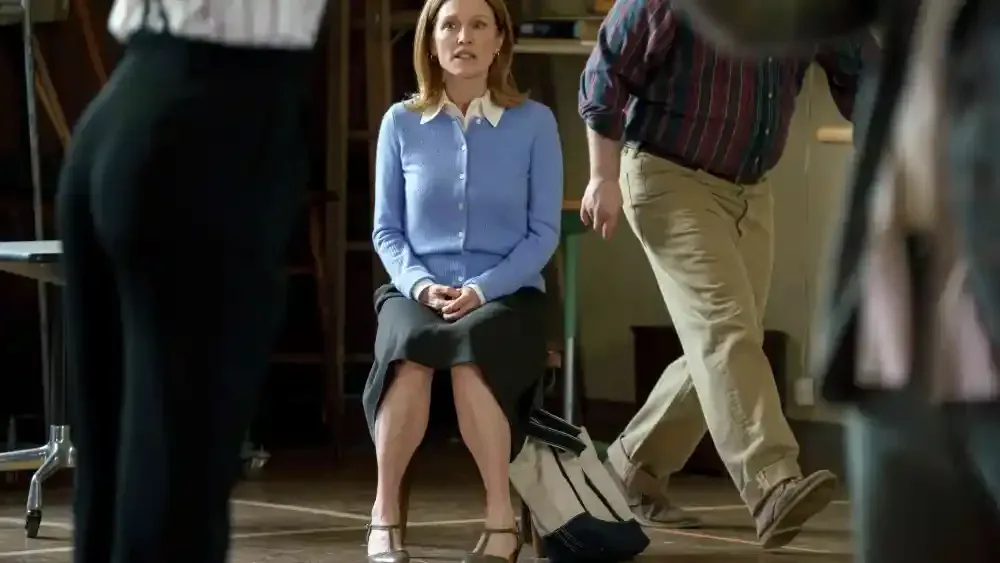
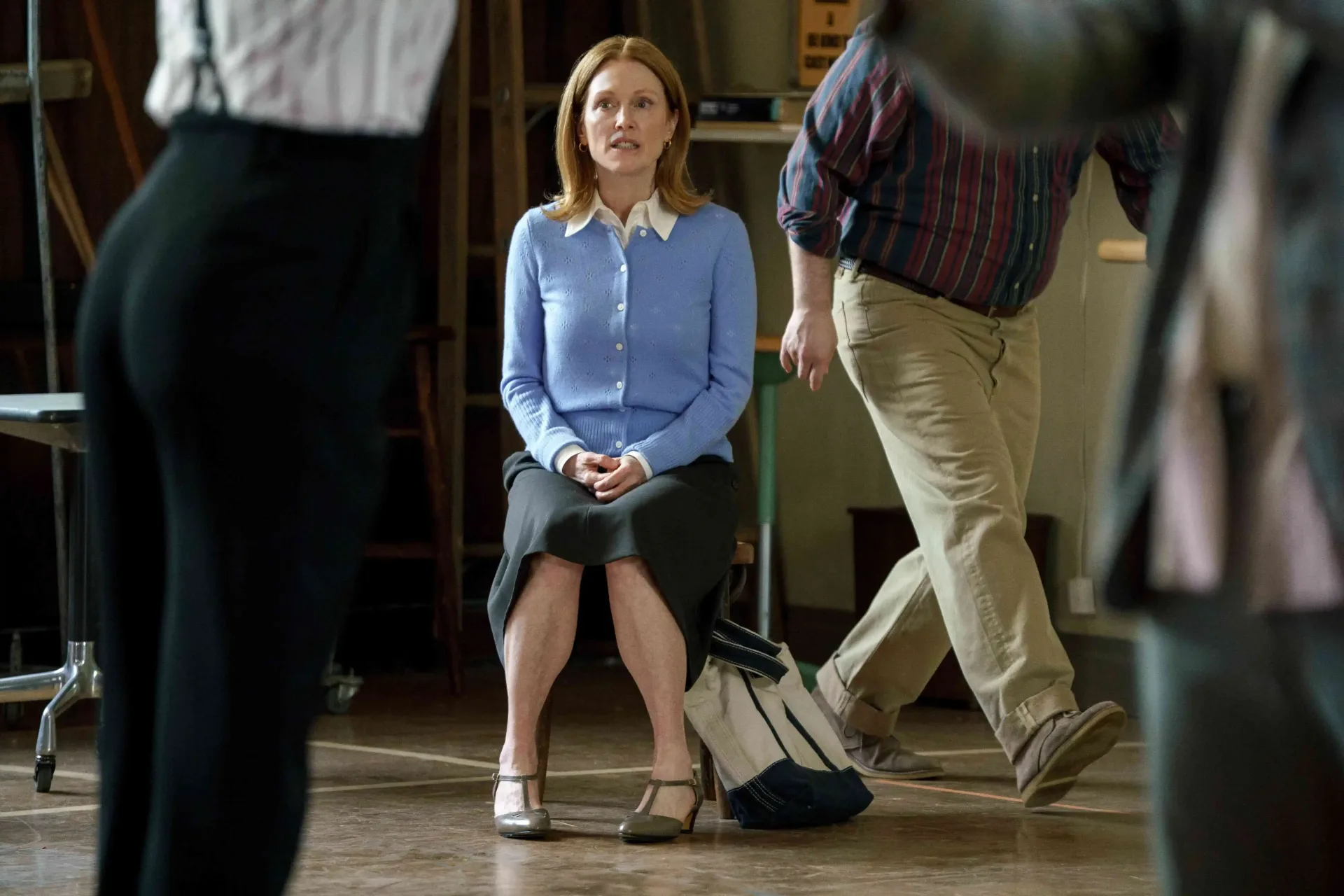
She auditions at the Brook Theater for Nosy Neighbors, the annual local musical. It is not a triumphant first scene. Mona’s attempt to land a small role goes badly, and the part initially goes to Serena Cherry, a Broadway-minded regular played by Bernadette Peters. Serena’s status in the local scene is underscored by a lobby poster recalling her turn as the lead in Evita.
Then the usual community-theater emergency strikes: Serena exits the production, and director Jerry needs someone immediately. Mona is offered the role, aided by her own desperate bit of sabotage involving the detachable phone numbers on an audition flyer. She arrives after weeks of rehearsals have already passed, a new cast member dropped into a machine whose shaky rhythms are already established.
Her character is Miss Danielle, the tough superintendent of a low-rent apartment building. The musical’s key bit of dialogue is a blunt demand for payment: “Rent’s due!” It should be a manageable line. At first, Mona cannot make it land. Her lack of stage experience, aside from singing in church choir as a child, is painfully obvious. The role asks for force, but the person playing it has spent years avoiding any kind of confrontation.
Paul Giamatti’s director tries to teach truth
Paul Giamatti plays Jerry, the frustrated director who sees both a looming production disaster and a possible breakthrough in Mona. Rather than quietly replacing her, Jerry gives her a highly charged private lesson. His method centers on a rent check held in his hand. Mona must ask for it, explain why she needs it, and continue pushing past rehearsed answers until something rawer emerges.
Related coverage includes The Debut Turns Community Theater Into a Wild Identity Crisis.
The exercise is important because it frames acting in The Debut as more than an arts-and-crafts hobby. It becomes an invitation for Mona to identify a want and claim it in public. Her eventual outburst turns a routine line reading into a survival scenario: she imagines herself destitute and desperate if she cannot get the money. In finding a fierce motivation for the fictional character, she cracks open emotions that have been buried in her own life.
Jerry’s coaching also sets up the film’s central comic danger. He wants Mona to be bolder, but may not be prepared for what “bolder” means when a lifetime of submission suddenly converts into uncompromising intensity. The film reportedly makes room for Jerry’s own bruised idealism as well. He is not merely a teacher or a joke about difficult directors; he is a theater romantic, full of hope, irritation and disappointment.
The supporting performers in Nosy Neighbors are said to play their show-business earnestness with careful restraint. Eisenberg appears among the musical’s cast, alongside Ken Todd Freeman, Eldar Isgandarov, Susan Blommaert, Colton Ryan and Bonnie Milligan. Halle Berry is also part of the film’s credited ensemble. This is a setup that benefits from a precise tonal balance: the theater group needs to feel heightened enough to be funny, but human enough that Mona’s transformation actually matters to the people around her.
The Method becomes a rabbit hole
Once Mona gets a taste of acting with conviction, The Debut reportedly declines to deliver a tidy, inspirational “find your voice” narrative. Jerry takes her into the world to practice. In one key sequence, Mona pretends to be a building superintendent, gets into a stranger’s apartment and announces that she has come to deal with a plumbing problem. The lesson works in the narrowest sense: she is suddenly capable of improvisation, authority and commitment.
But the film’s comic engine comes from recognizing the difference between useful artistic liberation and an identity crisis wearing a janitor uniform. Mona moves out of her family home and takes refuge in a shabby hotel. The setting is marked by dripping fixtures, buzzing lights and unexplained noise from adjacent rooms. Its atmosphere seems to push the story closer to a dreamlike, unsettling register without abandoning its everyday roots.
Her physical transformation is equally extreme. After a hotel electrical mishap burns away her eyebrows, Mona adopts a look associated with a hard-edged new self. The point is not a makeover in the conventional movie sense. She has committed so intensely to Miss Danielle—and to the idea that every line must correspond to lived reality—that the divide between role and life begins to erode.
That is where Eisenberg’s premise has room to become more than a satire of local productions. Mona’s journey can be read as a parable about confidence, but it also interrogates the self-help language surrounding confidence. Encouraging someone to stop apologizing, demand what they need and pursue their inner truth sounds undeniably healthy. Yet The Debut asks whether those slogans can become destructive when removed from context, responsibility or compassion for other people.
A musical inside a comedy with darker edges
The embedded musical is itself part of the joke. Nosy Neighbors is an upbeat production about residents in a struggling apartment building, with songs composed by Eisenberg. It is intentionally corny but apparently more durable than the cast’s reactions might suggest. The material’s bargain-bin-Broadway energy gives Mona a place to experiment with an identity she cannot access in her polite, carefully managed domestic life.
Its theatricality also lets the film play with scale. A seemingly minor part—a superintendent with a tool belt and a catchphrase—becomes enormous because Mona invests it with total seriousness. For a character who has spent years feeling invisible, even a stock figure in a community musical can become a vehicle for reinvention. The uncomfortable humor lies in the fact that reinvention is not automatically graceful, safe or socially convenient.
Moore’s performance is positioned as the film’s essential anchor. Mona moves between timidity, pain, focus, anger and a startling new pleasure in being noticed. The role asks for vulnerability without sentimentality, particularly as the story becomes more surreal around her. Giamatti’s Jerry supplies a complementary perspective: he is the man who opens a door for Mona, then has to confront the consequences of doing so.
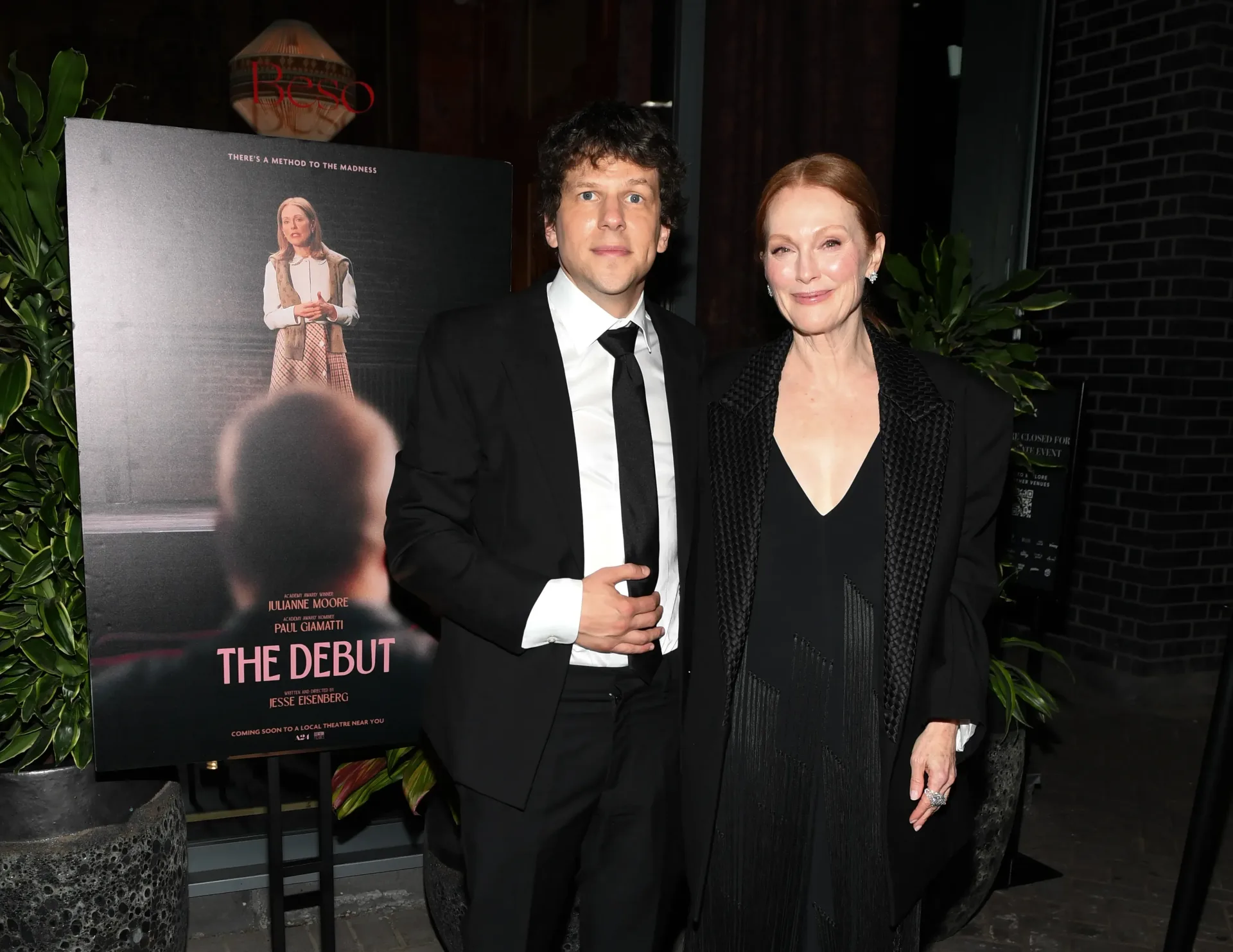
For viewers interested in Eisenberg’s work after A Real Pain, The Debut suggests another project built from recognizable behavior but willing to take a sharp left turn into heightened territory. The listed creative team includes cinematographer Drew Daniels, editor Robert Nassau and composer Emile Mosseri. Emma Stone, Dave McCary, Ali Herting and Eisenberg are credited as producers, with Fruit Tree and A24 attached to the production and release.
Its interest in people trying to perform versions of themselves also makes The Debut an intriguing companion piece to stories about the entertainment world’s rituals, prizes and public personas. For more awards-season pop-culture coverage, see the early Creative Arts Emmys honors for Bad Bunny, The Traitors and The Muppet Show.
Ultimately, the reported appeal of The Debut is its refusal to pick a single lane. It is a community-theater comedy, but one with thriller-like tension. It is a story of personal empowerment, but one skeptical of clean empowerment narratives. And it uses a gloriously low-stakes musical production to explore a far more intimidating debut: the moment a woman decides she will no longer play a minor role in her own life.