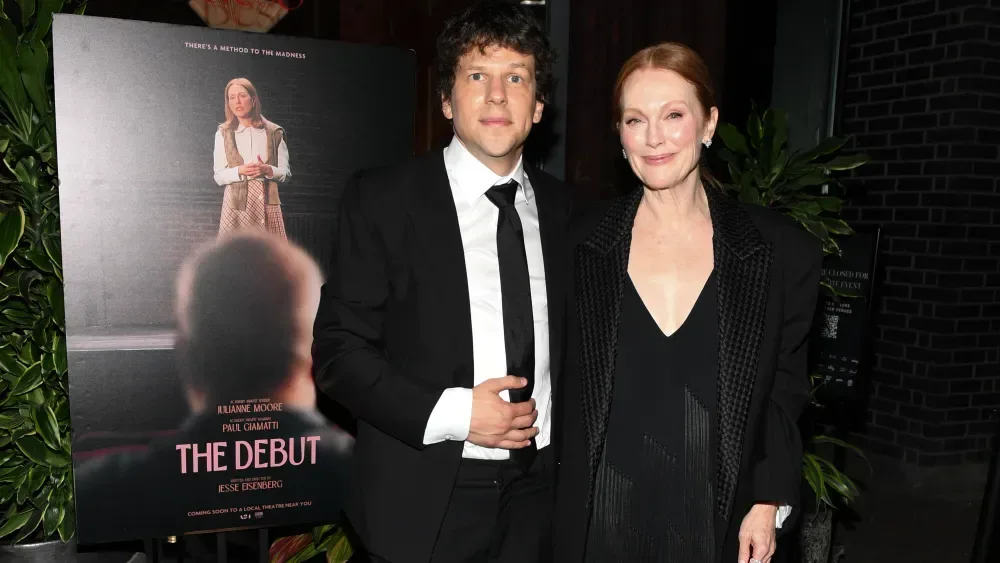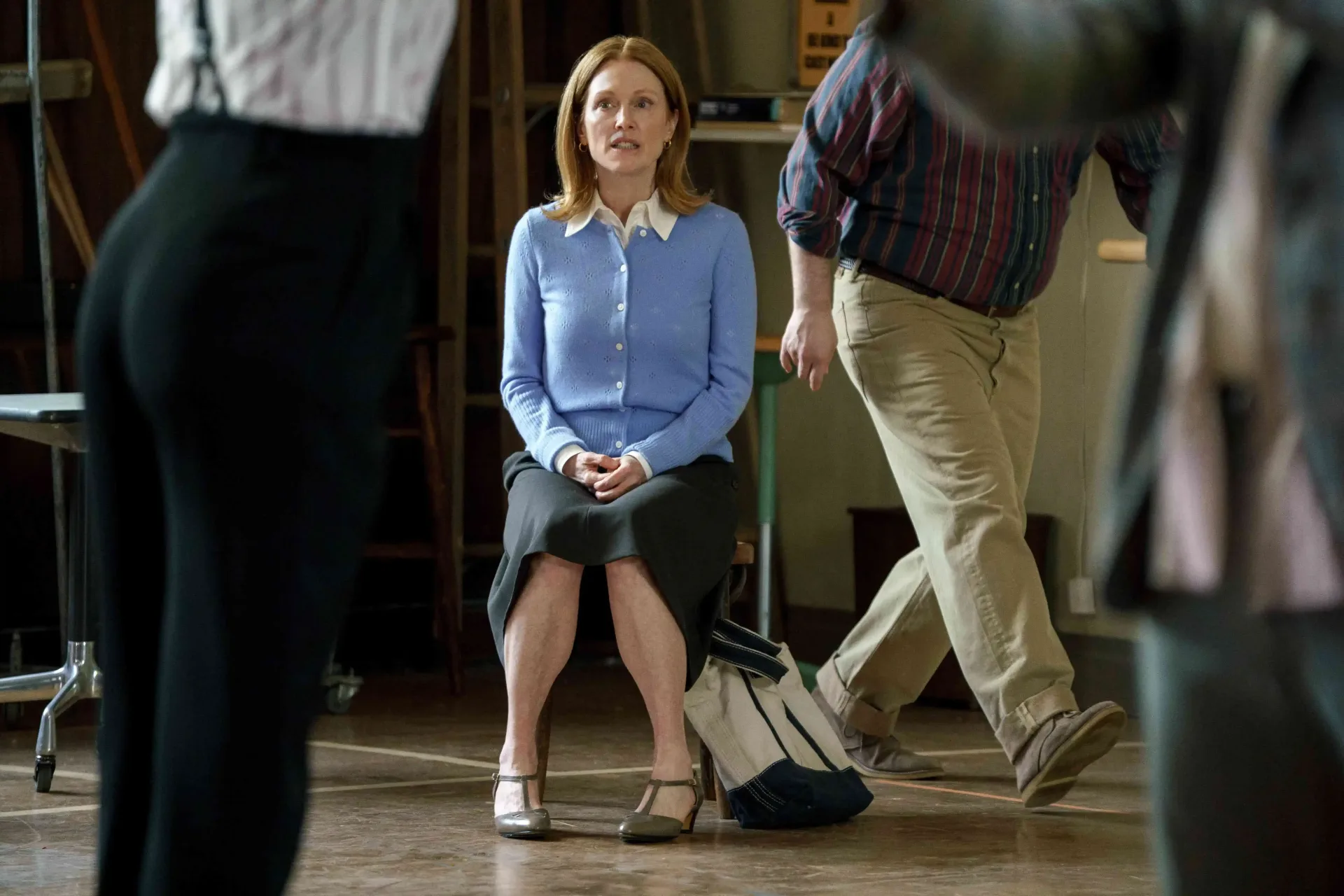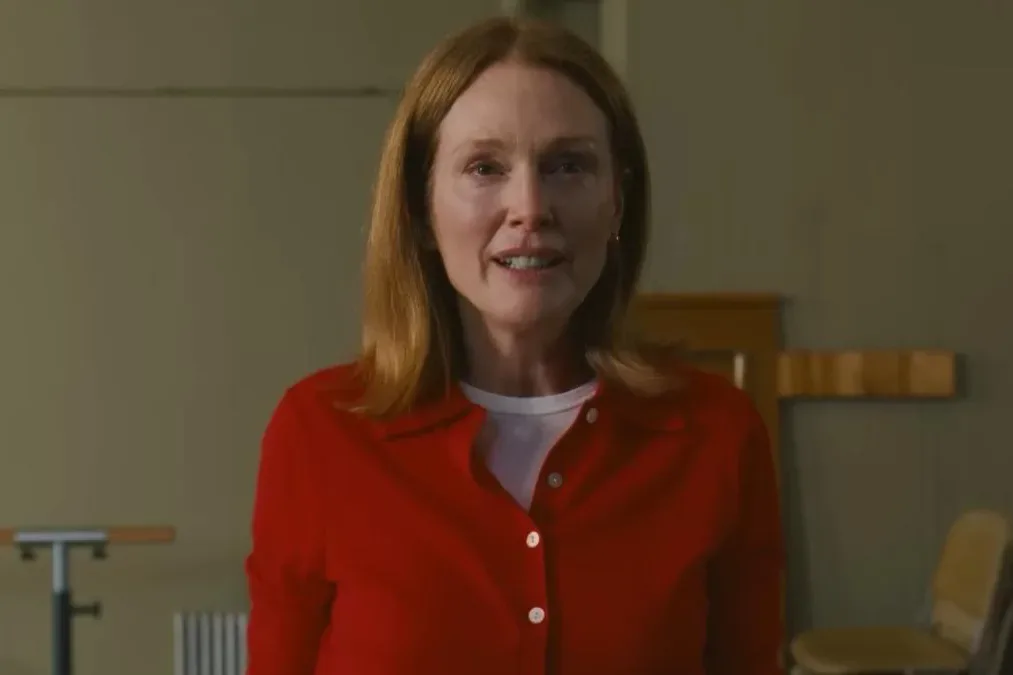
Jesse Eisenberg’s The Debut arrived at the New York Film Festival with a premise that sounds modest on paper but carries unusually expansive emotional territory: a Central Jersey housewife auditions to play a janitor in a community-theater musical. The film, Eisenberg’s third feature as writer-director, is set in 1990 and stars Julianne Moore as Mona Friedman, a timid woman whose ordinary routine has left her browbeaten and dissatisfied.
Mona’s audition is not presented simply as a late-life bid for applause. It is the entry point to a new social world. In the community production of the musical Nosy Neighbors, she encounters fellow cast members, including characters played by Halle Bailey and Colton Ryan, and an imposing director played by Paul Giamatti. As Mona becomes more deeply invested in the role, the theater itself becomes the setting for clashes, companionship and a more fundamental question: what happens when a person finally acts on a desire they have struggled to name?
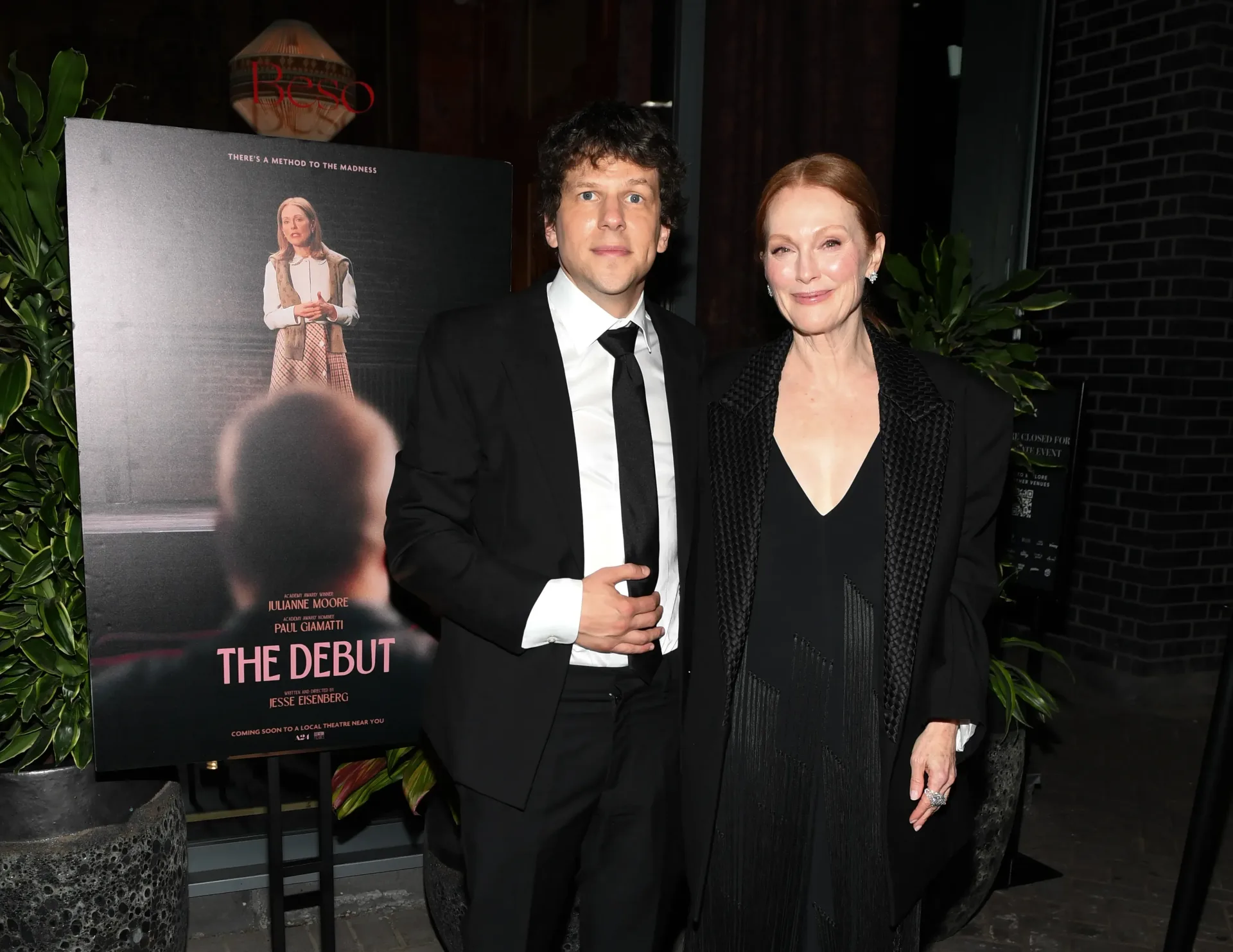
The New York premiere was held at Alice Tully Hall, with Eisenberg, Moore, Bailey, Ryan, Giamatti, producer Emma Stone and Claire Danes among those in attendance. The screening drew laughter and applause, an encouraging response for a film Eisenberg himself characterized as tonally unusual.
A community-theater story with personal roots
Eisenberg was born in Queens and grew up in East Brunswick, New Jersey, and he connected Mona’s experience directly to his own time in local theater. For him, the value of those productions was not limited to what happened under the lights. The show mattered, but the relationships formed around it mattered at least as much.
“The shows were always secondary to the backstage family,” Eisenberg said during the post-screening discussion.
That idea helps clarify what The Debut appears to be pursuing. Community theater is not merely scenic background or a convenient stage for jokes about rehearsal-room ego. It is a small, structured environment where people can temporarily try on different identities. There are auditions, parts, blocking, notes and performance, but there is also the informal work of belonging: arriving, helping, listening, failing in front of others and returning anyway.
Community theater, in this context, means productions made outside the commercial professional-theater system and rooted in local participants. Eisenberg noted that such spaces can contain performers as talented as those on Broadway, while being less dominated by a personal need to occupy the center of the stage. His point is not that ambition disappears. Rather, the shared process can become the main attraction, creating a different definition of success from being the star.
For Mona, that distinction is crucial. She is not stepping into Nosy Neighbors through a conventional leading role designed to validate her. She auditions for the janitor. The part’s apparent smallness makes the decision more revealing: the transformative act is not winning a glamorous role, but allowing herself to enter the room at all.
Related coverage includes Jesse Eisenberg’s ‘The Debut’ Brings Community Theater to NYFF.
Julianne Moore as Eisenberg’s on-screen avatar
Eisenberg wrote Mona specifically for Moore, who also appeared in his first feature as a director. At the premiere, he described the film as, above all, a tribute to her work and praised her performance in emphatic terms. His framing suggests that Mona is not an incidental protagonist fitted into a pre-existing idea; her voice and perspective were central to the project’s construction.
Moore offered an equally revealing way to think about the character. She described herself as, in effect, Eisenberg’s avatar, emphasizing the unusual creative move of placing elements of his own experience in the body and life of a middle-aged woman. That does not mean Mona should be reduced to a biographical stand-in. It means the film uses a character unlike Eisenberg on the surface to investigate an internal feeling he recognizes: not fitting into one’s current life, sensing change approaching and not yet knowing what form it should take.
Moore described Mona as someone “on the brink of change,” asking what it means to pursue a desire simply because it is there.
That is a useful distinction. Stories of reinvention often begin with a fully articulated dream: a character knows exactly what career, relationship or destination will fix their dissatisfaction. Mona’s uncertainty appears more central than any tidy objective. She wants something, but cannot fully define it. The community theater gives that uncertainty a place to become action.
Moore was also drawn to returning to a musical after Dear Evan Hansen, an experience she called both frightening and enjoyable. The musical component in The Debut matters because a musical asks performers to express feeling beyond plain dialogue. Songs, rehearsals and staged character work can heighten emotions that people may not be ready to state in daily life. That makes the form especially suited to a protagonist like Mona, whose inner life is pressing against the boundaries of her routine.
Musicals on screen can operate at very different scales, from intimate character pieces to large spectacle. The supplied details do not establish how Nosy Neighbors is staged or how extensively the film uses its songs, so it would be premature to label The Debut a particular kind of screen musical. What is clear is that the community production is integral to Mona’s story rather than a decorative subplot. For another example of how musical storytelling is being used in a very different entertainment setting, see the planned exclusive Encanto stage musical aboard Disney Believe.
The pressure behind a “small” role
Giamatti’s character, described as an imperious director, introduces an important counterweight to the theater’s promise of connection. A rehearsal room can be liberating, but it is not automatically gentle. It has authority figures, competing personalities, public criticism and the unnerving vulnerability of doing unfamiliar work in front of strangers. Mona does not discover a fantasy world free of conflict; she finds a community that asks something of her.
That tension may be where the film’s tonal oddness has room to thrive. Community theater naturally accommodates comedy: eccentric productions, uneven power dynamics and the gap between the grand emotional stakes of performance and the practical limitations of a local show. Yet the same setting can hold genuine pain. If a person has felt invisible in the rest of their life, even a supporting role can become a major emotional risk.
Falling into character is therefore more than a theatrical phrase in Mona’s case. In acting, it can describe sustained immersion in a role’s behavior and emotional logic. In narrative terms, it can also point to a person discovering that pretending to be someone else reveals something true about themselves. The available description says Mona falls ever deeper into her part, leaving open exactly how far that process goes and what it costs her. That uncertainty is one of the film’s more intriguing elements.
Why the 1990 setting fits the material
The Debut is set in 1990, a detail that places Mona’s story in a particular period without requiring the film to become a nostalgia exercise. The supplied information does not identify period-specific plot points, costumes or music, so those details remain unknown. But the setting does reinforce the local, pre-digital nature of the theater community Eisenberg describes: a gathering defined by physical presence, rehearsals and backstage relationships.
More importantly, the film’s core subject does not depend on a specific era. Mona’s feeling of wanting something without knowing exactly what it is has a broad emotional reach. Eisenberg’s own memories of local theater give the story a personal foundation, while Moore’s description of the role explains its wider pull. The character’s change begins neither with mastery nor certainty, but with an audition for a role other people might overlook.
That is the proposition at the heart of The Debut: the doorway to a different life does not always look like a grand opportunity. Sometimes it looks like an amateur musical, a backstage family and a janitor part that gives someone permission to be seen.