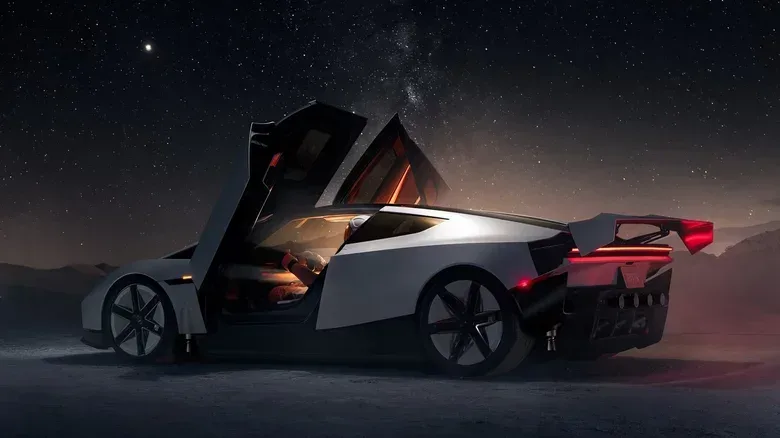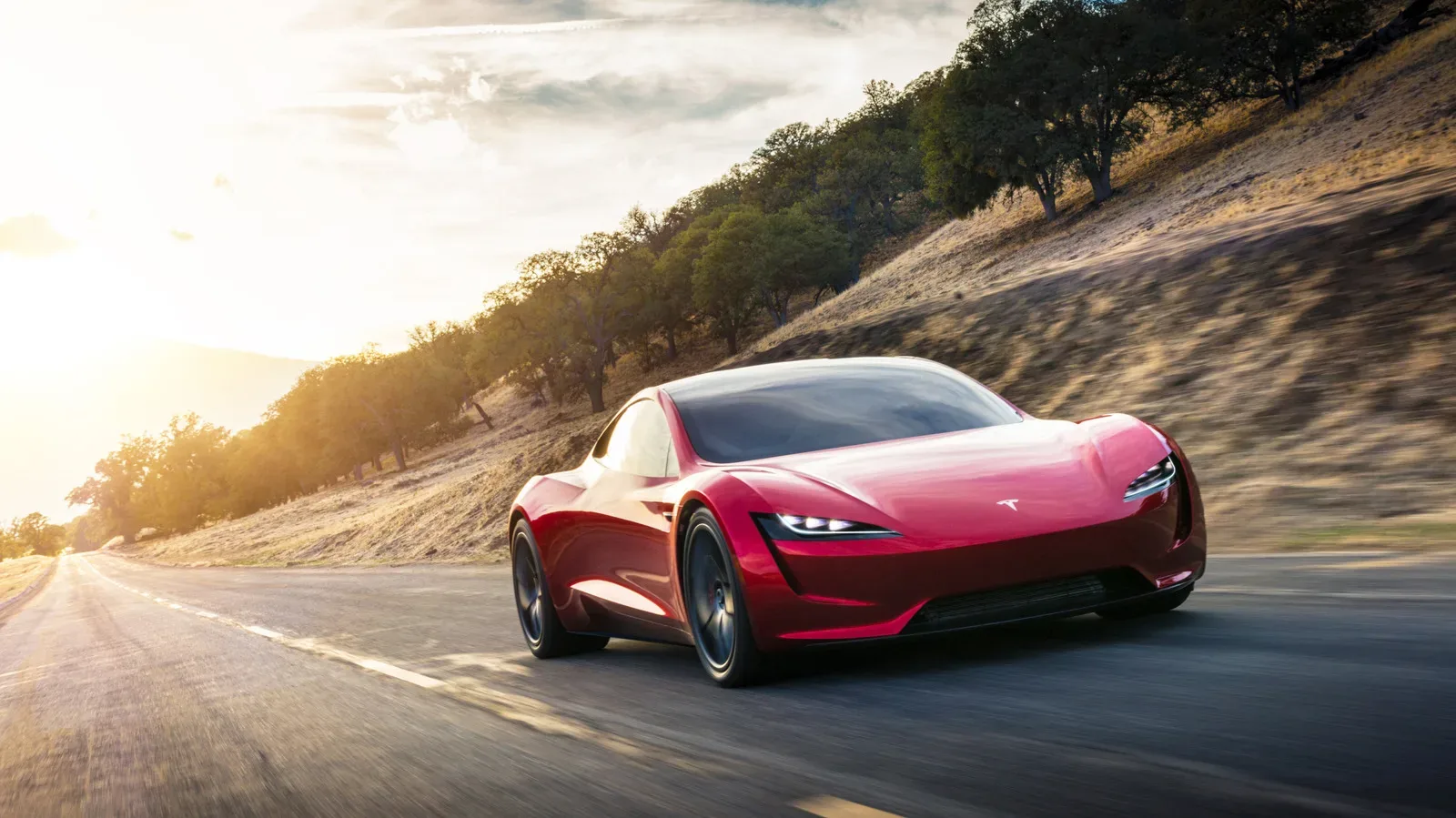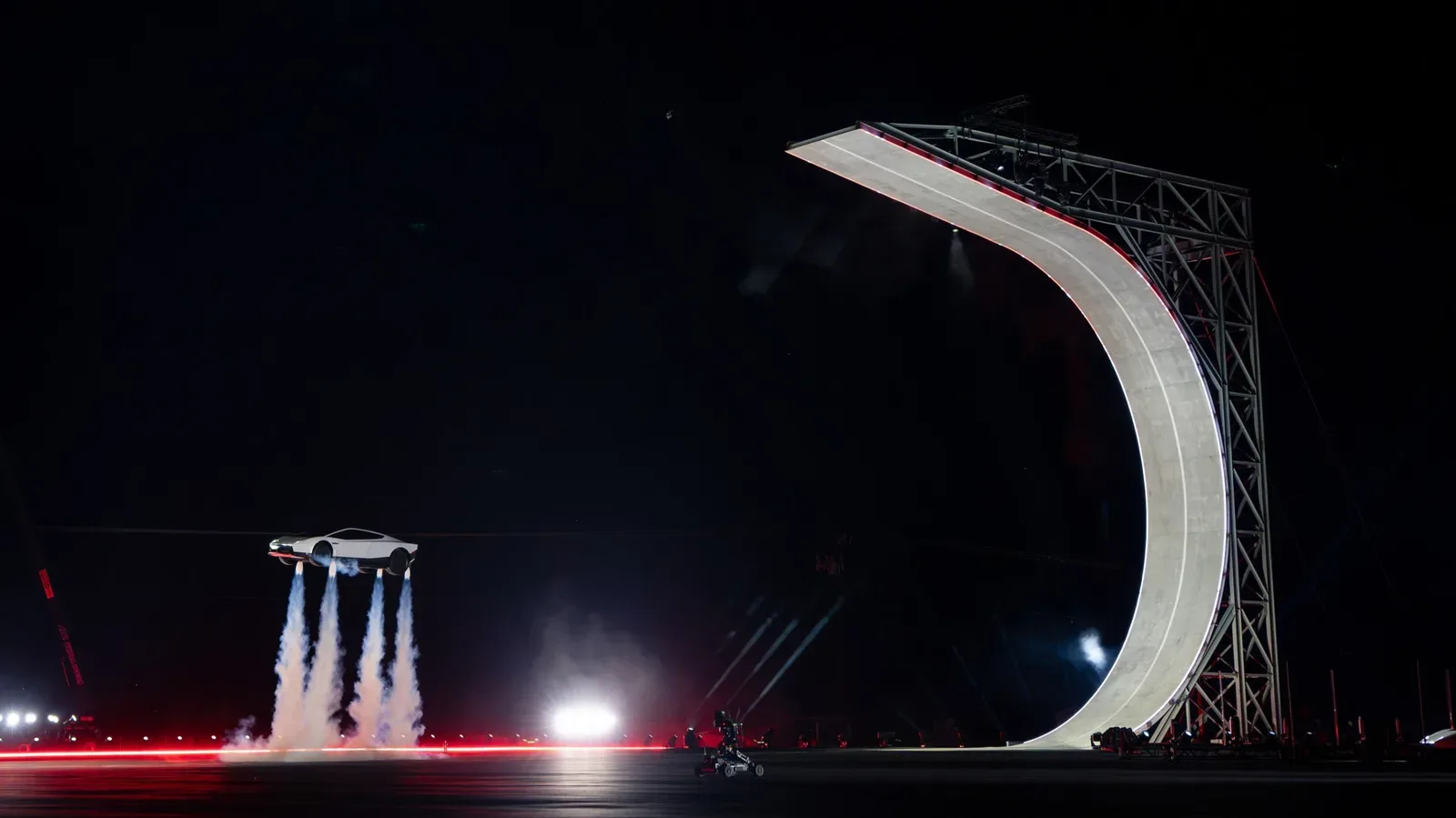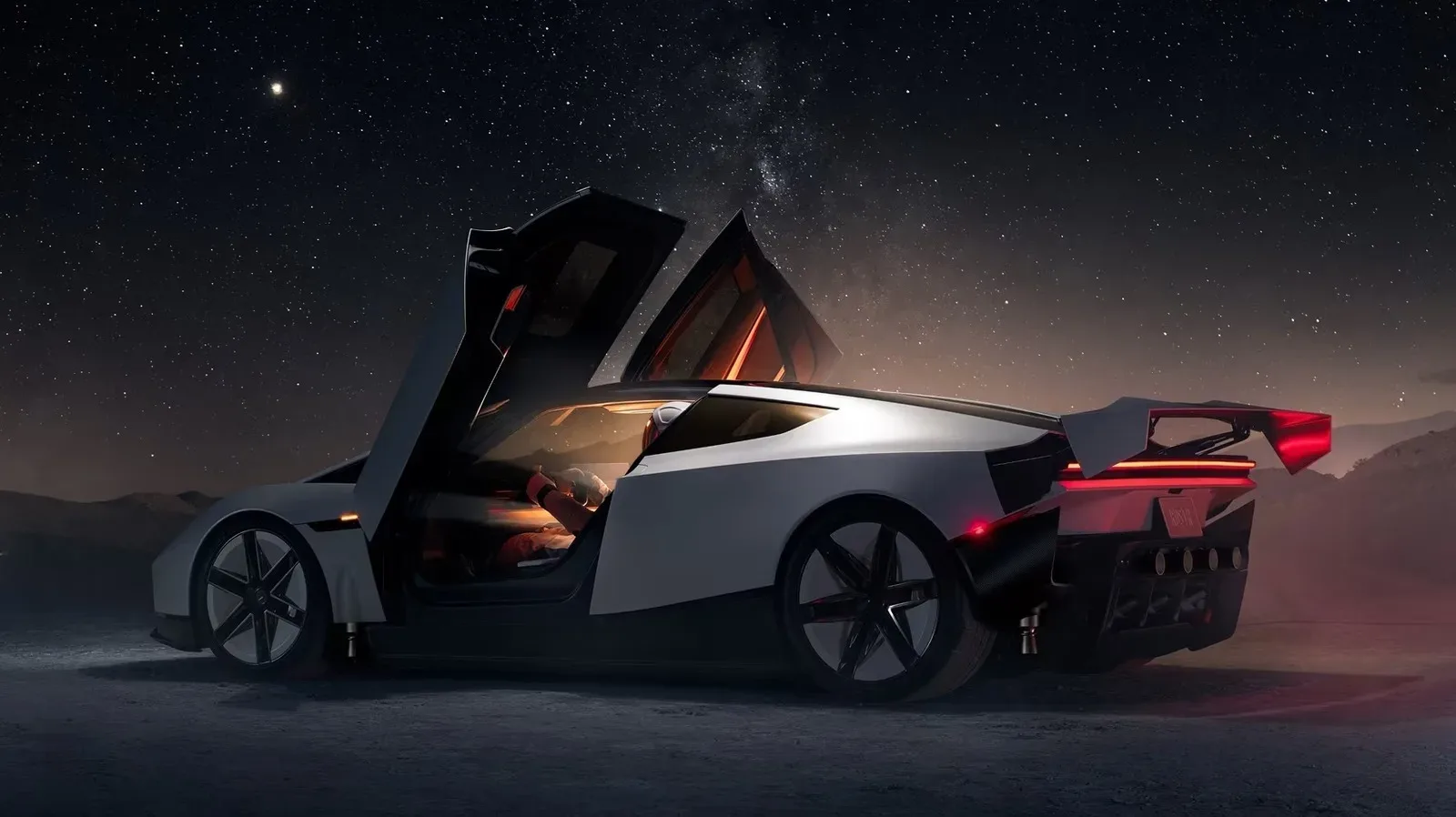
Tesla has put another date on the board for its long-promised second-generation Roadster: 2028. The target arrived during the company’s October 15 event, where a redesigned Roadster climbed a C-shaped ramp while attached to a suction rig, reached an upside-down position, then descended using rocket boosters. It was an eye-catching demonstration built for the highlight reel—and a conspicuous reminder that the vehicle remains a promise rather than a production car.
Elon Musk said Tesla would enter production in 2028, emphasizing that the claim was meant seriously. Tesla also attached a major financial figure to the showcase: reserving the Roadster’s “Thrust” trim, described as using cold-gas thrusters, costs $250,000. Tesla’s new 2028 Roadster production target is therefore significant not simply because it revives an extreme electric sports-car concept, but because it restarts a clock that has already run down several times.
A production target, not a delivery date
The wording matters. A production target identifies when a manufacturer expects to begin building a vehicle; it does not establish when an individual customer will receive one, how many units will be built, or whether all advertised versions will arrive together. Tesla’s event did not supply a firm launch date for customers.
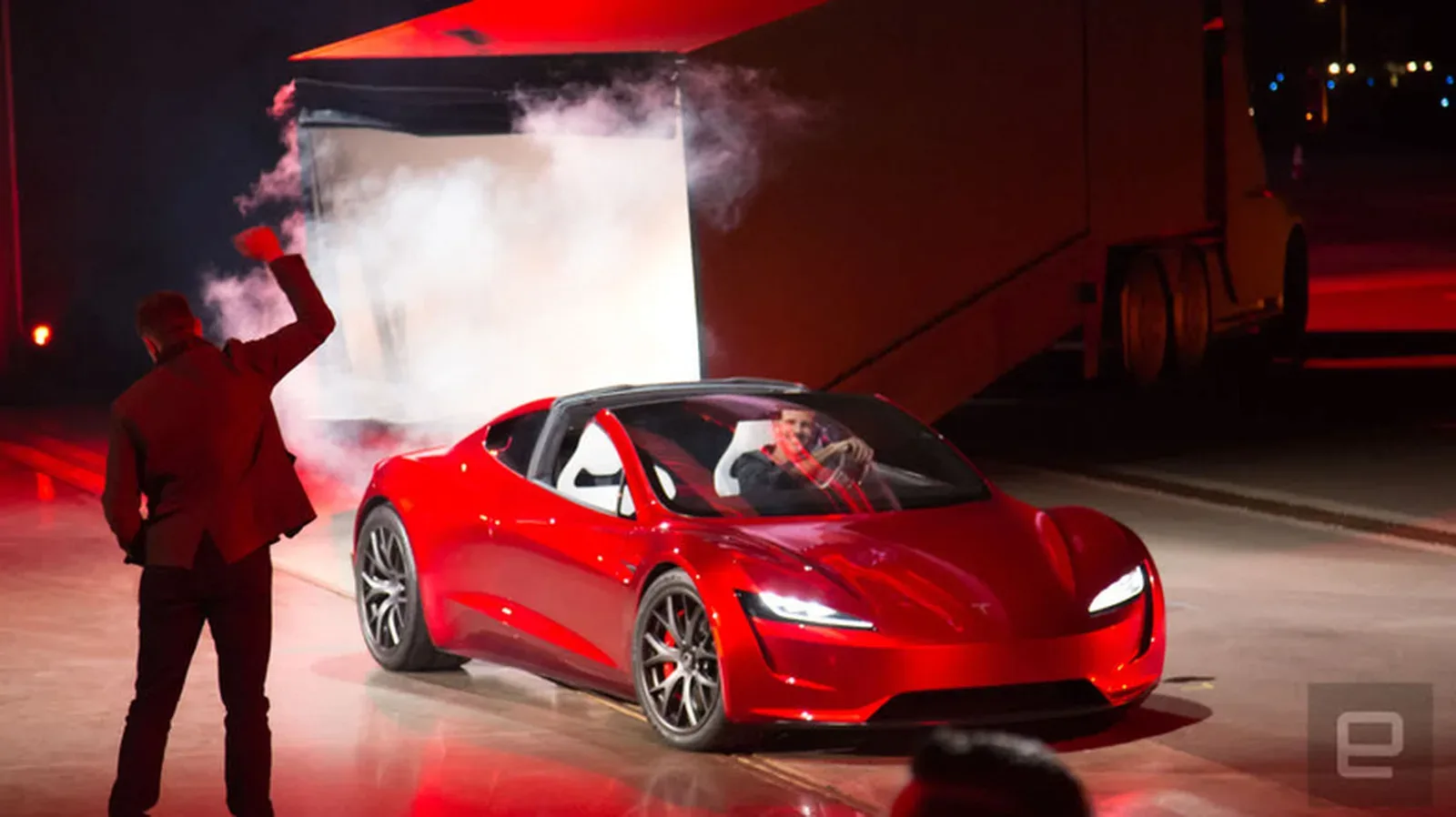
That distinction is especially important here. The second-generation Roadster was first shown in November 2017 with a 2020 release target. It was framed as a technological high point for Tesla’s EV manufacturing ambitions, and Musk described it at the time as a direct challenge to gasoline performance cars. Yet the 2020 window passed without production.
For more context, explore Michael Che Says ‘Shot in Minnesota’ Avoids Victims’ Names to Keep Focus on Broader Frustration.
In July 2020, Musk said production was expected within roughly the following 12 to 18 months. Early in 2021, the projection moved to 2022. By the end of that year, it had shifted again to 2023. Further delays followed in 2023 and 2024. Tesla recommitted to releasing the Roadster in April 2025, but the October presentation is the latest major attempt to turn that recommitment into a concrete future plan.
So 2028 should be understood as an intention with a long and difficult prehistory, not as a completion notice. That is not a verdict on whether Tesla can meet the date; it is the practical reading suggested by the vehicle’s own timeline.
Why the stunt does not answer the central question
The upside-down ramp sequence gave Tesla a memorable visual. The vehicle drove upward on a suction rig and later floated down on rocket boosters, with jet fuel also part of the event setup. But a staged demonstration and series production are fundamentally different tasks.
A demonstration shows that a particular configuration can perform a particular action under controlled circumstances. Series production means consistently building vehicles at scale, supplying their components, completing manufacturing validation, and delivering the final product to customers. The source material does not provide details on a Roadster factory plan, production volume, delivery schedule, or technical specifications beyond the Thrust trim’s cold-gas thrusters. Those missing details are why the spectacle cannot settle the delivery question on its own.
The term cold-gas thruster generally refers to a system that expels stored pressurized gas to create thrust, rather than burning fuel in a combustion process. Tesla has previously described a proposed SpaceX package featuring approximately 10 small rocket thrusters integrated around the car. In 2018, Musk said such a package could dramatically improve acceleration, top speed, braking, and cornering. The new Thrust trim keeps the thruster idea at the center of the Roadster’s identity, but the available information does not establish the final production design or its real-world capabilities.
That uncertainty does not make the concept uninteresting. It does, however, mean potential buyers should separate what was visibly demonstrated from what remains a stated goal. A rocket-assisted descent makes a formidable event moment. It is not, by itself, evidence of an established customer delivery program.
The Roadster name carries real Tesla history
The skepticism surrounding the new Roadster should not obscure the importance of the original. Tesla’s first Roadster arrived in 2008 in very limited numbers and used the chassis of a Lotus Elise. At the time, its claimed ability to travel 244 miles on a charge made a battery-powered sports car feel considerably more plausible to a public accustomed to very different expectations from EVs.
Martin Eberhard, one of Tesla’s original founders, conceived the early Roadster idea with fellow founder Marc Tarpenning. The car helped attract Musk to the startup in 2004 and prompted his initial investment. Musk later oversaw production after buying Eberhard and Tarpenning out of the company.
That original model established the Roadster as more than a familiar badge. It was tied to Tesla’s earliest argument that an electric vehicle did not have to be framed as a compromise machine. The second-generation Roadster is trying to inherit that symbolic role while pushing the concept into much more flamboyant territory: supercar performance claims, small thrusters, and a presentation designed to look almost physically implausible.
But the two cars occupy very different positions in Tesla’s story. The first Roadster was produced, albeit in limited quantities. The second remains in an extended pre-production era that has lasted since its 2017 unveiling. The name lends the new project legitimacy; it also raises the stakes for actually completing it.
Reservations turn delay into a customer issue
For casual observers, another delayed vehicle can become an internet punchline. For reservation holders, it is more concrete. Tesla has accepted Roadster deposits beginning at $50,000 and extending to $250,000. The Thrust reservation figure disclosed at the event sits at the top end of that range.
A reservation deposit is money paid to hold a place or signal intent to buy ahead of final delivery. It is not the same as possession of a finished vehicle. In this case, the long gap between deposits and production has become one of the defining parts of the Roadster story. Marques Brownlee, a Tesla owner who has interviewed Musk, publicly said in September 2025 that Tesla had held his $50,000 for eight years without delivering the Roadster. OpenAI chief Sam Altman, formerly a business partner of Musk and now a rival, has also complained publicly about his reservation.
Those high-profile examples matter because they illustrate the basic consumer problem without requiring anyone to take a position on the car’s design. A buyer considering a $250,000 reservation is not only evaluating a potential vehicle. They are also evaluating whether the company’s newest timetable deserves confidence after the previous ones failed.
The opportunity cost is difficult to quantify from the available facts, but the practical point is simple: money committed to a reservation is money a customer has chosen not to allocate elsewhere. The longer the wait, the more trust becomes part of the product.
Why 2028 is a credibility test
Tesla has previously prioritized other programs. In 2020, Musk said he wanted to build the Cybertruck before the Roadster. Cybertruck production ultimately happened after delays of its own. The Tesla Semi, unveiled alongside the redesigned Roadster in 2017, also stalled in production. These projects show that headline-grabbing prototypes and eventual manufacturing can have very different schedules.
The Roadster is now being pitched at an especially ambitious point on that spectrum. Its planned thrusters make it more unusual than an ordinary performance EV, while its reservation price places it firmly in rarefied territory. Any eventual launch will need more than a viral clip to persuade customers that the machine can be built and delivered as described.
For Tesla, meeting the 2028 target would do more than put a dramatic sports car on the road. It would end nearly a decade of shifting expectations around the second-generation Roadster and give existing reservation holders a tangible outcome. Missing it would deepen the view that the vehicle is perpetually one event away from becoming real.
For now, the fairest reading is neither that the Roadster is guaranteed to arrive nor that it is guaranteed to miss again. Tesla has stated a new production goal, demonstrated an audacious presentation concept, and tied the Thrust version to a $250,000 reservation. What it has not yet offered is the evidence customers need most: a fixed delivery timetable and proof that the unusual car can move from spectacle to repeatable production.