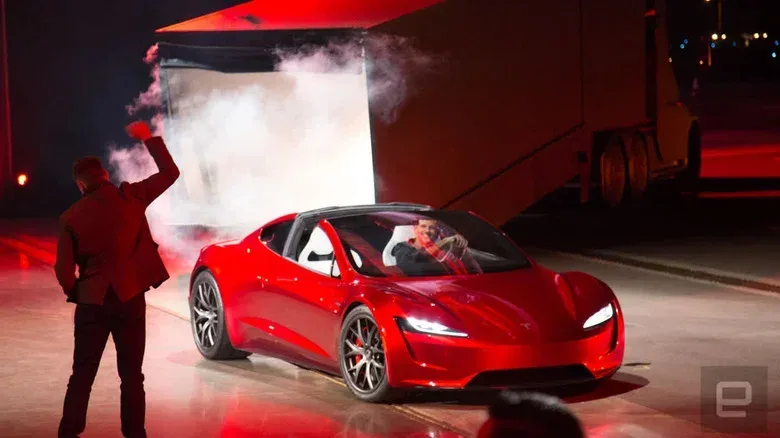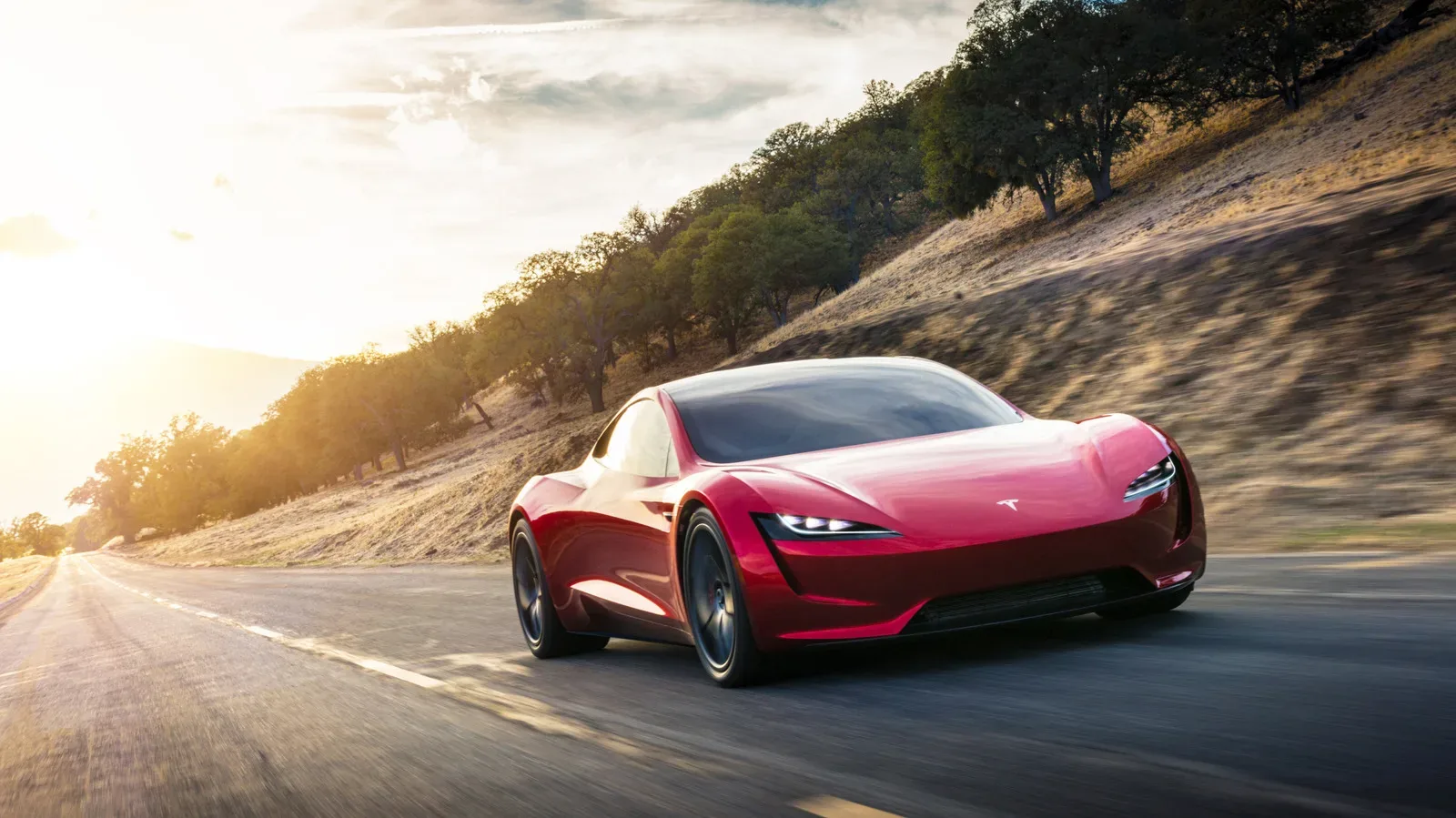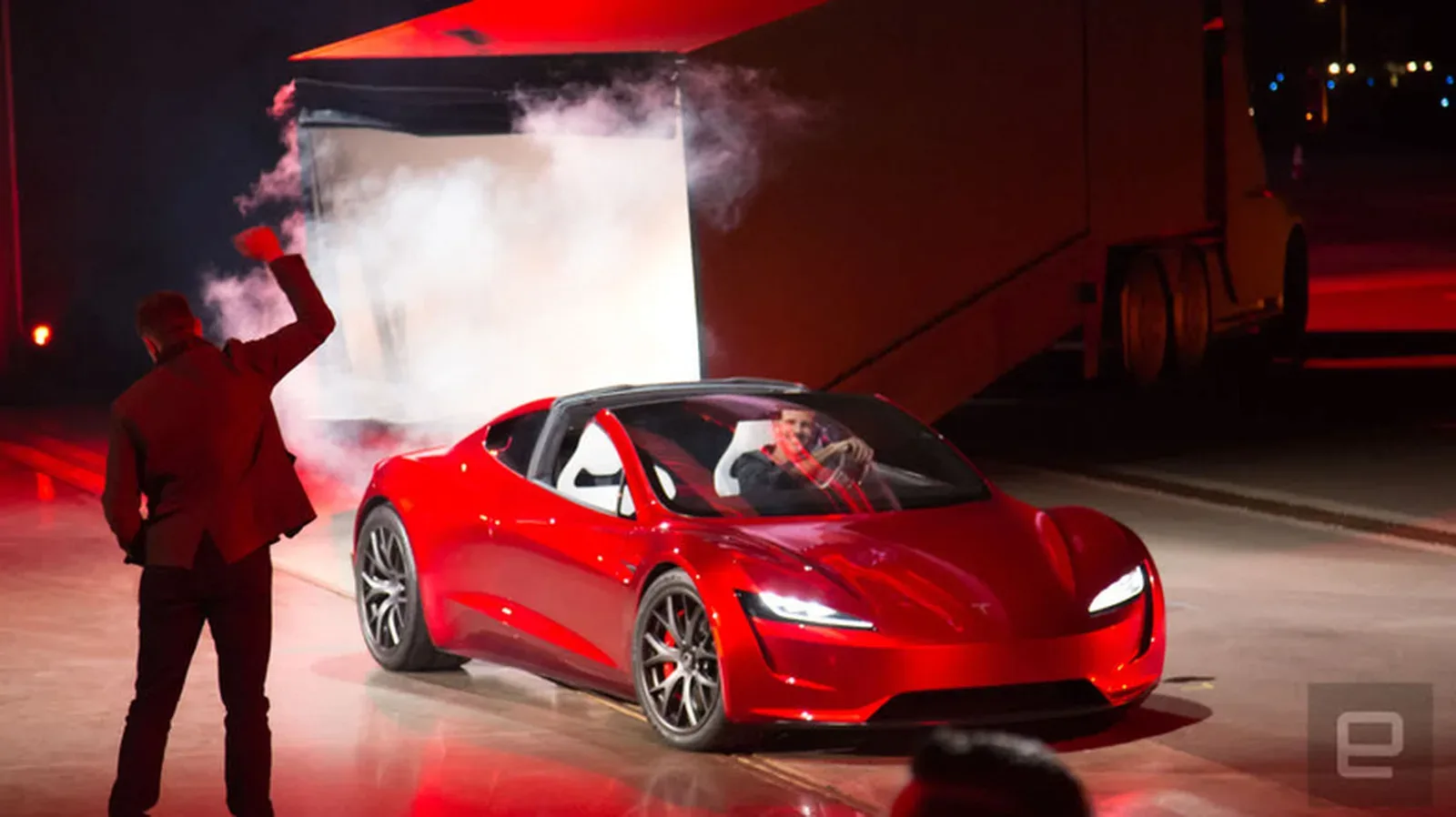
Tesla is scheduled to unveil its second-generation Roadster at 8:55PM ET on October 15, putting a long-promised electric sports car back in the spotlight after years of delays. The event matters not simply because it is another vehicle reveal, but because the Roadster has become a test of whether an unusually ambitious set of claims can finally be paired with a defined product and a credible route beyond the stage.
At its 2017 introduction, Tesla said the updated Roadster would be ready in 2020. That did not happen. Nearly nine years after that reveal, the car’s return arrives with familiar headline figures attached: a claimed 620-mile range and a 0-to-60 mph time of 1.9 seconds. More recent teasers have also raised the prospect of cold-gas thrusters, while reports have suggested a capability to fly. Tesla CEO Elon Musk has characterized the upcoming demonstration in especially expansive terms, calling it a candidate for the greatest product demo ever and saying it could be a “BANGER,” perhaps literally.
Those claims are precisely why the reveal deserves close reading. A flashy launch can communicate intent; it cannot, on its own, establish final specifications, road legality, production readiness, or how optional systems would work in everyday ownership. For enthusiasts, potential customers and anyone following the widening overlap between EV engineering and science-fiction presentation, the useful part of the event will be the detail beneath the spectacle.
What is actually on the table
The confirmed near-term point is the scheduled reveal itself. Tesla is presenting the Roadster as its next-generation electric performance car, following a long gap since the 2017 introduction and a succession of missed expectations around timing. The October 15 presentation is where the company could clarify what version of the original vision remains intact and what has changed during the extended development period.
The 2017 promises remain substantial even before the more theatrical recent hints enter the picture:
- 620 miles of range: a distance claim that would be enormous for a vehicle positioned as a high-performance sports car.
- 0–60 mph in 1.9 seconds: an acceleration target placing the Roadster firmly in hypercar territory.
- Possible cold-gas thrusters: imagery on Tesla’s site has been interpreted as teasing such a system, though the images alone do not establish its final function, inclusion, or availability.
- Reports of flight capability: this has circulated as a possibility, but remains an area where a live demonstration and clear technical explanation would be essential.
It is important to keep each item in its proper category. The range and acceleration figures are prior Tesla claims associated with the Roadster’s original introduction. The thruster idea is an implication drawn from later teaser imagery. The flight suggestion is reported possibility rather than a confirmed production feature. Treating all three as equally settled would blur the difference between a stated target, a visual hint and speculation surrounding an event.
Why the old numbers still command attention
Range and acceleration are easy shorthand, but they describe different engineering priorities. Range is the distance an EV can travel before needing to recharge under a specified test method. It can be affected by driving speed, weather, terrain, vehicle mass, tires and use of power-hungry systems. A figure such as 620 miles would therefore raise immediate questions about the conditions behind it and about the relationship between maximum range and maximum performance.
Zero-to-60 mph, meanwhile, measures straight-line acceleration from a standstill to 60 mph. A 1.9-second claim would be exceptional. Yet that number does not by itself explain repeatability, traction conditions, battery state, thermal limits, or which equipment and driving mode are required. None of those caveats diminish the excitement of a very quick car; they simply determine what an acceleration claim means outside of a perfectly controlled headline.
A Roadster makes those two measurements especially compelling because they can pull in opposite directions. Long-distance capability rewards efficiency and energy storage. Very rapid acceleration demands immense power delivery and traction. The central fascination of the second-generation Roadster is the suggestion that it can combine both at a level beyond ordinary EV expectations. The October presentation is an opportunity to show how Tesla frames that balance, rather than merely restating the extremes.
Cold-gas thrusters: the technical idea behind the tease
A cold-gas thruster is a propulsion device that expels pressurized gas to create force. Unlike a combustion rocket, it does not burn propellant; “cold” refers to the absence of combustion. The basic principle is Newtonian: sending mass in one direction generates a force in the other. Such systems are associated with controlled maneuvering in aerospace contexts, but that does not automatically tell us what a teased automotive application would be, how strong it might be, or whether it would be offered on a finished Roadster.
On a car, the obvious discussion points would be acceleration, handling, braking assistance or short bursts of force. But those possibilities are analysis, not established specifications. Each would bring consequential practical questions: Where would pressurized gas be stored? How often could it be used? What safety systems would govern it? Would use be limited to special environments? How would the system affect weight, service needs and regulatory treatment?
The reveal could answer some of these questions directly. A visual effect alone would not be enough to explain the vehicle’s real-world configuration. The distinction is particularly important because “thrusters” can describe anything from a limited demonstration element to a core performance system. Until Tesla specifies the hardware and its intended use, the most responsible description is simply that teaser material appears to point toward cold-gas thrusters.
“It might fly” needs definition, not just drama
The possibility that the Roadster could fly is even more dependent on precise language. “Fly” can mean very different things in a product presentation: an actual sustained airborne capability, a brief lift or hop, a stunt, an experimental proof of concept, or marketing language designed to heighten anticipation. The available information does not settle which meaning, if any, Tesla intends to demonstrate.
That uncertainty does not make the subject irrelevant. It makes definitions the story. If the Roadster reveal includes anything described as flight, viewers should look for a plain account of what the car did, what equipment enabled it, whether the function belongs to the vehicle as sold, and under what circumstances it could be used. A remarkable visual without those answers would remain a remarkable visual—not necessarily a feature buyers can expect.
This is the broader discipline for any highly theatrical technology launch. Demonstrations can be valuable, but their value rises when companies identify the boundaries: prototype versus production product, special setup versus normal operation, and aspiration versus committed specification. The Roadster’s unusually long development history gives those distinctions additional weight.
The delay changes the burden of proof
Announcing a car for 2020 and still preparing to reveal it years later creates a straightforward credibility challenge. Time can be used to improve a product, change its engineering assumptions or rethink its positioning. But elapsed time also makes prior promises harder to assess without updated specifics. Tesla’s Roadster event therefore has two jobs: generate excitement for a halo vehicle and explain, implicitly or explicitly, what the current Roadster is in relation to the one audiences first saw in 2017.
A halo vehicle is a product built partly to shape perceptions of a brand’s technological ambition. It may draw attention beyond its direct sales volume because it gives people an emblem of what the company says it can do. The Roadster has long occupied that role in Tesla’s lineup. Its relevance is not confined to buyers looking for a hypercar; it is also a statement about EV performance, battery range and the company’s appetite for unconventional features.
That is why timing matters as much as the car’s promised pace. A Roadster that remains a captivating concept can still make headlines. A Roadster with updated technical information, a carefully shown demonstration and clear next steps would offer a more durable answer to the question created by years of waiting: what, exactly, is Tesla now prepared to stand behind?
What to watch during the reveal
The most revealing moments may not be the loudest ones. The presentation will be more useful if it establishes the following points:
- Whether Tesla gives a current production timeline. A scheduled reveal is not the same as confirmation of when the vehicle will be built or delivered.
- Whether the 620-mile and 1.9-second figures are reaffirmed. If they are, viewers should note whether Tesla attaches conditions, configurations or testing details.
- What the thruster teaser means in practice. Is it described as a concept, an option, a demonstration aid or an integral Roadster system?
- What “flight” means, if the subject is addressed. The exact behavior demonstrated and the exact language used will matter more than a dramatic label.
- Whether the vehicle on stage is clearly identified. A production-intent car, prototype and showpiece are not interchangeable descriptions.
There is a useful parallel with game demos: a trailer can sell a fantasy, while a technical walkthrough tells an audience what they will actually get. For a roundup of how varied playable demonstrations can be in another medium, see these Steam Next Fest demos. Tesla’s event is not a game showcase, of course, but the principle translates cleanly: the closer a demonstration gets to explaining the product’s conditions and limits, the more meaningful it becomes.
Expectation management is part of the event
Musk’s language has intentionally set an enormous bar for entertainment value. That may be fitting for a Roadster whose past claims already sound like a spec sheet written to provoke disbelief. But the event’s lasting significance will turn on the grounded information surrounding any spectacle.
The best-case outcome for observers is not simply a memorable stunt. It is a clearer Roadster: what performance Tesla currently claims, whether the old targets still apply, which advanced systems are real vehicle features, and when the public should expect the model to move beyond an unveiling. Conversely, if the presentation emphasizes implication while leaving timing and technical definitions unresolved, the Roadster will remain more of a tantalizing promise than a settled product story.
For now, the scheduled October 15 launch is the next checkpoint for a vehicle that has spent years operating at the outer edge of automotive hype. Tesla has attached extraordinary language to it. The presentation now has the chance to turn at least some of that language into specifics.