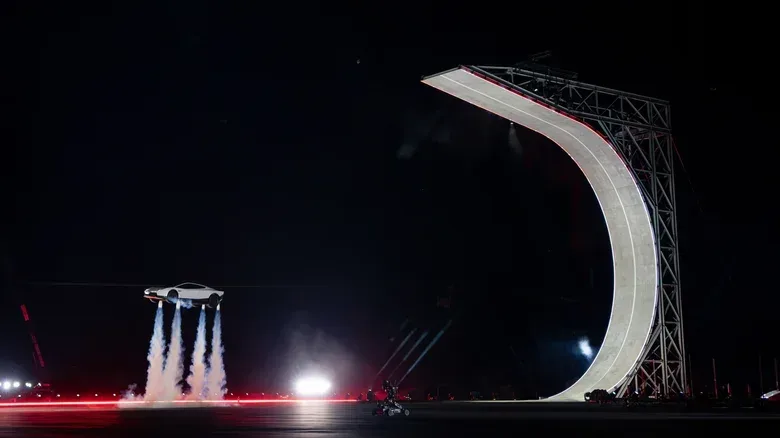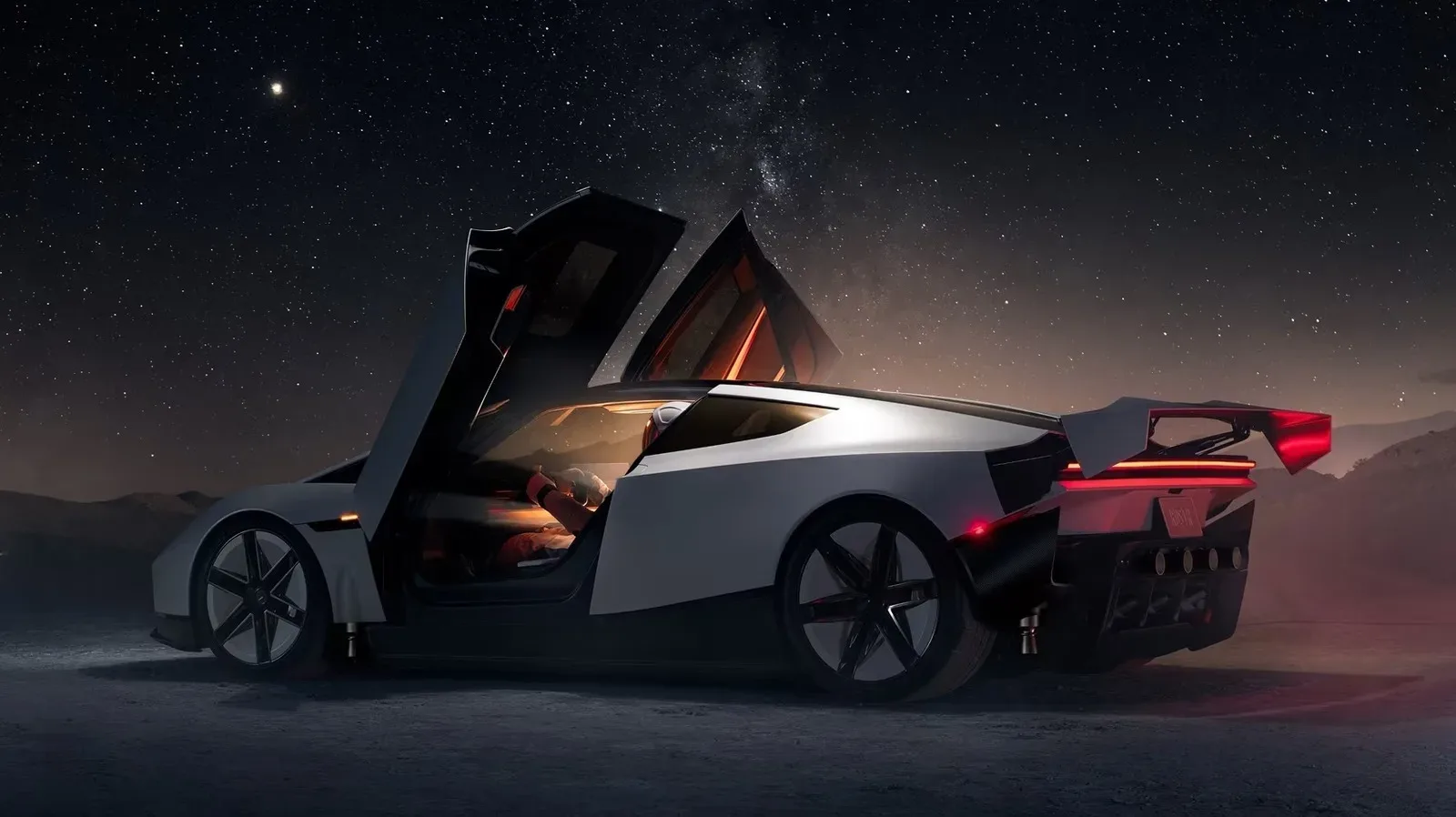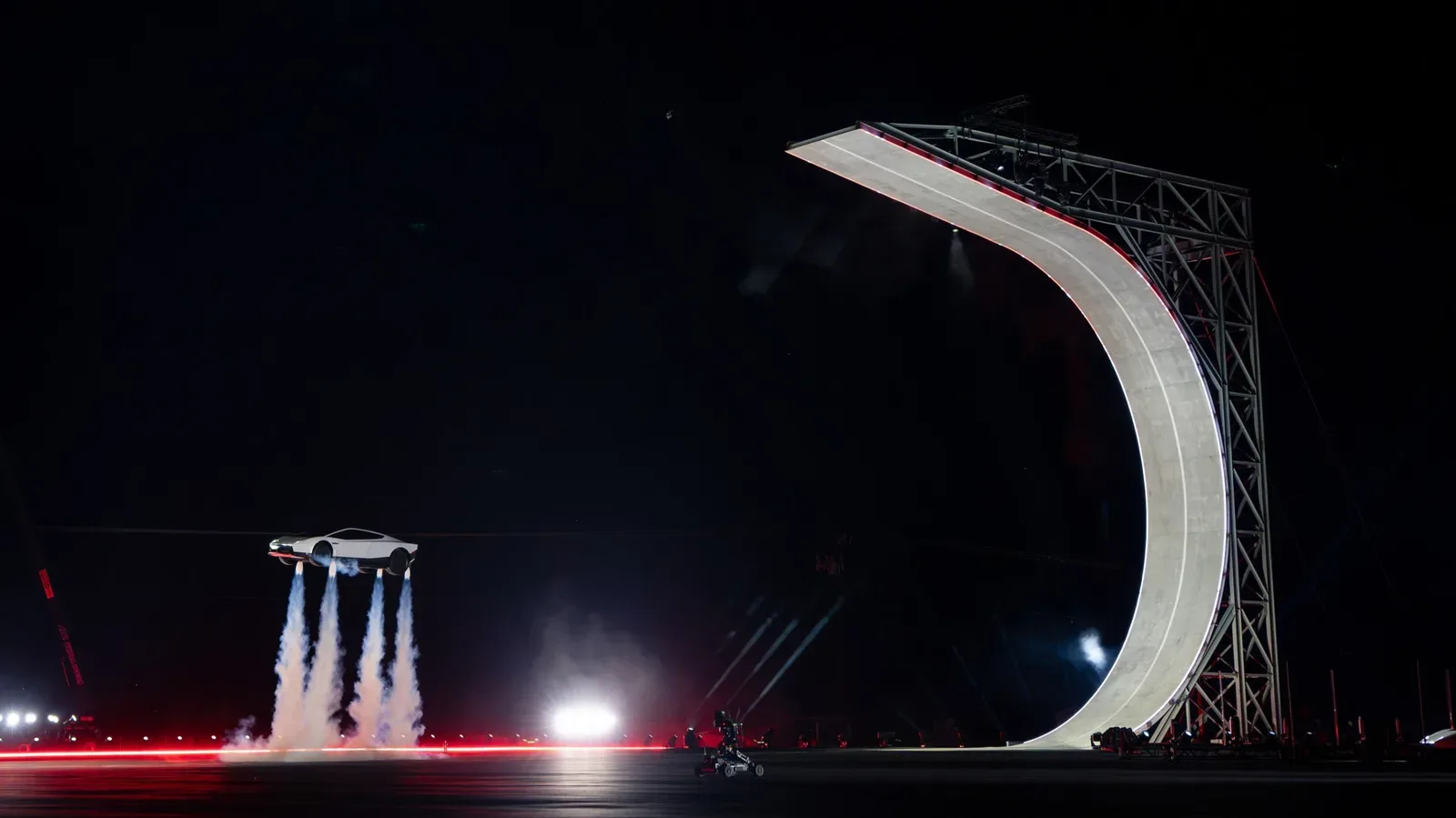
Tesla’s newly reintroduced Roadster is being discussed with the kind of vocabulary usually reserved for stunt modes, sci-fi racers and a particularly ambitious physics sandbox: it can supposedly “fly.” That description needs a large asterisk. The proposed vehicle is not presented as a hovering, road-going machine in the Back to the Future Part II sense. Its eye-catching moves are controlled jumps, falls, flips and stabilization maneuvers assisted by thrusters.
Even so, the underlying idea is more serious—and much older—than a supercar doing a kickflip. The same broad engineering problem, rapidly changing an object’s direction and orientation with small bursts of thrust, was central to experimental missile-defense work on Multiple Kill Vehicle, or MKV, systems. The comparison does not make the two projects equivalents. One is a consumer vehicle that remains unreleased; the other was part of a defense effort intended to intercept ballistic-missile threats. But it does put the Roadster’s wildest claimed behavior in a clearer technical context.
A car that “flies” by managing its fall
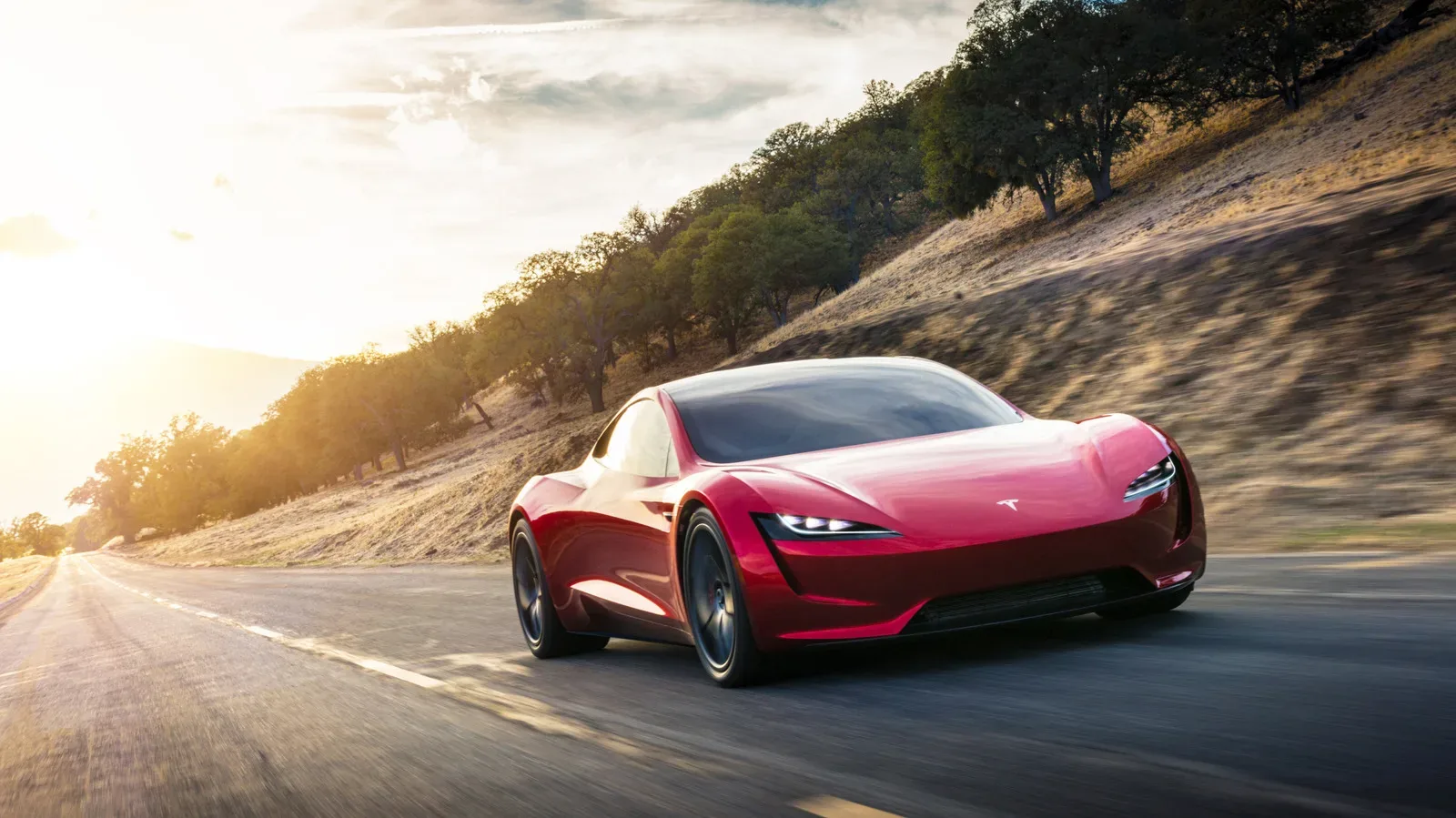
The Roadster was formally reintroduced on October 15 with an angular appearance likened to Tesla’s Cybertruck and a claimed zero-to-60 mph time of less than a second. The headline-grabbing element, however, is its proposed thruster hardware.
Tesla says the full system uses two high-pressure air tanks and 10 nozzles distributed around the vehicle. Those nozzles would release compressed air to move and stabilize the car. Rather than providing sustained aviation, that arrangement is intended to enable brief changes in motion: a jump may be adjusted, the body may be rotated, and a landing or fall may be stabilized. “Flying” is evocative shorthand, but controlled movement while airborne is the more useful description.
The configuration also is not said to be standard across the range. Tesla has described the Rocket trim as the version with the complete thruster arrangement. The Thruster trim is said to limit thrusters to the rear of the vehicle, while the Performance trim does not include them. Most importantly for anyone imagining rush-hour acrobatics, Tesla says the thrusters are not approved for public-road use.
That caveat matters more than the flashy terminology. A capability shown or described for a vehicle is not automatically a capability a driver can legally or practically deploy in ordinary traffic. The Roadster itself is still unreleased, and the information available describes a claimed design and trim structure, not an independently demonstrated road-use feature.
Cold-gas thrusters, explained
Tesla characterizes the Roadster setup as cold-gas thrusters. In plain language, a cold-gas system expels stored pressurized gas—in this case, Tesla says compressed air—to generate force. It does not need to burn propellant at the nozzle to make that thrust.
That distinction is especially helpful because “rocket” language can suggest flames and combustion. Here, the proposed mechanism is compressed air leaving the nozzles. The force may be brief, but positioned around an object it can affect more than straight-line motion. A burst at the right location can influence the vehicle’s orientation: its pitch, roll or yaw. Those are technical terms for how an object is angled and rotated in space, rather than simply where it is moving.
For a car in a jump, that control could be the difference between continuing to rotate, resisting rotation or changing its attitude before it comes down. That is why a collection of relatively small directional outputs can make such an outsized difference visually. The compelling part is not merely the force; it is the timing and placement of that force.
The missile-defense parallel is about control, not lifestyle
Long before the Roadster’s proposed stunt-car application, missile-defense development explored this kind of high-speed guidance problem. Lockheed Martin’s MKV effort began in earnest in 2004, when the company received a $760 million contract from the U.S. Missile Defense Agency. Its aim was described as a system able to destroy multiple ballistic-missile threats and decoys with a single launch.
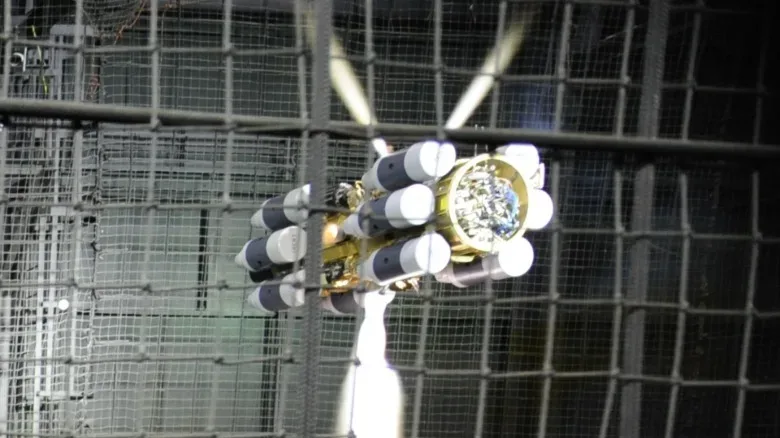
An MKV system is fundamentally unlike a road vehicle. It carries several smaller vehicles meant to collide with missiles to destroy them. Yet those smaller elements require the ability to rapidly adjust their direction and orientation, using thrusters to alter their position in flight. That is the direct connection to Tesla’s concept: not the mission, scale or user experience, but the use of controlled thrust to manage where something is pointed and how it moves.
The contrast is sharp enough to be almost absurd. Tesla’s proposed hardware is associated with an exotic car and dramatic maneuvers. The MKV concept was built around intercepting ballistic-missile targets and potential decoys. One is presented as performance theater; the other was part of a high-stakes military program. They share a motion-control principle, not a purpose.
That distinction is worth holding onto whenever impressive technology is reduced to a single adjective. “Thruster” does not describe one universal kind of device or a single outcome. It describes a component that produces thrust. What that thrust does depends on the whole system: the object’s mass, where the force is applied, the control software, the surrounding environment, and the task being attempted.
Why the history is murkier than the concept
The MKV’s public visual record is not especially clean. Footage sometimes associated with Lockheed Martin’s project has also been connected to the Reagan-era Strategic Defense Initiative, commonly called the “Star Wars” program. That creates an immediate timeline problem for some attributions: Lockheed Martin did not exist until 1995, so material claimed to show the company’s work before then cannot be treated as straightforward evidence of its MKV program.
The broader idea did predate the 2004 contract. Missile-defense systems capable of tackling multiple threats had circulated in development thinking since the Strategic Defense Initiative era. Lockheed Martin and Raytheon later pursued separate development tracks related to the MKV concept. The original MKV project was retired in 2009 amid military budget cuts.
In other words, the historical link is not that a particular old clip proves a Roadster-like maneuver. It is that the aerospace and defense field had already worked on systems where fast, precise thruster-driven changes in course and orientation were essential. The uncertain provenance of online footage is a reminder to separate a valid technical lineage from a viral visual claim.
That same discipline is useful for entertainment technology as well. Military hardware often becomes an aesthetic or mechanical reference point in action games, even when the real systems have far narrower and more consequential roles. Modern Warfare 4’s stated campaign influences, for example, show how quickly real-world conflict imagery is transformed into a different kind of fiction. The Roadster comparison runs in reverse: a consumer spectacle is being understood through an aerospace-and-defense control concept.
Compressed air versus “hot-fire” propulsion
There is also an important difference in how the two projects appear to produce thrust. Tesla is explicit about compressed air and cold-gas operation. Documentation from Lockheed Martin in 2008 referred to MKV “hot-fire tests,” which suggests that at least part of that system used propulsion involving fuel combustion.
A hot-fire test generally refers to testing a propulsion system while it is actually firing, rather than simply examining its structure or control electronics. In this context, the phrase is evidence that the MKV approach was not simply a compressed-air version of the Roadster proposal. It points toward a propulsion system with a different operating method.
It would be a mistake to turn that into a simple verdict that one solution is categorically better. The cited projects were created for radically different jobs, and neither is something the public can presently buy or own. Tesla’s compressed-air proposal is, on its face, less combustible than a system that burns fuel. But combustion is only one property among many, and the available details do not support a broader performance ranking.
What the comparison actually tells us
The Roadster’s thruster claim is remarkable because it transfers a control idea normally associated with aerospace and defense into a car-shaped object. It also shows why the claim should be read with precision. The proposal is not a promise of everyday automotive flight. It is a proposed method of exerting short, targeted forces during dynamic maneuvers—and Tesla itself says those thrusters are not approved for use on public roads.
Its most plausible reading is less magical, but arguably more interesting: the Roadster is meant to use compressed-air bursts as an active motion-control tool. That basic principle has a real technical ancestry in systems such as MKV, where the stakes had nothing to do with spectacle. The differences in mission, propulsion and present status are enormous. The shared lesson is simply that when a machine needs to correct its attitude in a hurry, well-placed thrusters can do a lot more than push it forward.