Apple TV is set to gain Apple Intelligence through a tvOS 27.2 beta, expanding Siri from a primarily command-driven remote-control assistant into something intended to handle entertainment discovery, follow-up questions and connected-home requests. The update is planned for second-generation Apple TV 4K hardware and later, so the new experience is not reserved entirely for buyers of the newly announced box.
The pitch is straightforward: a television is where many people already search for something to watch, pause to ask a question about what they are seeing, and check in on the home. Apple’s proposed answer is a Siri AI interface that tries to keep those tasks on the largest screen in the house rather than bouncing viewers back to a phone, a menu hierarchy or a separate smart-home app.
That can sound like a small interface upgrade, but the practical ambition is broader. Apple is combining search, recommendation context, general knowledge and HomeKit controls into the same assistant. Whether that proves genuinely convenient will depend less on the headline term “AI” than on how reliably Siri identifies the right show, understands a vague reference, and gives an answer without becoming an interruption during playback.
A full-screen route into movie and TV discovery
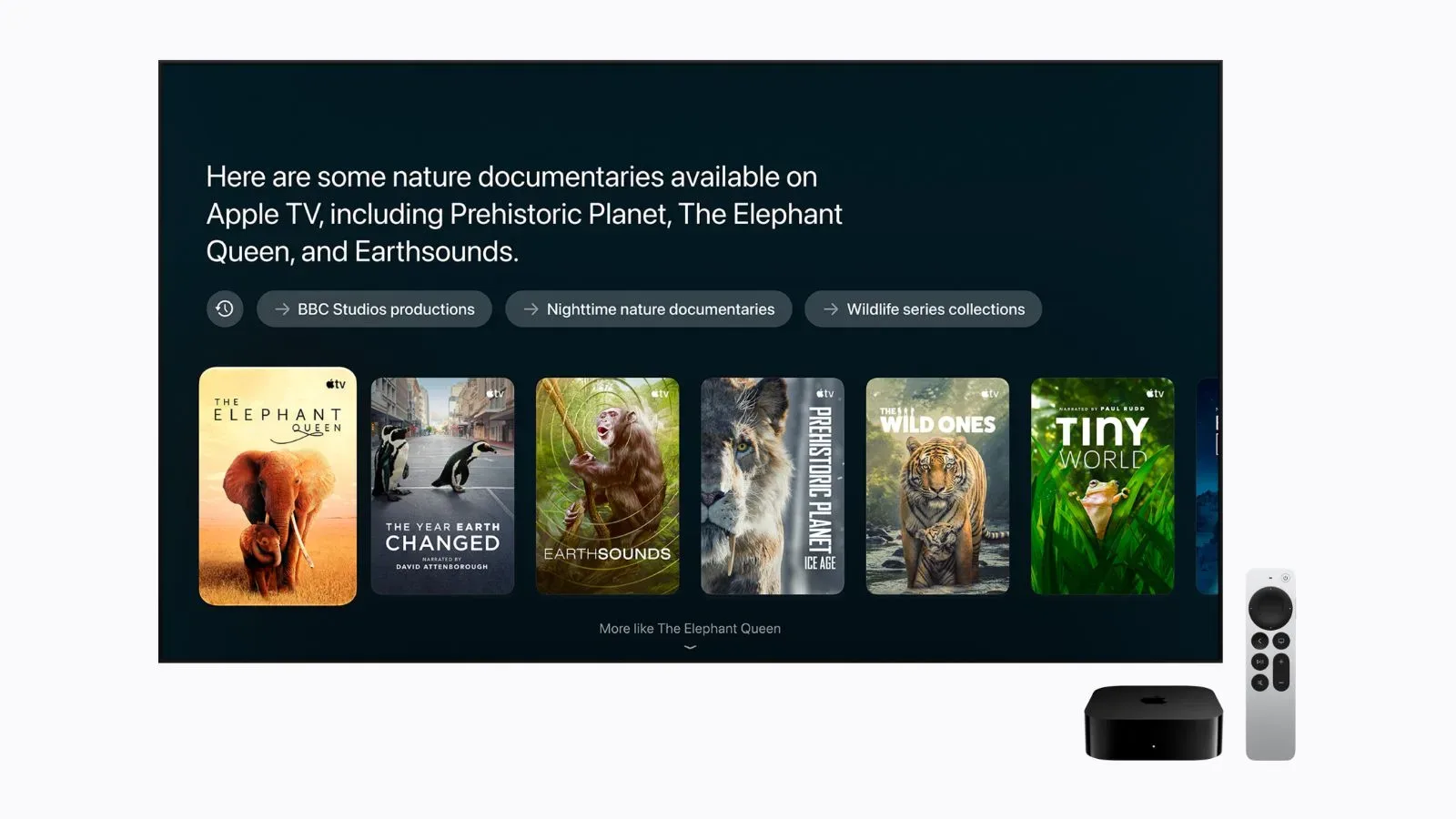
The centerpiece is a new full-screen Siri AI presentation for finding movies and television shows. Results use poster art from the Apple TV app and can lead into related suggestions. Rather than limiting queries to a title or performer, Apple describes questions built around broader attributes of programming. One example is asking which Apple TV shows won Emmy Awards in a given year, then using the results to explore other award-winning programs.
This matters because “what should we watch?” is usually not a clean database search. A household might know a genre, an award, a mood, an actor or simply that someone mentioned a series, while not remembering its name. Conventional streaming interfaces are often designed around typing a title, scrolling rails of thumbnails or selecting filters one at a time. A conversational request is meant to accept the messy version of that question.
In this context, conversational means a request does not necessarily have to stand alone. The assistant is intended to preserve enough context for a viewer to refine an earlier result instead of restarting the search from scratch. The supplied examples establish the direction of travel, though they do not define every type of question, every supported app action, or every situation where the system will retain context. Those boundaries will be important once the beta is in people’s homes.
Questions while a show is playing are designed to stay out of the way
Apple also says viewers will be able to ask Siri about a program during playback, including where something was filmed or whether a show is suitable for a particular age. The response is expected to appear in a small overlay on top of the video rather than replacing the show with a full-screen response.
That design detail is meaningful. A full-screen discovery page makes sense before the viewer presses play; it would be far less welcome when someone wants a quick piece of context halfway through an episode. A compact overlay is an attempt to make information available while keeping the program visible. It also suggests an answer can be useful even when it does not trigger an action: the viewer may simply want clarity without reaching for another device.
Apple says Siri AI will offer wider general-knowledge help and carry out more actions across apps. That wording signals a larger role for the assistant, but it should not be read as a complete feature list. The announced details identify entertainment questions, related recommendations, personal-context requests and home control as intended uses. They do not specify every app, service, region, language or command involved. As with any beta, the available experience may be narrower than the most expansive reading of the announcement.
Personal context may solve the “someone recommended it” problem
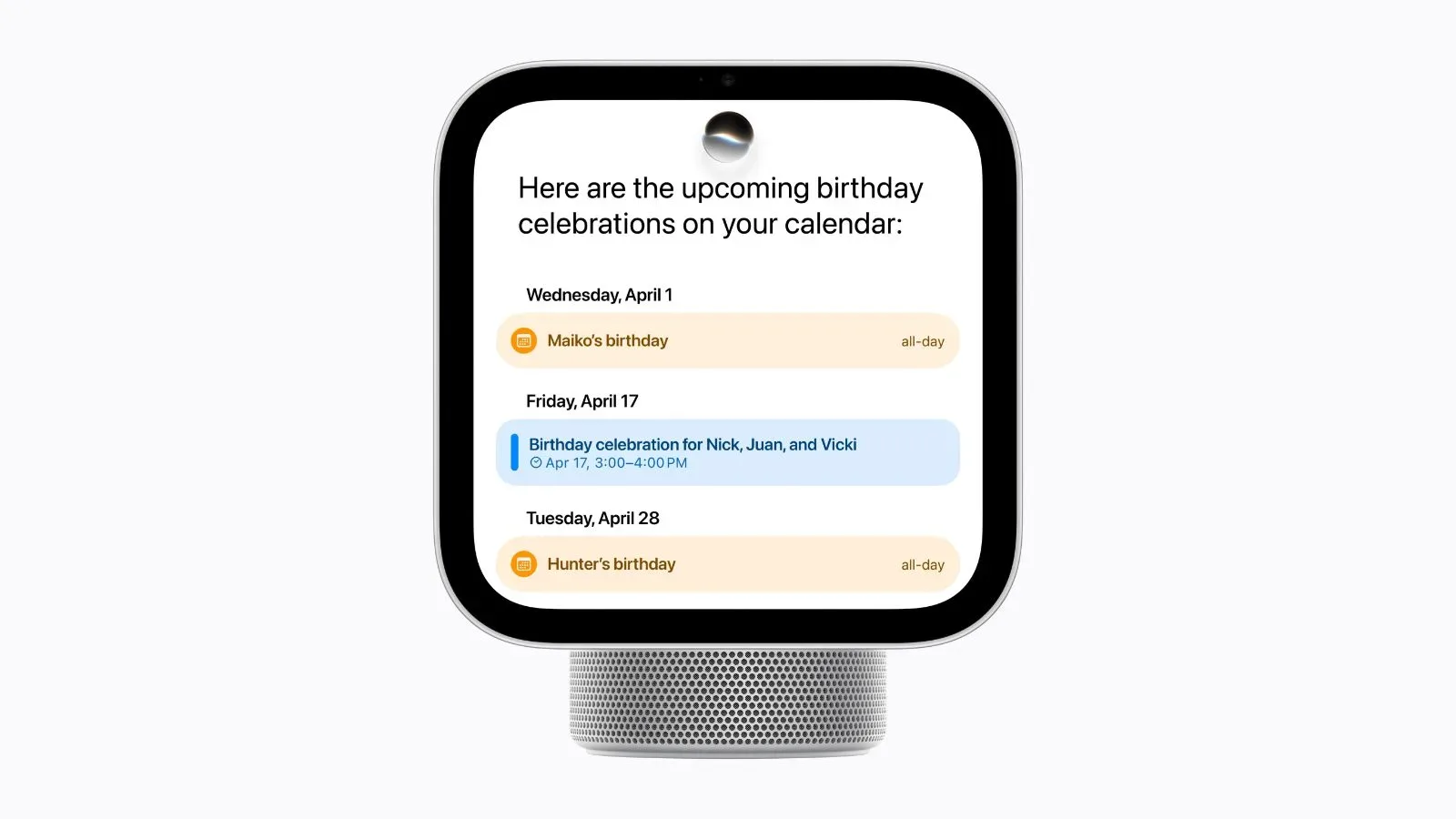
Perhaps the most human example is personal context. Apple says Siri AI can use information from a paired Apple Intelligence-enabled device to locate a recommendation that the viewer remembers only indirectly. Its example is asking to play a show recommended by “Alinda,” without having to recall the title.
Personal context, as described here, is not merely a record of what the Apple TV has played. It is information associated with a paired device that can help turn a partial recollection into an entertainment request. The potential appeal is obvious: recommendations often arrive in messages or conversations, and a remembered name is frequently more useful than a half-remembered show title.
It also makes paired-device status central to this particular convenience. Owners should distinguish between two related claims: compatible Apple TV 4K models are positioned to receive Siri AI with the beta, while personal-context requests specifically rely on an Apple Intelligence-enabled device being paired. The announcement does not detail setup requirements, what information is eligible, or how the assistant resolves ambiguous recommendations. Those are practical questions for anyone deciding whether the feature fits their household and comfort level.
The privacy implications are equally worth considering without assuming details that have not been provided. A request based on a person’s recommendation necessarily involves the system interpreting some information beyond the title itself. Apple has described the feature as drawing from a paired device, but the supplied information does not explain retention, controls or the full processing path. Anyone interested in Apple’s wider home-device approach may also want to read our coverage of Apple HomeView’s privacy pitch around paired devices and isolated processing.
Apple TV’s home-hub role gets more descriptive
The update is not solely about picking a show. Apple Intelligence is also being folded into Apple TV’s function as a home hub. Apple says it will provide descriptions of activity found in HomeKit Secure Video recordings, alongside summarized notifications in the Home app. Siri AI can additionally control compatible smart-home accessories and turn scenes on or off.
A home hub is the part of a connected-home setup that helps coordinate access to compatible accessories and services. Here, the Apple TV’s role is being extended with a layer that attempts to describe recorded camera events and condense alerts. Instead of treating a notification as a bare signal that activity occurred, a summary is intended to communicate the important point more directly.
That could be useful in a living-room setting, where several alerts may otherwise compete for attention. But summaries are interpretations, not raw footage. For anything consequential, a notification should still be treated as a prompt to review the relevant recording or check the situation rather than as a substitute for it. The announced capabilities do not state how much detail descriptions include, nor do they remove the need for compatible HomeKit Secure Video equipment and compatible accessories.
Scene control is the other side of the same idea. In smart-home terminology, a scene is a prearranged set of accessory states that can be activated or deactivated together. Apple says Siri AI can turn compatible accessories and scenes on or off, bringing basic environmental control into the same voice interface used for entertainment. That creates a potentially neat living-room workflow, but compatibility remains the key qualifier: Apple’s statement applies to accessories that support the relevant system.
Compatibility, beta status and the new Apple TV 4K
Siri AI is slated to arrive in beta with tvOS 27.2 and requires a second-generation Apple TV 4K or a later model. That compatibility note is significant for existing owners: the announced software features are not confined to the fourth-generation Apple TV 4K.
Beta software is a pre-release version made available before a final public release. In practical terms, that label is a reminder that features may evolve and that behavior may not yet be as polished or predictable as it will be later. It is also sensible to separate a beta availability statement from a promise that every announced function will perform identically in every home on day one.
Apple has also opened preorders in the United States for the fourth-generation Apple TV 4K at $299, with availability beginning November 13. The supplied details identify the model, price, country and availability date, but do not set out its complete technical specifications. Shoppers should therefore avoid inferring unannounced hardware features from the AI news alone. The clearest decision point currently is simpler: current owners with a second-generation Apple TV 4K or newer are included in the stated compatibility range, while people considering the new unit know its U.S. preorder price and planned arrival date.
What will determine whether this is a meaningful upgrade
Apple’s announcement frames the Apple TV as a place where an assistant can bridge entertainment and the home. The strongest use cases are also the most concrete: asking for a program through a half-remembered recommendation, checking a quick fact without leaving playback, discovering shows through a more natural question, and receiving a concise description of a camera event.
The trade-off is that each of those tasks depends on accurate interpretation. Search needs to return relevant results; personal context needs to connect the right recommendation to the right title; playback answers need to be concise and appropriate; and camera summaries need to be useful enough to help without overstating what happened. The new interface and the ability to ask follow-ups may reduce friction, but they do not automatically guarantee good answers.
For now, tvOS 27.2 is best understood as a beta-era expansion of what Apple TV can be asked to do. It places Siri AI at the center of discovery, viewing context and home control, while leaving a number of real-world details—especially the limits of app actions, personal context and camera summaries—to be clarified through the rollout. For compatible Apple TV 4K owners, the important fact is that the door is open without an automatic hardware replacement. For everyone else, the useful question is not whether the screen now has AI, but whether its answers make the remote feel meaningfully less necessary.