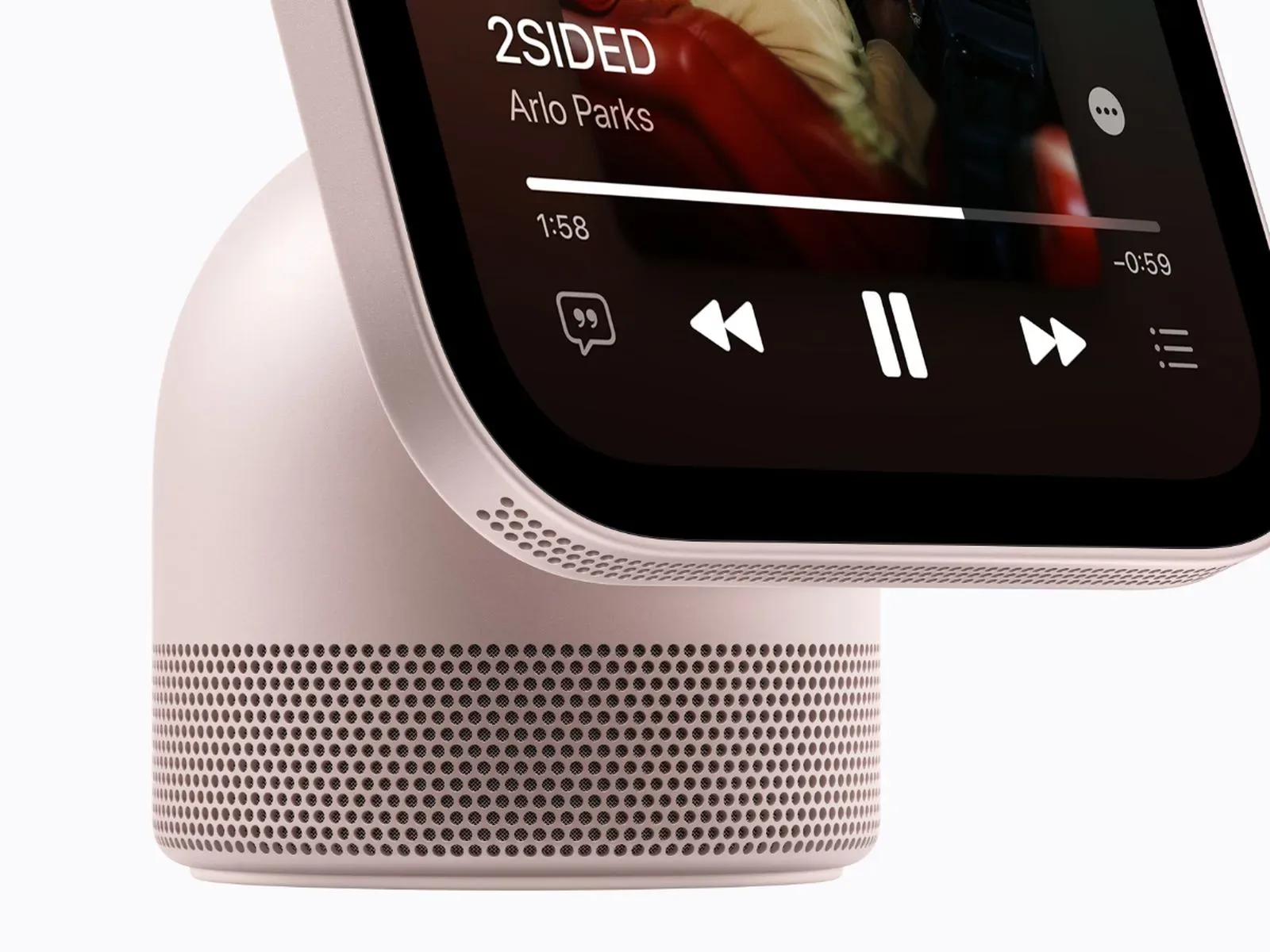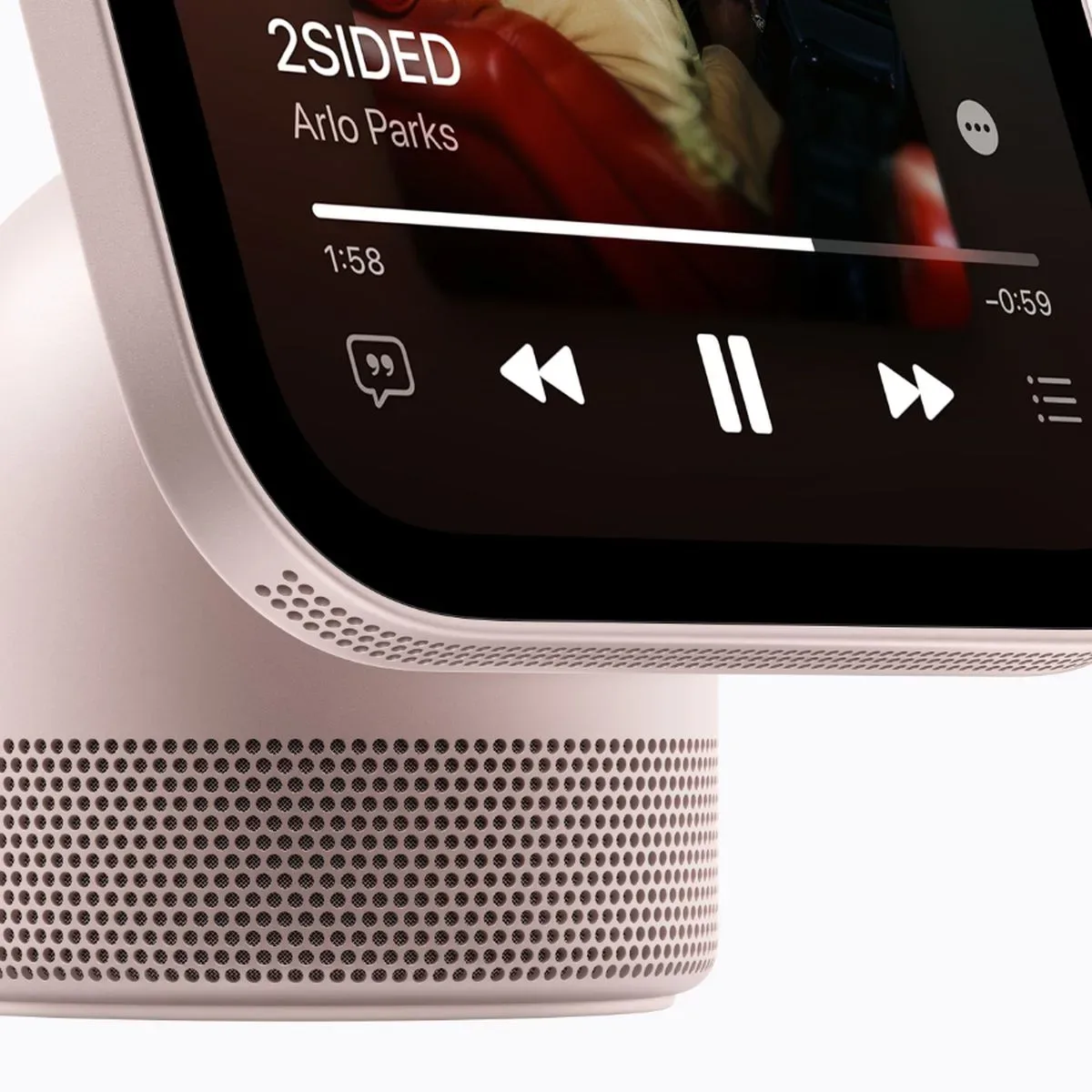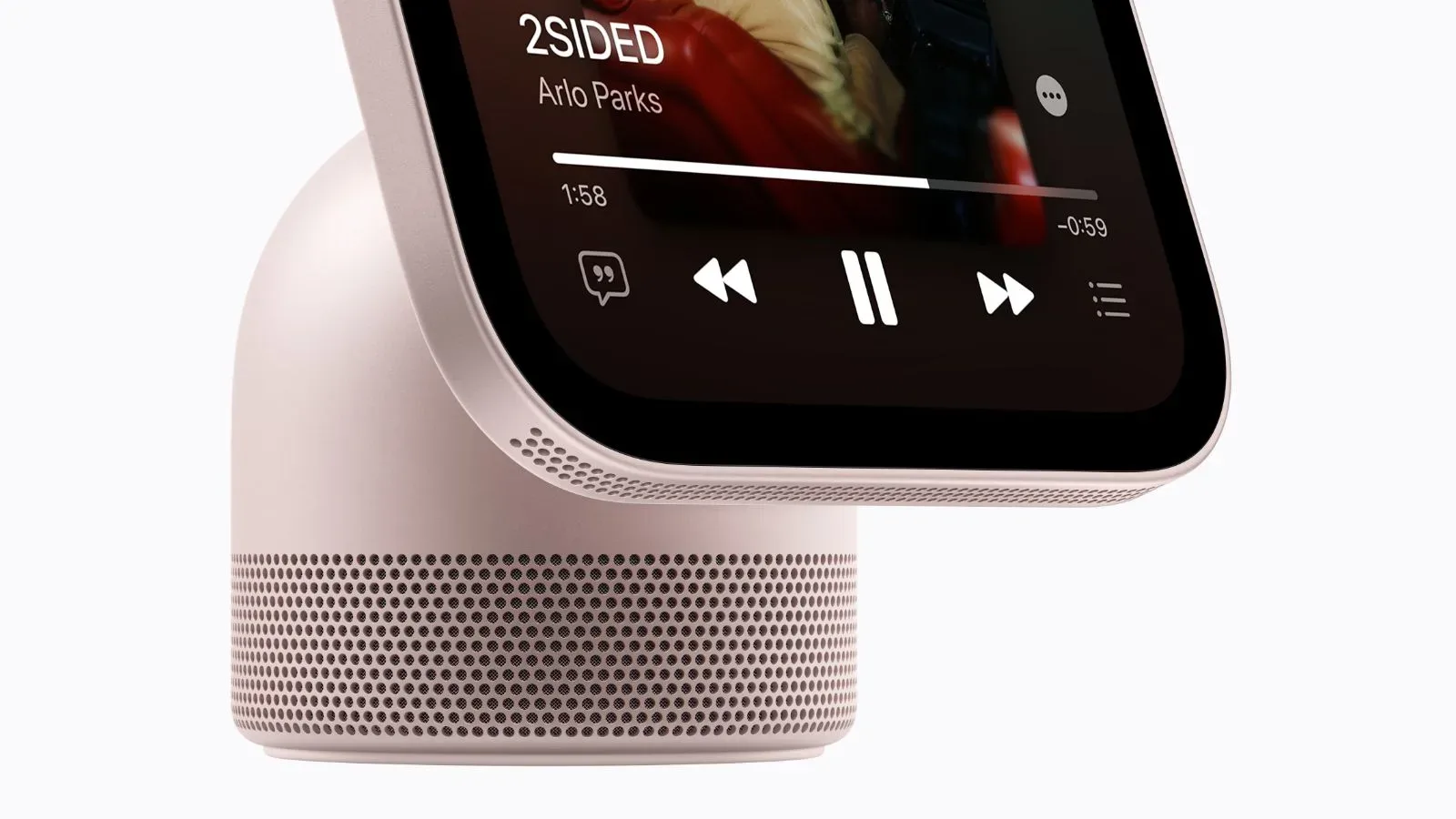
Apple’s HomeView is arriving in two physical forms, and the difference is not merely whether the display sits on a surface or hangs on a wall. The company has outlined two distinct audio systems: both models offer Spatial Audio, computational audio processing and a four-microphone array, but the tabletop HomeView receives substantially more dedicated speaker hardware.
That split makes practical sense. A tabletop device has a base that can house larger acoustic components and use the furniture beneath it as part of the listening environment. A wall-mounted display does not have that volume available, and it must account for its close proximity to a flat surface. Apple’s response is a model-specific design rather than an identical speaker setup shoehorned into two enclosures.
Both versions are scheduled to launch on November 13 in the United States at $299. For buyers deciding between them, the audio distinction is one of the clearest functional differences currently described. The tabletop model appears designed to deliver more low-end output, while the wall-mounted version prioritizes tuning appropriate to where it lives.
What is inside the tabletop HomeView
The tabletop HomeView distributes its audio components across the display and its domed stand. The display contains two custom full-range drivers. In speaker terms, a full-range driver is designed to reproduce a broad span of audible frequencies from a single unit, rather than handling only a narrow band such as bass or treble.
The domed base contributes the hardware that separates the tabletop model from its wall-mounted sibling: a down-firing woofer and two force-canceling passive radiators.
- Woofer: A speaker driver intended to reproduce low frequencies. The down-firing orientation means it projects toward the surface beneath the unit rather than directly at the listener.
- Passive radiator: A non-powered diaphragm that moves in response to air pressure inside the enclosure. It can help reinforce bass response without serving as an additional powered driver.
- Force-canceling: A design approach intended to offset opposing mechanical forces created when speaker parts move. In a compact tabletop device, limiting unwanted vibration can matter because the unit sits directly on furniture.
Apple says the arrangement is meant to produce clear audio with extended bass. “Extended bass” does not establish a particular frequency range, loudness level or room-filling capability, and no comparative performance measurements have been provided. It does, however, plainly describe the goal of adding the woofer and radiators: give the tabletop unit more support at the low end than the two display-mounted drivers alone would provide.
For a device likely to handle spoken requests, calls and general audio in shared home spaces, that physical division of labor is notable. Speech intelligibility depends heavily on the midrange frequencies handled by the full-range drivers, while bass components can make music, effects and other low-frequency material sound less thin. Apple has not made a claim about the tabletop HomeView replacing a dedicated speaker system, so it would be premature to frame it that way. The more grounded reading is that the stand is serving as usable acoustic volume rather than just structural support.
The wall-mounted model takes a different route
The wall-mounted HomeView also contains two custom drivers and supports Spatial Audio, but it does not include the tabletop model’s woofer or pair of passive radiators in a domed base. Instead, Apple says its computational audio is specifically tuned for wall installation.
That distinction is important because placement changes what listeners hear. A tabletop unit has open space around and beneath it, while a wall-mounted device sits against a nearby boundary. Reflections from that surface can affect the perceived balance of sound. Apple’s stated approach is not to pretend the wall model has the same physical layout as the tabletop product; it is to tune the processing for the realities of wall placement.
There is no indication that the wall model lacks Spatial Audio, microphone functionality or computational audio. It has all three. What it lacks is the added bass-focused hardware housed in the tabletop base. Buyers who value a flush, permanent display installation are therefore not giving up the core audio feature set, but they should understand that the two products are not acoustically identical.
Physical speaker volume and software tuning are related but not interchangeable. Tuning can adjust how a system behaves within its available limits. It cannot add the tabletop model’s actual woofer or passive radiators to the wall model. Conversely, hardware alone is not the whole story, since both HomeView designs also use ongoing processing to alter their output.
Computational audio, explained
Apple says HomeView’s A18 chip and built-in sensors enable computational audio that continually adjusts loudness and bass response. Computational audio is a broad term for using processing and sensor input to shape how audio is played back, instead of treating the speaker system as a fixed setup with a single static sound profile.
Here, the company’s stated aim is consistent, balanced audio at different volume levels. That matters because speakers can sound different as volume changes. A setting that feels balanced at one level may not preserve the same perceived weight or clarity at another. Apple says the HomeView adjusts loudness and bass response continuously to address that issue.
The word “continuously” is meaningful in context: this is presented as an active system rather than a one-time preset selected during setup. Still, Apple has not detailed which sensors are used for which adjustments, how users can control the processing, or whether it measures room acoustics. Those are open questions, and they should not be assumed from the general description.
The A18 chip’s involvement also signals that HomeView’s sound behavior is tied to on-device processing, not only its drivers and enclosure. For the tabletop model, that processing works alongside the display drivers, woofer and passive radiators. For the wall-mounted model, the tuning is specifically aimed at compensating for or working with its installation environment. In each case, Apple is describing hardware and software as a combined audio system.
HomeView’s hardware discussion follows other attention paid to the device’s room-oriented design, including its unusually dim display capability for bedroom use. The HomeView display’s 0.3-nit mode is another example of Apple describing the product around household placement and comfort rather than raw specification-sheet bragging rights.
Spatial Audio is shared, but exact behavior is still unclear
Spatial Audio is available on both HomeView models. In general terms, Spatial Audio refers to playback intended to create a sense that sound has position or space rather than coming from one undifferentiated point. Its effectiveness can depend on the audio itself, the speaker configuration and the listener’s position in a room.
Apple has not provided further detail here on supported content types, specific listening modes or how Spatial Audio will differ between the tabletop and wall-mounted models. It also has not said that the tabletop device’s additional bass hardware changes the Spatial Audio feature itself. The confirmed point is narrower: both models support it, despite their different speaker layouts.
That matters for buyers who need the wall-mounted form factor. The lower-profile model is not presented as a basic display with audio treated as an afterthought. It retains the same named spatial playback capability and its own placement-specific computational tuning. The tabletop unit’s advantage is in the additional physical speaker assembly, especially for bass, not exclusive access to the headline audio feature.
Four beamforming microphones serve voice and calls
HomeView includes four beamforming microphones for Siri requests and FaceTime calls. Beamforming is a microphone-array technique that uses multiple microphones to emphasize sound arriving from a desired direction while reducing other ambient noise. In a home device, the practical goal is straightforward: make a person’s voice easier for the system to isolate at a distance.
Apple says the four-microphone array can hear voices from across a room while reducing background noise. That is a company claim rather than an independently measured distance or noise-reduction rating, and no specific range has been shared. Nevertheless, it identifies the intended use case clearly: HomeView is meant to accept voice requests without requiring a user to stand close to the display, and to support FaceTime calls from a room-scale position.
It is also worth separating the microphone system from speaker playback. The microphone array concerns how HomeView captures voices for Siri and FaceTime; the drivers, woofer and radiators concern how HomeView produces sound. Both influence communication, but they solve different problems. A call can benefit from clearer incoming audio and from better pickup of the caller’s voice, and Apple is addressing both sides with separate hardware and processing.
What the configuration means for prospective buyers
With the same listed U.S. price and launch date, form factor is likely to be the starting point: tabletop placement for one model, wall installation for the other. But the audio design gives that decision more weight than a simple mounting preference.
The tabletop model is the more hardware-heavy option. Its two full-range display drivers are paired with a down-firing woofer and two force-canceling passive radiators in the base. Apple specifically connects that configuration with clearer audio and more extended bass. Anyone for whom fuller low-frequency sound is a priority has a concrete reason to look closely at the tabletop design.
The wall-mounted model makes a different trade-off. It keeps two custom drivers, Spatial Audio, four beamforming microphones and computational audio, while omitting the tabletop unit’s base-mounted components. Its processing is tuned for wall placement, which is the relevant design priority for a display intended to live against a wall rather than on furniture.
Neither description establishes a universal winner. Room size, mounting preference, typical volume and whether music listening matters more than calls or voice control will all shape the practical choice. What is confirmed is that Apple has not treated the two HomeView models as acoustically interchangeable. The tabletop device uses its base to add physical bass hardware; the wall-mounted device relies on a simpler driver arrangement with placement-aware computation.
That is a more useful comparison than reducing the decision to “screen on a stand” versus “screen on a wall.” HomeView’s audio architecture is part of the product split from the start, even as the shared A18-powered processing, Spatial Audio support and four-microphone setup keep the two models aligned on their central home-display role.