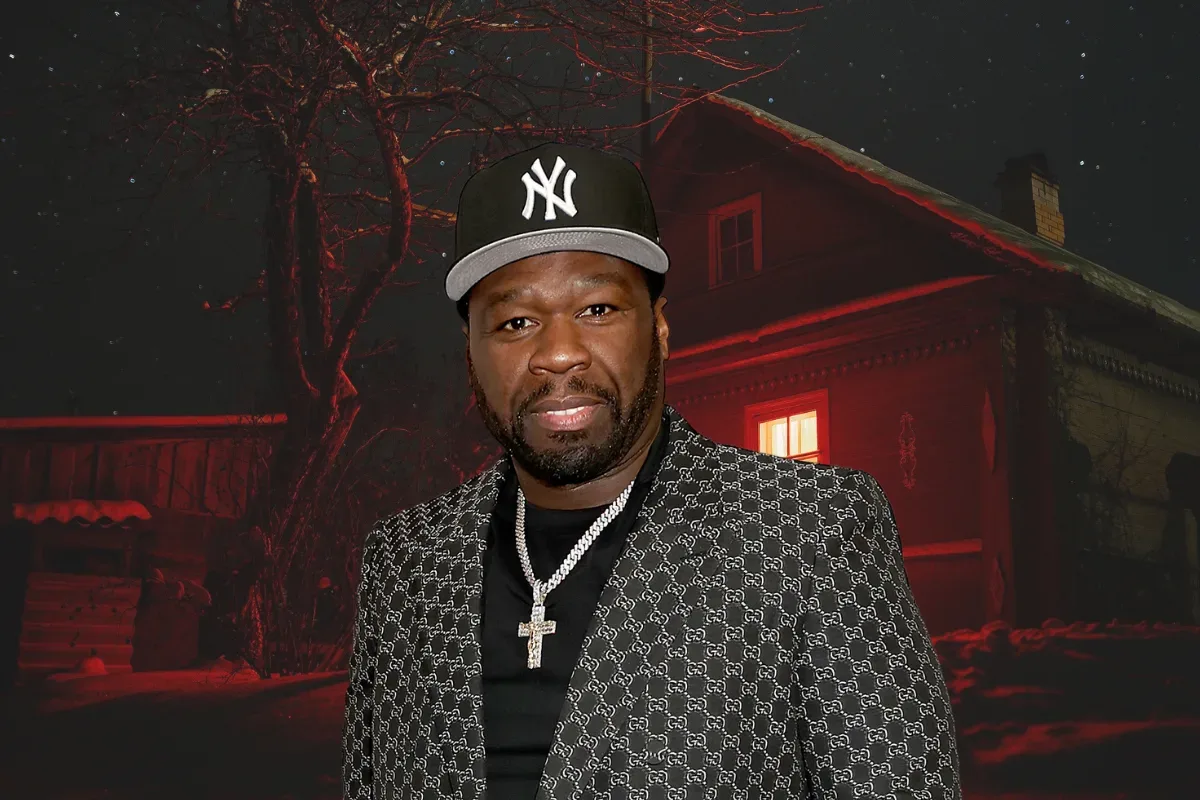
Sometimes a local-development disagreement stays where it belongs: in columns, planning documents, council discussions, and the deeply unglamorous world of temporary fencing. This was not one of those times.
50 Cent, whose legal name is Curtis Jackson, has answered criticism of alcohol advertising around two downtown Shreveport properties with an intensely personal social-media response aimed at former lawyer John Settle. The initial question concerned promotional banners for Jackson’s Branson Cognac and Le Chemin du Roi brands. But the exchange has landed amid a much wider and more consequential story: G-Unit’s proposed entertainment investment in Shreveport, which is expected to involve $74 million from G-Unit and $50 million from Louisiana across three venues.
That makes this more than a feud over fence copy. It is a collision between public-facing brand promotion, civic expectations, the sometimes messy pace of redevelopment, and an entertainer whose approach to online criticism has rarely involved a politely formatted rebuttal.
The disagreement began with temporary fence advertising
Settle questioned whether ads for Branson Cognac and Le Chemin du Roi were appropriate on temporary fencing placed around two downtown properties. His argument, as described in his column, distinguished between local rules governing development and the messages appearing on construction fencing. He suggested local development regulations did not necessarily control those signs, while federal restrictions on alcohol advertising could still be relevant.
Yet the sharper portion of his criticism was not presented as a narrow legal argument about a cognac logo beside a work site. Settle focused on the visible progress of Jackson’s downtown initiatives, contrasting major rhetoric about an entertainment and jobs hub with what he characterized as insufficient action at G-Unit Studios, Expo Hall, and other properties acquired downtown.
It is a familiar tension in redevelopment coverage. Announcements and early-stage commitments can create enormous expectations, particularly when a nationally known figure is involved. Residents and observers may reasonably ask when plans move from press-friendly ambition to construction, operations, programming, and jobs. At the same time, venue developments are not quick-save files. Financing, zoning, design, infrastructure, state partnerships, procurement, and construction all tend to stretch timelines well past the first burst of attention.
For an entertainment project, the gap between the initial promise and the finished space can be especially conspicuous. A studio, soundstage, arena-style facility, or mixed-use production site has to be more than a sign, a render, or a social post. It needs functional spaces, production systems, reliable local partners, and enough scheduled activity to justify the investment after opening day.
50 Cent took the argument somewhere else
Jackson did not publicly dwell on the finer distinctions between zoning authority and alcohol-advertising rules. Instead, he addressed Settle directly in an Instagram post that referenced Settle’s prior solicitation cases, asked whether repeated arrests for soliciting prostitution were acceptable, and tagged the two alcohol brands.
He then shared mugshots of Settle, added a Colonel Sanders image, and followed with an invitation to dinner framed in a deliberately threatening-comic style: Jackson said he would like to be friends and suggested that, with so many enemies already, another enemy would not mean much.
The posts fit a public persona built in part on confrontation, fast replies, and a willingness to turn critics into the subject of the next joke. That approach creates immediate attention, but it also shifts the core issue. A civic debate over signage, project delivery, and local priorities becomes a personal spectacle. The original questions do not disappear; they simply have to compete with the much louder machinery of social media.
The history cited in the posts is not merely rumor. Settle was convicted of solicitation following a January 10, 2025 arrest in a hotel sting, according to local television reporting. Shreveport police said nine arrests resulted from that operation. Separate local reporting also said Settle pleaded guilty after another arrest in March 2019. Those facts provide context for why Jackson chose that line of attack, but they do not resolve the separate questions Settle raised about advertisements or redevelopment activity.
The larger story is Shreveport’s production infrastructure
Behind the online clash sits the G-Unit expansion itself. The plan calls for a combined $124 million commitment: $74 million from G-Unit alongside a $50 million state contribution. The money is intended to cover three entertainment venues, including improvements to G-Unit Studios and Stageworks, plus a permanent G-Dome.
The initiative is expected to include production targets over a five-year period. Specific long-term results, naturally, remain dependent on execution. A project’s value is not proved by its announced total alone; it is measured over time through work completed, productions booked, durable employment, vendor spending, training opportunities, and whether the facilities serve a consistent creative pipeline.
Still, the scale matters. Entertainment infrastructure can have effects far beyond a single performer’s brand. A fully operating studio ecosystem can bring together camera and lighting crews, carpentry and set construction, costume and makeup work, transportation, catering, security, location services, post-production, hospitality, and local small businesses. The strongest version of the pitch is not simply “a famous person owns a building.” It is “a working facility creates repeat reasons for productions and workers to stay in the area.”
There is a gaming-world parallel here, even if this specific development is focused on film and entertainment venues rather than a game studio. Cities increasingly compete to become places where creative work can happen repeatedly, not just destinations for one splashy event. Soundstages, motion-capture spaces, digital-production facilities, conventions, esports programming, and immersive-media installations all benefit from the same basics: capable venues, a skilled workforce, predictable support, and a calendar that keeps the lights on.
That broader convergence is visible in projects experimenting with immersive formats and shared digital experiences, including the industry trends covered in Venice Immersive’s recent push toward shared spaces, smart glasses and more ambitious storytelling. Shreveport’s proposal is not interchangeable with an XR showcase, but both point to the same larger reality: entertainment development increasingly depends on physical places built to support changing forms of production and audience engagement.
The G-Dome has moved beyond the abstract stage
The most concrete update in this story is the G-Dome’s June 17 groundbreaking in downtown Shreveport. The event occurred nearly five months after the proposed venue received zoning approval. That is an important marker after earlier questions over when the expansion would visibly advance.
A groundbreaking is not the same thing as a completed venue, and it should not be treated as proof that every projected outcome is guaranteed. It does, however, move a proposal out of a purely conceptual phase. For critics asking whether development would begin, construction activity is a more meaningful answer than a slogan. For supporters, it is the first checkpoint rather than the finish line.
The G-Dome, G-Unit Studios, and Stageworks will now be judged in practical terms. How quickly does work progress? What does the finished capacity look like? Which kinds of productions or events use the facilities? What local hiring and economic activity emerge? How transparent are timelines and commitments? Those are the questions that determine whether the $124 million framework becomes a significant regional entertainment engine or an expensive headline waiting for its second act.
Why fence ads became a useful flashpoint
Temporary fencing is a strange but effective symbol for this dispute. It can advertise a product, obscure an inactive lot, signal incoming construction, or remind everyone that a project remains unfinished. In this case, the banners combined Jackson’s liquor brands with the visual footprint of downtown redevelopment. That naturally invited debate about messaging, tone, and the difference between a personal brand campaign and a civic revitalization effort.
Settle’s criticism argued that the ads sent a negative message to many observers. Jackson’s reaction made clear that he regarded the critic, rather than the critique, as the more interesting target. Neither response changes the fundamental standard by which the development will be evaluated: delivery.
If the planned venues open, attract ongoing productions, and generate the employment and economic activity envisioned by their backers, the fence controversy will likely become a very small footnote. If progress stalls, every banner, post, and promise will receive renewed scrutiny. That is the deal any high-profile development makes with a city: publicity creates momentum, but results settle the scoreboard.
For now, Shreveport has both a public spat and a major entertainment buildout to watch. The social-media exchange may generate the noisier headlines, but the meaningful story will unfold in permits, construction updates, operating schedules, and the work eventually produced inside the buildings.