Final Fantasy XIV: Evercold is shaping up to be an unusually systems-focused expansion. It is currently expected in January 2027, with Final Fantasy XIV Fan Fest Tokyo positioned to provide further major details before launch. What has been outlined so far touches nearly every layer of the MMO experience: combat roles, character appearance, main-story structure, endgame gearing, and the composition of dungeon parties.
That breadth is important. Expansions often add places to go and stories to complete, but Evercold’s announced direction also asks how players move through that content, how much repetition is required to maintain several jobs, and how distinctly each job should play. Several specifics still await clarification, particularly the second new job and the full scope of the combat redesign. Still, the early picture is clear: Evercold is intended to offer more player choice while reducing a few long-standing points of friction.
Two new jobs, with bastion leading the way
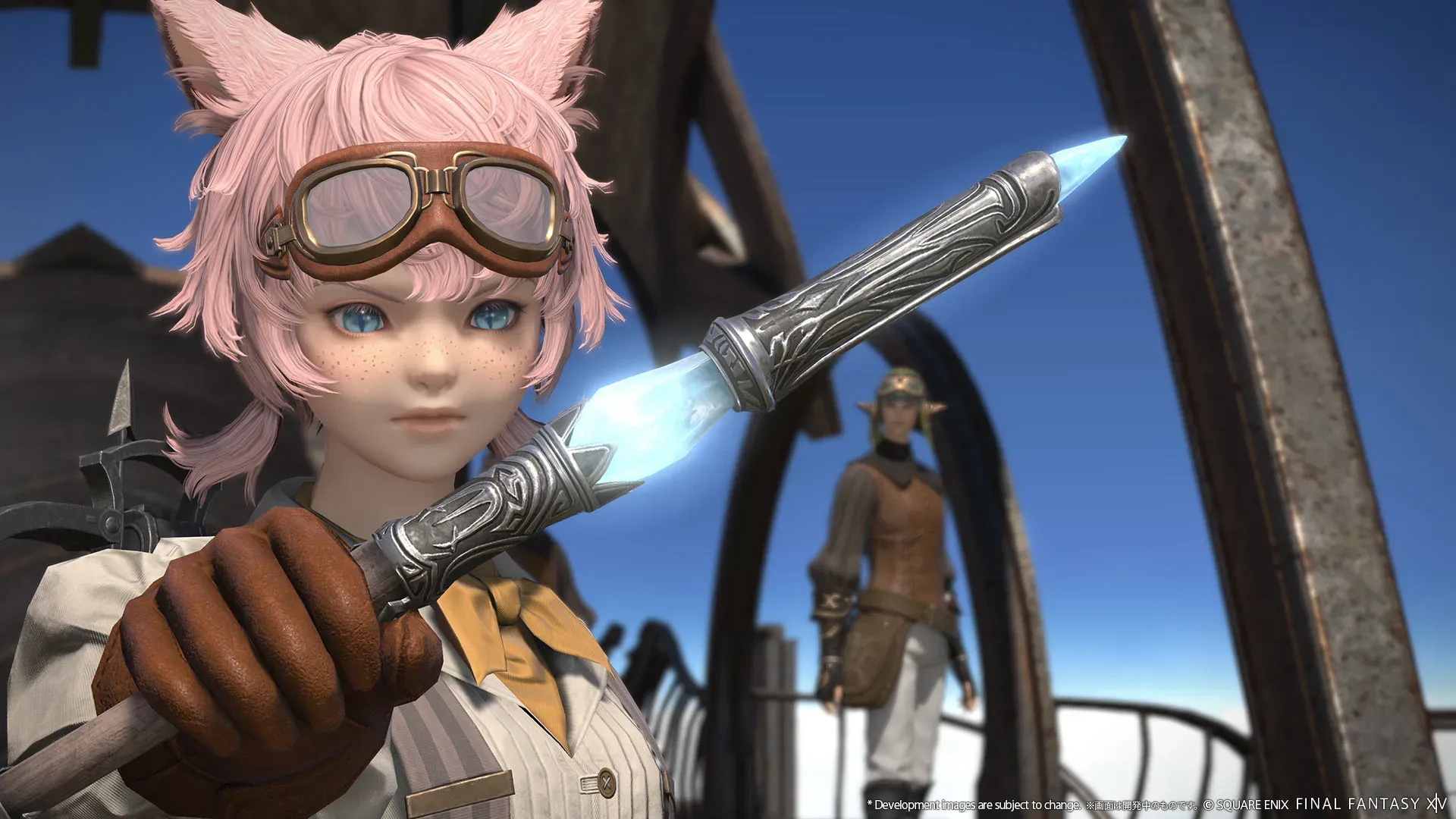
Evercold will add two jobs. The first revealed job is bastion, a tank that uses a weapon called the skyltborg. The name reflects an unusual hybrid concept: it is effectively a gunshield with a blade. Its showcased toolkit includes large defensive shields, ranged aether-fire attacks, and close-range strikes.
In MMO terminology, a tank is the party member designed to withstand enemy attacks and manage foes’ attention, allowing more fragile allies to operate safely. Bastion’s weapon and attack presentation make it visually broader than a purely defensive archetype, but its stated role remains tanking. The early material therefore points to a job whose identity is built around switching naturally between defense, ranged pressure, and melee engagement rather than treating those ideas as separate disciplines.
For more context, explore Night of the Idle Horde PC Design Feature: Can a Zombie Army Make Idling Feel Monstrous?.
The second job has not been officially identified. What is known is that it will fill a ranged physical damage role. This means damage delivered from range by a non-magical, weapon-oriented job rather than a caster. Community speculation has focused on a crossbow, but that remains theory, not confirmation. Until the job’s weapon, name, and mechanics are formally detailed, players should treat any specific crossbow expectation as provisional.
The addition of a new tank and a new ranged physical damage dealer has practical implications for players who enjoy role flexibility. It creates two new playstyles to level, gear, and learn—although Evercold’s planned equipment changes are also designed to make that broader job roster less punishing to maintain.
Character customization reaches beyond the character creator
Evercold’s customization plans extend both the appearance editor and certain visible actions. New options include changes to Au Ra horns, nose shading, face paint, and freely chosen colors for eyes, hair, and skin tones.
These additions matter because they offer finer control over an established character rather than merely adding a new outfit. Au Ra horn choices in particular affect a highly recognizable part of that race’s silhouette, while custom color selection offers a more exact way to create a desired look than relying only on a limited set of preset swatches. Face paint and nose shading, meanwhile, add small-scale facial detail that can be especially meaningful in a game where players spend years with a single avatar.
Evercold also plans customization for animations, including a player’s teleport spell and other job-specific actions. This is a distinct category from glamour, the term commonly used for visual gear presentation. Gear glamour changes what a character wears; animation customization changes some of the visual flourish of what the character does. The difference may sound cosmetic, but repeated actions such as teleporting are seen constantly across a long-running MMO. Giving players options there turns an everyday utility action into another expression of character identity.
Branching main-story progression, not necessarily a wholly separate story
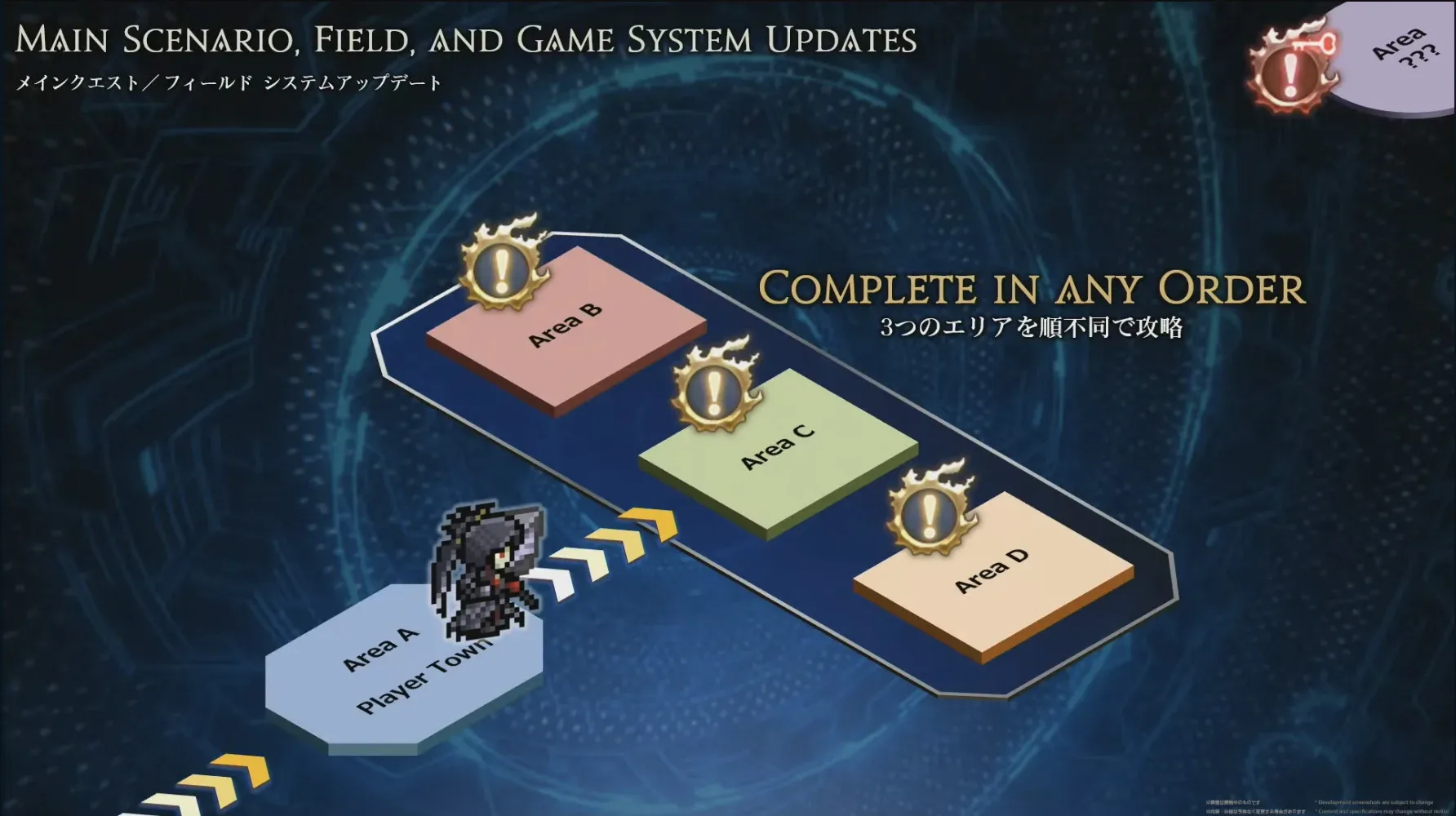
The main story quest, often shortened to MSQ, is set to become less linear in Evercold. Players will be able to choose where to proceed next at certain points, and NPC conversations will reflect the choices that have been made.
The example provided is straightforward: after completing one area, a player can choose from three other areas and approach them in any order. Each chosen area will automatically adjust its content to the player’s level, keeping progression workable regardless of which branch comes first.
This does not establish that Evercold will have permanently divergent campaigns or mutually exclusive endings. The announced information supports choice in route and sequence, plus responsive dialogue, rather than a guarantee that every choice creates an entirely different narrative outcome. That distinction is useful for expectations. The significant change is that the MSQ will no longer require every player to move through the same locations in one fixed order.
Level balancing is central to making that structure function. If players can select different regions but the content remains calibrated to their current level, none of those routes should become a clearly “wrong” pick simply because it was visited before another one. It also lets friends compare experiences that may have unfolded in different sequences, even while playing through the same broader expansion.
Combat’s “evolved” and “reborn” paths
Evercold will introduce an evolved combat system intended to restore more individual identity to jobs while streamlining their abilities. The issue being addressed is a perception that jobs within broad roles—tanks, melee damage dealers, ranged damage dealers, and healers—can feel too similar in their foundational actions, even when their visual effects and flavor differ.
Streamlining generally means reducing unnecessary action bloat: too many buttons, overlapping tools, or lengthy rotations that newcomers must memorize before they can feel comfortable. A rotation is the repeatable sequence or priority order of abilities used to perform effectively in battle. Reducing complexity does not automatically mean making combat shallow; in principle, it can mean shifting attention from memorizing redundant inputs toward choices that better express a job’s own mechanics. Whether that balance is achieved will depend on the full job-by-job implementations, which have not all been shown.
Players accustomed to the existing approach will have an alternative. Final Fantasy XIV will retain the older combat format through a reborn mode. That is a major accommodation in an MMO, where large combat revisions can otherwise leave longtime players feeling that a familiar role has been replaced overnight.
The two-mode approach suggests Evercold is not simply declaring one group’s preferred combat language obsolete. Evolved mode is framed as a route to greater differentiation and easier onboarding, while reborn mode preserves established habits. The unanswered question is how broadly the two approaches will differ in practice, and how each job’s new combinations and abilities will be expressed. More complete details will be necessary before players can judge the impact on their main job.
Weekly activity points aim to loosen the endgame schedule
Evercold also plans to change a familiar endgame loop. At present, players seeking higher-level gear use daily quests to build the currency required for it. The expansion will replace that arrangement with a weekly structure: players select quests to complete on their own schedule, earn activity points, and use those points to obtain higher-level equipment.
The core reward path—doing activities to earn currency for gear—remains. The adjustment is about time pressure. Daily systems create a recurring check-in expectation; missing a day can feel like losing progress. A weekly selection system should give players more discretion over when they play while still retaining a defined progression track.
This may be particularly helpful for anyone who plays in longer sessions on only a few days each week. Instead of needing to log in around a daily timetable, those players can choose qualifying quests when their time permits. The exact number of quests, point requirements, and available activities have not been specified, so it is too early to measure how demanding the replacement system will be. But the stated goal is plainly to make the gear chase less of a daily obligation.
Gear reflection could make alt jobs easier to sustain
A separate change addresses players who maintain several maximum-level jobs. Different jobs normally require different equipment sets, which can turn a desire to switch roles into another lengthy gear climb. Evercold’s planned gear reflection system will allow the highest item level owned by a player to be reflected to other max-level jobs.
Item level is a measure used to indicate the overall tier of equipment. Reflecting the highest owned item level to other eligible jobs should make it easier to bring a second or third role closer to baseline endgame readiness without rebuilding the entire foundation of their gear from scratch.
The system has a clear limit: it will not copy additional enhancements such as materia. Materia is used for further gear enhancement, and Evercold will still require players to pursue that optimization separately. That preserves a distinction between getting an alternate job sufficiently equipped to participate and completing a fully optimized best-in-slot setup.
For practical planning, this means players interested in bastion, the unannounced ranged job, or any existing alternate role may have less reason to feel locked into one job by gear maintenance alone. It does not eliminate progression, but it can reduce duplicated progression at the item-level stage.
Chocobos can finally fill dungeon party slots
Perhaps the most immediately social change is an upgrade to the companion system. Chocobos will be able to enter dungeons as combat party members. The stated example is a two-player group whose two chocobos occupy the remaining two party slots.
Traditionally, entering a dungeon requires waiting for the duty finder to assemble a party. A duty finder queue is the matchmaking wait while the game seeks the required roles and players. Letting companion chocobos join dungeon groups could provide a practical option for a pair of friends who would rather begin with their trusted birds than wait for a full human party.
This feature is not merely a cosmetic companion expansion. The chocobos are intended to count as combat-capable party members, changing how small groups can approach dungeons. Important particulars—such as the companions’ available roles, how they behave during mechanics, and what dungeon limitations might apply—have not yet been detailed. Still, the headline implication is substantial: the game is opening a route to dungeon runs that needs fewer people at the starting line.
Between flexible MSQ ordering, a less rigid weekly reward structure, reflected item levels, and chocobo-supported parties, Evercold’s throughline is player agency. The expansion will still have plenty left to explain before January 2027, but its announced systems point toward a Final Fantasy XIV that gives players more latitude in how they look, fight, progress, and group up.