Apple is reportedly preparing a new smart-home hub for its “Welcome home” product launch on Tuesday, October 13. If the reports prove accurate, this would be a purpose-built household screen rather than another general-purpose tablet: a compact device intended to sit in a kitchen, bedroom or living room, keep useful information visible, control connected accessories and make Apple’s voice assistant more central to everyday routines.
The important qualifier is that much of the hardware and software picture remains reported rather than officially confirmed. That includes its name, design, final specifications, the existence of two physical versions and the precise scope of its AI features. Even imagery circulating around the device should be treated cautiously if it is based on design reports rather than a finished product.
Still, the reported feature set paints a clear picture of what Apple may be aiming for: a shared, always-available home interface where music, calendars, reminders, cameras, calls and home controls do not require someone to unlock a personal phone or open a laptop.
What is expected on October 13
The new hub is expected to appear as part of Apple’s October 13 “Welcome home” launch. A public reveal may arrive in a press release around 9 a.m. Eastern Time, coinciding with the start of a private experience in New York for invited reporters and content creators. That timing is an expectation, not a confirmed publication schedule, but it suggests the company may be positioning the device as a dedicated home product rather than folding it into a broader phone or computer event.
Reports describe two versions:
- A tabletop model with a speaker base, suited to a counter, bedside table, shelf or desk.
- A wall-mounted model, which could make the device feel more like a fixed household control panel.
That distinction matters because placement changes how people use a screen. A tabletop unit is easier to move and may naturally become a music player, photo display or video-call device. A wall-mounted screen could prioritize quick glances: checking the day’s appointments, turning off lights, viewing a camera or starting a routine on the way out the door. Those use cases are logical implications of the reported designs, rather than confirmed interface behavior.
A small screen designed for the room, not a pocket
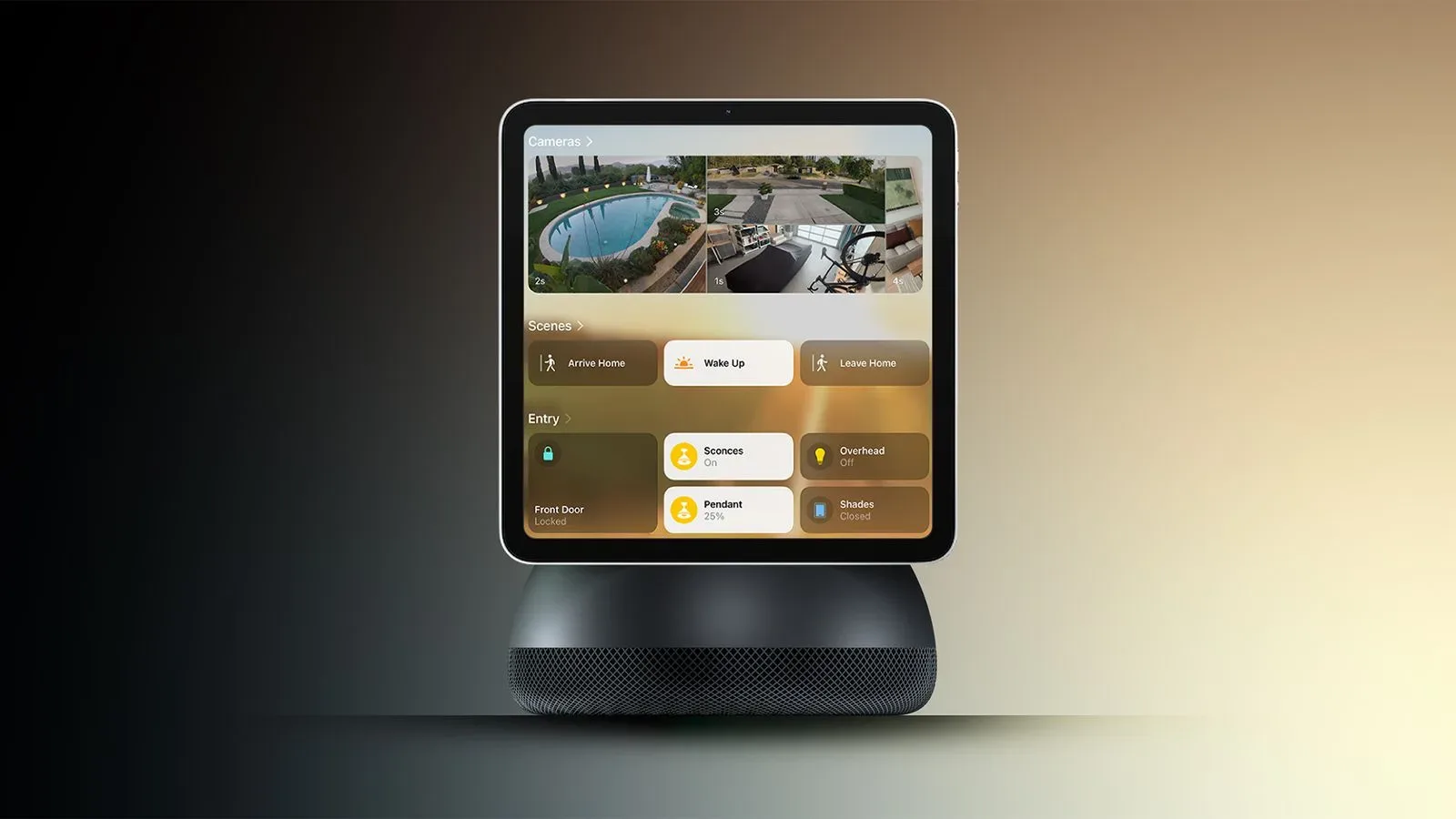
The hub is said to have a square 6-inch display. That would be substantially smaller than the screen many people associate with a tablet, but the reported purpose is different. A fixed smart display has to be readable from nearby and actionable at arm’s length; it does not necessarily need to serve as a handheld work device.
One especially notable reported behavior is an interface that changes the size of its elements when a person approaches or moves away. In practical terms, that could mean larger information for across-the-room viewing and more detailed controls once someone is close enough to interact. The source material does not explain exactly how the hub would detect proximity, which items would change or whether users could configure the effect. The core idea, though, is an interface that recognizes the difference between a glance from several feet away and a direct interaction.
For a household device, that is potentially more significant than simply adding another display. A calendar full of tiny text makes little sense on a kitchen counter if it cannot be read while someone is preparing breakfast. Conversely, oversized controls can waste space when the user is standing right in front of the screen. A responsive layout could help the hub serve both moments, assuming the final implementation is as flexible as the report suggests.
The reported role: Apple Home, security and shared daily information
The hub is said to center on managing smart-home accessories through the Apple Home app. In plain language, a smart-home hub is a central interface for connected household devices. Rather than opening an app on a phone each time, a person could potentially use the dedicated screen to reach lighting, other compatible accessories and home-related settings.
Home security monitoring is also among the reported functions. The preinstalled Camera app suggests cameras may be part of the experience, although the available information does not establish which camera products or security workflows would be supported. It would be premature to assume any specific alerting, recording or monitoring features beyond the broad reported focus on home security.
The rest of the expected software list points toward a communal screen rather than a single-task controller. Reported built-in apps include:
- Calendar
- Camera
- Apple Music
- Apple Podcasts
- Apple News
- Reminders
- Notes
- A new Siri app with Siri AI conversation history
There is a simple thread connecting those apps: they are the kinds of services that can be useful to multiple people passing through the same space. A shared calendar can show what is coming up; reminders can sit where household members will see them; music and podcasts can fill a room; a photo gallery can make the screen useful when nobody is actively controlling something.
Reports also say the device is intended for FaceTime video calls. A stationary screen can be useful here because it reduces the need for one person to hold a phone during a call. But details that would determine how well this works—such as camera placement, video framing, microphone performance and call controls—have not been provided. Those are the kinds of practical details worth watching for at the reveal.
Siri AI appears to be the centerpiece
The hub is reportedly set to use an A18 chip or something newer in support of Apple Intelligence, with Siri AI positioned as a major feature. A chip designation is a description of the device’s processor family; it does not, by itself, reveal how fast or capable the finished hub will be. But the claim suggests Apple expects the device to run AI-oriented Siri features locally or otherwise have the hardware needed for the company’s broader intelligence system.
The most concrete reported software clue is a new Siri app featuring Siri AI conversation history. “Conversation history” suggests the assistant may present previous interactions in an app interface, but the report does not spell out how much context Siri will retain, whether that history is tied to individual users, or what privacy controls will be available. Those questions are particularly important for a device intended to live in a shared family space.
Voice control is a natural fit for a home hub. It can be useful when hands are occupied with cooking, cleaning or carrying something, and it may be quicker than navigating menus for simple tasks. Yet the screen remains essential: it gives people a way to verify what the assistant heard, inspect a camera view, see the current calendar item or choose a control without speaking out loud.
That voice-and-screen combination is also the clearest reason a home hub could be more than a smaller tablet on a stand. The potential value is not raw computing power. It is friction reduction—putting a persistent, shared interface where a household already spends time.
What “homeOS” could mean
Reports say the device could introduce a new operating system potentially called homeOS. An operating system is the foundational software that controls a device and provides the platform for its apps and interface. The name is not confirmed, and Apple could choose another branding approach.
What has been reported is a home-focused visual environment with clock faces, widgets and related features. A widget is a small, glanceable interactive panel that presents focused information or a shortcut—for example, an upcoming appointment, a reminder, a music control or a home accessory control. Clock faces, meanwhile, would support the hub’s likely role as an always-visible room display when it is otherwise idle.
The reported app selection and interface concepts imply a deliberately narrower system than a full personal computer. That is not necessarily a limitation. A device meant to be consulted in seconds benefits from a clear purpose. The unresolved question is whether Apple will keep the platform tightly focused on its own apps and the Home ecosystem, or explain a broader app model. No information provided so far confirms third-party app support.
Multi-user support may be crucial for families
Apple’s reported multi-user support could be one of the defining features. A home hub needs to account for the fact that a kitchen display or living-room controller does not belong to only one person. Family members may have different calendars, reminders, music tastes and communication needs.
The report does not detail how the hub would distinguish people, switch profiles or protect private information. It also does not say whether every app would honor those distinctions. But multi-user support would be a meaningful expectation to test against the eventual announcement. Without it, a shared screen could easily become a display dominated by one person’s account and preferences.
This is where the device’s position in Apple’s wider account ecosystem becomes relevant. Account settings can affect what services, storefronts and content a person sees. For a useful primer on why such changes are more complicated than they first appear, see our look at changing an Apple Account country. The hub itself has not yet been explained in those terms, but shared household access makes account design an issue worth paying attention to.
Name, appearance and missing details are still open questions
“HomePad” is the informal nickname most often attached to the device in reports, reflecting the expectation of a product somewhere between a HomePod and an iPad. It is not established as the retail name. “Apple Home” and “HomeView” are also possibilities raised by the available reporting, with the latter connected to trademark filings that may be related to Apple.
A final name matters less than the product’s everyday execution, but it would signal how Apple wants customers to understand the device. “HomePad” emphasizes a screen; “Apple Home” emphasizes the ecosystem; “HomeView” emphasizes the visual dashboard. Until the company says otherwise, all remain speculative labels.
There are several major unknowns. No price has been provided. No release date has been confirmed. The exact design, speaker capabilities, mounting method, display quality, privacy settings, camera implementation and compatibility rules have not been detailed. The reports also do not establish whether the reported wall-mounted version will launch alongside the tabletop model or follow later.
For now, the most grounded expectation is a compact home display designed around Apple Home controls, shared information, entertainment, FaceTime and a more prominent Siri experience. October 13 should clarify whether Apple’s new device is chiefly a smart-home command center, a family communication screen, a photo-and-media appliance—or an attempt to combine all three in one small square display.