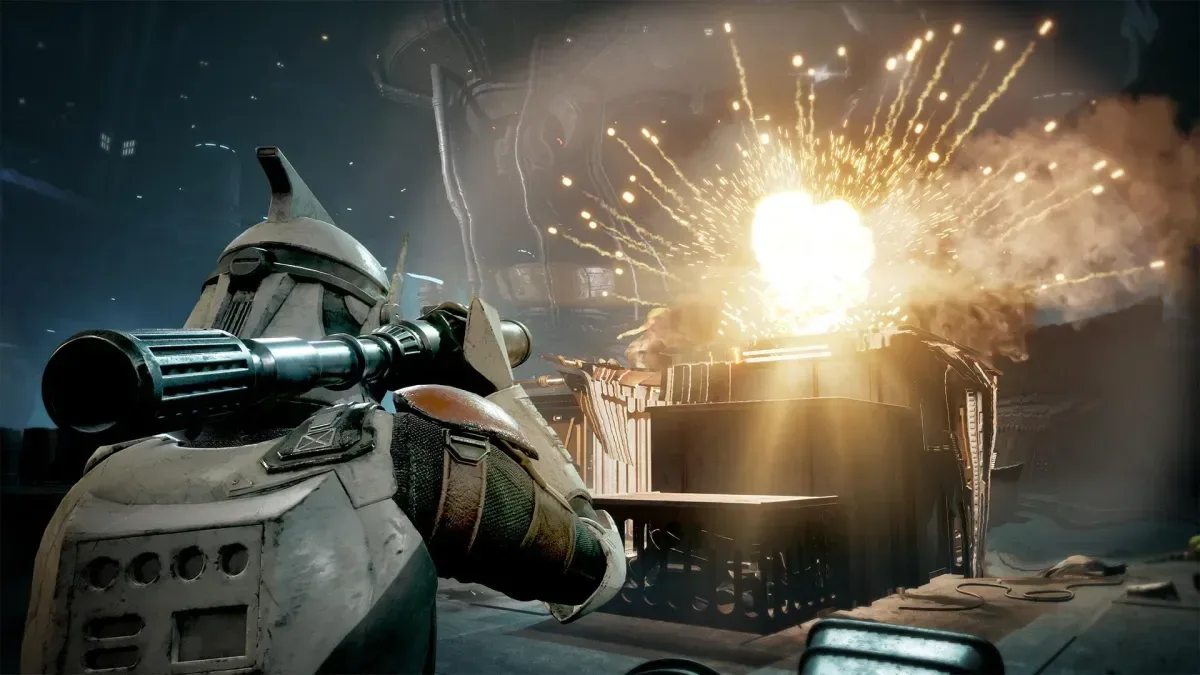
Star Wars Zero Company seems built around a very clear proposition: take a squad of specialists, put them under mounting pressure in the Clone Wars, and make every turn, upgrade and deployment choice matter. Bit Reactor’s game does not hide its tactical lineage; the studio includes former XCOM developers, and the resemblance extends beyond the broad idea of moving a team through turn-based firefights.
That comparison is useful, but it is not the whole picture. The strongest case for Zero Company is not simply that it wears Star Wars armor over familiar systems. Its campaign structure, resource demands and mission setups appear designed to keep the player thinking beyond the immediate shootout. A winning move is not just about landing a shot behind cover. It can be about deciding what to research at headquarters, which part of an enemy force to weaken, where to invest credits, and which problem on the galactic map can wait while another grows more dangerous.
For anyone who enjoys the particular flavor of tactical dread created by a well-run squad game—the feeling that the battlefield is only one part of a larger machine—that is an encouraging foundation. The caveat is equally clear: the story surrounding that machine reportedly has less force than the game’s tactical core.
A mercenary unit in the Clone Wars
The title refers to the mercenary outfit at the center of the campaign. Hawks, a former captain in the Galactic Republic military, leads Zero Company after leaving service in the wake of a mission that went badly. The team is struggling to get by when Republican Intelligence officer Bennic Halloren turns to them for help investigating the Coil, a cult whose influence is spreading across the galaxy.
It is a premise with useful Star Wars ingredients. The Clone Wars is a period full of divided loyalties, militarized bureaucracy and worlds caught between huge institutions, so a freelance crew can occupy a compelling space between the Republic’s official power and its blind spots. The Coil also provides an adversary that can expand as a campaign-level threat rather than functioning as one more group of targets waiting politely inside a mission boundary.
Yet the narrative reportedly does not always make the most of that setup. Familiar references from the wider Star Wars universe offer welcome recognition for fans who have gone beyond the central films, but they do not entirely compensate for a story and cast described as merely serviceable. Players with extensive knowledge of the franchise may get more from the connective material. Those arriving chiefly for a self-contained tale may find that the tactical layer supplies the momentum the writing does not consistently generate.
That imbalance does not make the premise worthless; games can absolutely thrive when their stories serve as a frame for great systems. It does mean prospective players should calibrate expectations. Zero Company looks less like a character-driven Clone Wars drama and more like a strategy campaign whose best storytelling happens through difficult decisions, shifting threats and the situations an operation creates.
The Den turns downtime into strategy
Between missions, Zero Company returns to its central hub, the Den. This is where the campaign’s strategic rhythm takes shape. Resources are not decorative currencies piled up for their own sake; they are tied to decisions that shape the unit’s future readiness.
- Credits can fund equipment for operators, improvements to the Den and rewards connected to broadening the group’s influence.
- Capacitors, alongside credits, contribute to permanent research upgrades for Zero Company.
- Intel is earned through mission completion and spent on operations.
- Influence is gained through operations and tied to the areas where those activities occur.
That arrangement gives the campaign a welcome amount of texture. Equipment, research, operations and regional influence each pull attention in slightly different directions. The player is therefore not only asking which squad member should carry which tool. They are weighing short-term strength against long-term growth and deciding how aggressively to address the Coil’s spread.
One especially sharp pressure point comes from choices that can force the player to sabotage one of two enemy upgrades. There is no option to neatly erase both problems. Selecting which threat to disrupt means accepting that the other will remain and that enemy capabilities will continue to rise alongside the company’s own. That is the sort of friction that gives a tactics campaign a memorable identity: progress is real, but control is incomplete.
It is also the aspect most likely to appeal to fans of strategic games that make logistics feel dramatic. A base-management layer works when it creates meaningful uncertainty rather than a sequence of obvious purchases. The Den’s systems appear to do exactly that, turning the quiet stretch before deployment into another arena for judgment. It is a design philosophy that has little in common with the social bargain-making described in The Unwritten Rules of Couch Multiplayer, Now Written Down, but it produces its own kind of table talk: the internal debate over the upgrade that is needed now versus the one that might save the campaign later.
Three action points and a lot of possibilities
On missions, each operator has three action points, or AP, per turn. Movement and actions draw from that shared pool, while weapons can have different AP costs. Some abilities spend AP directly; others rely on advantage, a resource generally earned by successfully attacking enemies.
That framework should be immediately legible to players familiar with modern XCOM, and Zero Company uses the familiarity productively. Cover and position remain essential. Operators carry specifications that determine active and passive abilities, so a unit’s role is more than a cosmetic label. Later, a second specification can be unlocked, widening the opportunities to create combinations tailored to a preferred approach.
The examples paint a lively picture of how those combinations work. A sniper can mark an opponent and contribute assistance against that target. A scout can scan a cluster of foes to create advantage, setting up a rocket attack against the group. These are not isolated power moves; they suggest a combat system that rewards sequencing. The satisfying question is not merely, “Who can deal damage?” It is, “Which action opens the best next action?”
That makes three AP feel like a meaningful constraint rather than a simple number. Spending points on movement may secure cover but reduce offensive options. Firing a heavier weapon can demand a different commitment than using a quick ability. Building advantage through an earlier successful attack can turn a later character’s turn into something more potent. In the right mission, one carefully assembled turn could be the difference between holding a clean position and being forced into a costly recovery.
The structure is familiar in the best sense: readable enough to support deliberate planning, but flexible enough to invite experiments with team composition and specialties. Rather than trying to reinvent the vocabulary of cover-based squad tactics, Zero Company appears to speak that language fluently.
Mission design gives the squad a reason to move
Strong tactical rules need missions that ask more of them than clearing a room. On that front, Zero Company’s standout scenarios reportedly understand that movement is often more interesting when survival and objectives pull in different directions.
One mission puts the team on a route toward extraction while hostile forces remain active. The danger escalates because the map behind the squad progressively becomes a death zone. It is not enough to win individual exchanges; the company has to keep advancing before its escape route becomes unreachable. A scenario like that can change the value of every action, making a safe-looking flank or one extra shot feel like a decision with a clock attached.
Another scenario places Zero Company between two enemy factions already attacking one another. Rather than treating every hostile presence as a single united wall, the encounter lets smart positioning and timing reduce the group’s workload. Allowing opposing forces to soften each other up can be as valuable as a direct attack. It is an old tactical pleasure, but a reliable one: when a battlefield contains competing interests, the player gets to act like an opportunist rather than just a combatant.
Those missions matter because they validate all the campaign planning at the Den. Better equipment and carefully chosen upgrades are useful, but their value becomes much clearer when objectives generate evolving priorities. Extraction pressure, hostile crossfire and the Coil’s increasing power promise battles where the best option is not always the loudest one.
Who should enlist with Zero Company?
Star Wars Zero Company looks most convincing for players who want a science-fiction tactics game first and a Clone Wars narrative second. The Star Wars setting contributes atmosphere, recognizable connective tissue and a fitting era for a mercenary squad, but the game's most persuasive features are its layered resource decisions, operator synergies and varied mission conditions.
For longtime XCOM players, the appeal is straightforward. The core loop shares the pleasures of squad positioning, cover, action economy and campaign-level tension, while the three-AP structure and advantage system offer a specific tactical texture of their own. For Star Wars fans, it offers a chance to approach the Clone Wars from the perspective of a smaller outfit trying to survive amid a sprawling conflict rather than from the command deck of the franchise’s usual heroes.
Players seeking memorable companions and a story that stands independently of franchise knowledge may want to keep expectations measured. The reported weak point is not that the game lacks a plot, but that the plot has a harder time matching the energy of its systems. Still, a tactics game does not need every conversation to be legendary if its maps repeatedly create stories worth retelling: the desperate sprint to extraction, the enemy factions that inadvertently do half the work, and the upgrade choice that saved one front while letting another become terrifying.
In that respect, Zero Company’s strongest promise is pleasantly focused. It aims to make the player feel responsible for a growing team under pressure, then gives that team problems that cannot be solved by simply pointing every blaster in the same direction. The Force may be with the squad, but apparently so are action points, intel budgets and an alarming number of enemy upgrades.